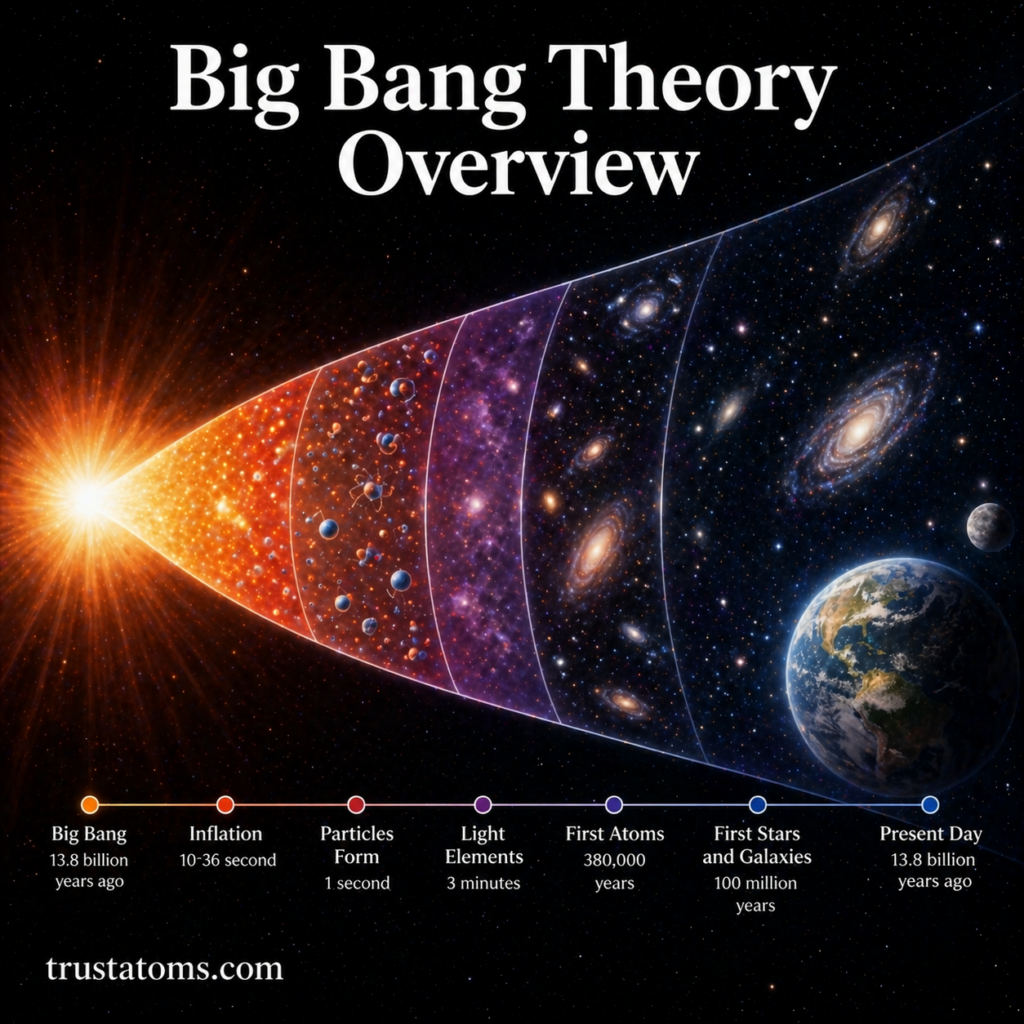
The Big Bang Theory is the most widely accepted scientific explanation for the origin of the universe. It proposes that the universe began about 13.8 billion years ago from an extremely hot, dense state and has been expanding ever since.
At the same time, many people explore the origins of the universe through religious or philosophical perspectives, such as creationism. These perspectives focus more on meaning, purpose, and the role of a creator.
Understanding both viewpoints requires recognizing that they address different kinds of questions.
What Is the Big Bang Theory?
The Big Bang Theory describes how the universe developed over time based on observable evidence.
Core Ideas
- The universe began in a hot, dense state
- Space has been expanding over time
- Matter, energy, galaxies, and stars formed as the universe cooled
This model is supported by observations and tested through scientific methods.
Scientific Evidence for the Big Bang
Several key discoveries support the Big Bang model:
1. Cosmic Expansion
Observed through Hubble’s Law, showing galaxies moving away from each other.
2. Cosmic Microwave Background (CMB)
A faint radiation that acts as a “snapshot” of the early universe.
3. Element Formation
The observed amounts of hydrogen and helium match predictions from early universe models.
Together, these lines of evidence form the foundation of modern cosmology.
What Is Creationism?
Creationism refers to a range of beliefs that the universe and life were created by a higher power or divine being.
Key Characteristics
- Based on religious texts or traditions
- Focuses on purpose, meaning, and origin
- Interpretations vary across cultures and religions
Creationism is not a single unified theory and is generally considered part of theology or philosophy, rather than empirical science.
Science vs. Belief: Different Questions
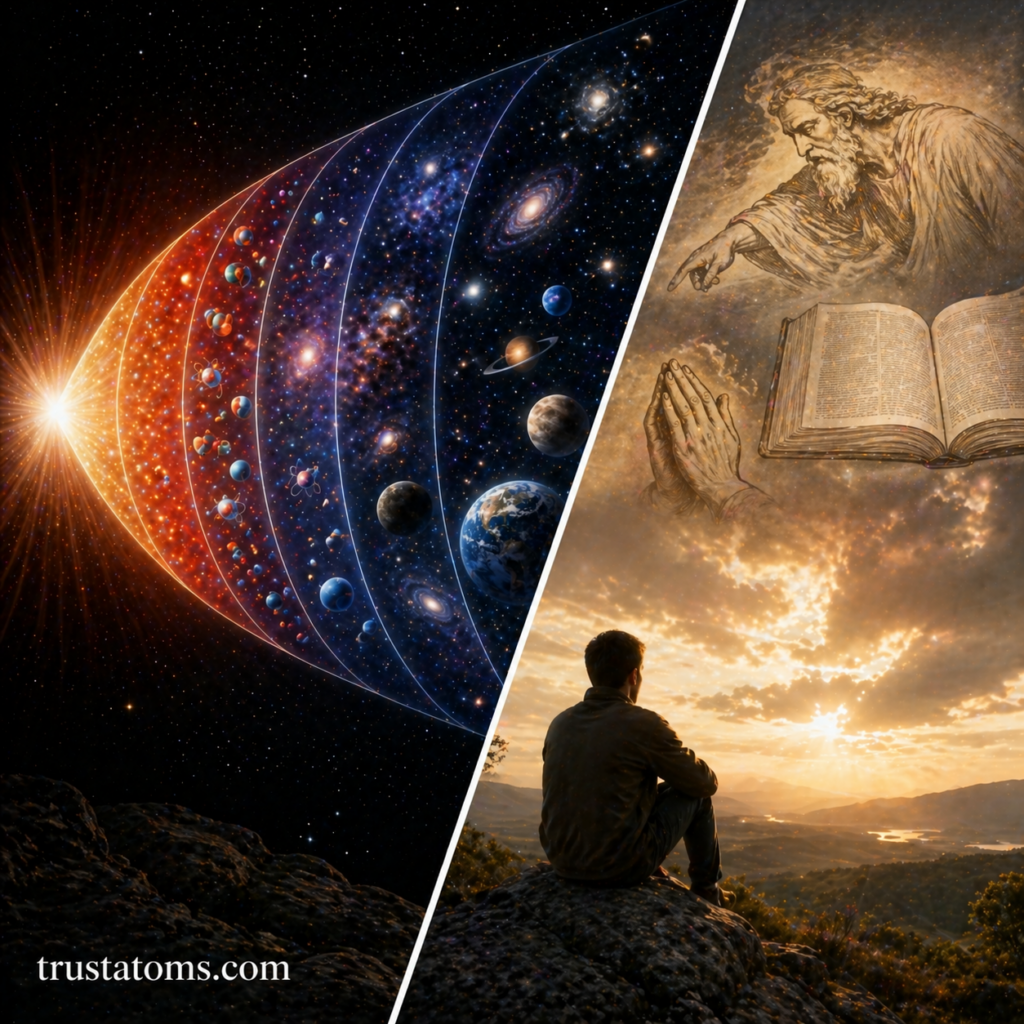
A helpful way to understand the distinction is to look at the types of questions each approach addresses.
Scientific Approach (Big Bang)
- How did the universe begin?
- How has it evolved over time?
- What physical processes are involved?
Philosophical/Religious Approach (Creationism)
- Why does the universe exist?
- Is there a purpose behind creation?
- What is the role of a creator?
These perspectives are not always in direct conflict—they often operate in different domains of understanding.
Areas of Discussion and Debate
The topic of origins has long been discussed across science, philosophy, and religion.
Common Points of Discussion
- Whether scientific explanations fully address the concept of “origin”
- How to interpret religious texts in light of scientific discoveries
- The relationship between evidence-based models and belief systems
Different individuals and communities approach these questions in different ways.
Why the Big Bang Theory Is Used in Science
In scientific contexts, the Big Bang Theory is used because it is:
- Based on observable evidence
- Testable and open to revision
- Supported by multiple independent measurements
Science relies on methods that can be measured, tested, and repeated, which is why the Big Bang remains the standard model in astronomy.
Final Thoughts
The origin of the universe is one of the most profound questions humans have explored. The Big Bang Theory provides a detailed, evidence-based explanation of how the universe developed, while creationist perspectives explore questions of meaning and purpose.
Recognizing the difference between scientific explanations and belief-based interpretations allows for a more informed and balanced understanding of this topic.