Gravity and Orbital Mechanics

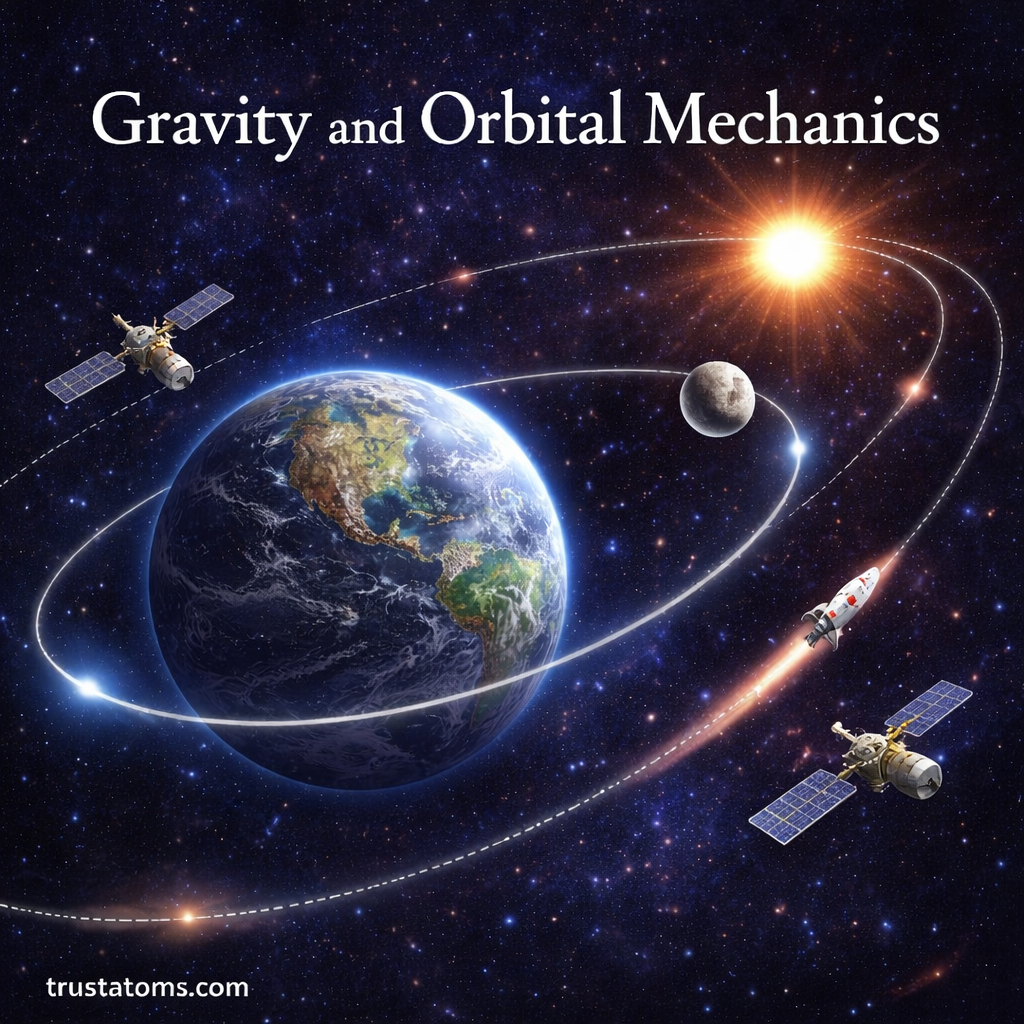
Illustration of Earth, Moon, and satellites demonstrating gravity and orbital mechanics with objects moving in curved orbits.
Earth’s gravity continually changes the direction of motion of the Moon and artificial satellites, keeping them in orbit.

Gravity and orbital mechanics explain how planets, moons, satellites, and spacecraft move through space under the influence of gravitational attraction. Gravity continuously changes an object’s velocity, while orbital mechanics uses physical laws and mathematics to predict its path, speed, and position over time.

These principles explain why Earth orbits the Sun, why the Moon circles Earth, and how satellites remain above our planet without constant propulsion. They are also fundamental to modern astronomy, allowing scientists to predict planetary positions, investigate celestial systems, and plan space missions.

An orbit is not a place where gravity disappears. Orbiting objects remain under gravitational attraction, but their sideways motion prevents them from falling directly into the body they circle.

Continue reading “Gravity and Orbital Mechanics”
Redshift and Cosmic Motion

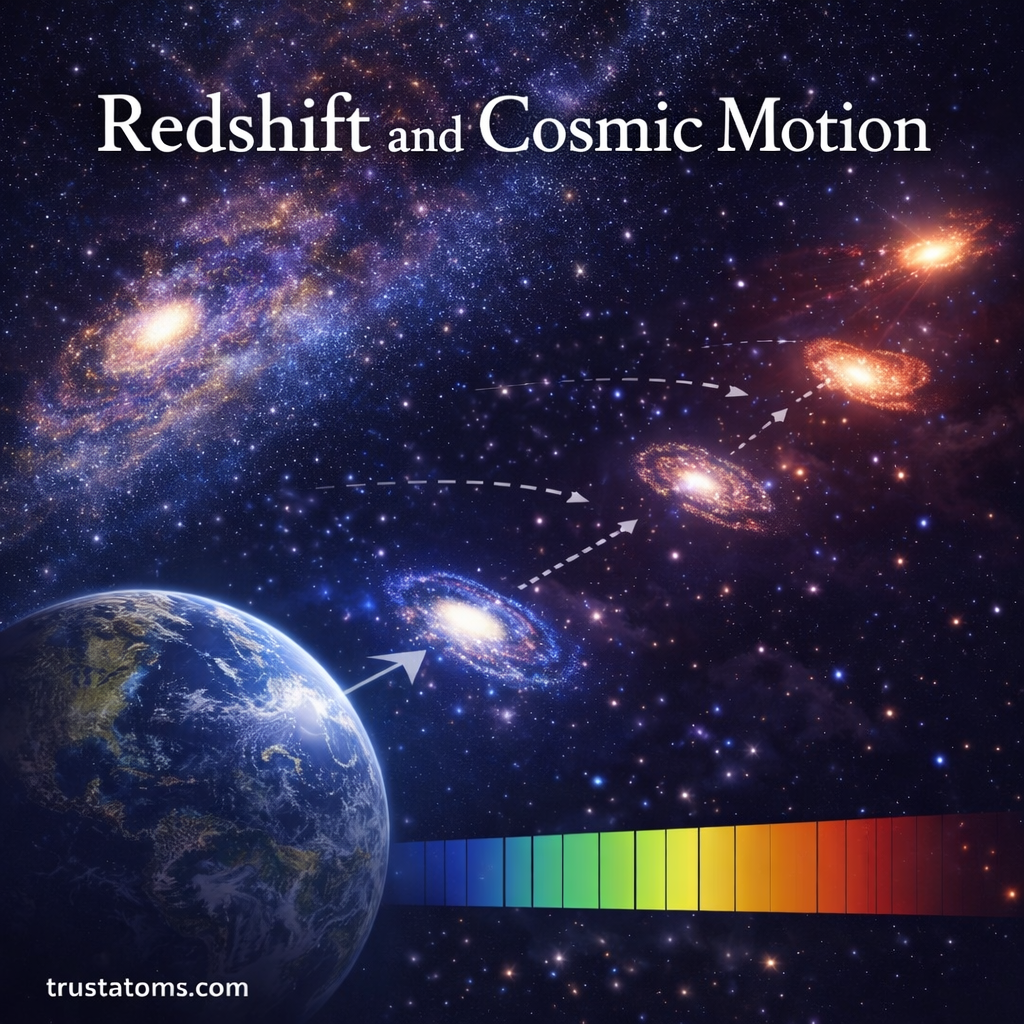
Illustration of galaxies moving away from Earth showing redshift and cosmic motion with light shifting toward red wavelengths.
Galaxies moving away from Earth demonstrating redshift and the expansion of the universe.

Redshift occurs when light reaches an observer with a longer wavelength than when it was emitted, often because its source is moving away or because the universe has expanded during the light’s journey. By measuring this wavelength change, astronomers can investigate the motion of stars and galaxies, estimate cosmic distances, and study the expansion of the universe.

Redshift is one of the most important concepts in modern space science. It helps scientists understand how objects move and how the universe evolves. In observational astronomy, precise measurements of light provide evidence about objects that may be millions or billions of light-years away.

Continue reading “Redshift and Cosmic Motion”

Spectroscopy in Space Science

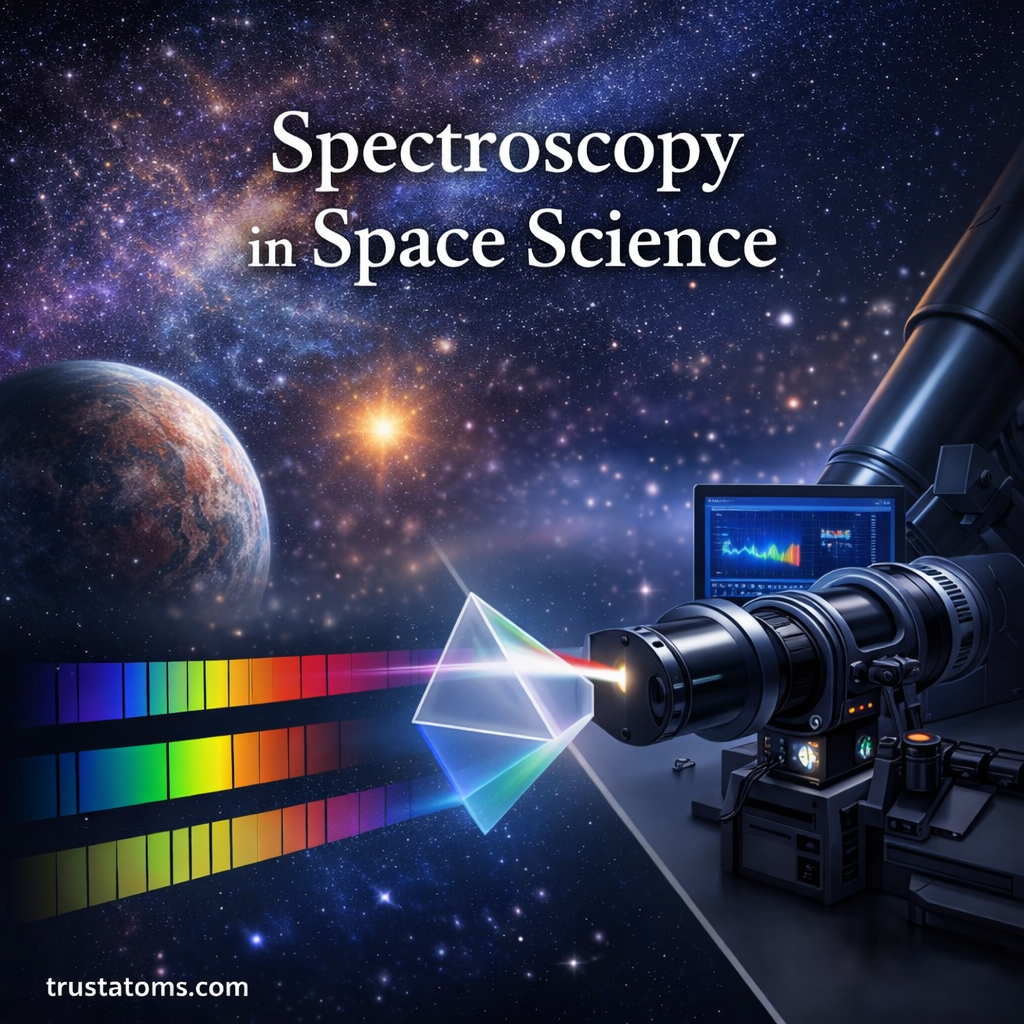
Illustration of spectroscopy in space science showing light being split into a spectrum using a telescope and prism.
A telescope collects light from a distant object, allowing a spectrograph to separate its wavelengths for scientific analysis.

Spectroscopy in space science is the study of light and other electromagnetic radiation to determine the composition, temperature, and motion of astronomical objects. By examining patterns in the light received from stars, planets, and galaxies, scientists can investigate objects that are far beyond the reach of spacecraft.

In the study of astronomy, spectroscopy provides information that ordinary telescope images cannot reveal. A star may appear as a bright point of light, but its spectrum can show which elements are present, how hot its atmosphere is, and whether it is moving toward or away from Earth.

Continue reading “Spectroscopy in Space Science”

Radio Telescopes and Signal Detection

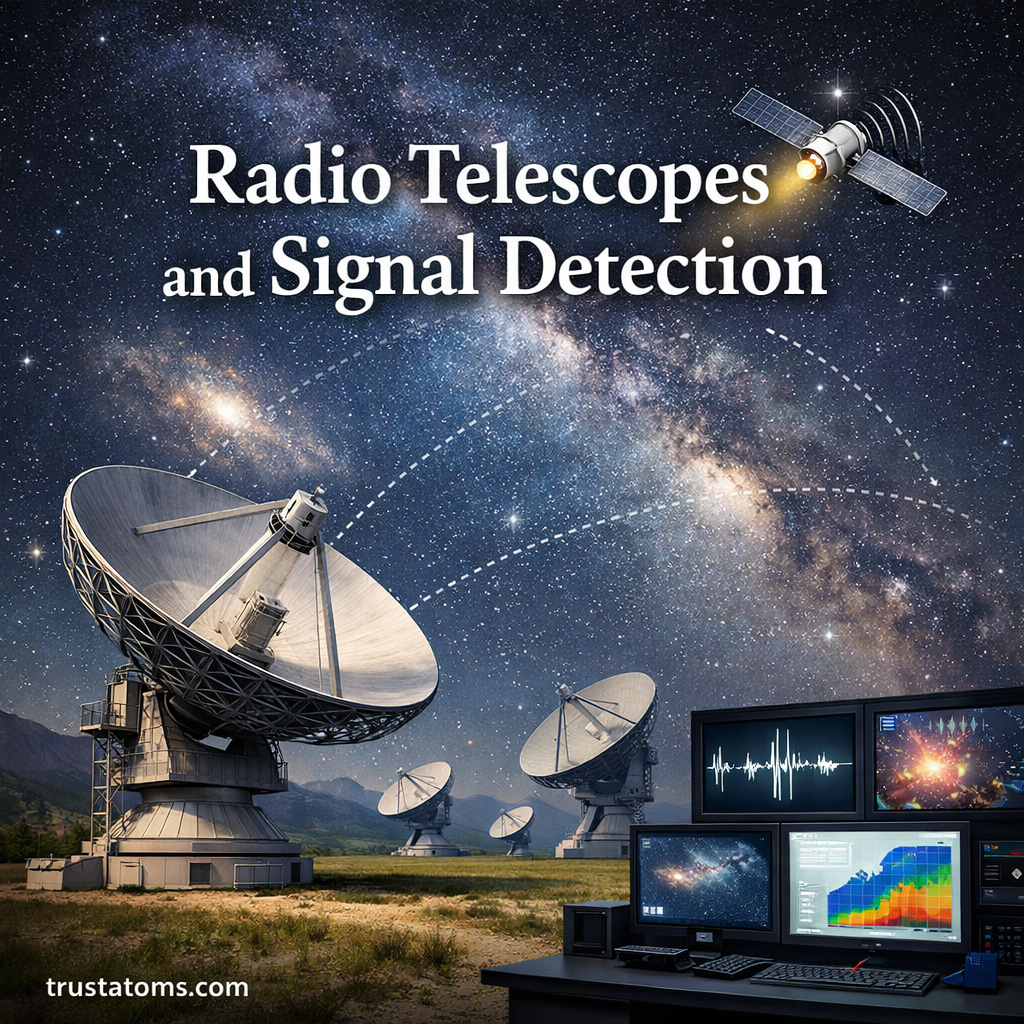
Illustration of radio telescopes detecting signals from space with satellite transmission and data monitoring screens.
Radio telescopes capturing and processing signals from space.

Radio telescopes detect radio waves emitted by objects in space and convert those faint signals into measurements, spectra, and images. By collecting wavelengths invisible to human eyes, they allow astronomers to study pulsars, galaxies, interstellar gas, and other phenomena that ordinary optical telescopes cannot fully reveal.

Radio astronomy extends our understanding of the universe beyond visible light. As a branch of modern observational astronomy, it combines sensitive antennas, electronic receivers, and computer processing to investigate distant objects and the physical processes producing their radiation.

Continue reading “Radio Telescopes and Signal Detection”

Telescopes: Reflecting vs Refracting – What’s the Difference?

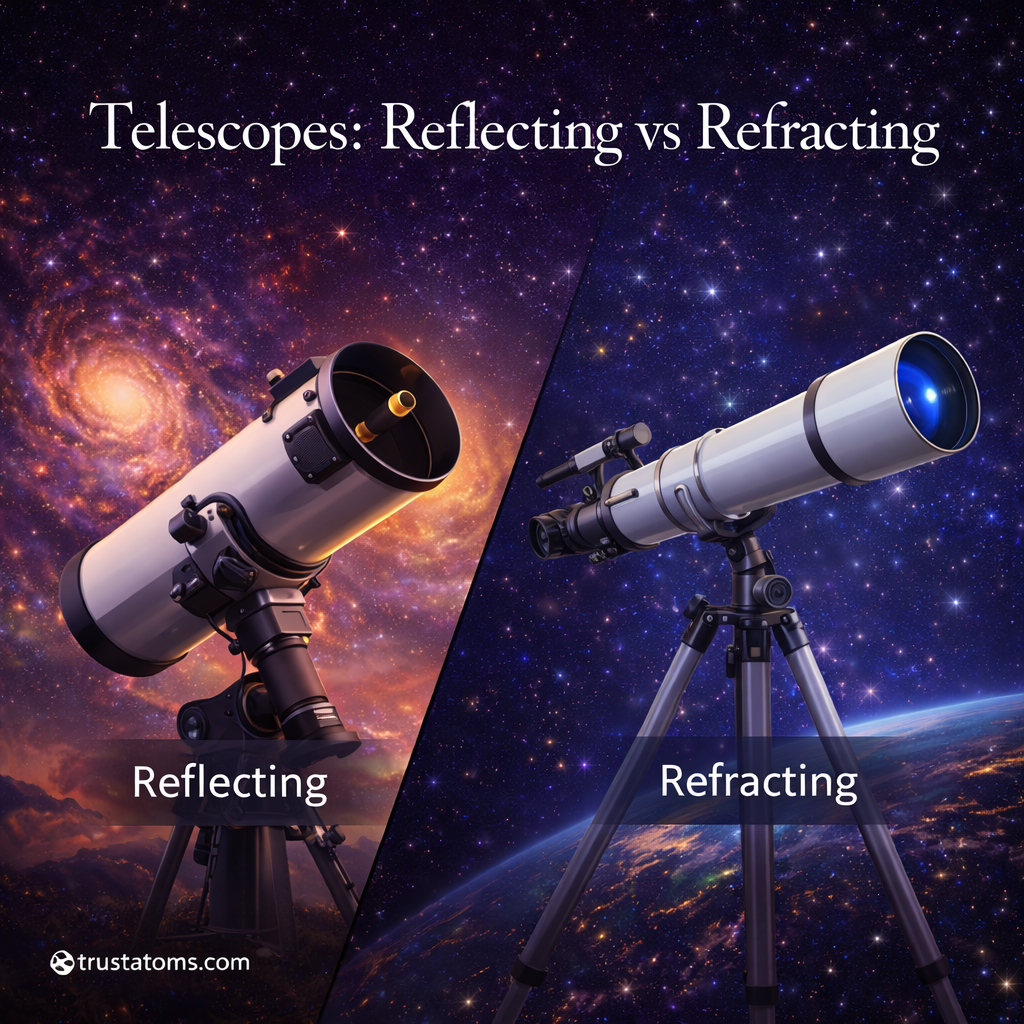
Split illustration comparing reflecting telescope with mirror design and refracting telescope with lens design.
Reflecting telescopes use curved mirrors to focus incoming light, while refracting telescopes use lenses to form an image.

The main difference between reflecting and refracting telescopes is how they focus light: reflecting telescopes use mirrors, while refracting telescopes use lenses. Reflectors generally offer larger apertures for the money, while refractors are often preferred for their straightforward operation, low maintenance, and sharp views of bright objects.

Both designs allow observers to see celestial objects in greater detail than the unaided eye. Understanding their differences is useful for anyone exploring the science of astronomy, whether observing the Moon from a backyard or studying distant galaxies through professional instruments.

Neither design is automatically better for every purpose. Aperture, optical quality, mounting stability, observing conditions, and intended targets all influence how well a telescope performs.

Continue reading “Telescopes: Reflecting vs Refracting – What’s the Difference?”

Electromagnetic Spectrum in Astronomy: How We See the Universe Beyond Visible Light

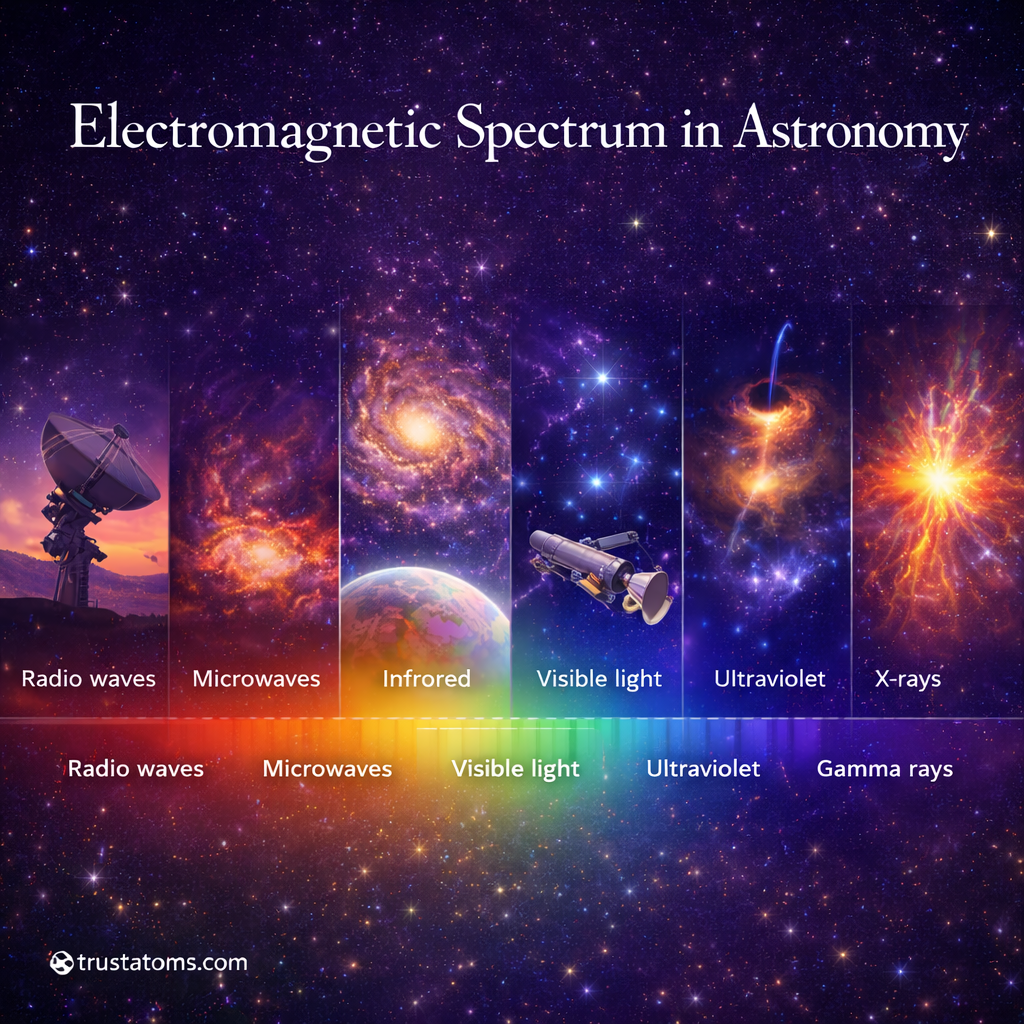
Diagram of the electromagnetic spectrum showing radio waves, microwaves, infrared, visible light, ultraviolet, X-rays, and gamma rays in astronomy.
Electromagnetic spectrum used in astronomy, from radio waves to gamma rays.

The electromagnetic spectrum allows astronomers to study the universe using forms of light that human eyes cannot detect, including radio waves, infrared, ultraviolet, X-rays, and gamma rays. Each wavelength reveals different physical conditions, helping scientists investigate everything from cold interstellar gas to extremely energetic events around black holes.

Visible light shows only a small portion of the radiation traveling through space. By combining observations across the spectrum, researchers practicing astronomy and space science can measure temperatures, identify chemical elements, trace magnetic fields, and investigate objects hidden from ordinary optical telescopes.

Continue reading “Electromagnetic Spectrum in Astronomy: How We See the Universe Beyond Visible Light”

Light-Year and Astronomical Units: Understanding Distance in Space

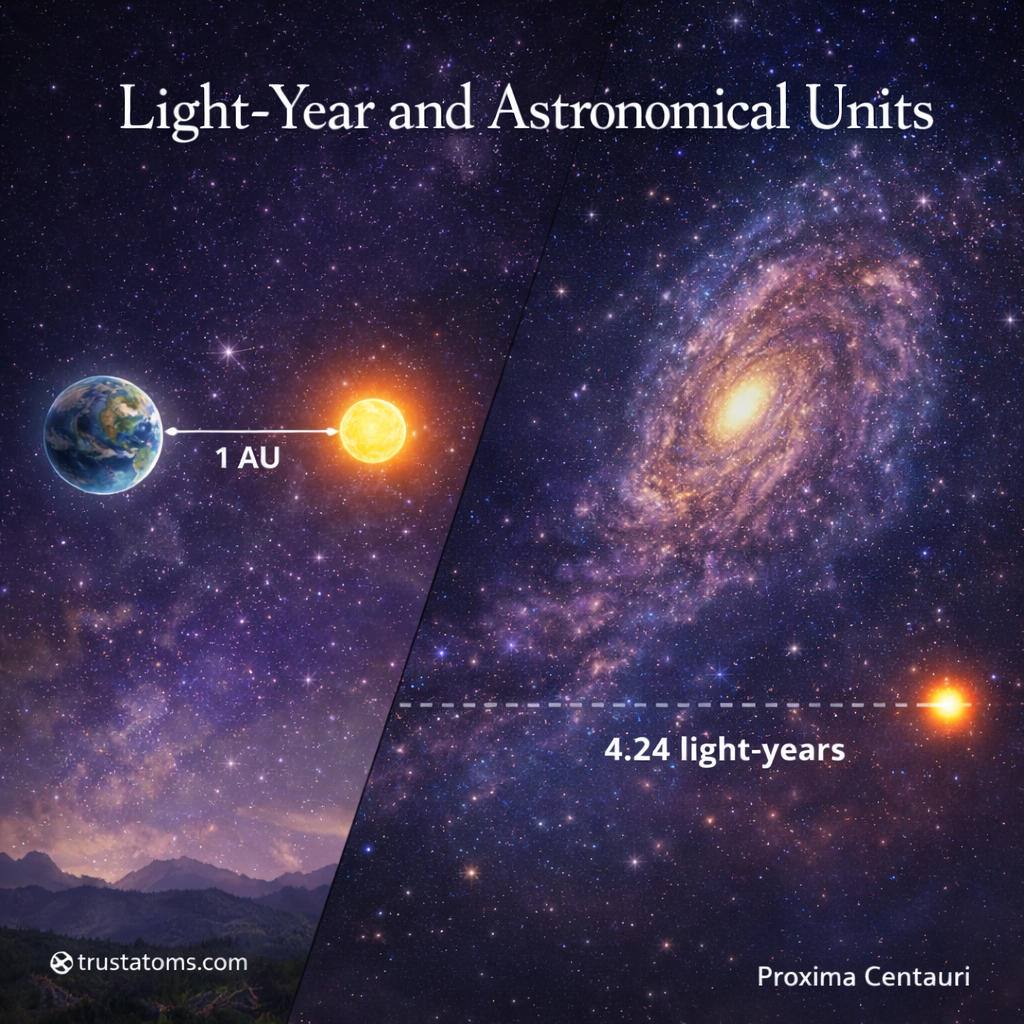
Illustration comparing an astronomical unit between Earth and the Sun with a light-year distance to a nearby star in space.
Visual comparison of astronomical units and light-year distances in space.

An astronomical unit (AU) is a distance of about 150 million kilometers, roughly the average distance between Earth and the Sun, while a light-year is the distance light travels in one year, approximately 9.46 trillion kilometers. Astronomers generally use astronomical units for distances within the solar system and light-years for the much greater distances between stars and galaxies.

Measuring distance on Earth is simple—we use miles or kilometers. But in space, those units quickly become impractical because distances can reach trillions of kilometers. Measuring distance in space requires methods and units suited to different scales, making these measurements an essential part of the study of astronomy.

Understanding the difference between an astronomical unit and a light-year makes it easier to compare planetary orbits, interpret distances to nearby stars, and appreciate how far light travels across the universe.

Continue reading “Light-Year and Astronomical Units: Understanding Distance in Space”

Celestial Sphere and Coordinate Systems: A Beginner-Friendly Guide to Mapping the Sky

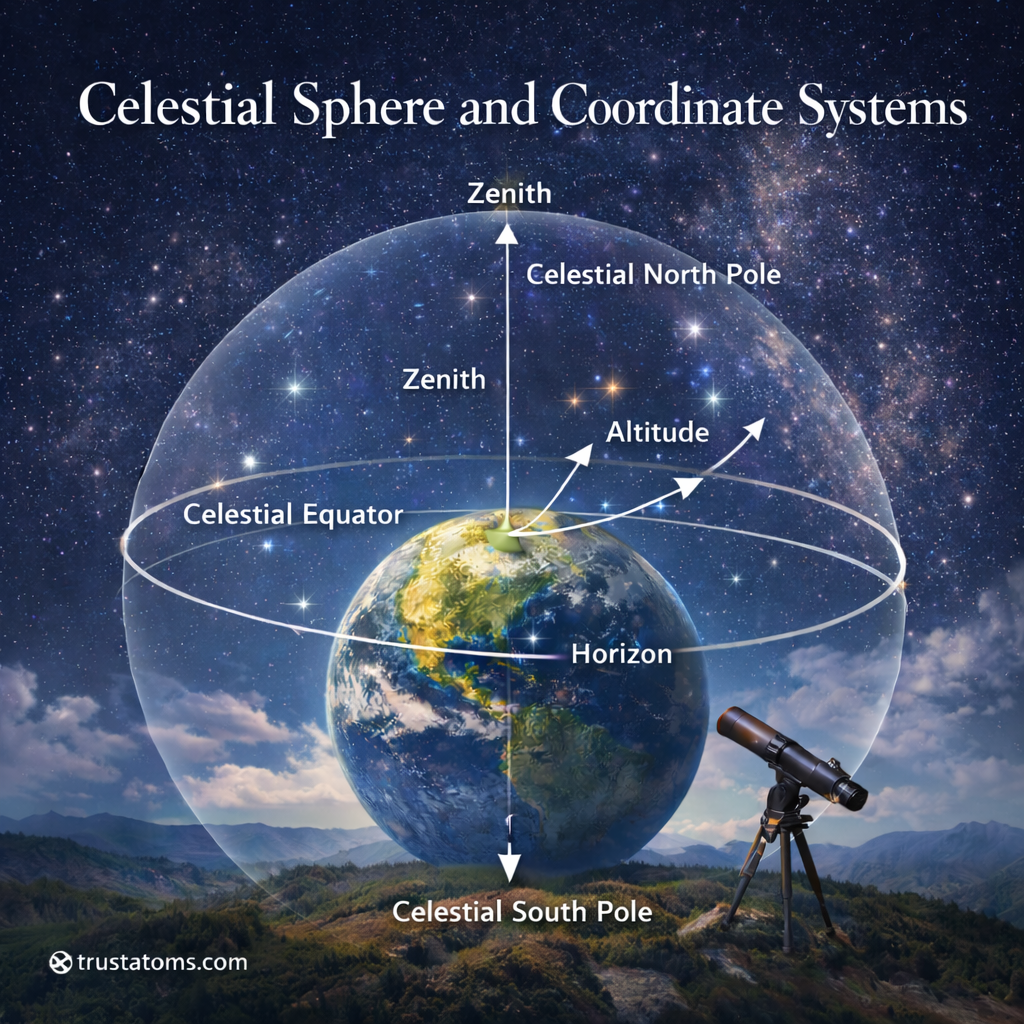
Illustration of the celestial sphere showing Earth at the center with labeled horizon, celestial equator, poles, and zenith.
The celestial sphere provides an imaginary reference surface for locating objects using the horizon, celestial equator, poles, and zenith.

The celestial sphere is an imaginary sphere surrounding Earth that astronomers use to map the apparent positions of stars, planets, and other objects in the sky. Celestial coordinate systems assign angular positions to these objects, allowing observers to locate them accurately regardless of their actual distances from Earth.

In the study of astronomy, these systems provide a practical way to describe directions in space. Two of the most commonly used systems are horizon coordinates, which depend on an observer’s location and time, and equatorial coordinates, which use Earth’s equator and rotation axis as references.

Understanding these systems makes it easier to read star charts, identify constellations, align telescopes, and follow the apparent movement of celestial objects across the sky.

Continue reading “Celestial Sphere and Coordinate Systems: A Beginner-Friendly Guide to Mapping the Sky”

Branches of Astronomy Explained

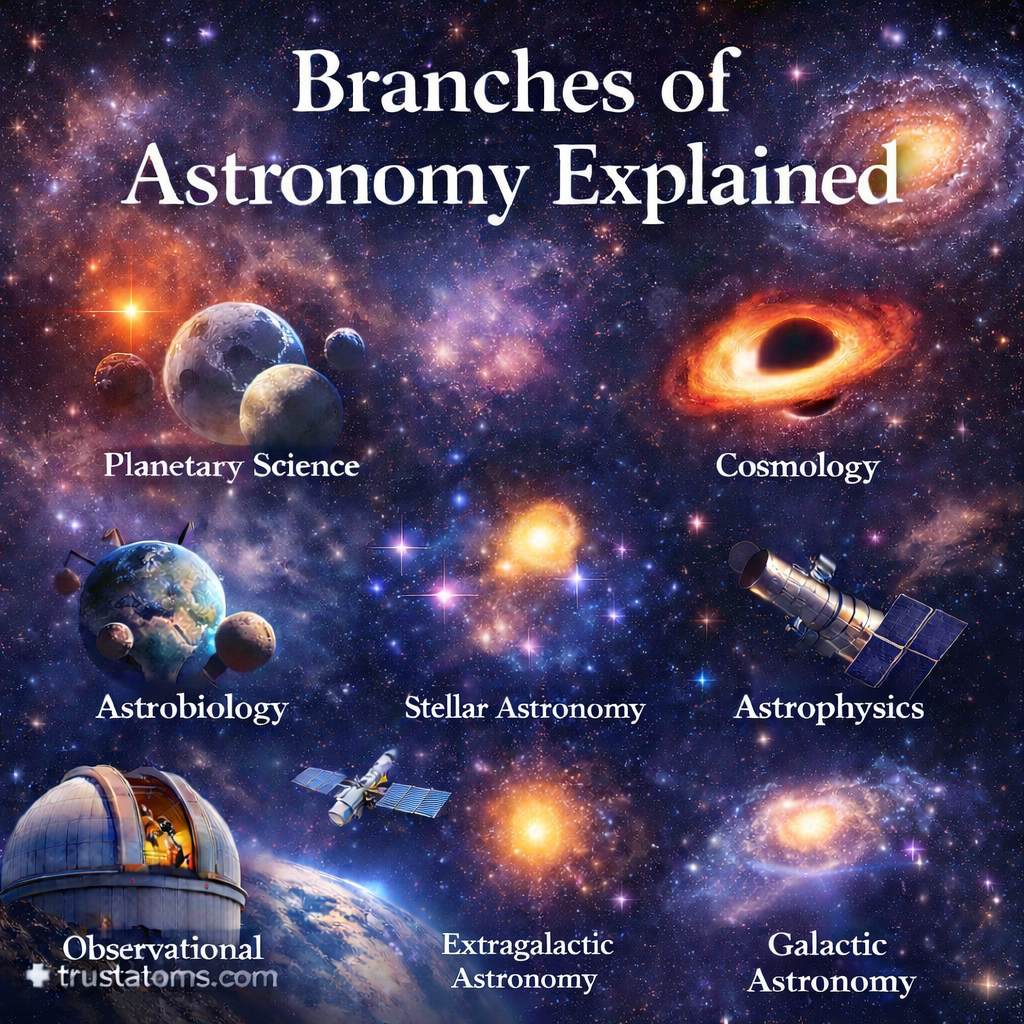
Infographic showing the branches of astronomy including planetary science, cosmology, astrobiology, stellar astronomy, astrophysics, observational astronomy, extragalactic astronomy, and galactic astronomy.
The major branches of astronomy investigate different celestial objects, physical processes, and questions about the universe.

The branches of astronomy are specialized fields that study different objects, processes, and phenomena throughout the universe. Major branches include observational astronomy, theoretical astronomy, astrophysics, cosmology, planetary science, stellar astronomy, galactic astronomy, extragalactic astronomy, and astrobiology.

These fields form part of the science of astronomy, which investigates celestial objects using observations, mathematics, and physical laws. Some branches focus on particular objects, such as planets or stars, while others examine how scientists collect evidence or explain cosmic behavior.

The boundaries between branches are not always strict. An astronomer studying a distant planet, for example, might combine planetary science, spectroscopy, atmospheric physics, and computer modeling to answer a single research question.

Continue reading “Branches of Astronomy Explained”

What Is Astronomy? A Guide to the Universe

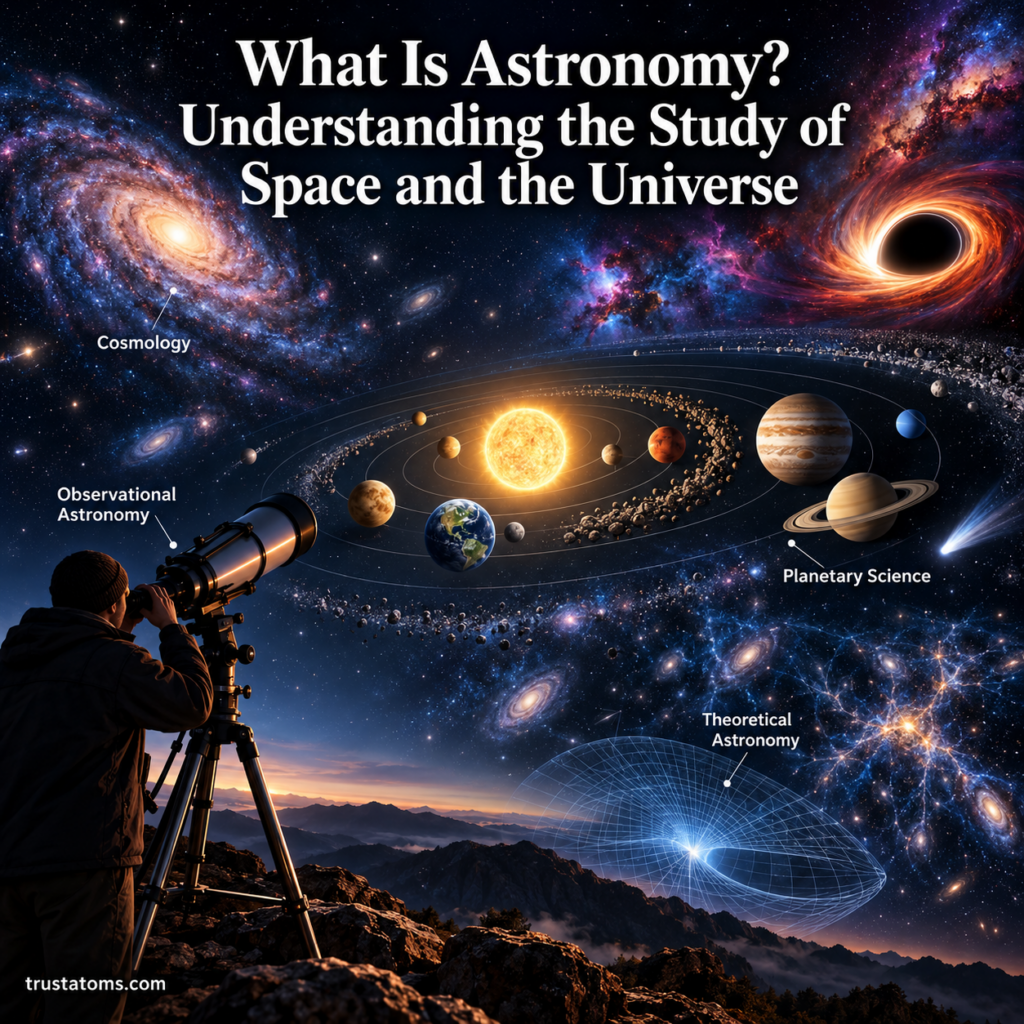
What Is Astronomy? Understanding the Study of Space and the Universe — Space showing galaxies, planets, telescopes, and an astronomer observing the night sky
A visual overview of astronomy featuring celestial objects and observational tools.

Astronomy is the scientific study of celestial objects, space, and the universe beyond Earth. It examines planets, moons, stars, galaxies, black holes, and the physical processes that govern their formation, movement, and evolution.

As one of humanity’s oldest sciences, astronomy began with people observing patterns in the night sky. Modern astronomers investigate those same objects using powerful telescopes, spacecraft, mathematics, and computer models. Their work helps explain how planetary systems form, why stars shine, how galaxies develop, and what observations reveal about the universe’s history.

Astronomy connects several scientific disciplines, including physics, chemistry, geology, and mathematics. Understanding its major branches provides a foundation for exploring everything from familiar sky events to distant cosmic structures.

Continue reading “What Is Astronomy? A Guide to the Universe”