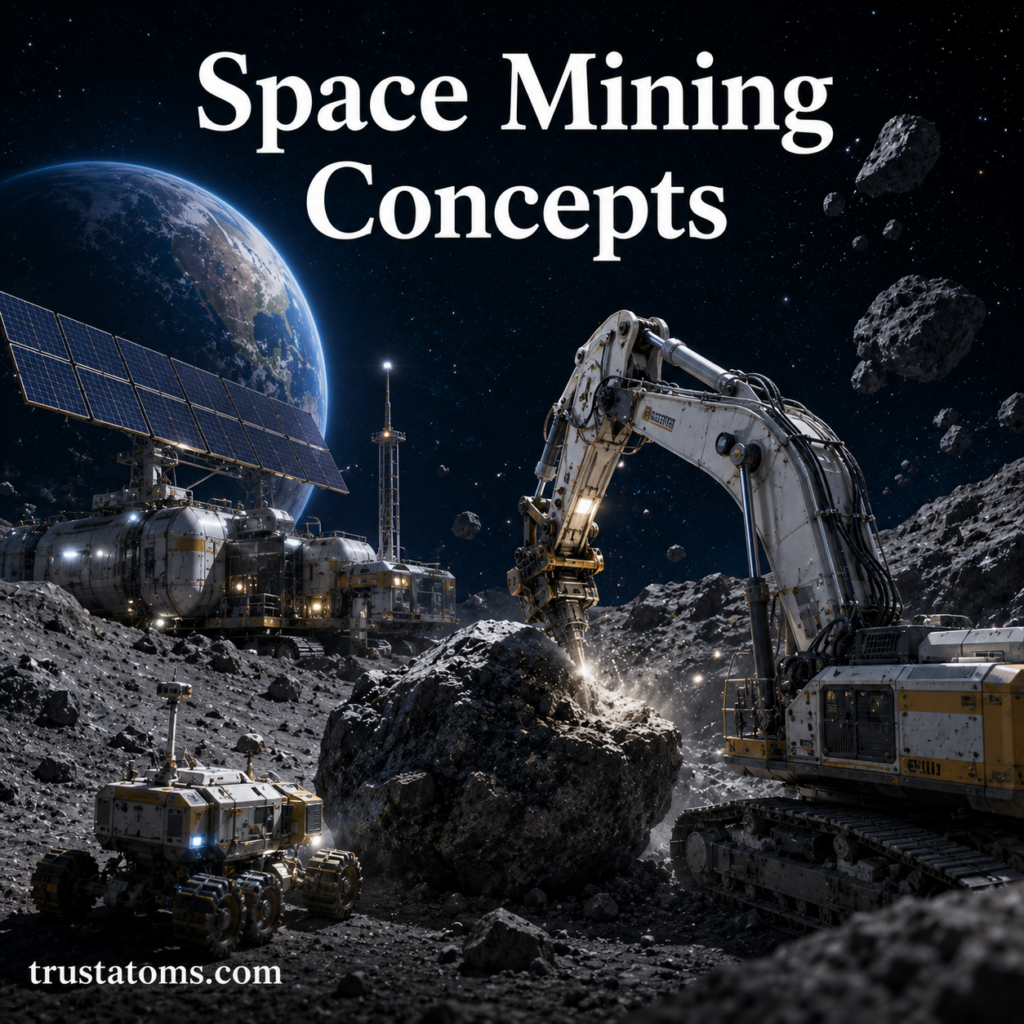
Space mining concepts explore the possibility of extracting valuable materials from asteroids, the Moon, and other celestial bodies for use in space exploration and potentially on Earth. Once considered purely science fiction, space mining is now an active area of research involving astronomers, aerospace engineers, scientists, and private space companies.
As humanity expands deeper into space, mining extraterrestrial resources could help support long-term missions, reduce launch costs, and provide materials needed for future space infrastructure.
Although large-scale space mining has not yet become a reality, many scientists believe it could play a major role in the future of astronomy and space exploration.
What Is Space Mining?
Space mining refers to the process of extracting useful materials from objects in space.
Potential mining targets include:
- Asteroids
- The Moon
- Mars
- Comets
- Other planetary bodies
These resources could support both scientific missions and future space industries.
Why Space Mining Is Important
Launching materials from Earth into space is extremely expensive.
Every kilogram of cargo requires enormous amounts of fuel and engineering effort.
Benefits of Space Mining
Mining resources in space could help:
- Reduce launch costs
- Support deep-space missions
- Build space habitats
- Produce rocket fuel in space
- Expand scientific research
- Support future colonies
Using local space resources is often called in-situ resource utilization (ISRU).
Resources Found in Space
Scientists believe many valuable materials exist throughout the solar system.
Common Potential Resources
Space mining targets may contain:
- Water ice
- Iron
- Nickel
- Platinum-group metals
- Rare earth elements
- Silicon
- Aluminum
Some asteroids may contain enormous quantities of valuable minerals.
Water as a Critical Resource
Water is considered one of the most important space resources.
Why Water Matters
Water can support:
- Human survival
- Food production
- Oxygen generation
- Radiation shielding
Water can also be separated into hydrogen and oxygen for rocket fuel.
One important chemical relationship is:
2H2O→2H2+O2
This process, called electrolysis, could allow spacecraft to refuel in space.
Sources of Water in Space
Water ice may exist on:
- The Moon’s polar regions
- Mars
- Certain asteroids
- Comets
Locating and extracting water is a major focus of current research.
Asteroid Mining Concepts
Asteroids are among the most attractive mining targets because many contain large quantities of metals and water.
Types of Asteroids
Different asteroids contain different materials.
C-Type Asteroids
Carbon-rich asteroids may contain:
- Water
- Organic compounds
- Carbon materials
S-Type Asteroids
Silicate asteroids contain:
- Iron
- Nickel
- Magnesium
M-Type Asteroids
Metal-rich asteroids may contain:
- Iron
- Nickel
- Precious metals
These asteroids are often considered highly valuable for future mining operations.
Why Asteroids Are Attractive Mining Targets
Asteroids offer several advantages compared to planets.
Lower Gravity
Many asteroids have extremely weak gravity, making it easier to:
- Land spacecraft
- Extract materials
- Launch resources into space
Resource Abundance
Some asteroids may contain more rare metals than are available in many locations on Earth.
Accessibility
Near-Earth asteroids may eventually become practical targets for robotic mining missions.
Lunar Mining Concepts
The Moon is another major focus for future space mining efforts.
Potential Lunar Resources
The Moon may contain:
- Water ice
- Helium-3
- Aluminum
- Titanium
- Silicon
These resources could support long-term lunar exploration.
Helium-3 and Fusion Energy
Helium-3 has received attention because of its potential use in future nuclear fusion systems.
Although practical fusion power remains experimental, helium-3 could someday become an important energy resource.
Mining Mars and Other Planets
Future Mars missions may rely heavily on local resource extraction.
Why Mars Mining Matters
Using Martian resources could reduce the need to transport materials from Earth.
Potential Martian resources include:
- Water ice
- Carbon dioxide
- Iron-rich soil
- Minerals
These resources could support:
- Fuel production
- Habitat construction
- Oxygen generation
Space Mining Technologies
Mining in space requires technologies very different from traditional Earth-based mining.
Robotic Mining Systems
Most early space mining missions will likely use robots.
Why Robots Are Important
Robotic systems can:
- Operate in dangerous environments
- Function without life support
- Work continuously
- Reduce mission risk
Autonomous robots may perform excavation, drilling, and material transport.
Drilling and Excavation Challenges
Mining in low gravity creates unique engineering difficulties.
Challenges in Low Gravity
Problems include:
- Dust control
- Equipment anchoring
- Material handling
- Surface stability
Mining tools must work in vacuum conditions and extreme temperatures.
Material Processing in Space
Extracted materials must often be refined before use.
Possible Processing Methods
Future systems may include:
- Solar-powered furnaces
- Chemical extraction systems
- Electrolysis units
- 3D printing facilities
Processing materials directly in space could reduce transportation costs.
Space Manufacturing and Construction
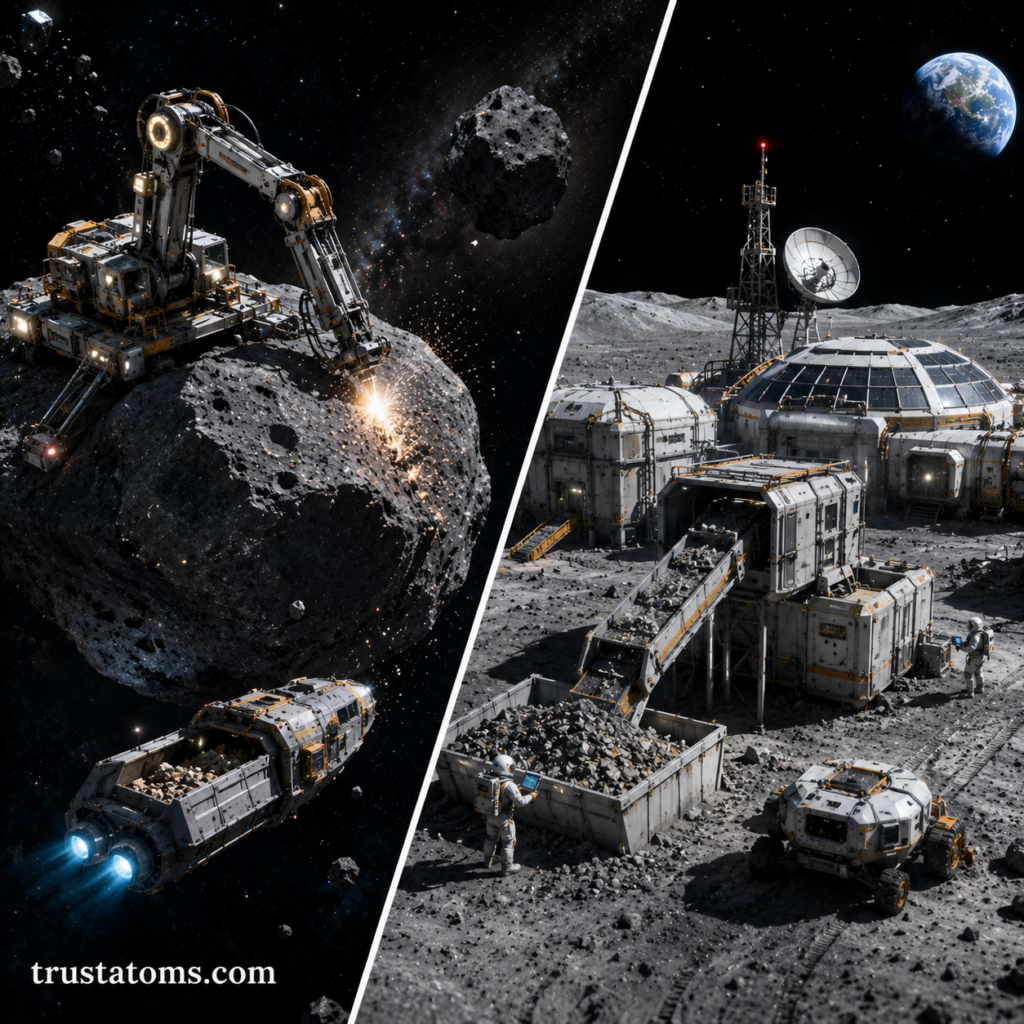
Mining resources in space may eventually support large-scale manufacturing.
Possible Space-Built Structures
Space resources could help build:
- Satellites
- Space stations
- Lunar habitats
- Solar power stations
- Deep-space spacecraft
Manufacturing in orbit could avoid the high cost of launching finished structures from Earth.
The Role of 3D Printing
3D printing may become a key technology in space mining operations.
Why 3D Printing Matters
Using mined materials, future systems could produce:
- Tools
- Spare parts
- Building components
- Scientific equipment
This could improve mission self-sufficiency during long-duration exploration.
Economic Potential of Space Mining
Some experts believe space mining could eventually become a major industry.
Valuable Materials
Asteroids may contain rare metals worth enormous amounts on Earth.
Potential materials include:
- Platinum
- Gold
- Palladium
- Rare earth elements
Economic Challenges
Despite the potential value, major challenges remain:
- High mission costs
- Complex technology
- Transportation limitations
- Market uncertainty
At present, space mining is still largely experimental.
Environmental Considerations
Space mining may eventually reduce some environmental pressures on Earth.
Possible Environmental Benefits
Space resources could help reduce:
- Deep-earth mining damage
- Habitat destruction
- Certain forms of pollution
New Environmental Risks
However, space mining may also create concerns involving:
- Space debris
- Planetary contamination
- Orbital traffic
- Resource competition
Responsible international regulations will likely become necessary.
Legal and Ethical Questions
Space mining raises important legal and ethical issues.
Who Owns Space Resources?
International space law currently prohibits nations from claiming ownership of celestial bodies.
However, resource extraction laws remain debated.
Important Questions
Future policies may need to address:
- Property rights
- International cooperation
- Resource sharing
- Environmental protection
- Commercial regulation
Global agreements will likely shape the future of space mining.
Private Companies and Space Mining
Several private companies have explored asteroid mining concepts.
Commercial Interest
Companies are researching technologies involving:
- Robotic prospecting
- Space resource extraction
- Orbital manufacturing
- Lunar infrastructure
Although some early companies faced financial challenges, interest in space resources continues growing.
Space Mining and Astronomy
Space mining research contributes to astronomy by improving understanding of celestial bodies.
Scientific Benefits
Mining missions could help scientists study:
- Asteroid composition
- Solar system formation
- Planetary geology
- Water distribution in space
Exploration missions often provide both scientific and commercial knowledge.
Future Space Mining Missions
Many future exploration programs may include resource extraction experiments.
Planned Areas of Research
Upcoming missions may investigate:
- Lunar water extraction
- Asteroid sample collection
- Martian resource processing
- Automated mining robotics
These early experiments could help determine whether large-scale space mining is practical.
Challenges Facing Space Mining
Space mining remains extremely difficult with current technology.
Major Obstacles
Key challenges include:
- High launch costs
- Extreme environmental conditions
- Communication delays
- Limited power systems
- Complex robotics
- Long mission timelines
Significant technological advances will likely be required before profitable mining becomes possible.
The Future of Space Resource Utilization
Many experts believe space mining will eventually support broader human expansion into space.
Long-Term Possibilities
Future developments could include:
- Lunar industrial bases
- Orbital fuel depots
- Space-based manufacturing
- Deep-space transportation networks
Space mining may become a foundation for sustained exploration beyond Earth.
How Space Mining Inspires Innovation
Research into space mining drives innovation across multiple scientific fields.
Important areas include:
- Robotics
- Artificial intelligence
- Materials science
- Aerospace engineering
- Energy systems
These technologies may also create benefits for industries on Earth.
Final Thoughts
Space mining concepts represent an ambitious vision for the future of astronomy and space exploration. By extracting resources from asteroids, the Moon, and other celestial bodies, humanity may eventually reduce the cost of space travel and support long-term missions across the solar system.
Although major technical and economic challenges remain, ongoing research continues advancing the possibility of space-based resource utilization. From robotic asteroid mining to lunar water extraction and orbital manufacturing, space mining could one day become an essential part of humanity’s expansion into space.
As technology improves, space mining may transform not only space exploration but also how humans use resources beyond Earth.