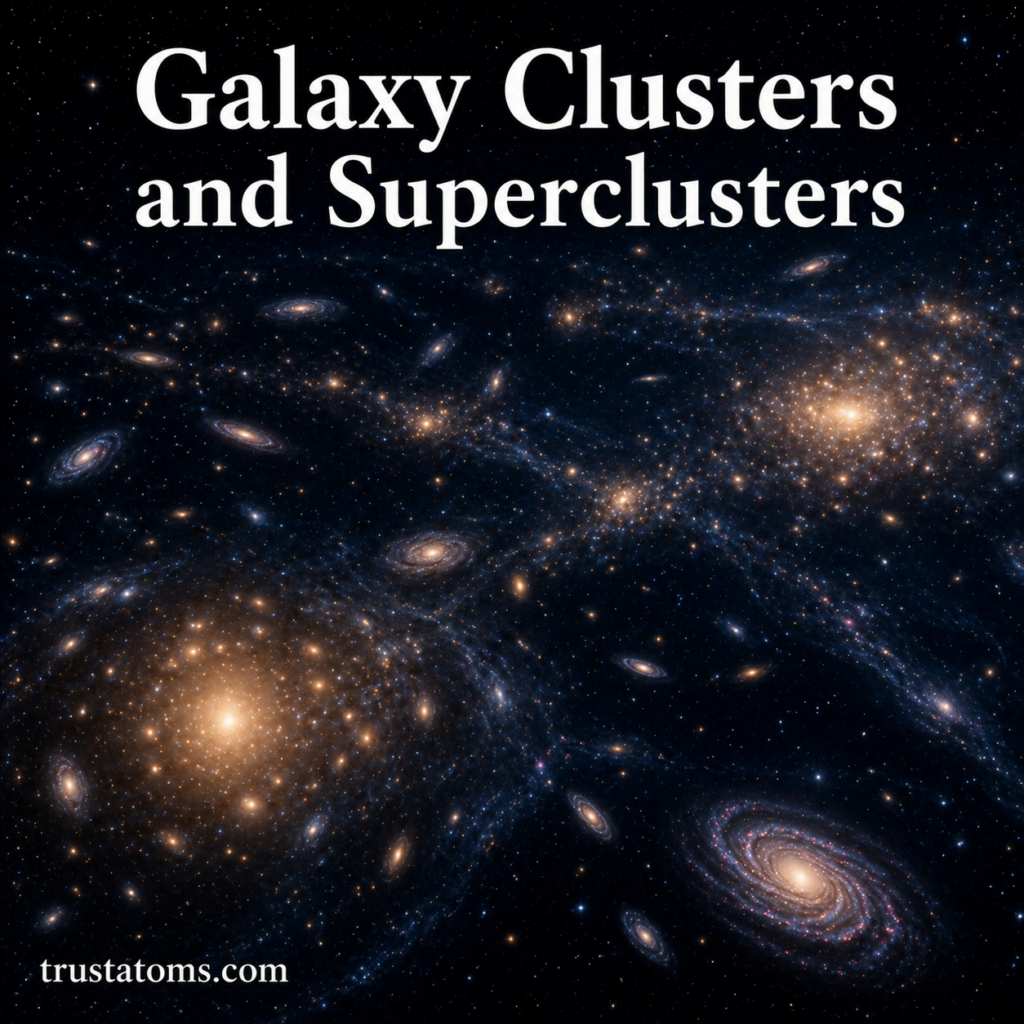
The universe is structured on an unimaginable scale, far beyond individual stars and even galaxies. At the largest levels, galaxies group together into vast systems known as clusters and superclusters—forming a cosmic web that stretches across billions of light-years.
Understanding these structures helps astronomers map the universe, study gravity, and uncover the role of dark matter and dark energy.
What Are Galaxy Clusters?
A galaxy cluster is a group of hundreds to thousands of galaxies bound together by gravity. These are among the largest gravitationally bound structures in the universe.
Key Characteristics of Galaxy Clusters
- Contain hundreds to thousands of galaxies
- Span millions of light-years
- Held together by gravity and dark matter
- Filled with extremely hot gas emitting X-rays
One well-known example is the Virgo Cluster, which contains over 1,000 galaxies, including members of our local cosmic neighborhood.
Structure of a Galaxy Cluster
Galaxy clusters are complex systems made up of more than just galaxies.
Main Components
- Galaxies
Spiral, elliptical, and irregular galaxies orbiting within the cluster. - Intracluster Medium (ICM)
A vast cloud of hot gas between galaxies, often reaching millions of degrees. - Dark Matter
The dominant mass component, providing the gravitational “glue” that holds the cluster together.
Why They Matter
Galaxy clusters act as cosmic laboratories, allowing scientists to study:
- Galaxy interactions and mergers
- The behavior of dark matter
- Large-scale gravitational effects
What Are Superclusters?
A supercluster is a massive grouping of multiple galaxy clusters and smaller galaxy groups. These are among the largest known structures in the universe.
Unlike clusters, superclusters are not always gravitationally bound as a whole, meaning their outer regions may still be expanding with the universe.
Key Features of Superclusters
- Contain multiple galaxy clusters and groups
- Span hundreds of millions of light-years
- Form part of the cosmic web
One of the most significant examples is the Laniakea Supercluster, which includes the Milky Way and stretches across roughly 500 million light-years.
The Cosmic Web: How Everything Connects
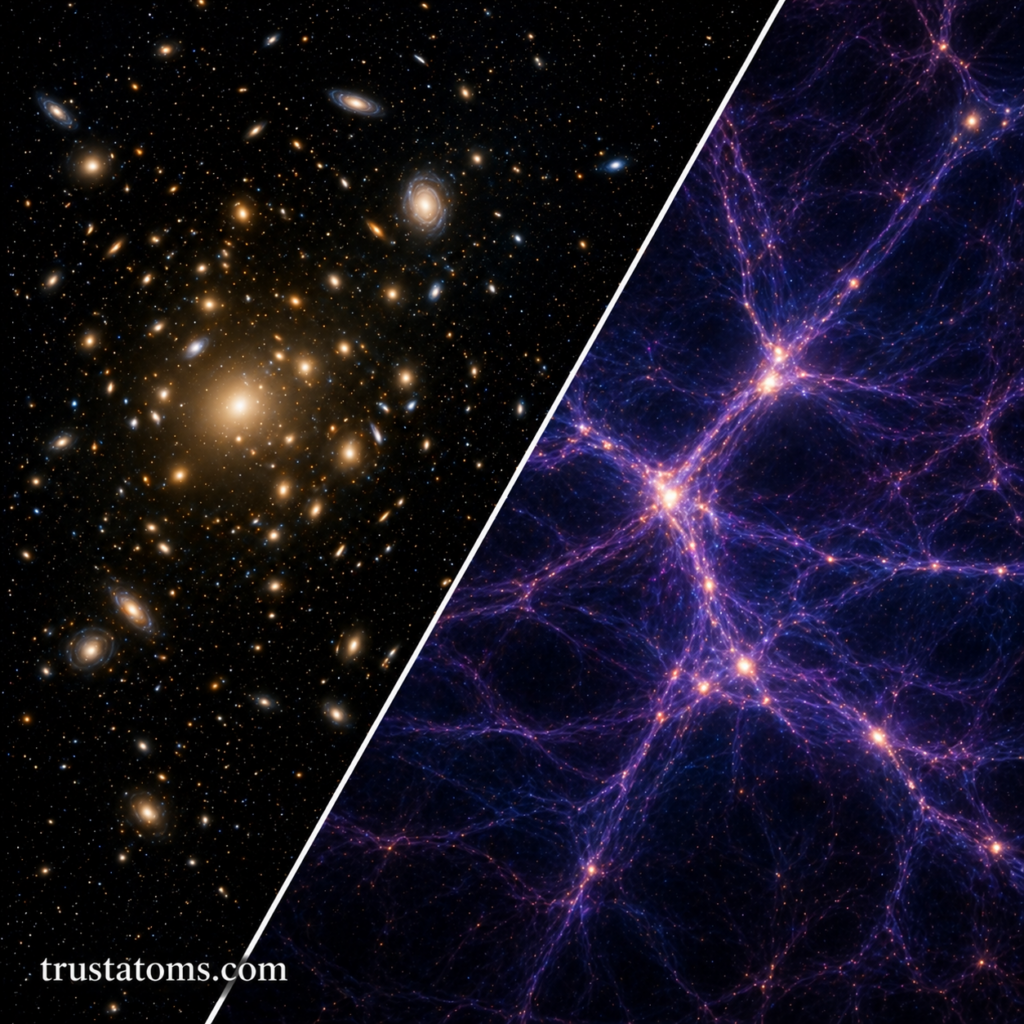
Galaxy clusters and superclusters are not randomly scattered. Instead, they form a vast interconnected structure known as the cosmic web.
Components of the Cosmic Web
- Filaments
Long strands of galaxies and clusters connecting across space - Voids
Huge empty regions with very few galaxies - Nodes
Dense regions where clusters and superclusters intersect
This web-like structure reveals how matter in the universe is distributed on the largest scales.
How Galaxy Clusters Form
Galaxy clusters form over billions of years through gravitational attraction.
Formation Process
- Small density fluctuations form after the Big Bang
- Gravity pulls matter together into galaxies
- Galaxies group into clusters
- Clusters merge into larger systems
Dark matter plays a crucial role by providing the mass needed for gravity to pull these structures together.
Comparing Clusters and Superclusters
While both are large-scale structures, they differ in size, structure, and behavior.
Key Differences
- Galaxy Clusters
- Gravitationally bound
- Smaller (millions of light-years)
- Contain individual galaxies
- Superclusters
- Not fully bound
- Much larger (hundreds of millions of light-years)
- Contain clusters and galaxy groups
Why These Structures Are Important
Studying galaxy clusters and superclusters helps astronomers answer some of the biggest questions in science.
Scientific Insights
- Understanding dark matter distribution
- Measuring cosmic expansion
- Testing theories about the early universe
- Observing galaxy evolution over time
Clusters also act as gravitational lenses, bending light from distant objects and allowing astronomers to see deeper into space.
Interesting Facts About Galaxy Clusters and Superclusters
- Galaxy clusters are the largest gravitationally bound systems
- Superclusters are among the largest known structures in the universe
- Most of a cluster’s mass comes from dark matter, not visible galaxies
- The universe’s structure resembles a giant 3D web
Final Thoughts
Galaxy clusters and superclusters reveal the universe on its grandest scale. These enormous structures show that galaxies are not isolated—they are part of a vast, interconnected system shaped by gravity and cosmic evolution.
As technology improves, astronomers continue to map these structures in greater detail, bringing us closer to understanding the true architecture of the universe.