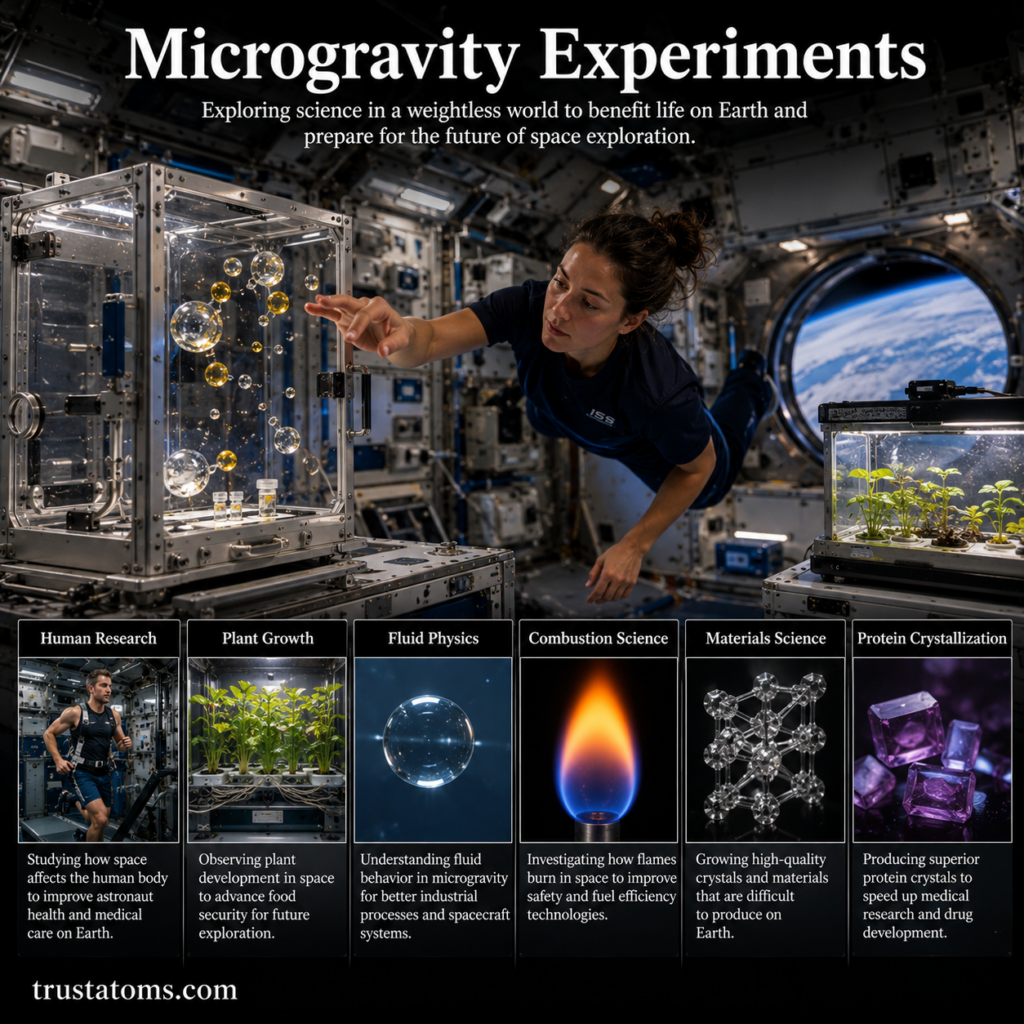
Microgravity experiments are among the most valuable scientific activities conducted in space. By studying how materials, living organisms, fluids, and physical systems behave in near-weightless conditions, scientists gain insights that are difficult or impossible to achieve on Earth.
Space stations such as the International Space Station (ISS) serve as orbital laboratories where astronauts and researchers perform experiments in biology, medicine, physics, engineering, and materials science.
Microgravity research not only improves our understanding of life and physics in space but also contributes to advances in healthcare, manufacturing, agriculture, and future deep-space exploration.
This guide explores what microgravity is, how microgravity experiments work, major research areas, and why these studies are important for science and humanity.
Continue reading “Microgravity Experiments: Research in the Weightless Environment of Space”