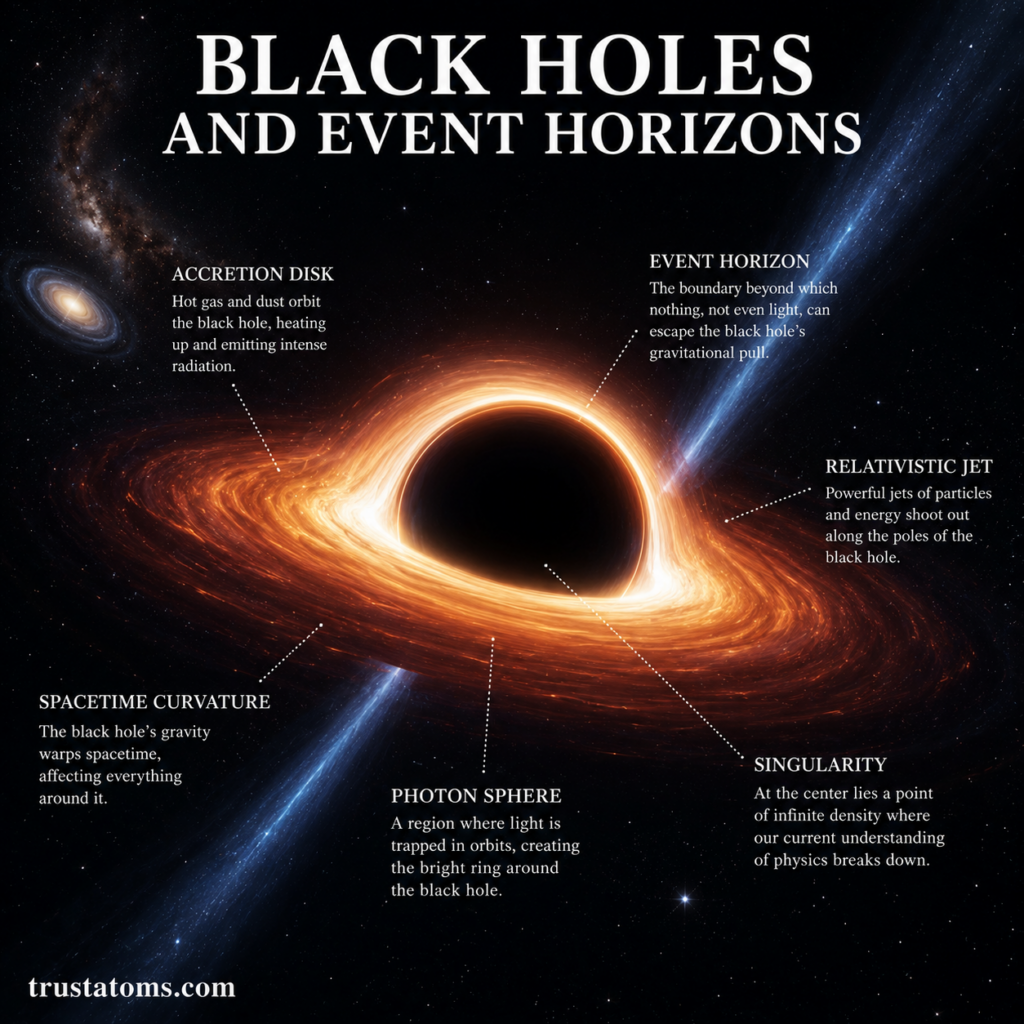
Black Holes and Event Horizons: Understanding the Most Extreme Objects in the Universe

Illustration of a black hole with an accretion disk, event horizon, relativistic jets, and warped spacetime in deep space.
Illustration showing the structure and physics of black holes and event horizons in modern astronomy. trustatoms.com.

Black holes are among the most fascinating and mysterious objects in astronomy. They possess gravitational forces so powerful that nothing — not even light — can escape once it crosses a certain boundary known as the event horizon.

Although black holes cannot be directly seen, scientists study them through their effects on nearby matter, radiation, and spacetime itself.

Modern astronomy has revealed that black holes exist throughout the universe, from stellar remnants to gigantic supermassive structures at the centers of galaxies.

Understanding black holes and event horizons helps explain gravity, relativity, and some of the most extreme conditions known in physics.

Continue reading “Black Holes and Event Horizons: Understanding the Most Extreme Objects in the Universe”
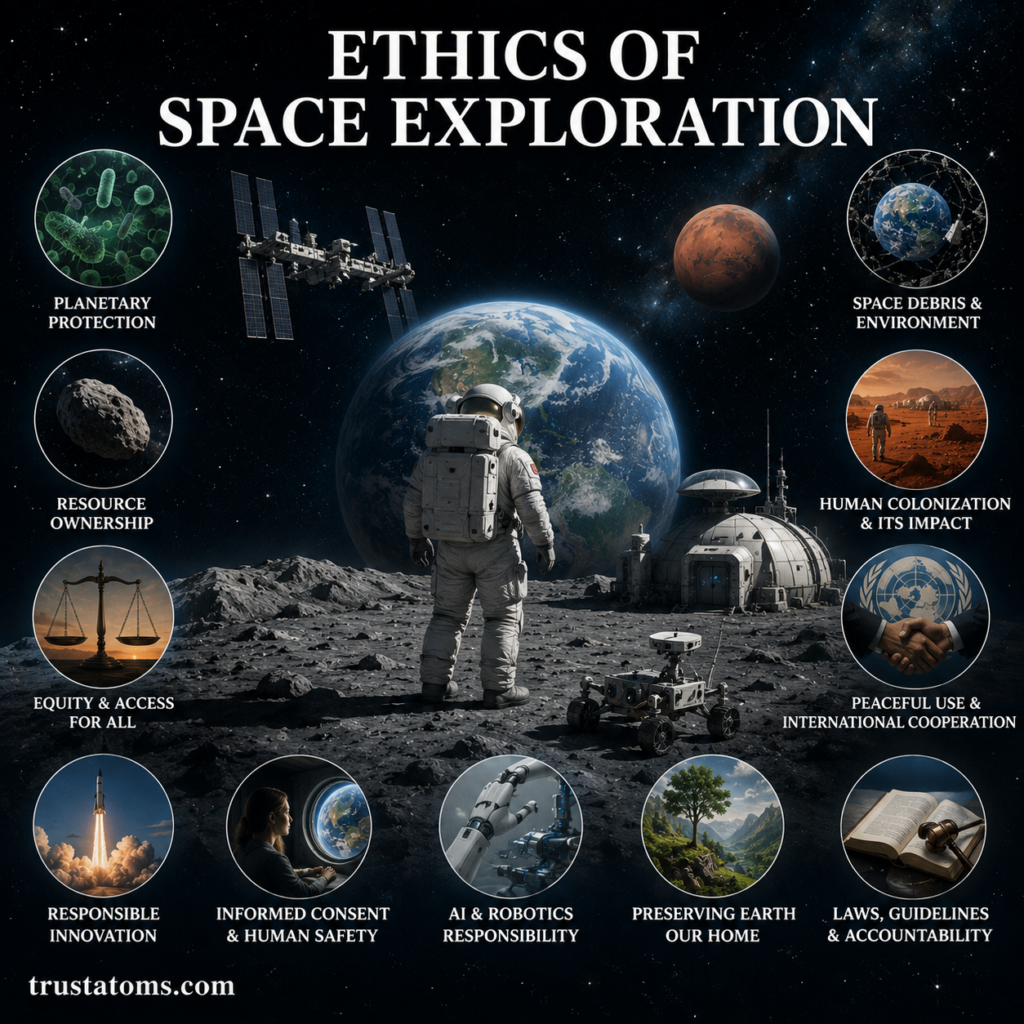
Ethics of Space Exploration: Balancing Discovery, Responsibility, and Humanity’s Future

Illustration showing ethical issues in space exploration including planetary protection, human colonization, space debris, AI robotics, and international cooperation.
Illustration exploring the major ethical questions surrounding modern space exploration and humanity’s future beyond Earth. trustatoms.com.

Space exploration has transformed humanity’s understanding of the universe. From landing on the Moon to studying distant galaxies with advanced telescopes, modern astronomy and space science continue expanding the boundaries of human knowledge.

However, as missions become more ambitious and commercial activity in space increases, ethical questions surrounding space exploration are becoming more important than ever.

The ethics of space exploration involve debates about planetary protection, resource ownership, environmental responsibility, commercialization, human settlement, and the long-term impact of humanity’s expansion beyond Earth.

Understanding these ethical challenges helps shape the future of responsible exploration.

Continue reading “Ethics of Space Exploration: Balancing Discovery, Responsibility, and Humanity’s Future”

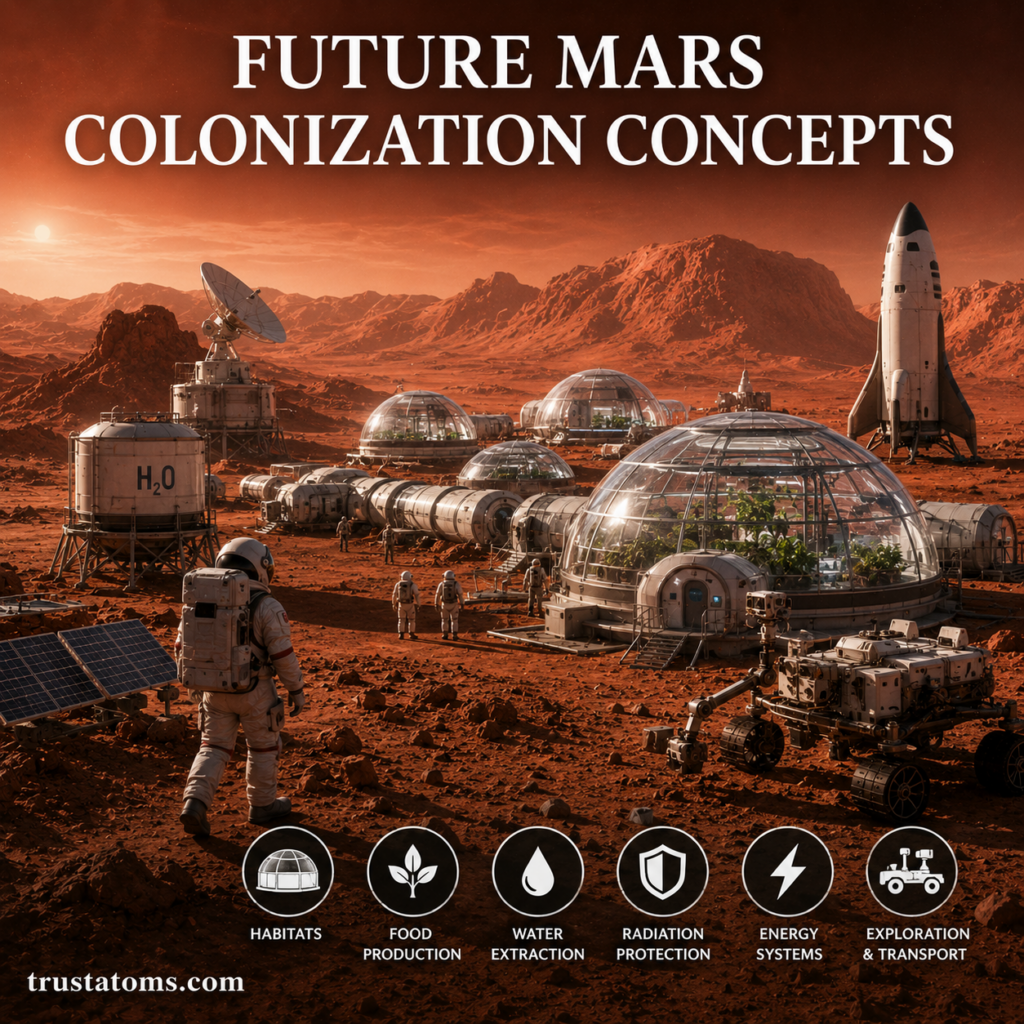
Future Mars Colonization Concepts: How Humans Might Live on the Red Planet

Illustration showing a futuristic Mars colony with habitats, astronauts, rovers, greenhouses, and energy systems on the Martian surface.
Concept illustration of future Mars colonization technologies including habitats, farming systems, and robotic exploration. trustatoms.com.

For decades, Mars has captured human imagination as the most realistic candidate for future planetary colonization. With its rocky surface, polar ice caps, changing seasons, and day length similar to Earth’s, Mars offers possibilities that no other nearby planet currently provides.

Scientists, engineers, and private aerospace companies are actively developing future Mars colonization concepts that could eventually allow humans to establish permanent settlements on the Red Planet.

Although enormous challenges remain, modern space technology continues bringing Mars colonization closer to reality.

Continue reading “Future Mars Colonization Concepts: How Humans Might Live on the Red Planet”

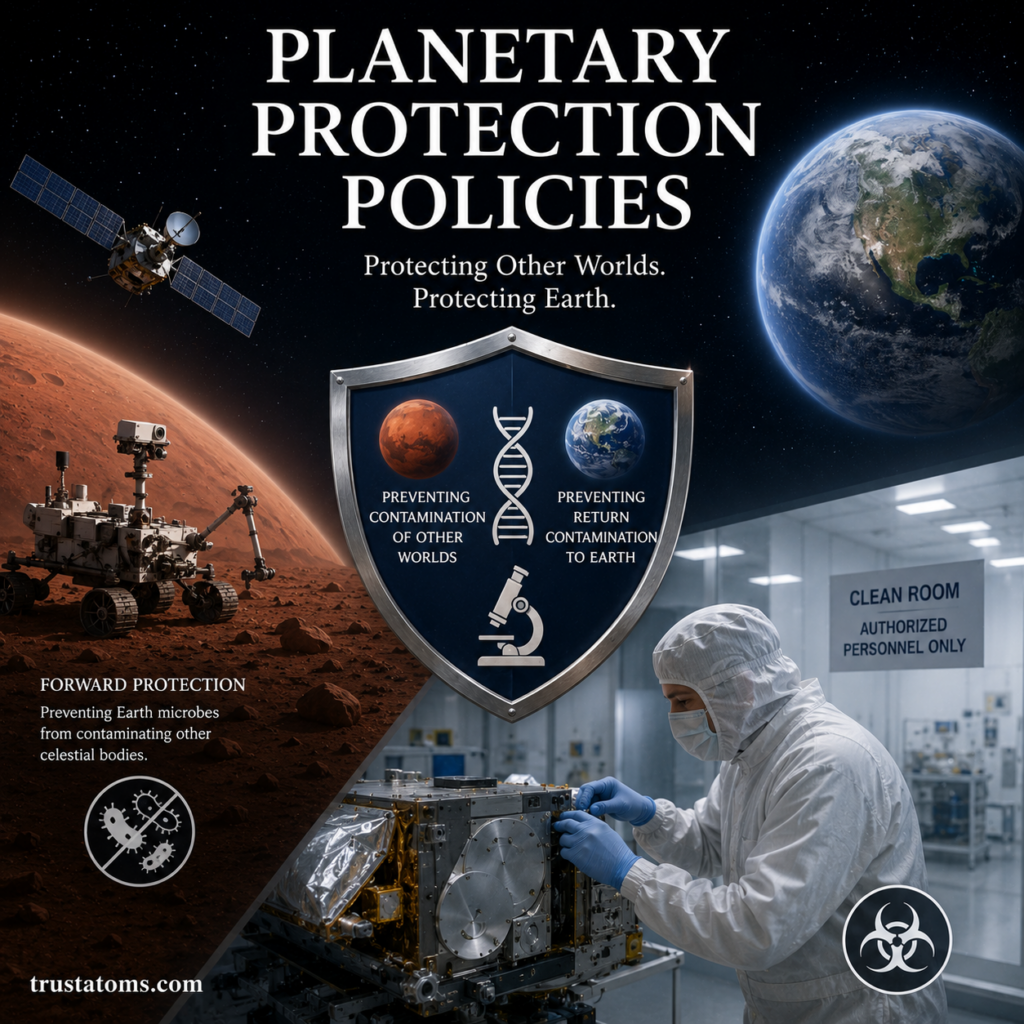
Planetary Protection Policies: Preventing Contamination Beyond Earth

Illustration showing planetary protection policies with Mars exploration, spacecraft sterilization, and Earth contamination prevention concepts.
Illustration representing planetary protection policies designed to prevent contamination during space exploration missions. trustatoms.com.

As humanity explores deeper into the solar system, scientists face an important challenge that extends beyond rockets, robotics, and engineering: preventing biological contamination between worlds.

Planetary protection policies are international scientific guidelines designed to reduce the risk of contaminating other planets, moons, and celestial bodies with Earth-based microorganisms while also protecting Earth from potential extraterrestrial material brought back by space missions.

These policies play a critical role in modern astronomy, astrobiology, and space exploration.

Continue reading “Planetary Protection Policies: Preventing Contamination Beyond Earth”

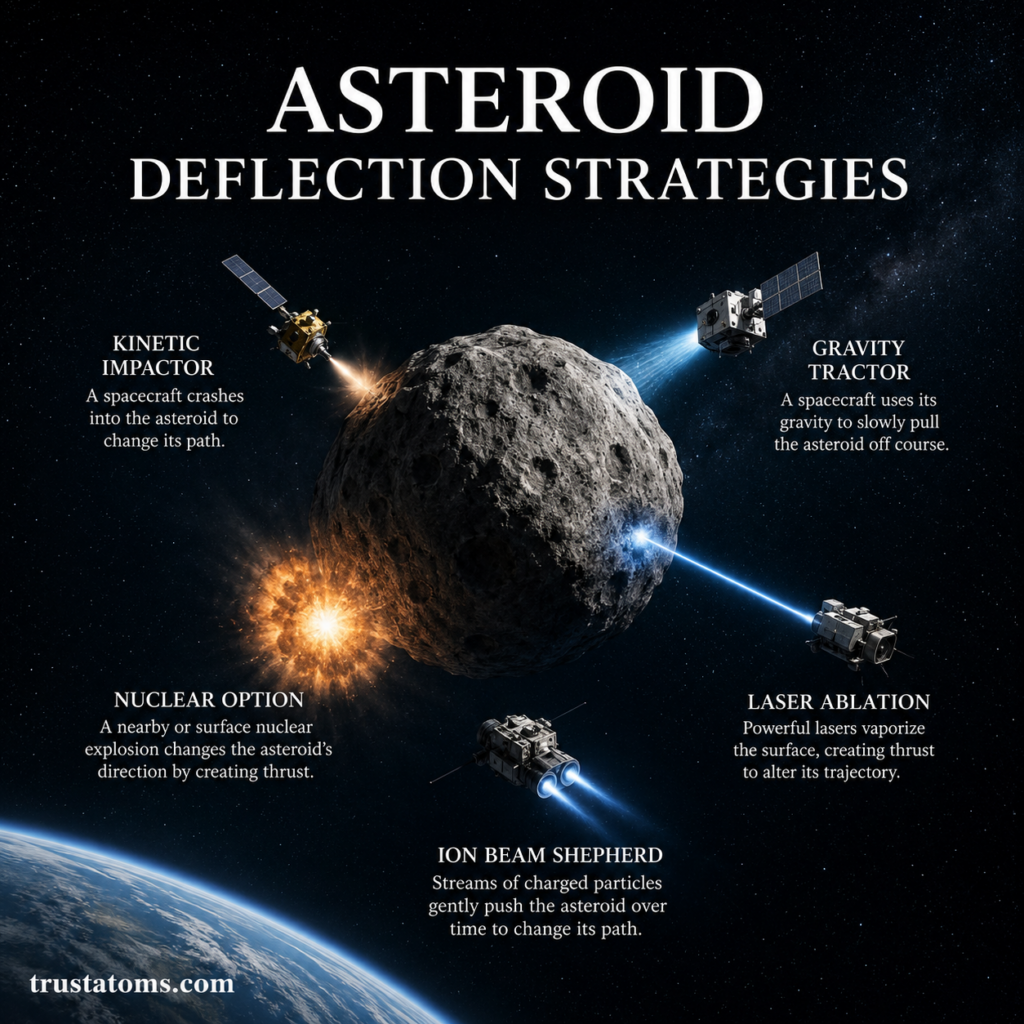
Asteroid Deflection Strategies: How Humanity Could Prevent a Space Impact

Illustration showing asteroid deflection strategies with spacecraft redirecting an asteroid in space near Earth.
Illustration of asteroid deflection strategies used in planetary defense research. trustatoms.com.

Asteroids have shaped the history of Earth for billions of years. From creating massive craters to contributing to the extinction of the dinosaurs, these rocky objects remain one of the few natural threats capable of affecting the entire planet.

Today, scientists and space agencies are developing asteroid deflection strategies designed to prevent catastrophic impacts before they occur. Rather than waiting for an emergency, researchers focus on early detection, orbital calculations, and technologies that could safely alter an asteroid’s path long before it reaches Earth.

Understanding how these strategies work helps explain one of the most important areas of modern planetary defense.

Continue reading “Asteroid Deflection Strategies: How Humanity Could Prevent a Space Impact”

Space Mining Concepts

Futuristic robotic mining equipment extracting resources from an asteroid in deep space near Earth.
Space mining concepts explore how future missions could extract water, metals, and other valuable resources from asteroids and celestial bodies. trustatoms.com.

Space mining concepts explore the possibility of extracting valuable materials from asteroids, the Moon, and other celestial bodies for use in space exploration and potentially on Earth. Once considered purely science fiction, space mining is now an active area of research involving astronomers, aerospace engineers, scientists, and private space companies.

As humanity expands deeper into space, mining extraterrestrial resources could help support long-term missions, reduce launch costs, and provide materials needed for future space infrastructure.

Although large-scale space mining has not yet become a reality, many scientists believe it could play a major role in the future of astronomy and space exploration.

Continue reading “Space Mining Concepts”

Interstellar Probe Concepts

Interstellar space probe traveling beyond the solar system with deep-space stars and galaxies in the background.
Interstellar probe concepts explore how future spacecraft could travel beyond our solar system to study nearby stars and exoplanets. trustatoms.com.

Interstellar probe concepts represent some of the most ambitious ideas in modern astronomy and space exploration. These proposed spacecraft are designed to travel beyond our solar system and explore the vast regions between stars.

Although humans have not yet built a true interstellar spacecraft capable of reaching another star system within a practical timeframe, scientists and engineers continue developing advanced concepts that may eventually make such missions possible.

Interstellar probes could help answer some of humanity’s biggest questions about the universe, including whether habitable planets exist around nearby stars and how planetary systems form beyond our own solar neighborhood.

Continue reading “Interstellar Probe Concepts”

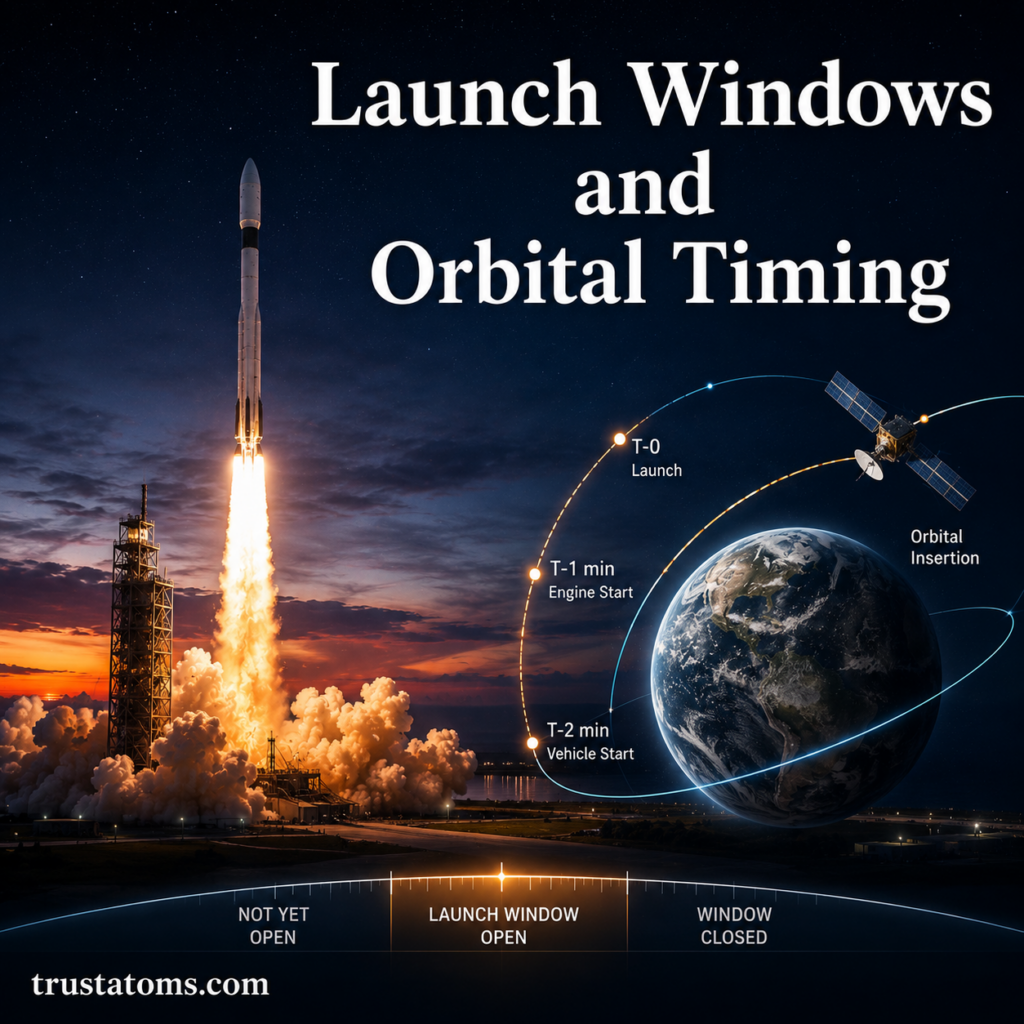
Launch Windows and Orbital Timing

Rocket launch beside an orbital timing diagram showing Earth orbit paths and launch window alignment for space missions.
Launch windows and orbital timing help spacecraft reach their destinations using precise trajectories and fuel-efficient spaceflight planning. trustatoms.com.

Launching a spacecraft into space is far more complicated than simply igniting rocket engines and lifting off. Every mission must account for precise timing, orbital mechanics, planetary motion, weather conditions, and fuel efficiency. Even a delay of a few minutes can affect whether a spacecraft successfully reaches its destination.

Launch windows and orbital timing are critical parts of modern astronomy and space exploration. They determine when rockets can safely launch, how spacecraft travel through space, and how missions reach planets, satellites, and orbital stations with maximum efficiency.

Understanding launch timing helps explain why some missions launch only during specific dates, why delays can be costly, and how scientists plan journeys across the solar system.

Continue reading “Launch Windows and Orbital Timing”

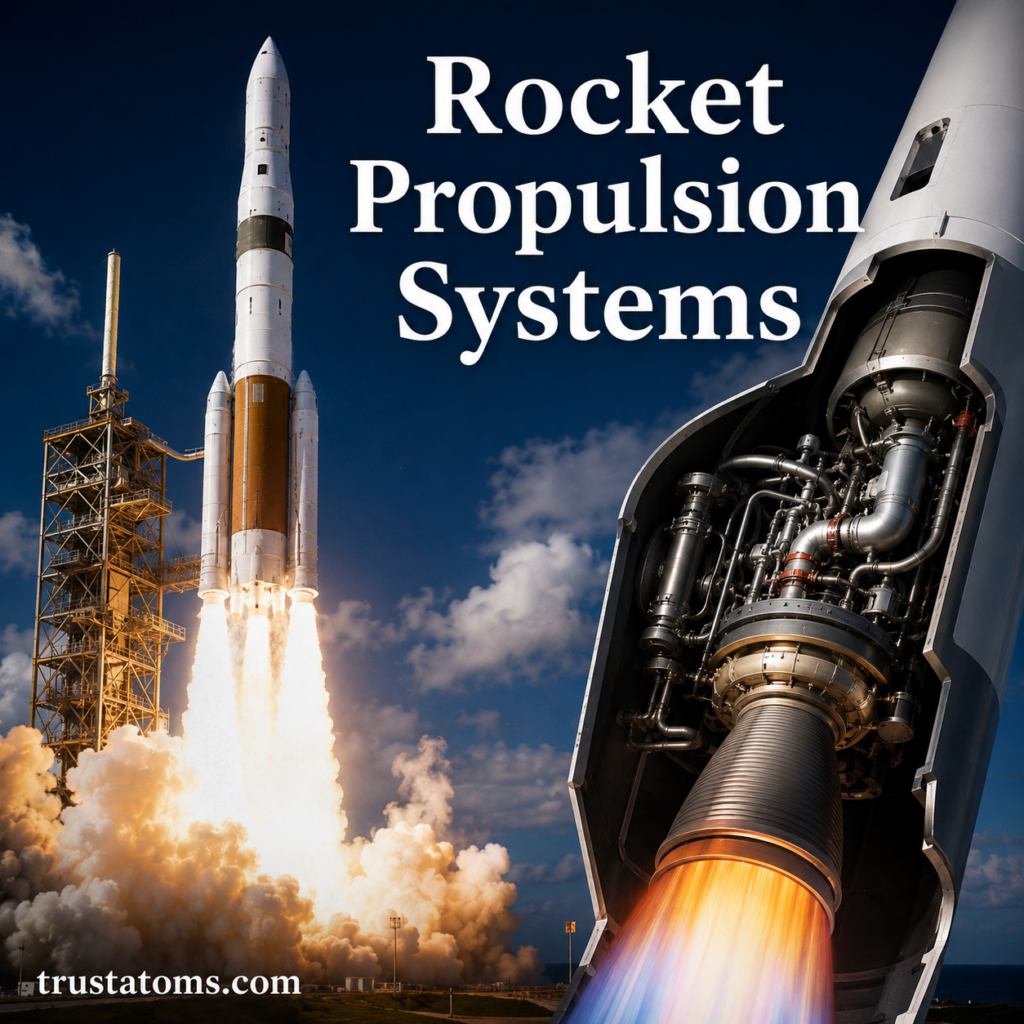
Rocket Propulsion Systems

Rocket launching beside a detailed rocket engine propulsion system illustration showing modern spaceflight technology.
Rocket propulsion systems generate the thrust needed for launches, orbital travel, and deep-space exploration missions. trustatoms.com.

Rocket propulsion systems are the powerful technologies that allow rockets to launch into space, maneuver in orbit, and travel across the solar system. Without propulsion systems, satellites could not orbit Earth, astronauts could not reach space, and robotic probes would never explore distant planets.

Modern rocket propulsion combines physics, chemistry, engineering, and advanced materials science to generate enormous amounts of thrust. From the earliest gunpowder rockets to reusable launch vehicles and ion engines, propulsion technology continues to evolve as humanity expands deeper into space.

Continue reading “Rocket Propulsion Systems”

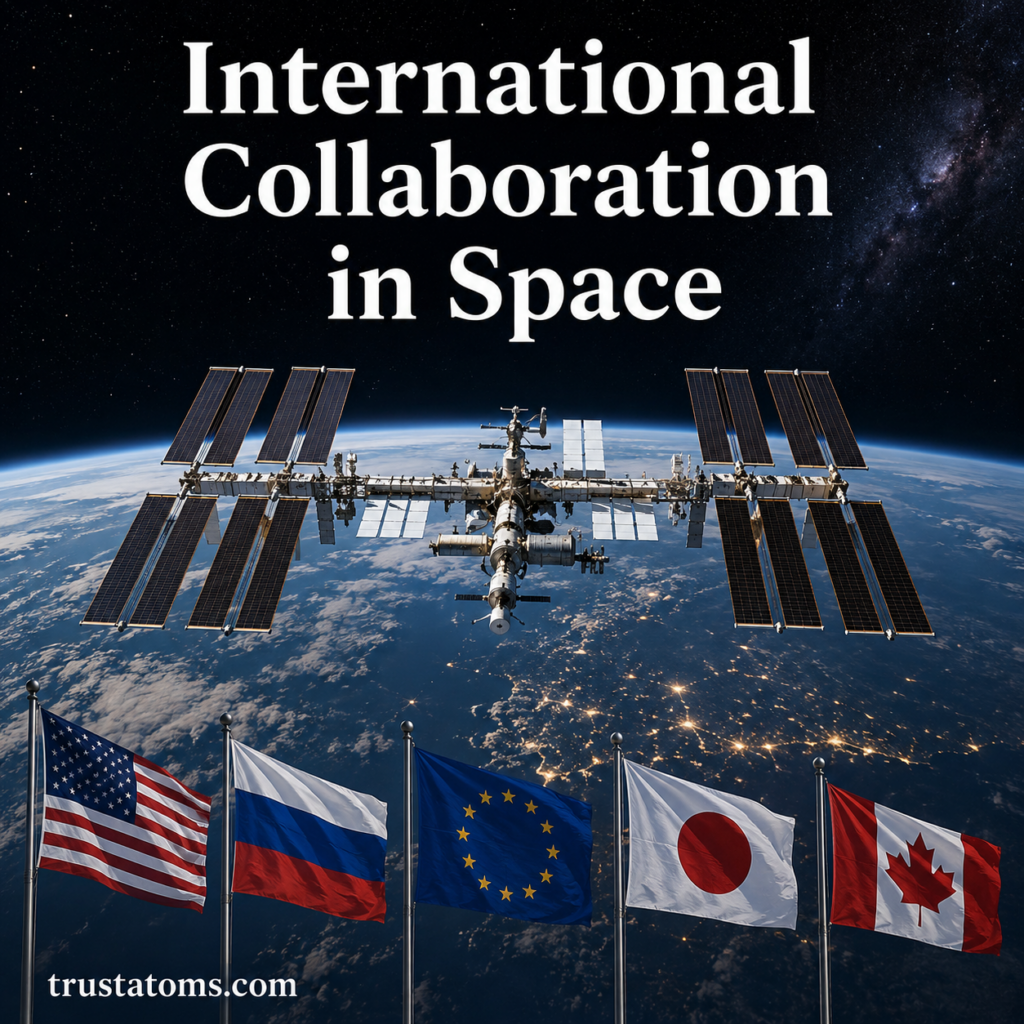
International Collaboration in Space

International Space Station orbiting Earth with multiple national flags representing global cooperation in space exploration.
International collaboration in space helps countries work together on scientific discovery, space missions, and astronomical research. trustatoms.com.

Space exploration has evolved from a competition between nations into one of humanity’s greatest examples of international teamwork. Modern space missions often involve multiple countries, agencies, universities, and private companies working together to share knowledge, reduce costs, and solve complex scientific challenges.

From orbiting laboratories to deep-space telescopes, international collaboration in space has helped advance science, strengthen diplomacy, and expand our understanding of the universe. As missions become more ambitious and expensive, cooperation between nations is becoming increasingly important for the future of astronomy and space exploration.

Continue reading “International Collaboration in Space”