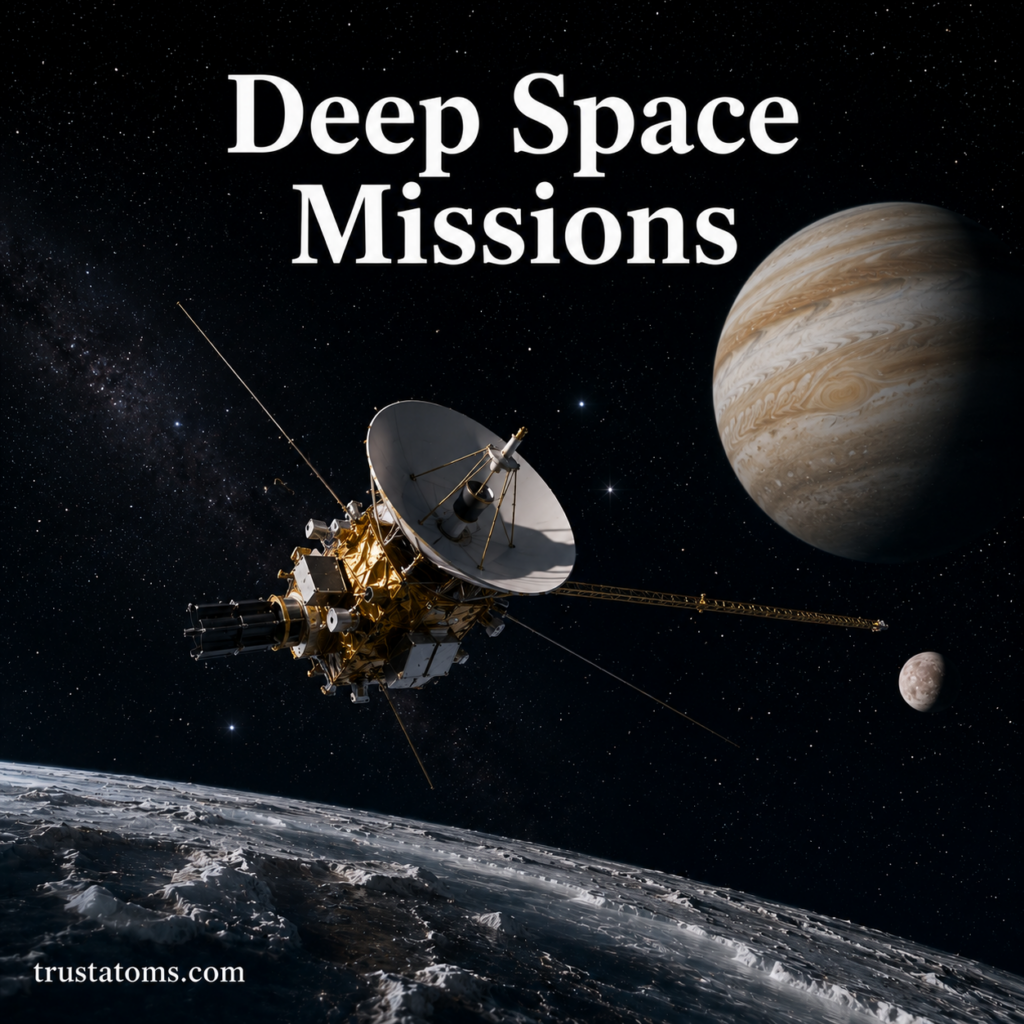
Deep space missions send spacecraft beyond Earth’s immediate surroundings to investigate planets, moons, asteroids, comets, and distant regions of the solar system. These missions use robotic probes, scientific instruments, and long-distance communication systems to collect information that expands our understanding of planetary science and astronomy.
Unlike satellites operating close to Earth, deep space spacecraft may travel for years before reaching their destinations. Their journeys require precise navigation, reliable equipment, and the ability to operate with limited instructions from Earth.
What Are Deep Space Missions?
Deep space missions are exploration projects that operate far beyond low Earth orbit, usually traveling toward the Moon, other planets, or more distant destinations. The exact boundary of deep space depends on the technical or operational definition being used.
Most missions beyond the Moon rely on uncrewed spacecraft because of the distances, travel times, and hazards involved. Robotic Space Missions explains how automated spacecraft conduct exploration without astronauts aboard.
Mission planners must also consider planetary positions before departure. Launch Windows and Orbital Timing describes how the movement of celestial bodies determines when particular trajectories are practical.
Some spacecraft travel beyond the planets and investigate the outer heliosphere or interstellar environment. Scientists also study Interstellar Probe Concepts for missions designed to explore regions far beyond conventional planetary destinations.
Why Deep Space Exploration Matters
Spacecraft provide direct measurements of distant environments that telescopes on Earth cannot always obtain. By examining planetary surfaces, atmospheres, magnetic fields, and surrounding space, scientists can test explanations for how different worlds formed and changed.
Deep space exploration supports several scientific goals:
- Understanding planetary formation: Comparing planets, moons, and smaller bodies helps researchers investigate the solar system’s development.
- Investigating habitability: Missions examine environments that may contain water, useful chemical ingredients, or other conditions associated with life.
- Studying geological activity: Spacecraft reveal volcanoes, impact craters, tectonic features, and other surface processes.
- Improving engineering: Long-distance exploration advances autonomous operations, navigation, communications, and spacecraft reliability.
Exploration closer to Earth also contributes to these goals. Lunar Exploration Probes examines how robotic missions investigate the Moon’s surface, composition, and environment.
Types of Deep Space Missions
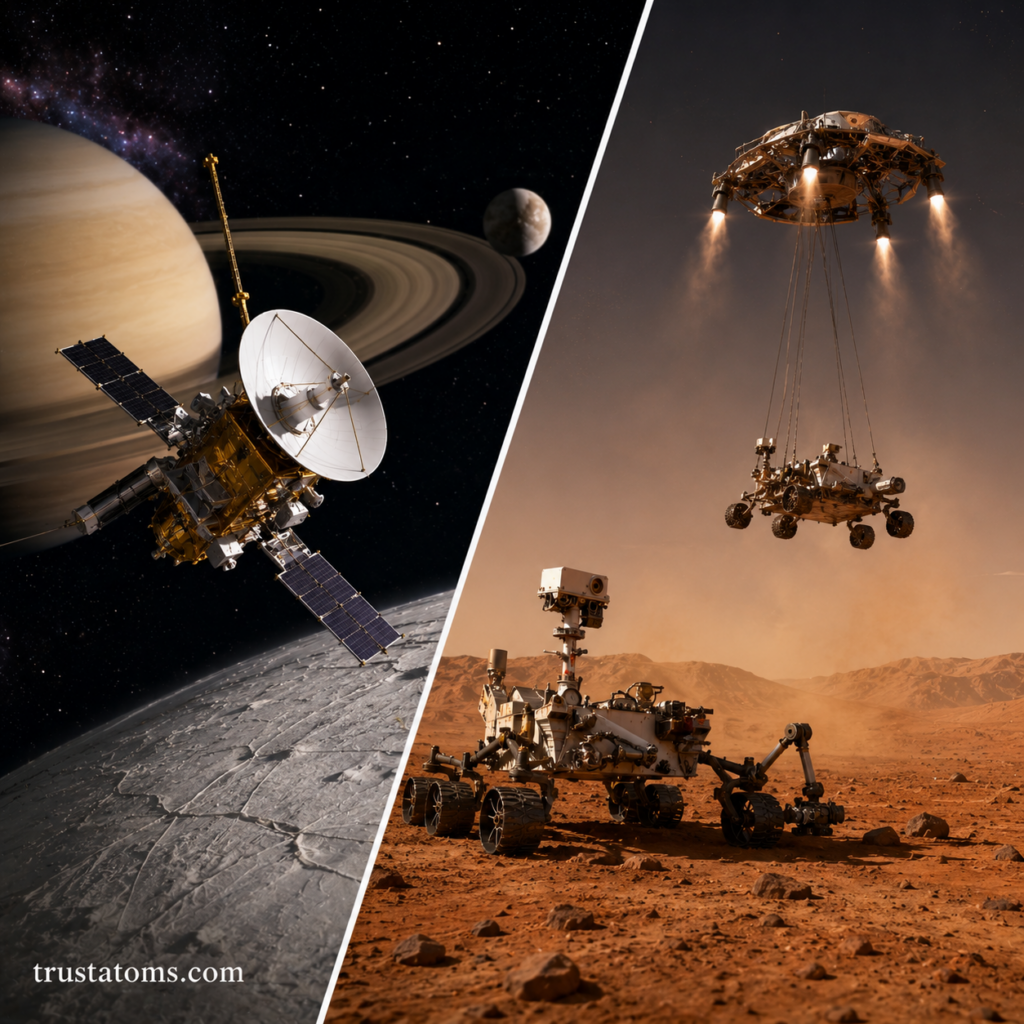
Different spacecraft designs serve different scientific objectives. Some collect observations during brief encounters, while others remain near a destination for years.
Flyby Missions
Flyby spacecraft pass near a planet, moon, asteroid, or comet without entering orbit. They collect images and measurements during the encounter, often while traveling at high speed. NASA’s Voyager spacecraft used planetary flybys to investigate the outer solar system.
Orbiter Missions
Orbiters remain gravitationally bound to a destination, allowing repeated observations of its surface and surroundings. NASA’s Mars Reconnaissance Orbiter, for example, has mapped Martian terrain and studied the planet’s atmosphere.
Landers and Rovers
Landers reach the surface of a celestial body and conduct experiments from a fixed location. Rovers can move across terrain, investigate rocks, and examine multiple sites. NASA’s Perseverance rover studies Martian geology and collects samples intended for possible future return.
Sample Return Missions
Sample return missions collect extraterrestrial material and transport it to Earth for laboratory examination. Japan’s Hayabusa2 mission returned samples from asteroid Ryugu, while NASA’s OSIRIS-REx mission delivered material collected from asteroid Bennu.
How a Deep Space Mission Works
Every mission follows a carefully designed sequence, although individual spacecraft may require additional operations depending on their destinations.
- Mission planning: Engineers select scientific objectives, instruments, trajectories, and launch opportunities.
- Launch and departure: A rocket carries the spacecraft into space and places it on a suitable trajectory.
- Cruise: The spacecraft travels toward its destination while controllers monitor its condition and adjust its path when necessary.
- Arrival: Depending on the mission, the spacecraft performs a flyby, enters orbit, or attempts a landing.
- Scientific operations: Instruments gather measurements that are transmitted to Earth for analysis.
Some spacecraft use gravity assists, passing near planets to change their speed and direction relative to the Sun. This technique can reduce the amount of propellant needed to reach distant destinations.
How Far Away Are Deep Space Spacecraft?
The enormous distances involved become easier to understand by considering communication delays.
Radio signals travel at approximately 300,000 kilometers per second, the speed of light. If a spacecraft is 300 million kilometers from Earth, a radio message takes roughly 1,000 seconds, or about 16 minutes and 40 seconds, to reach it.
A response requires approximately the same amount of time to travel back. Under these simplified conditions, a complete communication exchange takes more than 33 minutes, excluding spacecraft processing and ground operations.
At greater distances, communication delays become much longer. This prevents mission controllers from steering distant spacecraft continuously as though they were operating remote-controlled vehicles.
Technologies That Make Deep Space Exploration Possible
Deep space spacecraft must operate reliably in environments where repairs are generally impossible. Several engineering systems make these missions practical.
- Autonomous control: Onboard computers execute commands, monitor spacecraft health, and respond to certain problems without immediate human intervention.
- Scientific instruments: Cameras, spectrometers, magnetometers, and particle detectors measure different properties of distant environments.
- Communication systems: High-gain antennas and sensitive receiving stations exchange information across enormous distances.
- Power systems: Solar arrays provide electricity where sunlight is sufficient, while radioisotope power systems can support missions operating far from the Sun.
- Thermal control: Insulation, heaters, radiators, and other components help protect equipment from extreme temperatures.
NASA’s Deep Space Network provides communication and tracking services for numerous spacecraft through large antenna facilities positioned around Earth.
Major Discoveries From Deep Space Missions
Robotic exploration has revealed environments that scientists could previously study only through distant observations.
- Jupiter’s moon Io: Voyager observations revealed active volcanism, demonstrating that geological activity occurs beyond Earth.
- Saturn’s moon Enceladus: Cassini observed plumes containing water vapor and icy particles, providing evidence of material escaping from a subsurface ocean.
- Pluto: New Horizons revealed mountains, plains, and complex surface features during its 2015 flyby.
- Asteroids: Sample return missions have provided material for detailed investigations of chemistry and mineral composition.
- Interstellar space: Voyager 1 and Voyager 2 crossed the heliopause, allowing instruments to measure conditions beyond the Sun’s surrounding plasma region.
These discoveries demonstrate that planets and moons can have dramatically different environments, even within the same solar system.
Challenges of Exploring Distant Worlds
Deep space missions face technical limitations that become more demanding with distance and mission duration.
Communication delays require spacecraft to handle many routine activities independently. Limited electrical power constrains instrument operation, while radiation and temperature extremes can damage sensitive components.
Most deep space probes cannot be serviced once launched. Engineers therefore build redundant systems, conduct extensive testing, and design procedures for recovering from certain equipment failures.
Mission duration creates another difficulty. Components must continue operating after years of exposure to the space environment, and scientific teams must manage changing equipment performance over time.
Future Deep Space Exploration
Future exploration efforts include investigations of icy moons, distant small bodies, and environments that may preserve evidence of past chemical processes.
NASA’s Europa Clipper mission is designed to investigate Jupiter’s moon Europa and assess whether conditions beneath its icy surface could support life. The European Space Agency’s Jupiter Icy Moons Explorer, known as JUICE, is investigating Jupiter and its large icy moons.
Engineers are also developing more capable autonomous systems that could help spacecraft select observations, navigate difficult environments, and manage limited resources.
Human exploration beyond the Moon remains a longer-term objective, particularly for Mars. Such missions would require additional advances in life support, radiation protection, transportation, and surface operations.
International Cooperation in Space Exploration
Major exploration projects frequently involve multiple space agencies, universities, and research institutions. International partnerships allow organizations to contribute scientific instruments, engineering expertise, and mission support.
Cooperation also enables researchers from different countries to analyze shared observations. These collaborations can expand the scientific return of a mission while distributing some of its technical and financial responsibilities.
Frequently Asked Questions
What is the difference between deep space and low Earth orbit?
Low Earth orbit refers to the region relatively close to Earth where many satellites and the International Space Station operate. Deep space generally refers to locations much farther away, including destinations beyond Earth’s immediate orbital environment. Specific operational definitions vary.
How do deep space probes communicate with Earth?
Deep space probes primarily use radio signals transmitted through specialized antennas. Ground stations receive scientific information and send commands, but communication delays increase with distance because signals cannot travel faster than light.
Have any spacecraft reached interstellar space?
Yes. Voyager 1 and Voyager 2 have crossed the heliopause, the boundary where the solar wind gives way to the surrounding interstellar plasma environment. However, neither spacecraft has traveled beyond the distant gravitational domain of the solar system or reached another star.
Deep space missions extend scientific observation to places that cannot be reached by conventional Earth-based instruments. From the volcanic surface of Io to the distant environment beyond the heliopause, robotic spacecraft have revealed unexpected features of the solar system. Continued advances in autonomous navigation, communications, and spacecraft reliability will determine how much farther future missions can explore.
Sources: NASA Jet Propulsion Laboratory, Deep Space Network; NASA Science, Solar System Exploration; European Space Agency, Science and Exploration Missions.