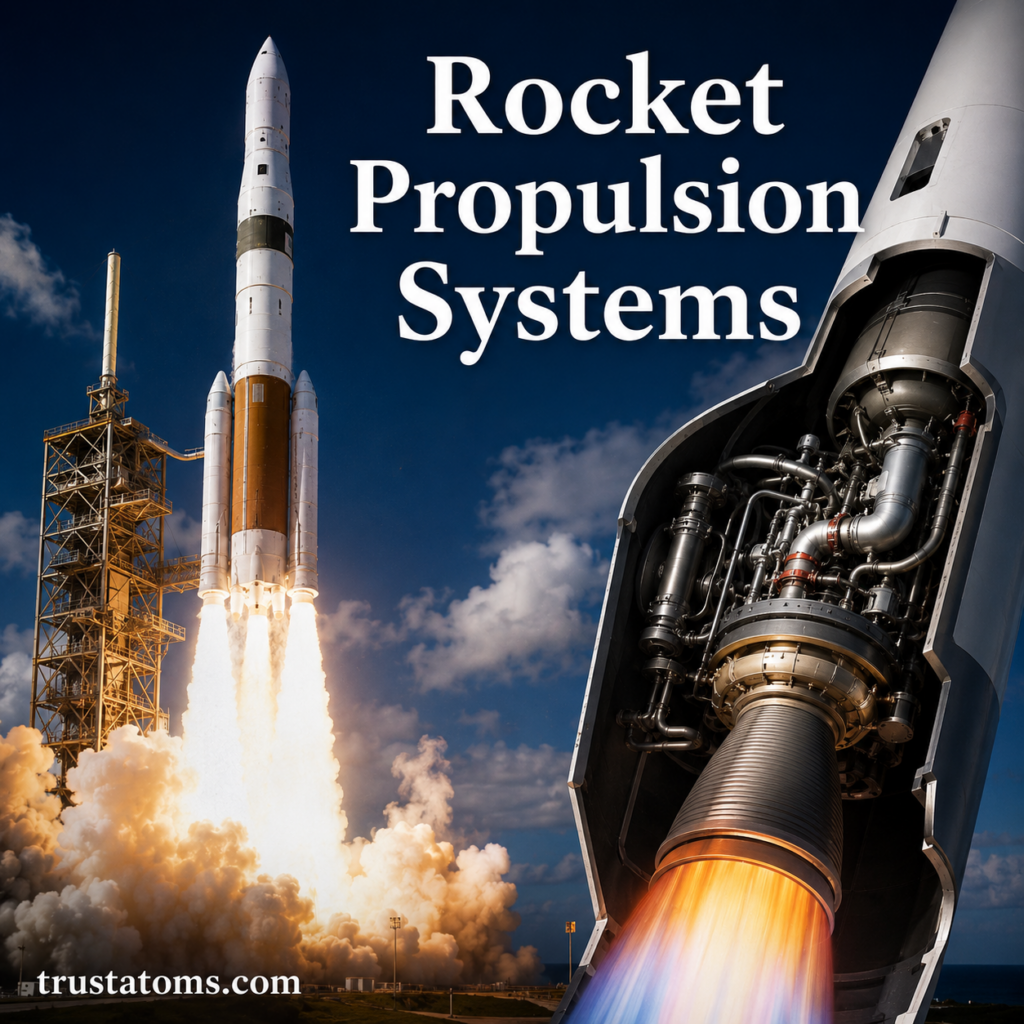
Rocket propulsion systems generate thrust by accelerating and expelling mass in the opposite direction of a rocket’s motion. They allow launch vehicles to reach space, satellites to adjust their orbits, and spacecraft to travel between planets without relying on air for propulsion.
Different propulsion technologies serve different purposes: chemical engines provide powerful thrust for launch, while electric engines deliver small but efficient thrust over long periods. Understanding these systems connects engineering with the study of astronomy, helping explain how scientists send instruments and spacecraft to investigate distant celestial objects.
What Is a Rocket Propulsion System?
A rocket propulsion system converts stored energy into the motion of expelled propellant. As material accelerates backward through an engine, the rocket experiences a forward force called thrust.
This process follows Newton’s third law of motion: when one object exerts a force on another, the second exerts an equal and opposite force on the first. Rockets also demonstrate conservation of momentum, which explains why expelling mass changes the vehicle’s velocity.
Unlike air-breathing jet engines, chemical rockets carry both fuel and an oxidizer. This allows combustion to continue in space, where atmospheric oxygen is unavailable. Electric rockets operate differently, using electrical energy to accelerate propellant without conventional combustion.
Propulsion determines how much velocity a spacecraft can gain, but successful missions also depend on when and where that velocity is applied. Launch Windows and Orbital Timing explains how orbital positions influence the energy needed to reach a destination.
How Rocket Engines Generate Thrust
In a chemical rocket engine, fuel and oxidizer react to release energy. The resulting hot, high-pressure gases expand through a nozzle and accelerate outward, generating thrust in the opposite direction.
Several components work together to control this process.
Combustion Chamber
The combustion chamber contains the chemical reaction that produces hot gases. Its walls must withstand high temperatures and pressures while maintaining stable combustion.
Engine Nozzle
The nozzle converts thermal energy and pressure into directed exhaust velocity. Many chemical engines use a converging-diverging nozzle, which accelerates exhaust to supersonic speeds under suitable operating conditions.
Propellant Delivery and Ignition
Liquid engines use tanks, valves, and either pumps or pressurized gas to deliver propellants. Ignition systems initiate combustion, although certain propellant combinations ignite automatically upon contact.
Solid motors differ because their fuel and oxidizer are incorporated into a solid propellant grain. Once ignited, the exposed propellant surface burns and produces exhaust.
Thrust, Specific Impulse, and Rocket Efficiency
Engine performance is commonly described using thrust and specific impulse. These measurements answer different questions.
- Thrust: The force produced by the engine, measured in newtons.
- Mass flow rate: The amount of propellant expelled each second.
- Exhaust velocity: The speed at which propellant leaves the engine relative to the rocket.
- Specific impulse: A measure of how effectively an engine uses propellant to produce impulse, conventionally expressed in seconds.
For a rocket operating in a vacuum, thrust depends on exhaust momentum and the pressure difference across the nozzle exit. Increasing exhaust velocity can improve propellant efficiency, but it does not automatically produce greater thrust.
Consider a simplified engine expelling 10 kilograms of propellant per second at 3,000 meters per second. Ignoring the nozzle pressure contribution, it produces approximately 30,000 newtons of thrust, or 30 kilonewtons. This example shows how both exhaust speed and the amount of expelled material determine thrust.
High thrust is especially useful during launch. High specific impulse becomes increasingly valuable when a spacecraft must conserve propellant during extended operations.
Types of Rocket Propulsion Systems
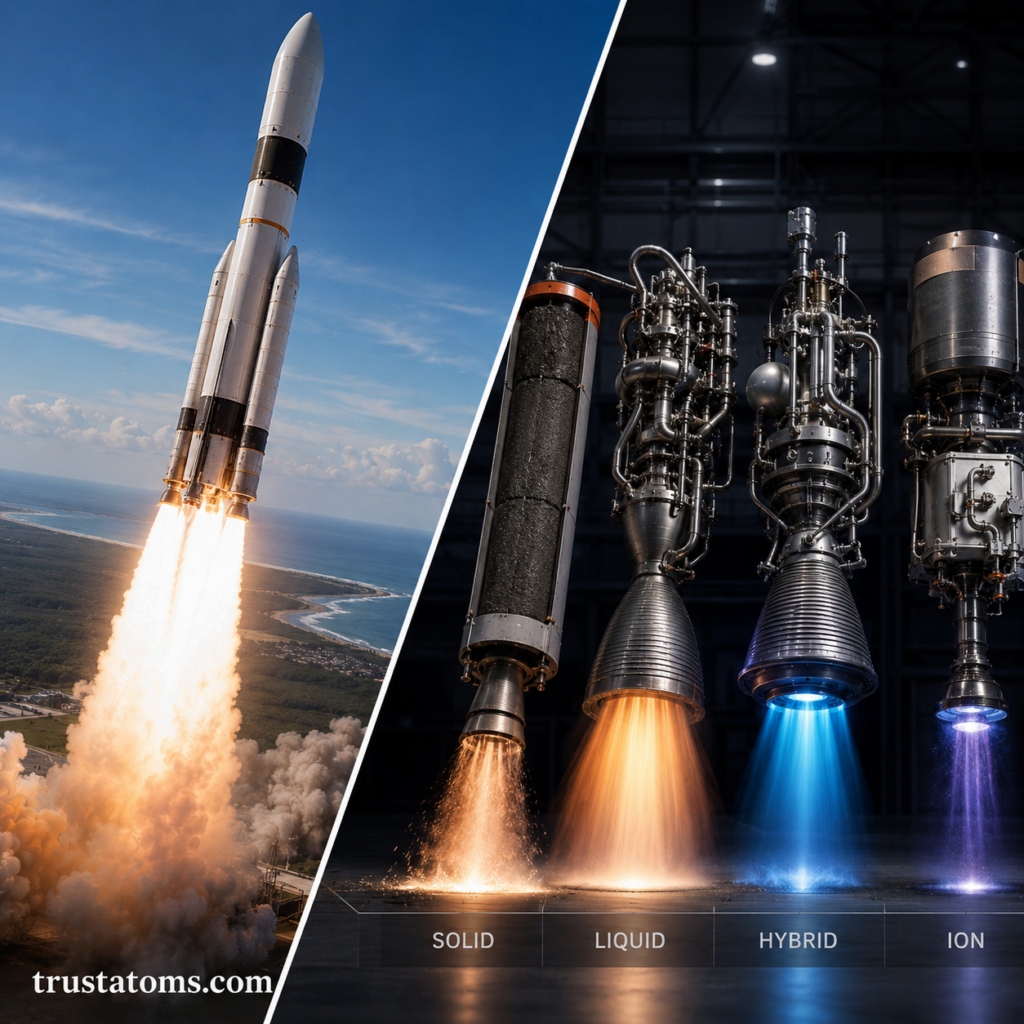
Rocket engines can be classified by how they store energy, accelerate propellant, and control thrust. The most widely used systems include solid, liquid, hybrid, and electric propulsion.
Propulsion design also affects whether a launch vehicle can return safely after flight. Reusable Rockets and Launch Systems explains how restartable engines and controlled landing burns make booster recovery possible.
Solid Rocket Propulsion
Solid rocket motors contain fuel and oxidizer within a solid propellant grain. When ignited, the burning surface produces high-pressure gases that escape through a nozzle.
Solid motors are mechanically simpler than many liquid engines because they generally require no turbopumps or complex propellant plumbing.
Advantages and Limitations
- Advantages: High thrust, relatively simple construction, and the ability to store propellant for extended periods.
- Limitations: Most conventional designs cannot be easily shut down or restarted after ignition, and thrust control is restricted.
Solid rocket boosters helped launch NASA’s Space Shuttle and are also used on the Space Launch System. Their strong initial thrust makes them suitable for assisting heavy vehicles during liftoff.
Liquid Rocket Propulsion
Liquid rocket engines store fuel and oxidizer separately, delivering them into a combustion chamber during operation. Many designs allow engineers to regulate thrust, shut down combustion, and restart the engine.
Common propellant combinations include:
- Liquid hydrogen and liquid oxygen: Provide high specific impulse but require extremely cold storage temperatures.
- RP-1 kerosene and liquid oxygen: Offer dense fuel storage and strong thrust for launch vehicles.
- Liquid methane and liquid oxygen: Support modern engine designs, including systems being developed for repeated use.
Why Liquid Engines Are More Complex
Liquid propulsion requires precise propellant delivery, reliable ignition, and effective thermal management. High-performance engines may use turbopumps operating under demanding mechanical conditions.
Despite this complexity, their controllability makes liquid engines suitable for launch, orbital insertion, spacecraft maneuvering, and powered booster landings.
Hybrid Rocket Propulsion
Hybrid rockets typically combine a solid fuel with a separately stored liquid or gaseous oxidizer. The oxidizer flows into the combustion chamber, where it reacts with the solid fuel surface.
Because oxidizer flow can be regulated, hybrid engines generally offer more control than conventional solid motors. Some designs can also be shut down and restarted.
However, maintaining efficient combustion can be difficult because the solid fuel burns away progressively. Changes in the fuel surface affect mixing, combustion behavior, and thrust.
Hybrid propulsion has been used in experimental vehicles and commercial suborbital spacecraft, although it remains less common than solid or liquid propulsion for orbital launches.
Ion Engines and Electric Propulsion
Electric propulsion uses electrical energy to accelerate propellant rather than relying primarily on chemical combustion. Ion engines create charged particles and accelerate them through electric fields to produce thrust.
These engines typically generate much less thrust than chemical rockets, but they can achieve substantially higher exhaust velocities and specific impulse.
Why Low-Thrust Engines Work in Space
A spacecraft traveling through space does not need continuous thrust to maintain its motion. Small forces applied over weeks or months can gradually produce significant changes in velocity.
NASA’s Dawn spacecraft demonstrated this approach by using ion propulsion to travel between the asteroid Vesta and dwarf planet Ceres.
Electric propulsion is unsuitable for launching heavy vehicles directly from Earth’s surface because its thrust is generally too low. It is especially useful after a spacecraft has already reached space.
Nuclear Propulsion Concepts
Nuclear propulsion could provide alternative ways to generate the energy needed for spacecraft acceleration. Two major concepts are nuclear thermal propulsion and nuclear electric propulsion.
Nuclear Thermal Propulsion
A nuclear thermal rocket uses a reactor to heat propellant, typically hydrogen, before expelling it through a nozzle. Because the propellant is heated without chemical combustion, this approach could achieve higher specific impulse than conventional chemical engines.
Nuclear Electric Propulsion
Nuclear electric propulsion uses a reactor to generate electricity for electric thrusters. This could provide substantial electrical power for long-duration missions, particularly where sunlight is weak.
Both approaches face challenges involving reactor safety, mass, cooling, testing, and mission integration. Nuclear propulsion concepts remain under development rather than being routine operational systems.
For journeys beyond the outer planets, researchers also examine advanced approaches discussed in Interstellar Probe Concepts, where propulsion efficiency and extremely long mission durations become major design considerations.
Comparing Rocket Propulsion Technologies
Different propulsion systems are optimized for different mission requirements. The following comparison summarizes their typical characteristics.
| Propulsion Type | Typical Thrust | Main Advantage | Common Application |
|---|---|---|---|
| Solid chemical | High | Simple, powerful operation | Launch boosters |
| Liquid chemical | High | Thrust control and possible restart | Launch and orbital maneuvers |
| Hybrid chemical | Moderate to high | Controllable oxidizer flow | Suborbital and experimental vehicles |
| Ion electric | Very low | High propellant efficiency | Long-duration spacecraft propulsion |
| Nuclear thermal | Potentially high | Higher specific impulse than chemical propulsion | Proposed interplanetary missions |
These categories describe general performance rather than fixed limits. Actual thrust and efficiency depend on engine design, operating conditions, and available power.
Why Rockets Use Multiple Stages
Reaching orbit requires a large increase in velocity. Carrying empty propellant tanks and unused engines throughout the entire ascent would make that task unnecessarily difficult.
Multistage rockets solve this problem by separating sections after their propellant has been consumed. Discarding an empty stage reduces the mass that the remaining engines must accelerate.
Common configurations include two-stage vehicles, three-stage vehicles, and rockets equipped with additional strap-on boosters. Some modern launch systems recover selected stages instead of allowing them to be destroyed.
How Rocket Engines Survive Extreme Heat
Chemical rocket combustion chambers operate at temperatures high enough to damage ordinary structural materials. Engineers therefore combine specialized alloys, protective coatings, and cooling methods to prevent engine failure.
Regenerative Cooling
In regeneratively cooled engines, fuel or another propellant flows through channels surrounding hot engine components before entering the combustion chamber. This removes heat from the walls while warming the propellant.
Other Thermal Protection Methods
Some engines use film cooling, ablative materials, or radiation cooling. The appropriate method depends on engine temperature, operating duration, materials, and performance requirements.
Cooling is especially demanding for engines designed to restart or operate repeatedly because components must withstand repeated heating and cooling cycles.
Rocket Propulsion and Space Exploration
Rocket propulsion supports nearly every major category of spaceflight, including satellite deployment, human transportation, lunar exploration, and robotic planetary missions.
The development of increasingly capable engines is closely connected to the History of Space Exploration, from early experimental rockets to vehicles capable of carrying spacecraft beyond Earth orbit.
Propulsion is also essential to Deep Space Missions, where spacecraft may need course corrections, orbital insertion burns, or sustained low-thrust acceleration during journeys lasting years.
Different missions demand different propulsion strategies. A launch vehicle must overcome Earth’s gravity and atmospheric resistance, while a spacecraft already in orbit may need only modest thrust to change its trajectory.
Future Propulsion Research and Engineering Challenges
Researchers continue investigating higher-efficiency electric thrusters, improved chemical engines, nuclear propulsion, and more speculative approaches such as fusion-powered spacecraft.
Solar sails offer another approach by using momentum transferred from sunlight rather than expelling onboard propellant. Although they are not conventional rocket engines, they demonstrate how spacecraft can accelerate without consuming reaction mass.
Every propulsion technology involves trade-offs among thrust, efficiency, power supply, mass, reliability, and cost. Engineers must also manage vibration, extreme temperatures, mechanical stresses, and the environmental consequences of launch operations.
Advanced propulsion may reduce travel times or increase spacecraft capabilities, but proposed technologies must demonstrate reliable performance before they can support operational missions.
Frequently Asked Questions
How do rockets work in space without oxygen?
Chemical rockets carry their own fuel and oxidizer, allowing combustion without atmospheric oxygen. Rocket thrust comes from expelling propellant, so the engine does not need surrounding air to push against.
Which rocket propulsion system is most efficient?
Electric propulsion systems such as ion engines generally achieve much higher specific impulse than chemical rockets. However, chemical engines produce far greater thrust, making them better suited to launching spacecraft from Earth’s surface. The most suitable system depends on the mission.
Can a spacecraft use more than one propulsion system?
Yes. A mission may use chemical rockets for launch and major maneuvers, then rely on electric propulsion or small chemical thrusters for later trajectory adjustments. Combining propulsion methods allows engineers to match different technologies to different phases of flight.
Rocket propulsion systems make spaceflight possible by converting stored energy into directed motion, but no single engine design is ideal for every mission. Chemical rockets remain essential for high-thrust launches, while electric propulsion and developing nuclear concepts offer different possibilities for efficient travel beyond Earth.
Sources: NASA Glenn Research Center, Beginner’s Guide to Rockets; Sutton and Biblarz, Rocket Propulsion Elements, Ninth Edition; NASA, In-Space Propulsion Technology Program.