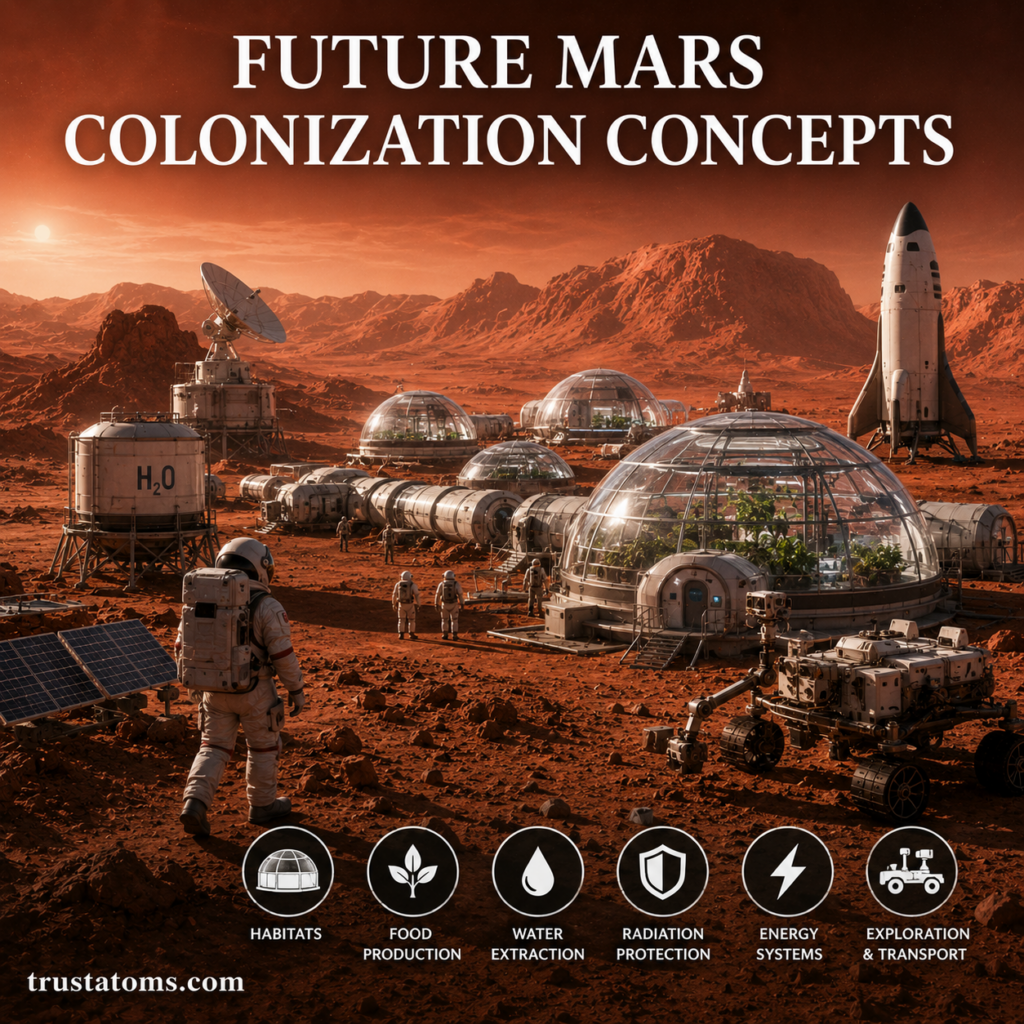
Future Mars colonization concepts involve building protected habitats, producing oxygen and water, growing food, and developing reliable transportation so humans could live on the Red Planet for extended periods. Although these technologies are being researched and tested, establishing a permanent, self-sustaining settlement on Mars remains far beyond current human capabilities.
Mars attracts attention because it has accessible water ice, a solid surface, and a day nearly as long as Earth’s. Research in astronomy and planetary science helps scientists evaluate whether these advantages could support future human exploration and settlement.
Why Mars Is a Leading Candidate for Human Settlement
Mars offers several characteristics that make it an attractive destination for long-duration exploration. Its surface contains minerals, its polar regions hold ice, and evidence indicates that liquid water existed there in the distant past.
A Martian day, called a sol, lasts approximately 24 hours and 39 minutes. This is close to Earth’s daily cycle and could make scheduling easier than on worlds with much longer days.
However, Mars is not naturally habitable for humans. Its atmosphere is extremely thin and consists mostly of carbon dioxide, surface temperatures are generally cold, and its gravity is only about 38% of Earth’s.
Any settlement would require artificial life support. Questions about protecting possible Martian ecosystems and managing human activity are also examined in the ethics of space exploration.
What Would a Mars Colony Need to Survive?
A functioning settlement would depend on several interconnected systems. Failure of one could threaten the others, making redundancy and repair capabilities essential.
- Pressurized habitats: Maintain breathable air, safe temperatures, and living space.
- Water systems: Extract, purify, store, and recycle water.
- Food production: Supply nutrition through stored provisions and controlled agriculture.
- Power generation: Operate life support, heating, communications, and scientific equipment.
- Medical facilities: Provide emergency treatment without immediate assistance from Earth.
- Transportation: Move people, supplies, and equipment safely across the surface.
Early outposts would likely depend heavily on supplies from Earth. A genuinely self-sustaining settlement would also need the ability to manufacture replacement parts, maintain equipment, and produce essential resources locally.
Transportation Systems for Mars Missions
Traveling to Mars requires spacecraft capable of supporting crews for months. With conventional chemical propulsion and favorable orbital alignments, a one-way journey commonly takes approximately six to nine months.
Launch opportunities for relatively efficient Earth-to-Mars transfers occur approximately every 26 months. Mission planners must therefore consider transportation schedules, surface supplies, and possible delays before crews depart.
Reusable Rockets and Cargo Spacecraft
Reusable launch vehicles could reduce the cost of delivering equipment into space. Proposed Mars transportation systems also emphasize large cargo capacities, orbital refueling, and spacecraft capable of supporting long-duration missions.
Robotic spacecraft would likely deliver equipment before astronauts arrive. Previous Mars exploration missions have demonstrated technologies for landing, surface navigation, scientific analysis, and remote operations.
Nuclear Propulsion Research
Nuclear thermal propulsion is being investigated as a possible alternative for some future missions. It could offer greater propulsion efficiency than conventional chemical rockets, potentially changing travel times and mission designs.
However, nuclear propulsion for crewed Mars transportation remains developmental. Reactor safety, testing, mass, and spacecraft integration present substantial engineering challenges.
Building Habitats on the Martian Surface
Mars habitats must maintain internal pressure, regulate temperature, remove carbon dioxide, and protect occupants from environmental hazards. Engineers are considering several construction approaches.
Inflatable and Modular Habitats
Inflatable modules could provide relatively large interior spaces while occupying less volume during transportation. Rigid modules offer another approach, particularly for equipment areas and airlocks.
Once deployed, habitats could be reinforced with Martian soil for radiation protection.
Experience gained from space stations and habitats provides useful knowledge about air recycling, maintenance, crew routines, and long-duration living in enclosed environments.
Underground and 3D-Printed Structures
Buried habitats or structures inside suitable lava tubes could offer additional shielding from radiation and temperature changes. Their practicality depends on geological stability, access, construction requirements, and emergency evacuation options.
Robotic construction systems might eventually use Martian regolith to create protective walls or structural components. Such techniques remain experimental and would need extensive testing before supporting human occupants.
Protecting Astronauts From Radiation
Mars lacks Earth’s strong global magnetic field and thick atmosphere. Consequently, astronauts on its surface would face greater exposure to galactic cosmic rays and energetic particles from solar events.
Long-term exposure can increase health risks, including cancer. The biological effects of prolonged radiation exposure combined with reduced gravity remain incompletely understood.
Proposed protective measures include:
- Covering habitats with thick layers of regolith.
- Using water or other hydrogen-rich materials as shielding.
- Providing dedicated shelters for solar particle events.
- Monitoring space weather and limiting unnecessary surface exposure.
Shielding requirements would influence habitat location, construction methods, and the amount of material transported from Earth.
Producing Food in Martian Greenhouses
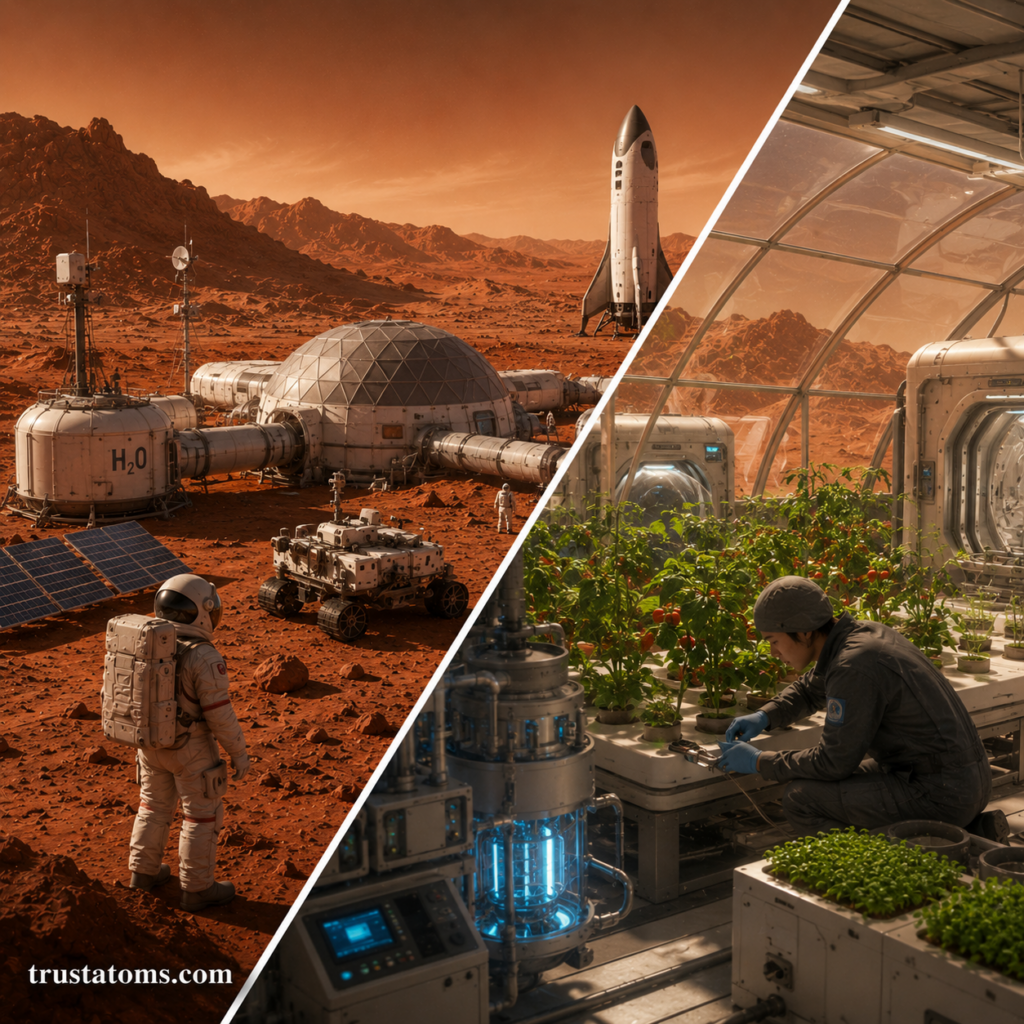
Transporting every meal from Earth would be expensive and create dependence on scheduled deliveries. Future settlements may therefore combine stored food with crops grown in controlled environments.
Hydroponics and Aeroponics
Hydroponic systems grow plants using nutrient-rich water rather than ordinary soil. Aeroponic systems deliver nutrients through a mist directed toward plant roots.
Both methods could help conserve water and provide precise control over plant nutrition. However, they require dependable pumps, lighting, temperature regulation, and maintenance.
Controlled Greenhouse Environments
Martian greenhouses would need pressurized interiors and protection from cold temperatures. Artificial lighting could supplement sunlight, especially during periods of reduced visibility caused by atmospheric dust.
Researchers must also consider crop nutrition, pollination, microbial control, and nutrient recycling. Martian regolith cannot simply replace agricultural soil without treatment because it lacks established soil biology and may contain harmful perchlorate compounds.
Extracting Water, Oxygen, and Rocket Fuel
Using resources already present on Mars is called in-situ resource utilization, or ISRU. It could reduce the mass of supplies launched from Earth.
Obtaining Water From Ice
Orbital observations and surface investigations show that Mars contains substantial water ice. Future equipment might excavate ice-bearing material, extract water through heating, and purify it for human use.
Water could support drinking supplies, hygiene, agriculture, and oxygen production. However, the accessibility and purity of local ice would strongly influence settlement locations.
Producing Oxygen From Carbon Dioxide
NASA’s MOXIE experiment aboard the Perseverance rover demonstrated that oxygen can be produced from carbon dioxide in the Martian atmosphere.
MOXIE was a small technology demonstration rather than a complete life-support system. A settlement would require much larger equipment, continuous power, storage capacity, and backup systems.
Manufacturing Return-Trip Propellant
One proposed approach would combine hydrogen with atmospheric carbon dioxide to produce methane, while oxygen could serve as the oxidizer for rocket engines.
Producing propellant locally could reduce the amount carried from Earth, but the process would require substantial energy and dependable industrial equipment.
Generating Reliable Electricity on Mars
Electricity would support nearly every essential settlement function, including heating, water processing, oxygen production, communications, and food cultivation.
Solar panels are one option, although Mars receives less sunlight than Earth. Dust accumulation, seasonal changes, and storms could reduce power output.
Small nuclear fission reactors are another proposed option because they could provide electricity regardless of sunlight. Combining multiple power sources with energy storage may improve reliability.
For example, a settlement consuming an average of 100 kilowatts would require 2,400 kilowatt-hours of electrical energy over a 24-hour period. This hypothetical calculation illustrates why power generation and backup capacity must be planned before a crew arrives.
Communication Delays and Medical Independence
Radio signals travel at the speed of light, but the changing distance between Earth and Mars creates significant communication delays. Depending on their orbital positions, a message can take approximately 3 to 22 minutes to travel one way.
This delay prevents ordinary real-time conversations. Crews would need authority to handle emergencies, repair equipment, and make operational decisions without immediate instructions from Earth.
Medical care presents another challenge. A Mars settlement would require trained personnel, diagnostic equipment, medication supplies, and procedures for emergencies when evacuation is not immediately possible.
Mental Health and Social Life in Isolation
Living in a confined environment for months or years could create psychological strain. Limited privacy, separation from family, demanding work schedules, and communication delays would affect daily life.
Potential support measures include private living areas, regular recreation, reliable communication with Earth, exercise facilities, and access to mental health care.
Crew selection and training would also need to address teamwork, conflict resolution, and decision-making under prolonged stress.
Terraforming Concepts and Their Limitations
Terraforming refers to deliberately changing a planet’s environment to make it more suitable for Earth-like life. Proposed Martian concepts include warming the atmosphere, increasing atmospheric pressure, and releasing additional greenhouse gases.
However, current scientific assessments indicate that Mars does not have enough readily accessible carbon dioxide to create a thick, Earth-like atmosphere using existing technology.
Some speculative proposals involve importing materials or extracting resources on an enormous scale. Related space mining concepts examine how extraterrestrial materials might be collected and processed, although such operations would face major engineering and economic obstacles.
Even substantial atmospheric changes would not automatically solve radiation exposure, oxygen availability, or long-term climate stability. Terraforming should therefore be distinguished from the more practical goal of maintaining small, enclosed habitats.
Who Would Govern a Mars Settlement?
Permanent human activity on Mars would raise legal and ethical questions involving resource use, scientific preservation, environmental contamination, and political authority.
The Outer Space Treaty establishes principles governing national activities in outer space, including restrictions on national claims of sovereignty over celestial bodies. However, many practical questions about settlement governance and resource operations remain unresolved.
Protecting locations that might contain evidence of past or present microbial life would be especially important. Exploration plans must consider planetary protection procedures to reduce biological contamination.
From Scientific Outposts to Permanent Settlements
A realistic progression toward sustained human presence would likely involve several stages rather than immediate construction of a large colony.
- Robotic preparation: Survey landing sites, locate accessible resources, and test essential technologies.
- Initial crewed missions: Establish temporary habitats and conduct scientific research.
- Expanded outposts: Increase power generation, local resource processing, and surface infrastructure.
- Long-duration settlements: Develop dependable food production, equipment repair, medical services, and reduced dependence on Earth.
These stages are conceptual rather than an established schedule. No organization has yet demonstrated all the systems required for a permanently occupied, self-sustaining Mars settlement.
Frequently Asked Questions
Could humans live on Mars without spacesuits?
Humans could live without spacesuits inside properly pressurized, temperature-controlled habitats. Outside those environments, protective suits would be essential because Mars has an extremely thin atmosphere, insufficient breathable oxygen, and hazardous temperatures.
How long would it take to travel from Earth to Mars?
With conventional propulsion and favorable orbital conditions, a one-way journey commonly takes approximately six to nine months. Actual travel time depends on spacecraft capabilities, mission design, and the positions of Earth and Mars.
When could the first permanent Mars colony be established?
There is no scientifically established date for a permanent Mars colony. Crewed exploration may become possible before a settlement can reliably produce its own food, water, oxygen, power, and replacement equipment without regular assistance from Earth.
Future Mars settlements would depend on proven systems for life support, radiation shielding, resource extraction, transportation, and medical care. Experiments such as MOXIE demonstrate progress toward using local resources, but an independent colony would require far more extensive infrastructure and testing. The most realistic near-term objective is developing the technologies needed for safe, sustained human exploration rather than assuming that self-sustaining Martian cities are imminent.
Sources: NASA, Moon to Mars Architecture; NASA Jet Propulsion Laboratory, Mars Oxygen In-Situ Resource Utilization Experiment (MOXIE); National Academies of Sciences, Engineering, and Medicine, A Science Strategy for the Human Exploration of Mars.