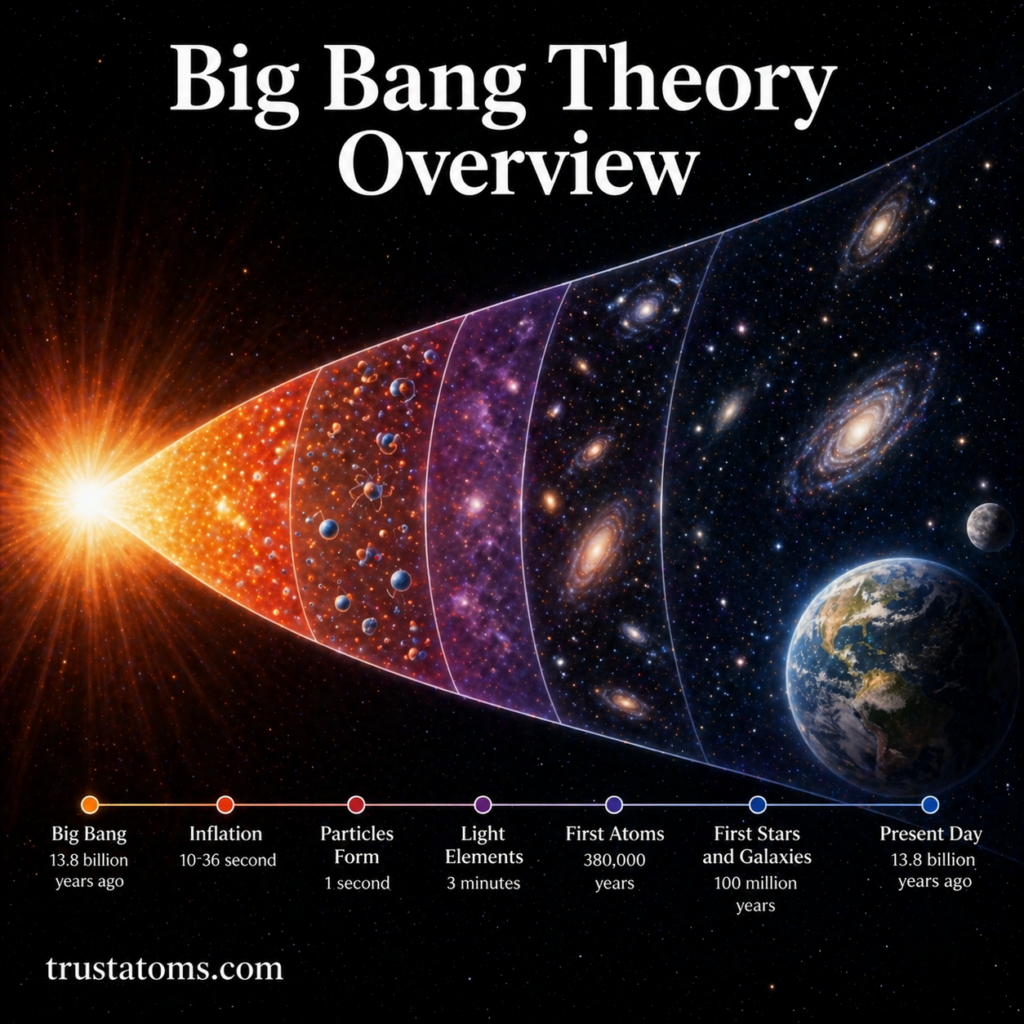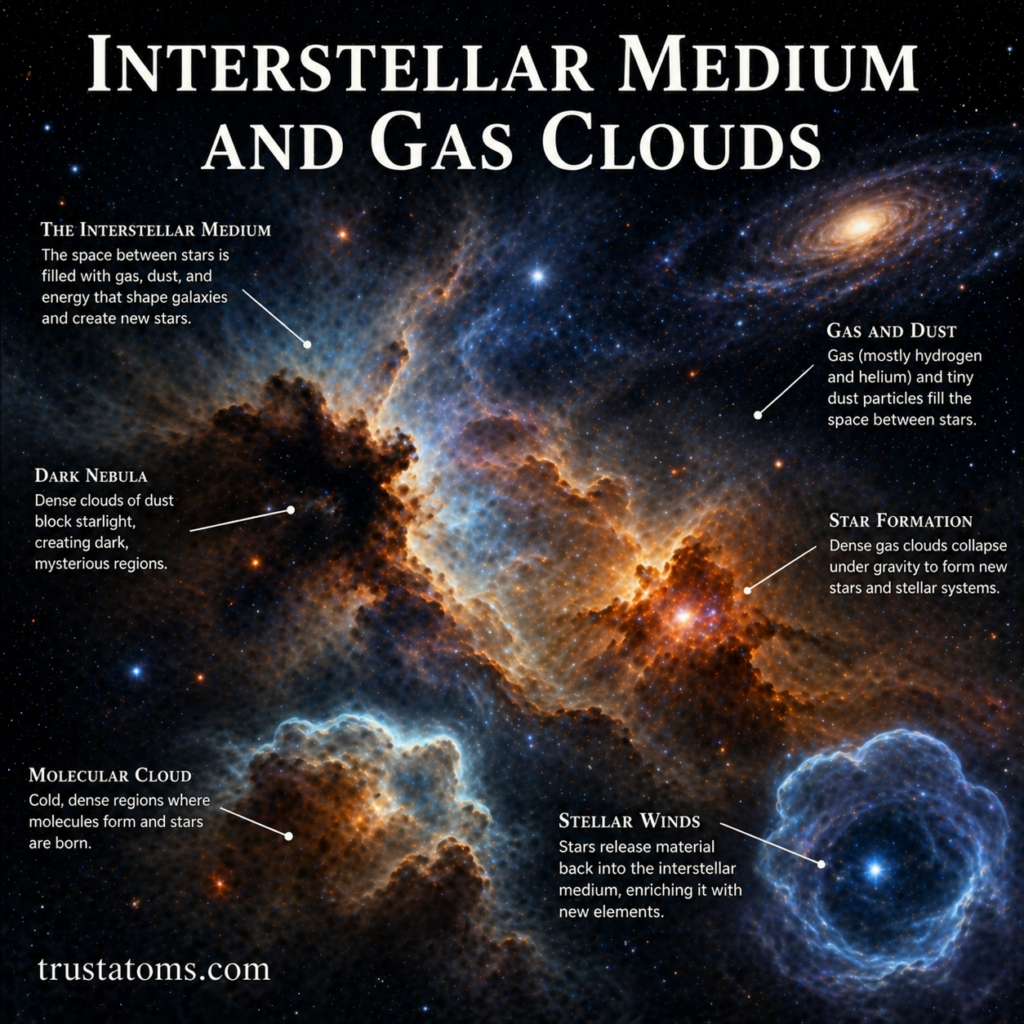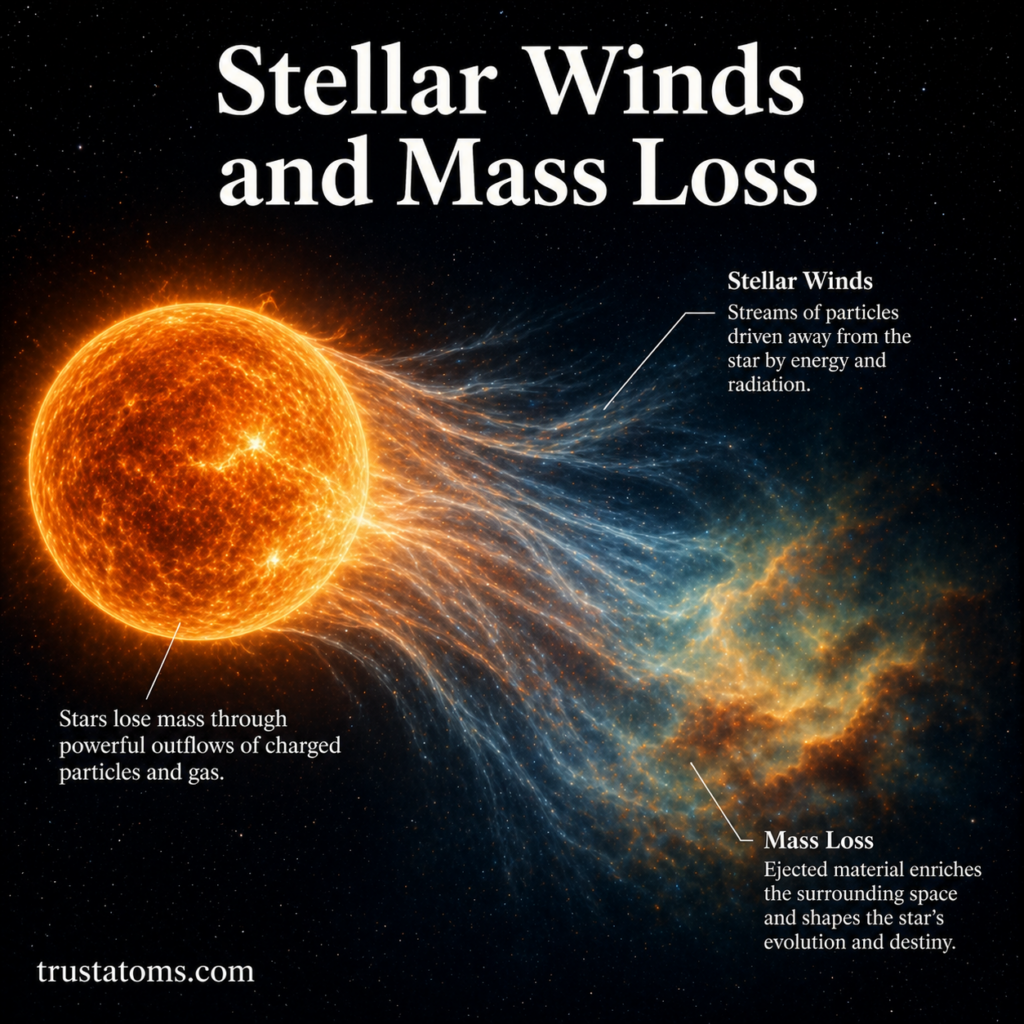
Stellar winds are continuous outflows of gas and charged particles that carry matter away from stars into surrounding space. This mass loss can alter a star’s evolution, influence its eventual fate, and distribute material that may become part of future stars and planets.
Stars lose mass at very different rates depending on their temperature, luminosity, and evolutionary stage. Understanding these outflows is an important part of the study of astronomy because stellar winds connect the physics of individual stars with the changing environments of galaxies.
What Are Stellar Winds?
A stellar wind is a flow of material escaping from a star’s outer atmosphere. In hot stellar environments, this material is largely ionized plasma containing electrons and atomic nuclei. Cooler evolved stars can also release gas containing atoms, molecules, and dust.
Unlike a single explosive event, a stellar wind can operate continuously for thousands, millions, or billions of years. Its strength depends on how effectively energy and momentum overcome the star’s gravitational attraction.
Radiation can help accelerate escaping material, particularly in luminous stars. The interaction between outward radiation and stellar matter is examined in Radiation Pressure in Stars.
Stellar winds should not be confused with supernova explosions, which can eject enormous amounts of material during a comparatively brief event. Both processes contribute to the redistribution of matter, but they operate through different mechanisms.
The expelled material can contain elements produced during earlier stages of stellar evolution. Cosmic Element Formation in Stars explains how nuclear reactions create many of the elements later released into space.
Over time, some recycled gas becomes incorporated into molecular clouds. These clouds provide the raw material for the star-forming environments described in Stellar Nurseries and Nebulae.
What Causes Stars to Lose Mass?
Stellar winds arise through different physical mechanisms. The dominant process depends on the star’s surface temperature, luminosity, magnetic activity, and evolutionary stage.
Hot Plasma and Magnetic Fields
In stars like the Sun, energy heats the outer atmosphere to extremely high temperatures. The resulting gas pressure helps drive plasma outward, while magnetic fields influence how the material accelerates and escapes.
The solar wind originates in the Sun’s corona and travels through the solar system. Its properties vary with solar magnetic activity and the regions from which the plasma escapes.
Radiation-Driven Winds
Hot, luminous stars can generate powerful winds when radiation transfers momentum to material in their atmospheres. Absorption and scattering by ions, particularly through numerous spectral lines, help accelerate gas outward.
These line-driven winds can remove substantial amounts of material from massive stars, changing their outer layers and subsequent evolution.
Pulsations and Dust Formation
Some aging giant stars experience atmospheric pulsations that lift gas away from their surfaces. As the gas cools, dust grains may form, allowing radiation pressure on the dust to help drive an outflow.
This combination is especially important in cool, evolved stars on the asymptotic giant branch, where mass loss can become much stronger than during the main sequence.
How Stellar Winds Differ Across Star Types
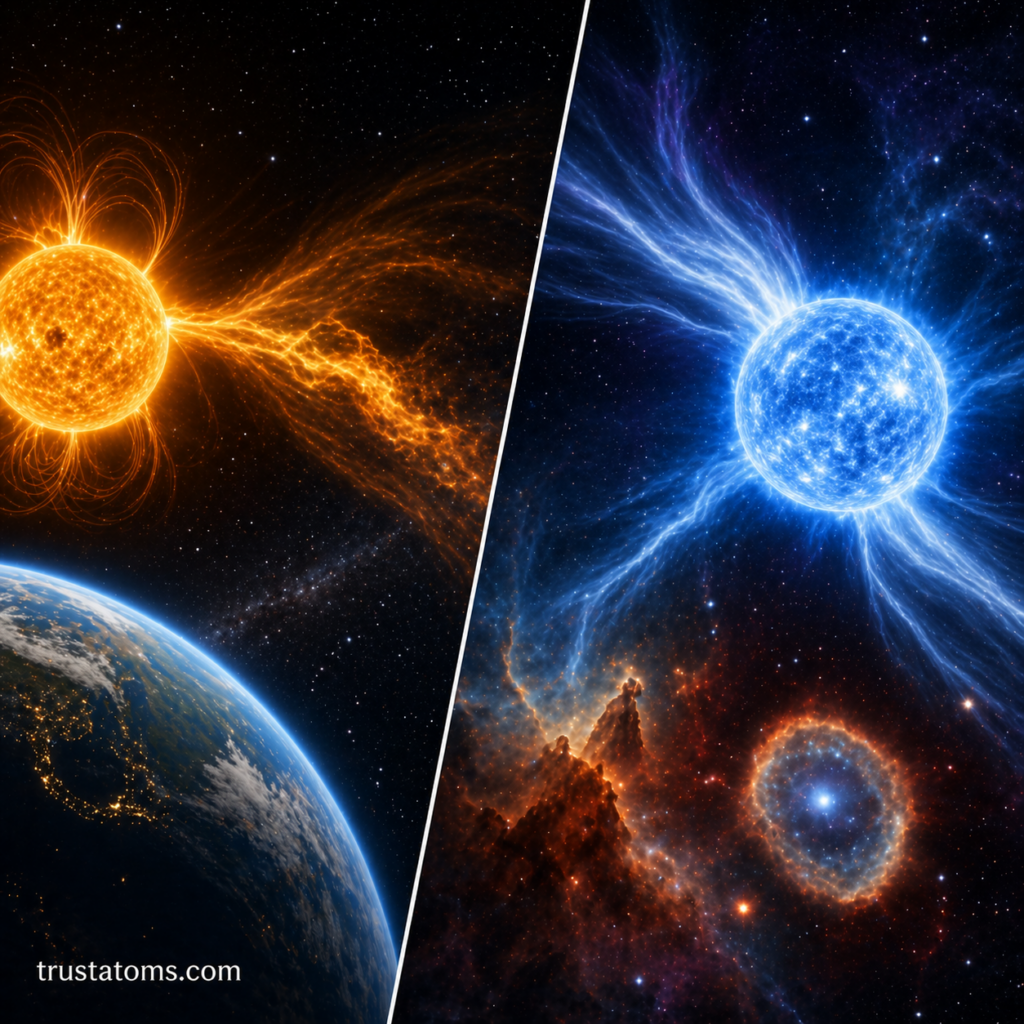
Wind speed and mass-loss rate describe different properties. A fast wind does not necessarily remove more total mass than a slower, denser outflow.
| Star Type | Typical Wind Characteristics | Effect on the Star |
|---|---|---|
| Sun-like star | Hot, relatively low-density plasma moving hundreds of kilometers per second | Gradual mass and angular momentum loss |
| Hot massive star | Fast, radiation-driven winds that can reach thousands of kilometers per second | Potentially substantial mass loss during stellar evolution |
| Cool red giant | Slower, denser outflows that may contain dust | Removal of extended outer atmospheric material |
| Asymptotic giant branch star | Strong, often dust-driven winds | Major envelope loss before white dwarf formation |
These are broad patterns rather than fixed values. Wind properties also depend on chemical composition, stellar variability, magnetic fields, and interactions with companion stars.
The Solar Wind: A Measurable Example of Mass Loss
The Sun continuously releases plasma into space. Near Earth’s orbit, solar wind speeds commonly range from roughly 300 to 800 kilometers per second, although conditions can vary considerably.
Despite these impressive speeds, the solar wind removes only a tiny fraction of the Sun’s total mass. Its typical mass-loss rate is approximately two trillionths of a solar mass per year.
At that rate, the Sun would lose only about 0.002% of its mass over 10 billion years. This simplified calculation assumes a constant wind and excludes mass converted into radiation through nuclear fusion.
The example demonstrates why wind speed alone cannot determine how strongly mass loss affects a star. The Sun’s wind moves rapidly, but its relatively low density makes the total mass removed small.
How Mass Loss Changes Stellar Evolution
When a star loses material, its total mass decreases. Significant mass loss can alter its internal structure, temperature, luminosity, and future nuclear-burning stages.
The consequences depend strongly on when the material is removed. A small amount of mass lost during a long main-sequence lifetime may have little effect, while rapid envelope loss near the end of stellar evolution can dramatically change the star’s appearance and final outcome.
Mass loss also influences how much material remains available for later evolutionary stages. The differences among low-mass, Sun-like, and massive stars are explored in Stellar Evolution Pathways Compared.
For massive stars, strong winds can expose deeper layers and affect the mass of the core and surrounding envelope. These changes influence the conditions preceding core collapse, although wind strength alone does not determine whether the remnant becomes a neutron star or black hole.
Stellar Winds Near the End of a Star’s Life
Stars resembling the Sun experience increasingly important mass loss as they evolve into red giants and later asymptotic giant branch stars. Strong outflows can remove much of their outer envelopes.
After sufficient envelope loss, the hot remaining core may illuminate surrounding expelled gas, producing a planetary nebula. The core eventually becomes a white dwarf.
Massive stars follow different pathways. Some lose enough hydrogen-rich material to expose helium-rich layers, while others retain substantial envelopes until their final collapse.
The amount of mass retained can affect the appearance of a subsequent supernova and the properties of the compact remnant. Binary interactions can complicate these outcomes by transferring or stripping material.
How Stellar Winds Shape Interstellar Space
Stellar winds interact with surrounding gas rather than simply disappearing into empty space. Powerful outflows can create expanding bubbles, compress nearby material, and reshape clouds within galaxies.
These interactions can influence star formation in different ways. Compression may help some dense regions collapse, while heating and dispersal can prevent other regions from forming stars.
Winds from evolved stars also return chemically enriched material to the interstellar medium. Carbon, nitrogen, and other elements produced or redistributed inside stars can become part of later generations of astronomical objects.
However, stellar winds are not the only source of chemical enrichment. Supernovae and other stellar processes also distribute elements, including many produced during explosive nucleosynthesis.
How Stellar Winds Affect Planets and Space Weather
Charged particles carried by stellar winds can interact with planetary magnetic fields and upper atmospheres. Around Earth, the solar wind helps shape the magnetosphere and contributes to conditions associated with geomagnetic activity.
Strong stellar winds may also contribute to atmospheric erosion on some planets, particularly when combined with intense ultraviolet radiation and other environmental factors.
The outcome depends on atmospheric composition, planetary gravity, magnetic conditions, orbital distance, and the star’s activity. A powerful stellar wind does not automatically mean a planet will lose its atmosphere.
Frequently Asked Questions
Do all stars produce stellar winds?
Stellar outflows occur across many types and evolutionary stages of stars, but their driving mechanisms and strengths differ considerably. Hot massive stars, Sun-like stars, and cool evolved giants can all produce winds with distinct properties.
Can a star lose enough mass to change how it dies?
Yes. Substantial mass loss can remove outer layers, change the mass remaining before collapse, and influence the type of stellar remnant. The outcome also depends on internal evolution, chemical composition, and possible binary interactions.
Are stellar winds the same as solar flares?
No. A stellar wind is an ongoing outflow of material, while a flare is a relatively sudden release of magnetic energy that produces enhanced radiation. Flares may accompany eruptions of plasma, but these events are distinct from the continuous wind.
Stellar winds connect a star’s internal evolution with its surrounding environment by carrying away mass, momentum, and chemically enriched material. Their effects range from the gradual slowing of Sun-like stars to the removal of massive stellar envelopes and the formation of expanding bubbles in interstellar gas. Measuring these outflows helps astronomers reconstruct how stars change and how their expelled matter contributes to future stellar generations.
Sources: Carroll and Ostlie, An Introduction to Modern Astrophysics; NASA Heliophysics; OpenStax Astronomy 2e.