Galactic rotation curves are graphs showing how the orbital speeds of stars and gas change with distance from a galaxy’s center. Astronomers use these measurements to investigate how mass is distributed throughout galaxies, and the unexpectedly high speeds observed in their outer regions provide strong evidence for unseen matter.
These curves reveal how stars and gas move within a galaxy and have led to one of the most surprising discoveries in modern astronomy: the existence of dark matter. Understanding this discovery is an important part of the study of astronomy because it connects observable motion with the gravitational structure of the universe.
What Is a Galactic Rotation Curve?
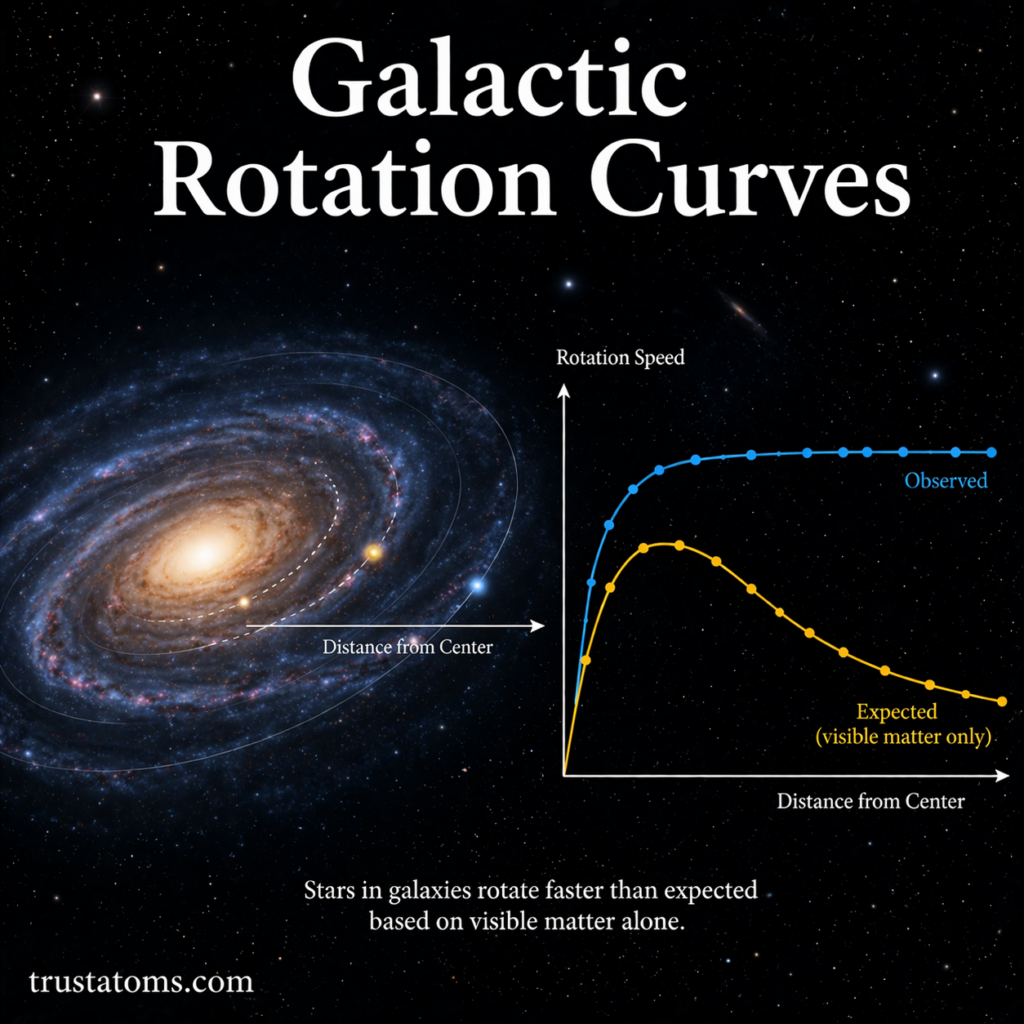
A galactic rotation curve plots the orbital speed of stars or gas against their distance from the center of a galaxy. It allows astronomers to compare the motion they observe with the motion predicted from the galaxy’s estimated mass distribution.
The graph contains two axes:
- Horizontal axis: Distance from the galactic center, often measured in kiloparsecs.
- Vertical axis: Orbital speed, usually measured in kilometers per second.
By examining the curve’s shape, researchers can estimate how much gravitationally influential mass lies within different regions of a galaxy.
What Astronomers Expected From Visible Matter
Gravity determines how quickly objects must travel to maintain approximately circular orbits. For a simplified system in which most mass is concentrated near the center, orbital speeds decrease as distance increases.
Our solar system provides a familiar example. Mercury travels around the Sun faster than Neptune because Mercury orbits much closer to the Sun’s concentrated mass.
A galaxy is more complicated because its stars and gas are spread across a disk and central bulge. Nevertheless, beyond the region containing most of its visible mass, astronomers would generally expect orbital speeds to decline if ordinary visible matter accounted for nearly all the gravitational attraction.
Instead, observations of many spiral galaxies reveal a different pattern.
What Astronomers Actually Observed
In many spiral galaxies, orbital speeds increase across the inner regions and then remain approximately constant over large distances.
This produces a flat rotation curve rather than the declining curve expected from a centrally concentrated distribution of visible matter.
Consider a simplified example: suppose gas orbits a galaxy at 200 kilometers per second, both 10 and 20 kiloparsecs from its center. If most of the galaxy’s mass were concentrated inside 10 kiloparsecs, the expected speed at 20 kiloparsecs would be approximately 141 kilometers per second.
Maintaining the higher speed at the greater distance indicates that additional gravitationally influential mass must be accounted for, or that the assumed description of gravity needs modification.
Vera Rubin and the Evidence for Flat Rotation Curves
Astronomer Vera Rubin, working with Kent Ford, conducted influential measurements of spiral galaxy rotation during the 1970s. Their observations showed that stars and gas in outer galactic regions often maintained unexpectedly high orbital speeds.
Earlier researchers, including Fritz Zwicky and radio astronomers studying galactic hydrogen, had already identified evidence suggesting discrepancies between visible matter and gravitational measurements.
Rubin and Ford’s work helped establish flat rotation curves as an important observational result. Their measurements strengthened the case for substantial amounts of matter that could not be detected through ordinary emitted light.
Dark Matter and Rotation Curves
The leading scientific explanation for flat galactic rotation curves is that galaxies contain extensive halos of dark matter surrounding their visible stars and gas.
Dark matter does not emit, absorb, or reflect light in a way that makes it directly observable with ordinary telescopes. Scientists infer its presence primarily through gravitational effects.
A dark matter halo provides additional gravitational attraction at distances where visible stars and gas alone cannot explain the observed orbital speeds.
Research into dark matter evidence also examines gravitational lensing, galaxy clusters, and large-scale cosmic structure, providing independent tests of the dark matter explanation.
Although dark matter is widely accepted in modern cosmology, its fundamental physical nature remains unknown. Scientists continue searching for possible particles and testing alternative gravitational theories.
Comparing Expected and Observed Rotation Curves
The distinction between a declining curve and a flat curve becomes clearer when their main characteristics are compared.
| Feature | Visible-Matter-Only Prediction | Common Observed Pattern |
|---|---|---|
| Inner regions | Speeds generally increase | Speeds often increase |
| Outer regions | Speeds decline beyond most visible mass | Speeds often remain nearly constant |
| Mass distribution | Gravity attributed to stars and gas | Additional gravitational influence required |
| Interpretation | Limited mass beyond the visible disk | Consistent with an extended dark matter halo |
Not every galaxy has a perfectly flat curve. Some curves rise gradually, decline slightly, or show irregular features associated with local structures and differences in mass distribution.
Rotation Curves in Different Galaxy Types
Galaxies vary in structure, so astronomers use different approaches to investigate their internal motions.
Spiral Galaxies
Spiral galaxies are particularly suitable for rotation curve measurements because their disks contain stars and gas moving in relatively organized orbits.
For example, the Milky Way shows a broadly flat rotation curve, indicating a large amount of hidden mass. Measuring its rotation is challenging because observers are located inside the galaxy rather than viewing it from outside.
The nearby Andromeda galaxy also provides valuable rotation measurements. An overview of the Andromeda Galaxy offers additional context for studying the structure and motion of this large spiral system.
Elliptical and Irregular Galaxies
Elliptical galaxies often contain stars moving along many differently oriented orbits rather than within a single rotating disk. Astronomers therefore frequently analyze the spread of stellar velocities instead of relying on a conventional rotation curve.
Irregular and dwarf galaxies can also reveal mass discrepancies. Some gas-rich dwarf galaxies are especially useful for investigating dark matter because their gravitational behavior may be strongly influenced by unseen mass.
How Astronomers Measure Galactic Rotation
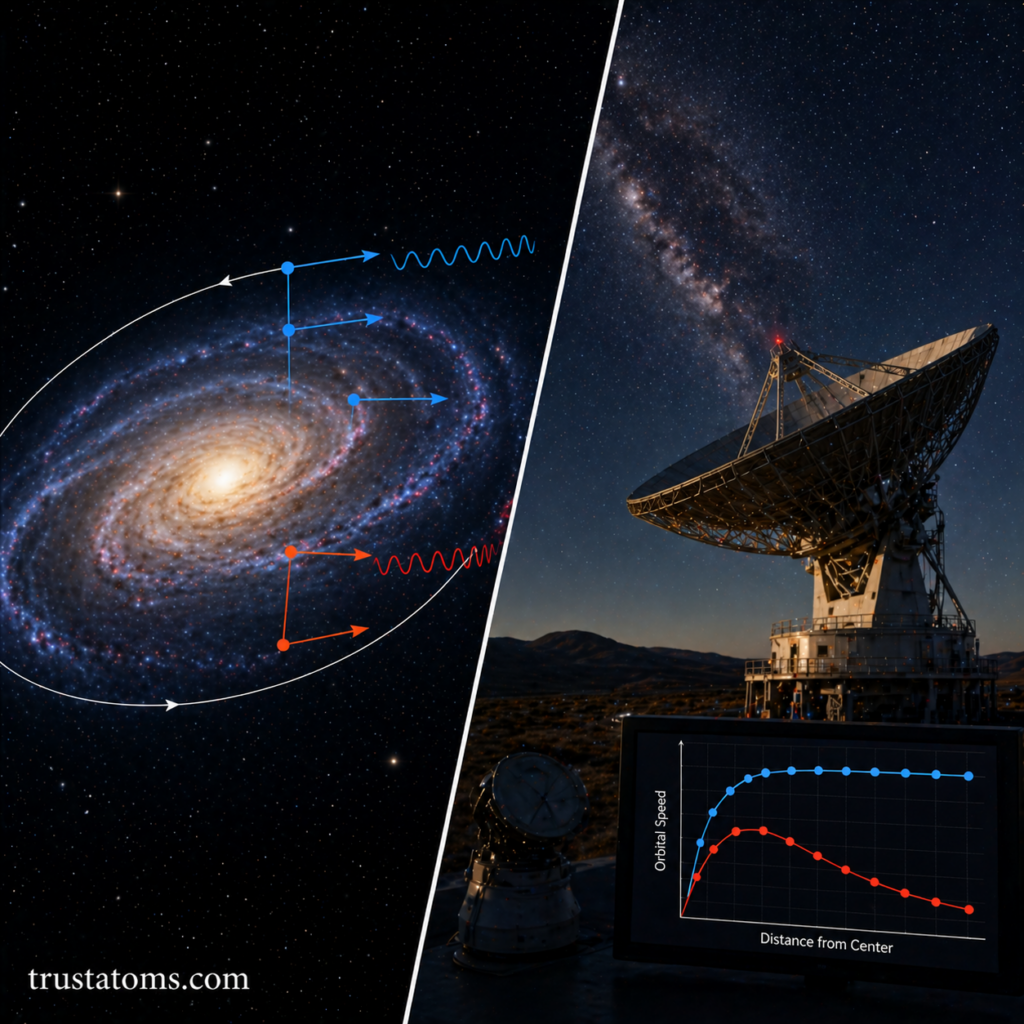
Rotation curves are constructed using measurements of light or radio emission from material moving within galaxies.
The Doppler effect allows astronomers to determine whether gas or stars are moving toward or away from Earth. Light from approaching material shifts toward shorter wavelengths, while light from receding material shifts toward longer wavelengths.
Researchers commonly use:
- Hydrogen radio observations: The 21-centimeter emission line traces neutral hydrogen across galactic disks, including regions beyond most visible stars.
- Optical spectroscopy: Emission and absorption lines reveal the motion of stars and ionized gas.
- Velocity mapping: Measurements across different positions reveal patterns of approaching and receding material.
Astronomers must account for the galaxy’s inclination, systemic velocity, and other motions before estimating its true orbital speeds. These corrections are necessary because telescopes measure motion along the observer’s line of sight rather than the complete three-dimensional velocity.
What Rotation Curves Reveal About Galaxies
Rotation curves help researchers estimate how mass is distributed within galaxies and test models of their structure.
They also provide information about the relationship between visible matter and gravitational behavior. By comparing galaxies with different sizes, brightness levels, and gas contents, astronomers can investigate how dark matter halos may influence galaxy development.
These measurements are also useful for evaluating alternative theories of gravity. Any successful explanation must account for rotation curves while remaining consistent with other astronomical observations.
Frequently Asked Questions
Why are galactic rotation curves often flat?
Many galaxies contain stars and gas that maintain nearly constant orbital speeds far from their centers. The leading explanation is that extended dark matter halos provide additional gravitational attraction beyond what visible matter alone can account for.
Do rotation curves prove dark matter exists?
Rotation curves provide strong evidence for additional gravitational influence that visible matter cannot fully explain. Dark matter is the leading explanation, supported by several other observations, but scientists continue testing its properties and alternative models.
Can astronomers measure the rotation of the Milky Way?
Yes. Astronomers measure the motions of stars and gas using spectroscopy, radio observations, and precise stellar measurements. Because Earth is located inside the Milky Way, researchers must carefully reconstruct the galaxy’s rotation from observations made at different positions and distances.
Galactic rotation curves reveal that stars and gas in many galaxies move faster at large distances than visible matter alone would predict. Their measurements provide strong evidence for extended dark matter halos while allowing scientists to test competing explanations of galactic gravity. Continued observations of spiral, dwarf, and other galaxies are refining our understanding of how mass shapes their motion.
Sources: Rubin, Ford, and Thonnard, Rotational Properties of 21 SC Galaxies with a Large Range of Luminosities and Radii; Sofue and Rubin, Rotation Curves of Spiral Galaxies; NASA Science, Dark Matter.