Singularities in Physics

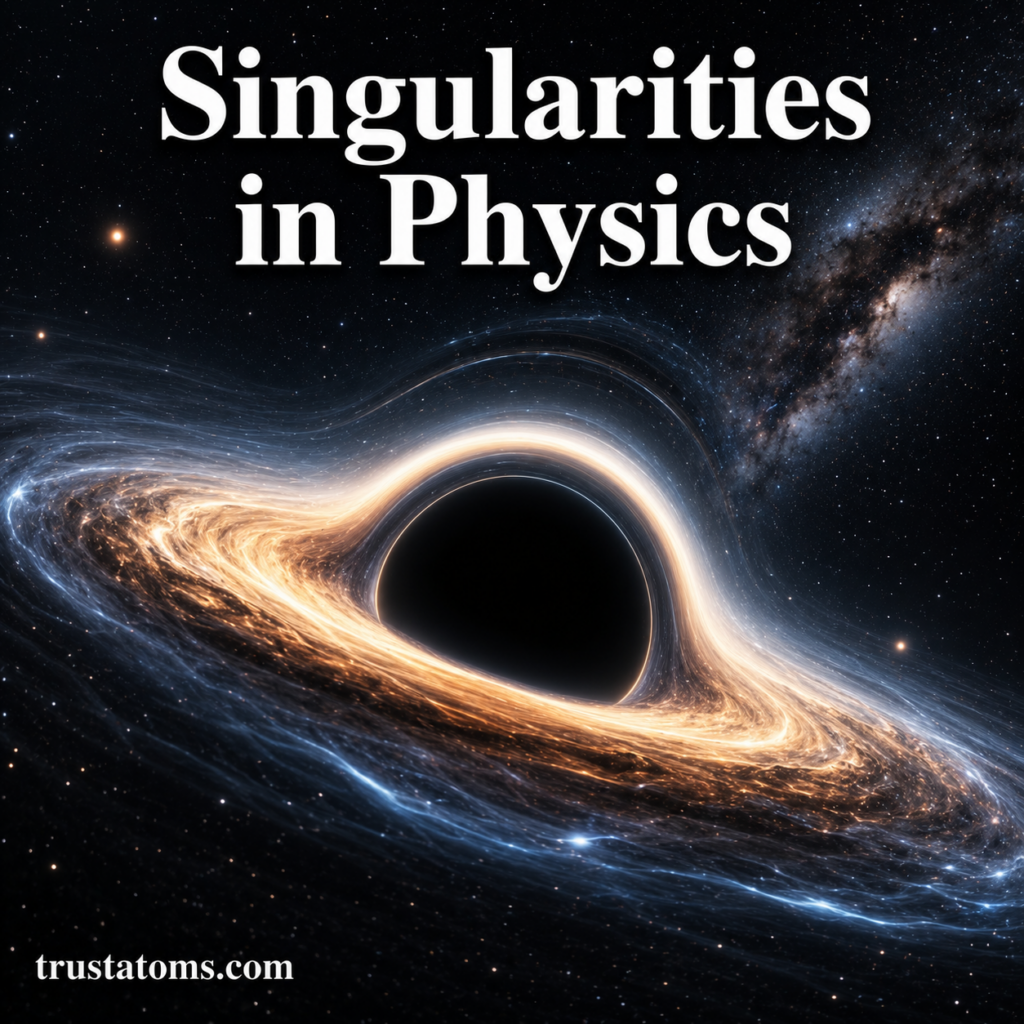
Illustration of a black hole singularity surrounded by a glowing accretion disk in deep space.
A conceptual illustration representing a black hole singularity and the extreme spacetime conditions studied in modern physics. trustatoms.com.

Singularities are among the most mysterious and controversial concepts in modern physics. They appear in mathematical models where physical quantities become infinite or impossible to define using current scientific theories.

Most commonly associated with black holes and the beginning of the universe, singularities challenge humanity’s understanding of space, time, gravity, and reality itself.

Physicists study singularities because they may reveal where our current laws of physics break down — and where entirely new theories may be needed.

Continue reading “Singularities in Physics”
Warp Drive Theoretical Concepts

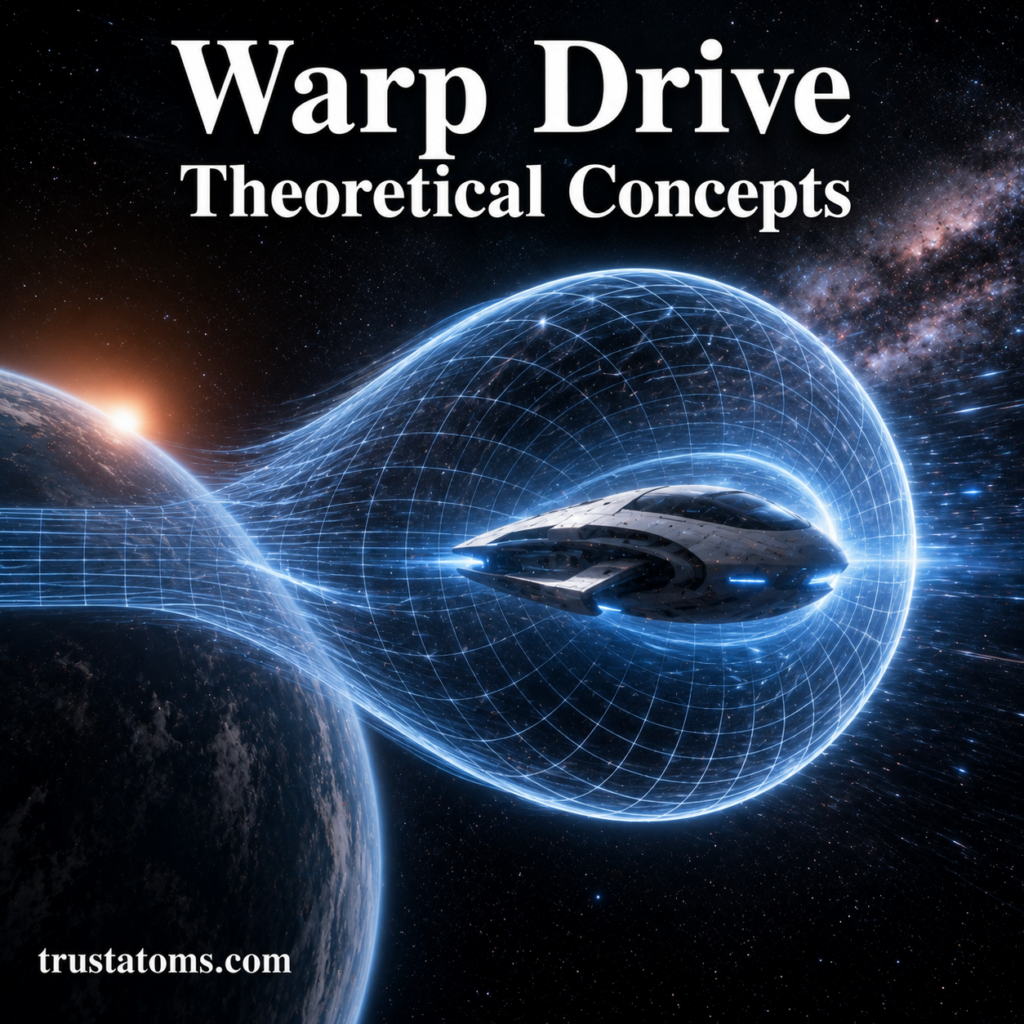
Illustration of a futuristic spacecraft inside a glowing warp bubble traveling through deep space.
A conceptual illustration depicting a theoretical warp drive spacecraft manipulating spacetime for faster-than-light travel. trustatoms.com.

Warp drives are one of the most fascinating ideas in theoretical physics and science fiction. Popularized by movies and television, warp drives promise a way to travel across enormous cosmic distances faster than light without technically violating Einstein’s laws of relativity.

Although warp drives remain entirely theoretical, real physicists have explored whether certain mathematical models might allow spacetime itself to move in ways that could make apparent faster-than-light travel possible.

Understanding warp drive concepts requires examining relativity, spacetime geometry, exotic energy, and some of the biggest unanswered questions in modern physics.

Continue reading “Warp Drive Theoretical Concepts”

Interstellar Travel Physics Challenges

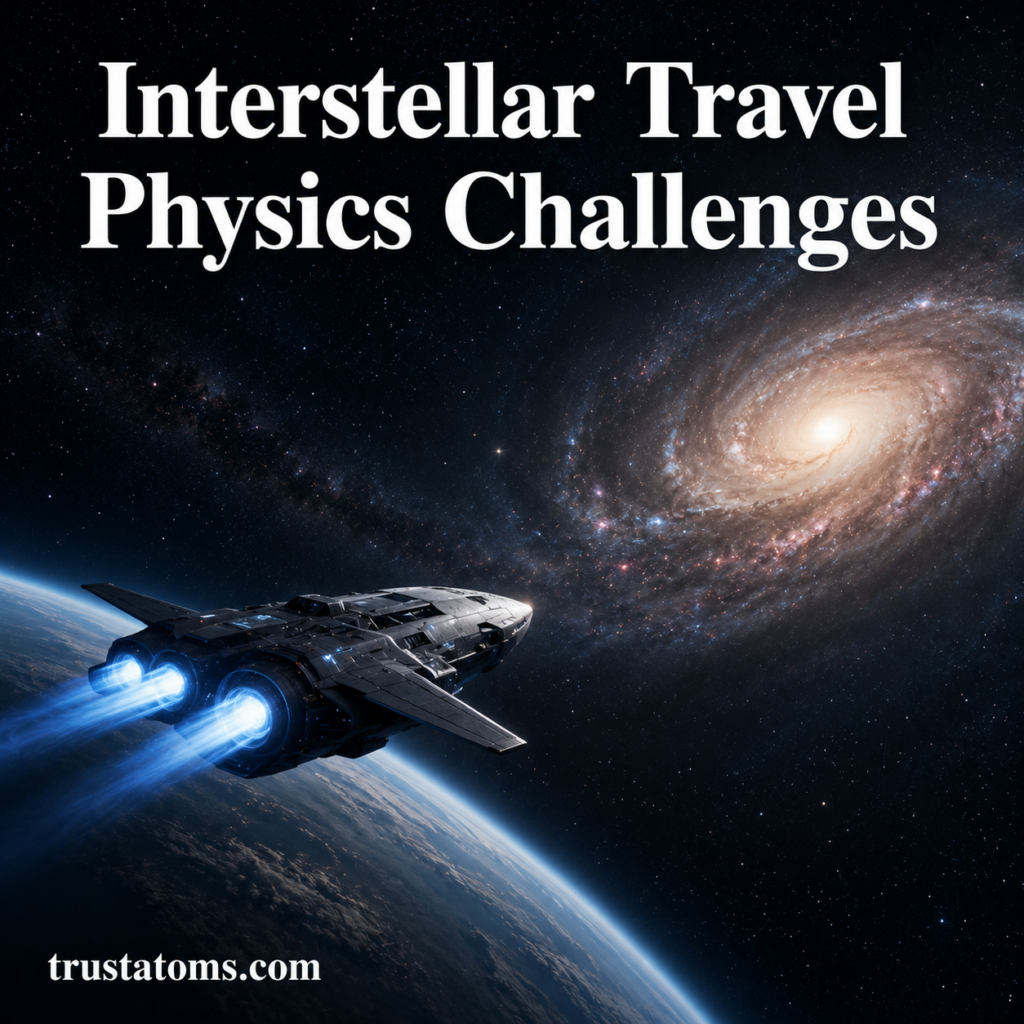
Illustration of a futuristic spacecraft traveling through deep space toward a distant galaxy during interstellar travel.
A conceptual illustration of a spacecraft facing the immense distances and physics challenges of interstellar travel. trustatoms.com.

Interstellar travel has fascinated scientists, writers, and dreamers for generations. The idea of traveling beyond our solar system to distant stars captures humanity’s curiosity about exploration, survival, and the possibility of discovering extraterrestrial life.

However, while science fiction often portrays starships crossing galaxies with ease, the real physics behind interstellar travel presents enormous challenges. The distances involved are almost unimaginable, and the laws of physics place serious limits on speed, energy, and survival.

Understanding these physics challenges helps explain why interstellar travel remains one of the most difficult technological goals humanity has ever considered.

Continue reading “Interstellar Travel Physics Challenges”

Magnetars and Extreme Magnetic Fields

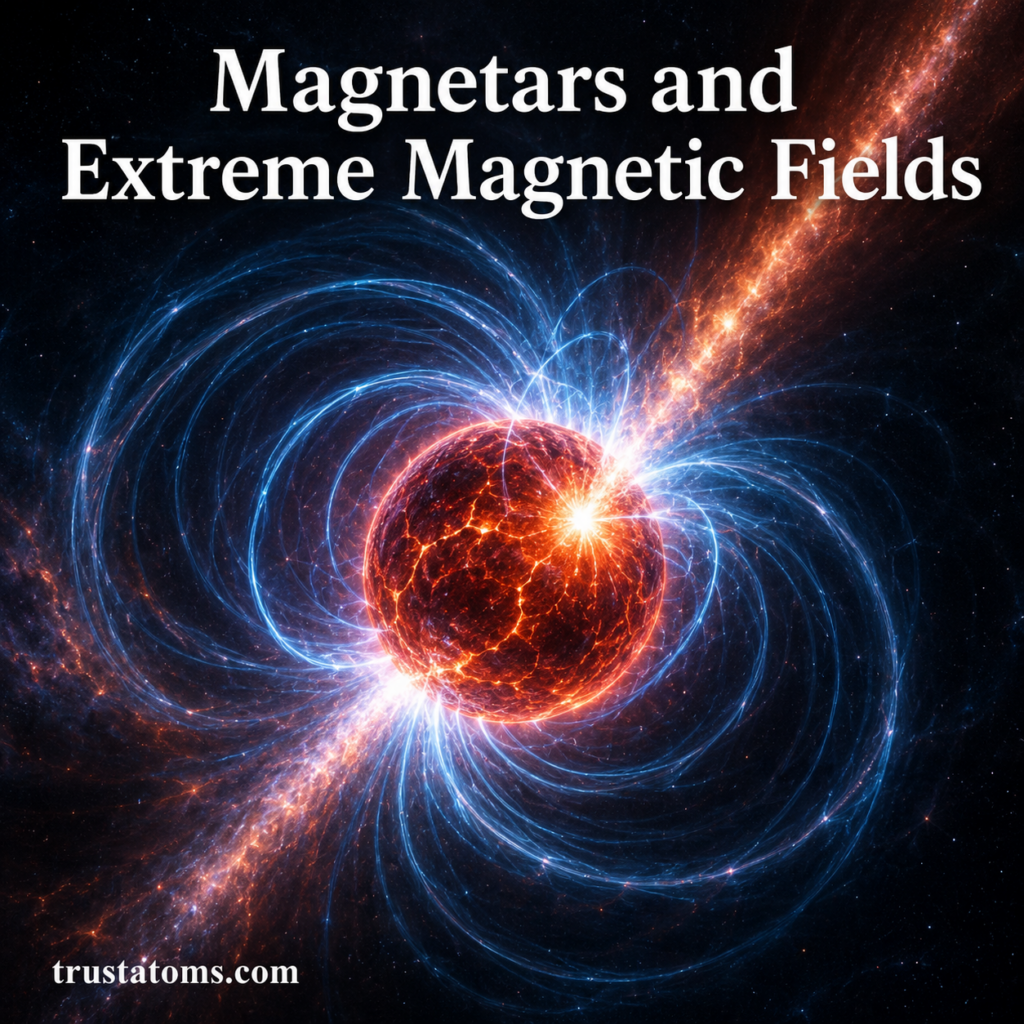
Illustration of a glowing magnetar in space with powerful magnetic field lines surrounding the neutron star.
A conceptual illustration showing a magnetar emitting intense magnetic fields in deep space. trustatoms.com.

Magnetars are among the most mysterious and powerful objects in the universe. These rare neutron stars possess magnetic fields so intense that they can distort atoms, trigger massive bursts of radiation, and reshape the space around them.

While black holes often capture public attention, magnetars represent a different kind of cosmic extreme — one driven not by gravity alone, but by unimaginable magnetic power.

Scientists study magnetars to better understand stellar evolution, high-energy astrophysics, and the behavior of matter under conditions that cannot be recreated on Earth.

Continue reading “Magnetars and Extreme Magnetic Fields”

Cosmic Rays and High-Energy Particles: Exploring the Most Energetic Matter in Space

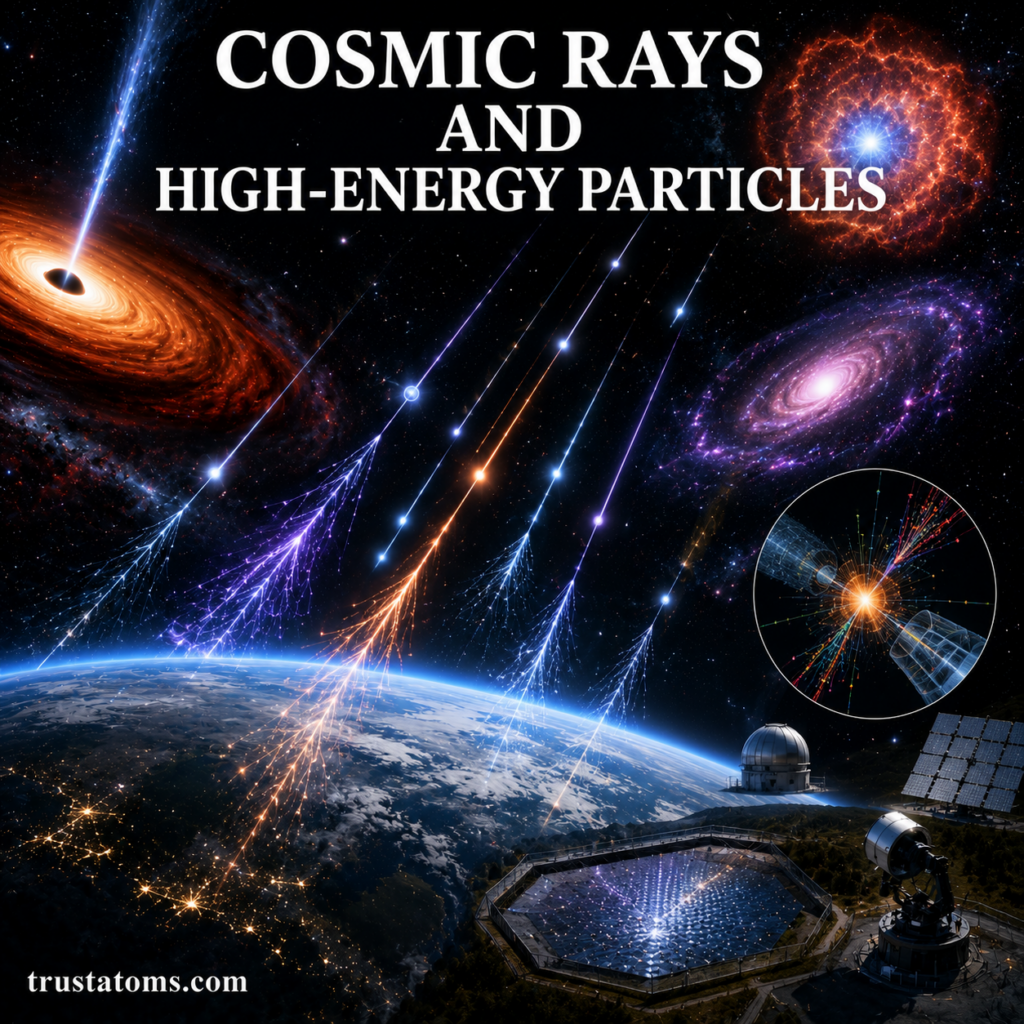
Illustration showing cosmic rays and high-energy particles traveling through space from supernovae, black holes, pulsars, and gamma-ray bursts toward Earth.
Illustration exploring cosmic rays, high-energy particle acceleration, and the extreme astrophysical events that produce energetic particles in space. trustatoms.com.

Space is filled with invisible streams of high-energy particles constantly traveling across the universe. Some originate from the Sun, while others come from distant galaxies, exploding stars, black holes, and other extreme cosmic events.

These particles, known as cosmic rays, move at enormous speeds — sometimes approaching the speed of light — and carry immense amounts of energy.

Although cosmic rays were discovered over a century ago, scientists are still investigating many mysteries surrounding their origins, acceleration mechanisms, and effects on Earth and space environments.

Understanding cosmic rays and high-energy particles helps astronomers study some of the universe’s most violent and energetic phenomena.

Continue reading “Cosmic Rays and High-Energy Particles: Exploring the Most Energetic Matter in Space”

Quantum Mechanics in Space: How Quantum Physics Shapes the Universe

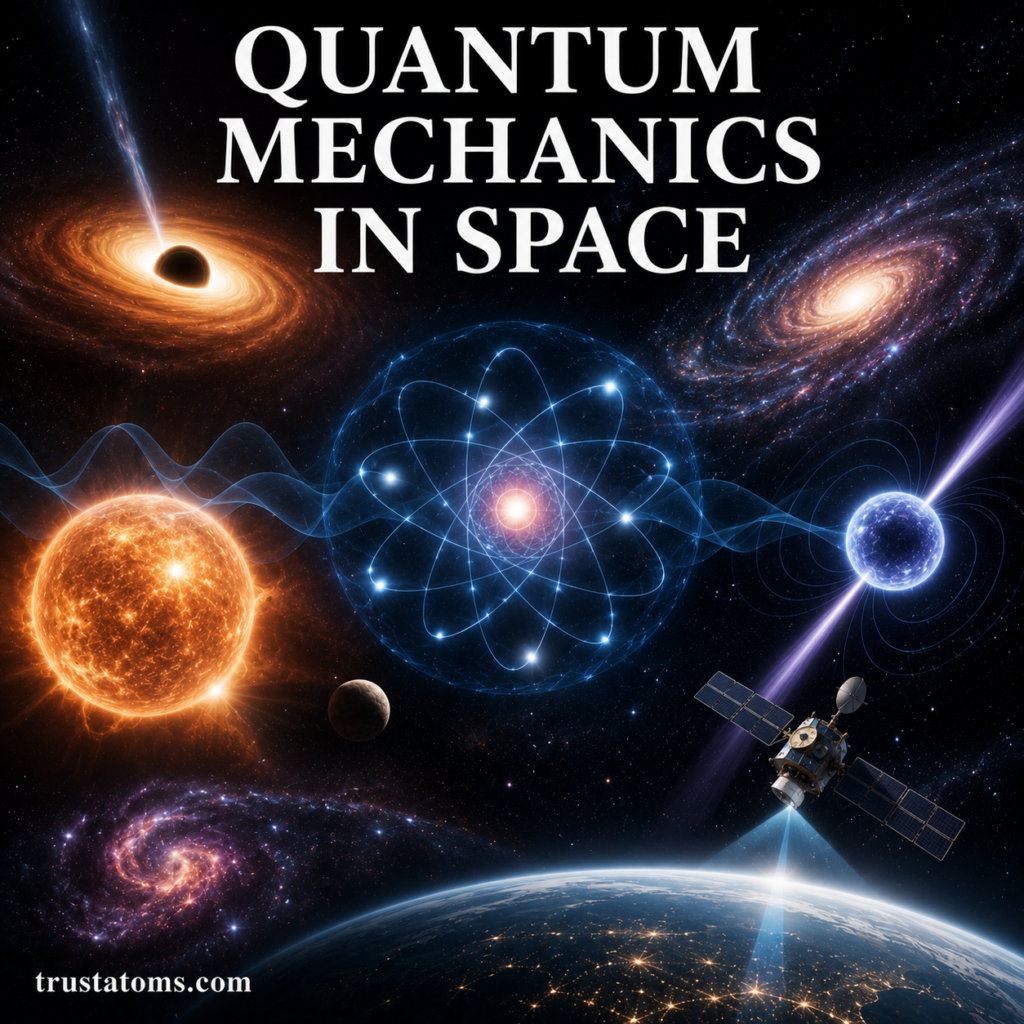
Illustration showing quantum mechanics in space with atoms, black holes, stars, galaxies, satellites, and quantum energy effects across the universe.
Illustration exploring how quantum mechanics influences stars, black holes, cosmic radiation, and the structure of the universe. trustatoms.com.

Quantum mechanics is one of the most important and mysterious branches of modern physics. It explains the behavior of matter and energy at extremely small scales, including atoms, electrons, photons, and subatomic particles.

While quantum mechanics is often associated with laboratory experiments and microscopic particles, it also plays a major role in astronomy and space science.

From the formation of stars to black holes, neutron stars, cosmic radiation, and the structure of the early universe, quantum mechanics helps scientists understand some of the most extreme environments in space.

Understanding quantum mechanics in space reveals how the smallest physical laws influence the largest cosmic structures in the universe.

Continue reading “Quantum Mechanics in Space: How Quantum Physics Shapes the Universe”

Time Dilation in Relativity: Why Time Passes Differently in Space and Gravity

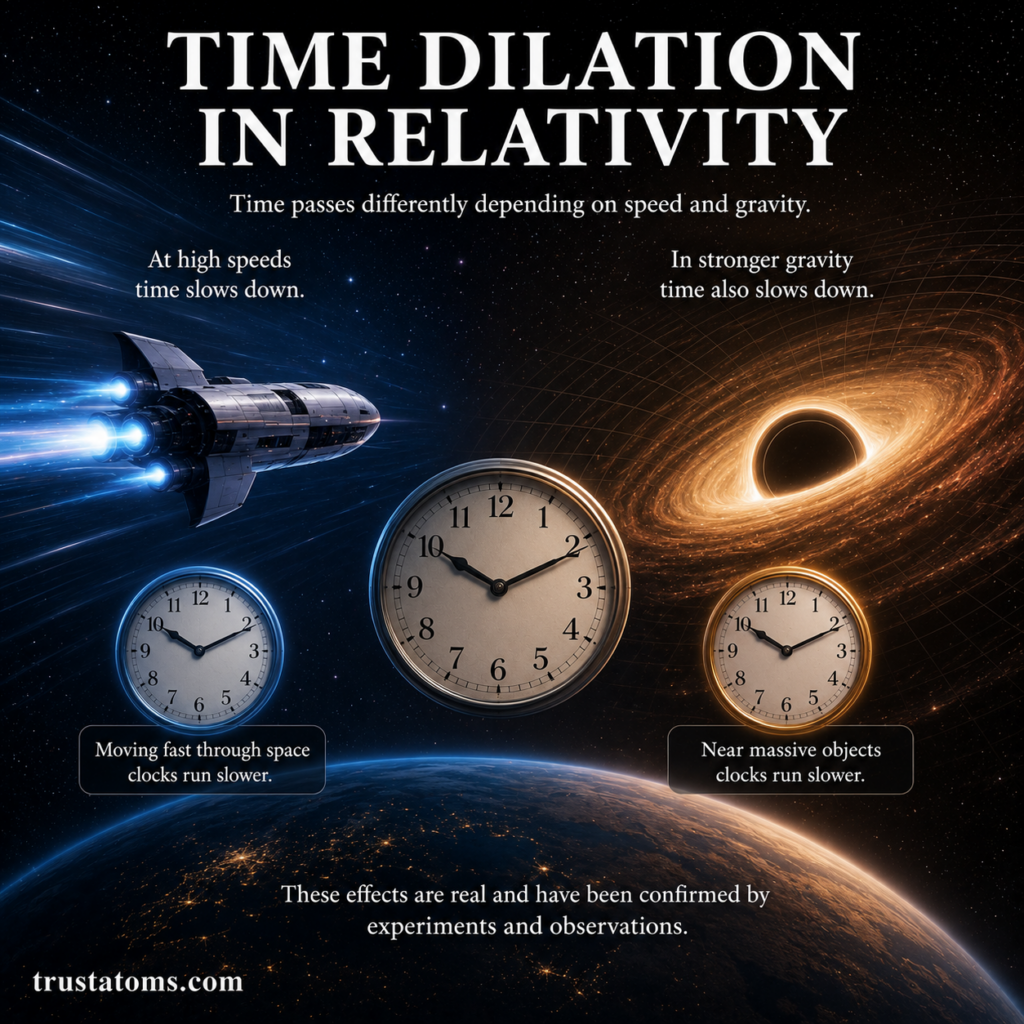
Illustration showing time dilation in relativity with a fast-moving spacecraft, black hole gravity, and clocks experiencing different rates of time.
Illustration explaining how motion and gravity affect the passage of time in Einstein’s theory of relativity. trustatoms.com.

Time feels constant in everyday life. Seconds pass steadily, clocks tick uniformly, and events appear to unfold at the same rate for everyone around us.

However, modern physics shows that time is not absolute.

According to Albert Einstein’s theories of relativity, time can slow down depending on speed and gravity. This phenomenon is called time dilation.

Time dilation has been confirmed through experiments involving atomic clocks, satellites, particle physics, and astronomical observations. It plays a major role in modern physics, cosmology, and space exploration.

Understanding time dilation in relativity helps explain how spacetime behaves under extreme conditions and why time itself depends on motion and gravity.

Continue reading “Time Dilation in Relativity: Why Time Passes Differently in Space and Gravity”

Dark Energy Theories: Understanding the Force Driving Cosmic Expansion

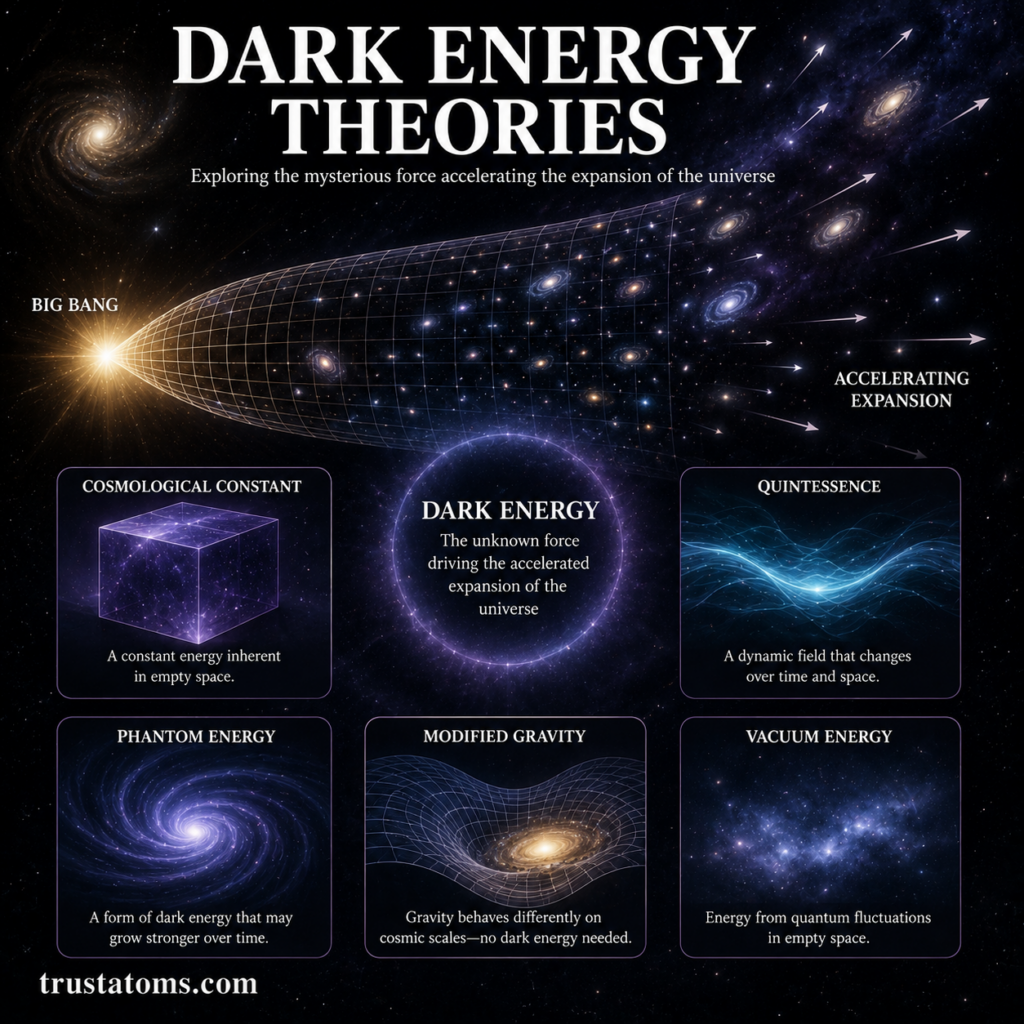
Illustration showing dark energy theories including cosmic expansion, quintessence, vacuum energy, modified gravity, and the accelerating universe.
Illustration explaining major dark energy theories and the accelerating expansion of the universe. trustatoms.com.

One of the greatest mysteries in modern astronomy is the discovery that the universe is not only expanding, but expanding at an accelerating rate.

Scientists originally expected gravity to gradually slow cosmic expansion after the Big Bang. Instead, observations revealed that galaxies are moving away from one another faster over time.

To explain this unexpected acceleration, researchers proposed the existence of dark energy — an unknown form of energy thought to permeate space itself.

Although dark energy has never been directly observed, it appears to dominate the universe on the largest scales.

Understanding dark energy theories helps scientists investigate the future of the cosmos, the structure of spacetime, and the limits of modern physics.

Continue reading “Dark Energy Theories: Understanding the Force Driving Cosmic Expansion”

Dark Matter Evidence: Why Scientists Believe Most Matter in the Universe Is Invisible

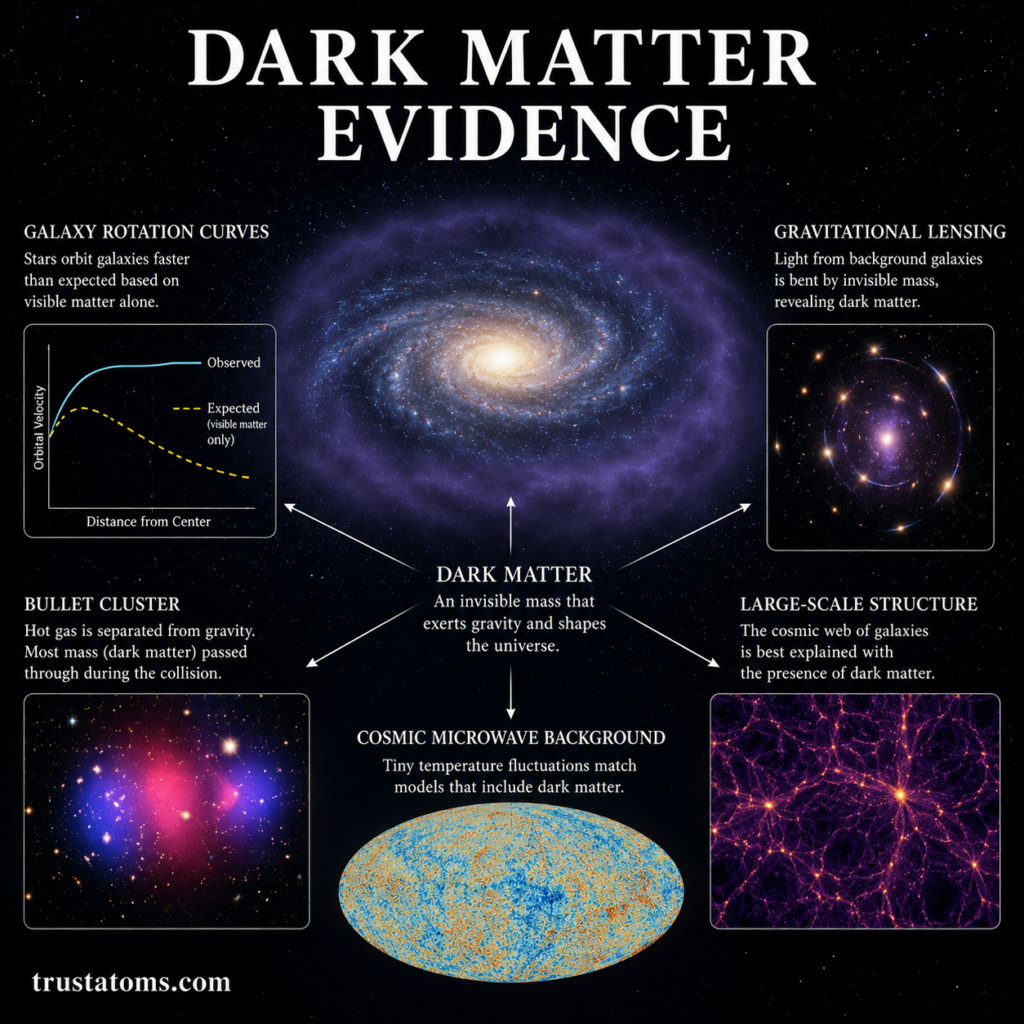
Illustration showing evidence for dark matter including galaxy rotation curves, gravitational lensing, the Bullet Cluster, and cosmic microwave background radiation.
Illustration explaining the major astronomical observations that support the existence of dark matter in the universe. trustatoms.com.

Dark matter is one of the biggest mysteries in modern astronomy and physics. Although scientists cannot directly see it, strong evidence suggests that an enormous amount of invisible matter exists throughout the universe.

Observations of galaxies, galaxy clusters, gravitational lensing, and cosmic background radiation all indicate that visible matter alone cannot explain the behavior of cosmic structures.

Today, scientists estimate that ordinary matter — everything made of atoms, stars, planets, and living organisms — represents only a small fraction of the universe’s total mass-energy content.

Understanding dark matter evidence helps explain how galaxies form, how gravity behaves on cosmic scales, and why the universe appears structured the way it does.

Continue reading “Dark Matter Evidence: Why Scientists Believe Most Matter in the Universe Is Invisible”

Gravitational Waves Detection: How Scientists Listen to the Universe

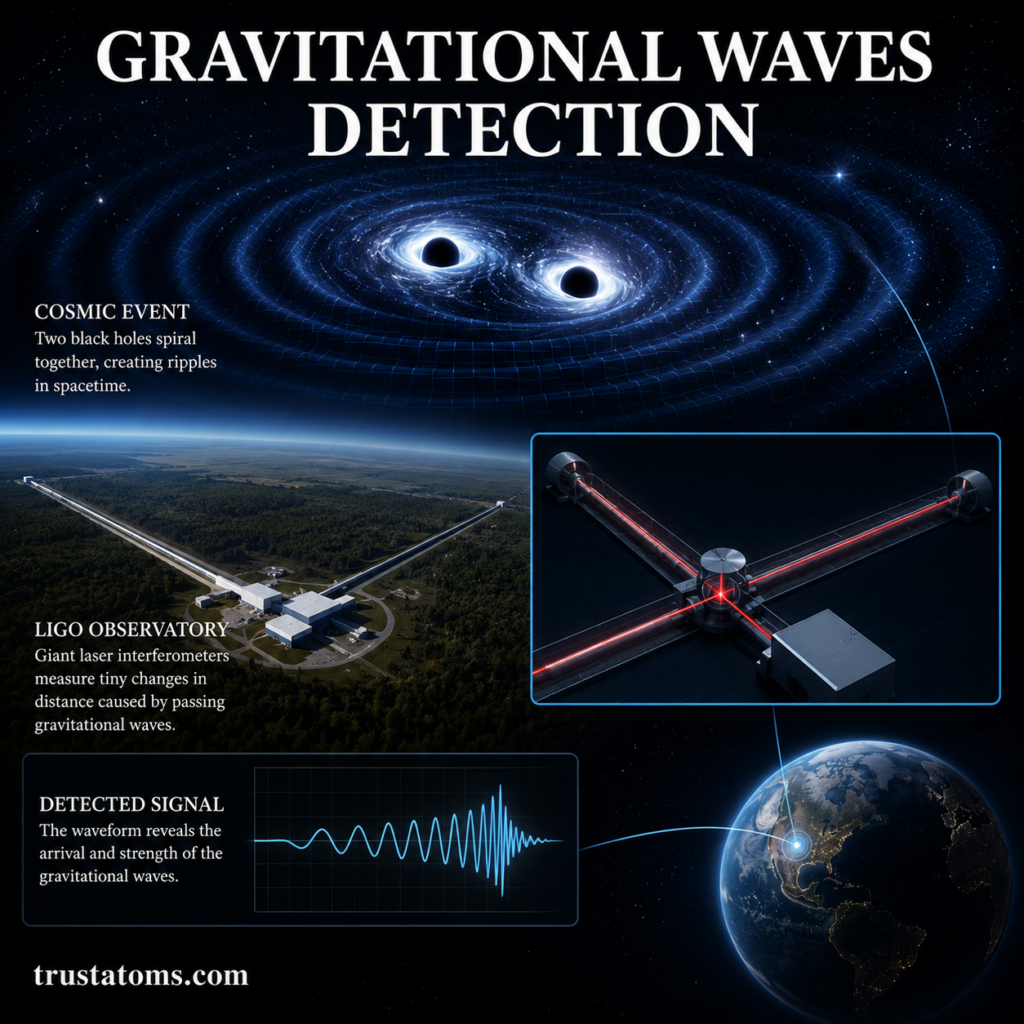
Illustration showing gravitational waves detection with merging black holes, LIGO interferometers, waveform signals, and Earth-based observatories.
Illustration explaining how gravitational waves are generated and detected using advanced observatories like LIGO. trustatoms.com.

For centuries, astronomy relied primarily on observing light. Telescopes studying visible light, radio waves, X-rays, and infrared radiation allowed scientists to explore planets, stars, galaxies, and black holes across the universe.

However, in 2015, scientists confirmed the first direct detection of gravitational waves — tiny ripples in spacetime predicted by Albert Einstein nearly 100 years earlier.

This breakthrough opened an entirely new way to study the cosmos. Instead of only seeing the universe, astronomers can now “listen” to some of the most violent events ever discovered.

Understanding gravitational waves detection helps explain one of the greatest achievements in modern physics and astronomy.

Continue reading “Gravitational Waves Detection: How Scientists Listen to the Universe”