History of Space Exploration

Illustration showing the history of space exploration with rocket launch, astronaut on the Moon, space shuttle, satellite, and Earth in the background.
Illustration depicting key milestones in the history of space exploration including rockets, satellites, and lunar missions. trustatoms.com.

Space exploration is one of humanity’s most ambitious and transformative pursuits. From ancient stargazing to modern missions reaching the edges of our solar system, our desire to understand the universe has driven innovation, discovery, and global collaboration.

This article explores the key milestones, eras, and breakthroughs that shaped the history of space exploration—and where it may be headed next.

Continue reading “History of Space Exploration”
Cosmic Background Light Mapping

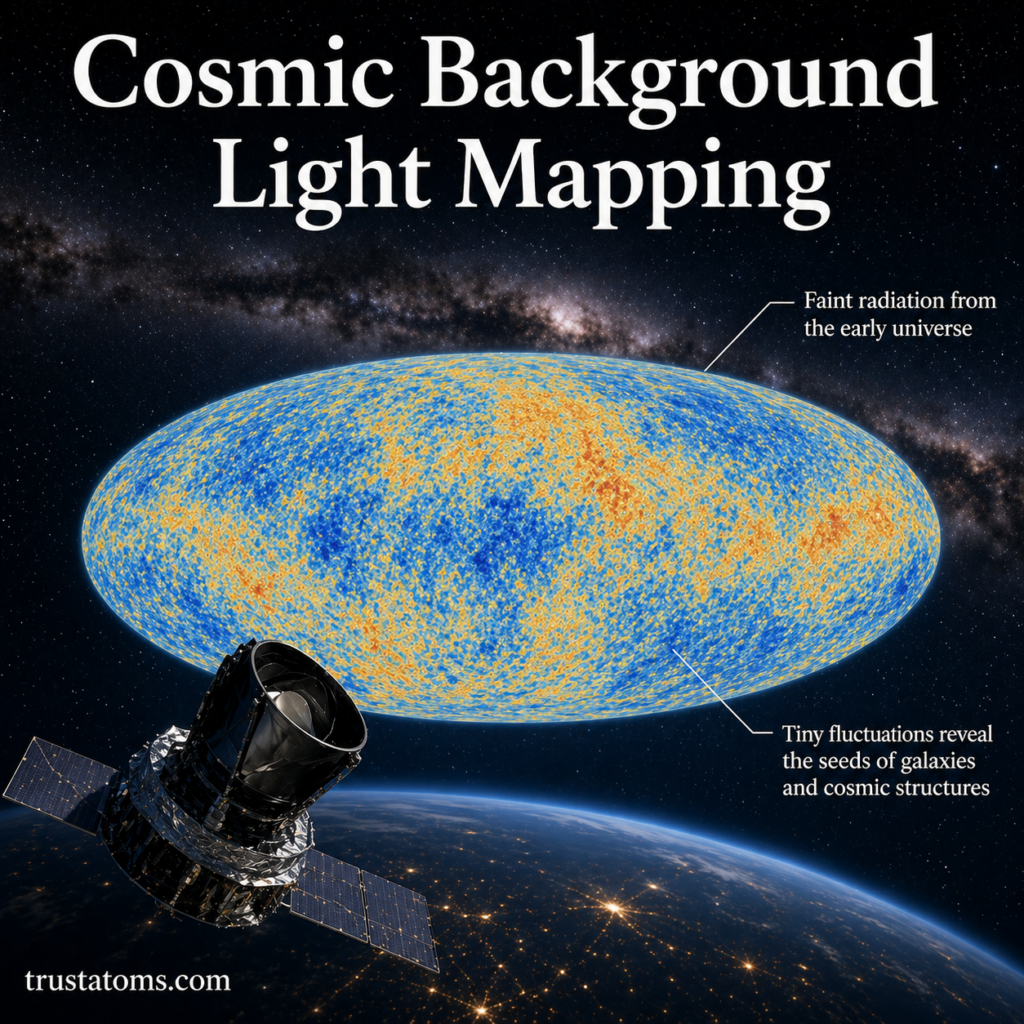
Illustration of cosmic background light mapping showing a full-sky radiation map with subtle temperature variations and a space telescope observing the universe.
Visualization of cosmic background light mapping highlighting faint radiation and early universe structure. trustatoms.com.

Cosmic background light mapping is one of the most powerful tools astronomers use to understand the universe. By studying faint radiation that fills space, scientists can reconstruct the early conditions of the cosmos and trace how galaxies and large-scale structures formed over billions of years.

This field combines advanced telescopes, precise measurements, and sophisticated data analysis to create detailed maps of the universe’s oldest light.

Continue reading “Cosmic Background Light Mapping”

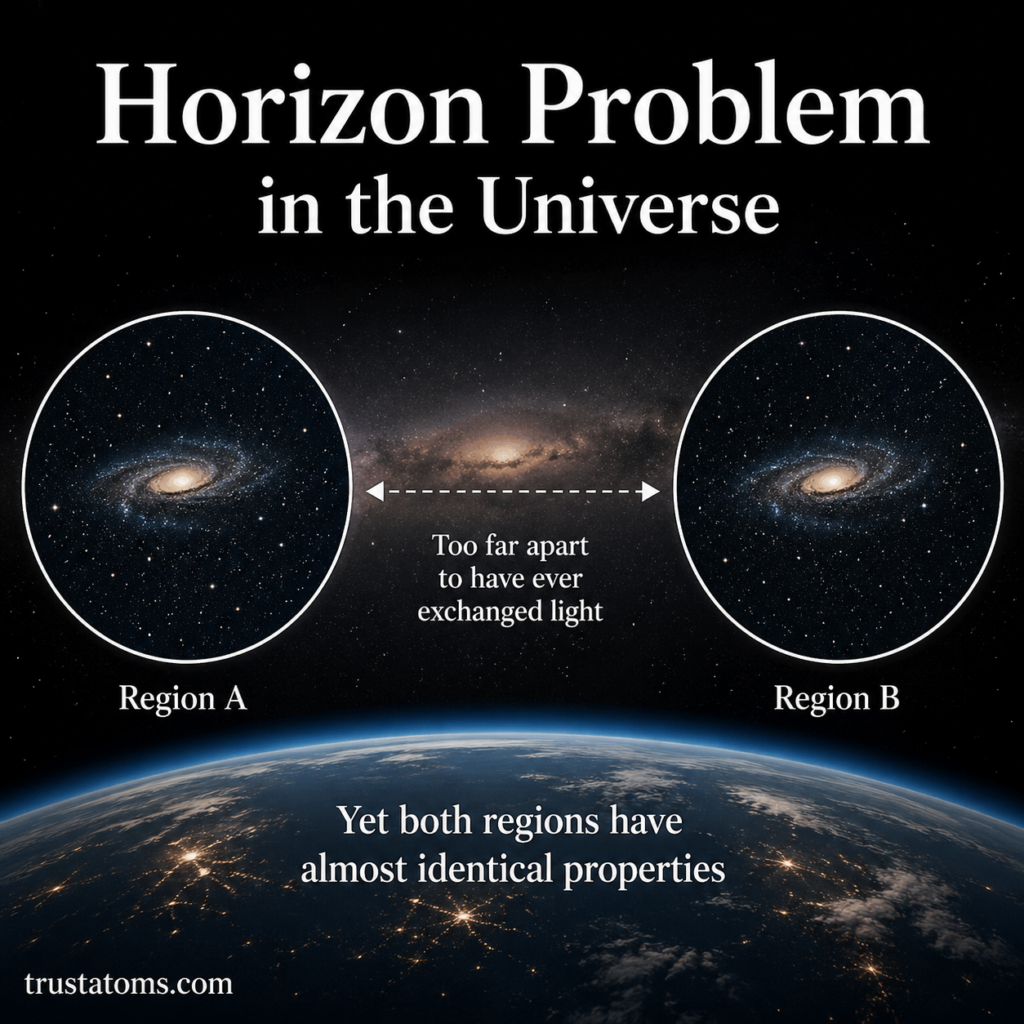
Horizon Problem in the Universe

Simple diagram illustrating the horizon problem in the universe showing two distant regions with identical properties despite being unable to exchange light.
Illustration of the horizon problem showing distant regions of the universe with similar properties. trustatoms.com.

The universe is vast, complex, and filled with mysteries that challenge our understanding of physics and cosmology. One of the most intriguing puzzles is the horizon problem—a question that arises when scientists study the large-scale uniformity of the universe.

Despite regions of space being incredibly far apart and seemingly disconnected, they appear to share nearly identical properties. How is that possible? This article breaks down the horizon problem, why it matters, and how modern cosmology attempts to solve it.

Continue reading “Horizon Problem in the Universe”

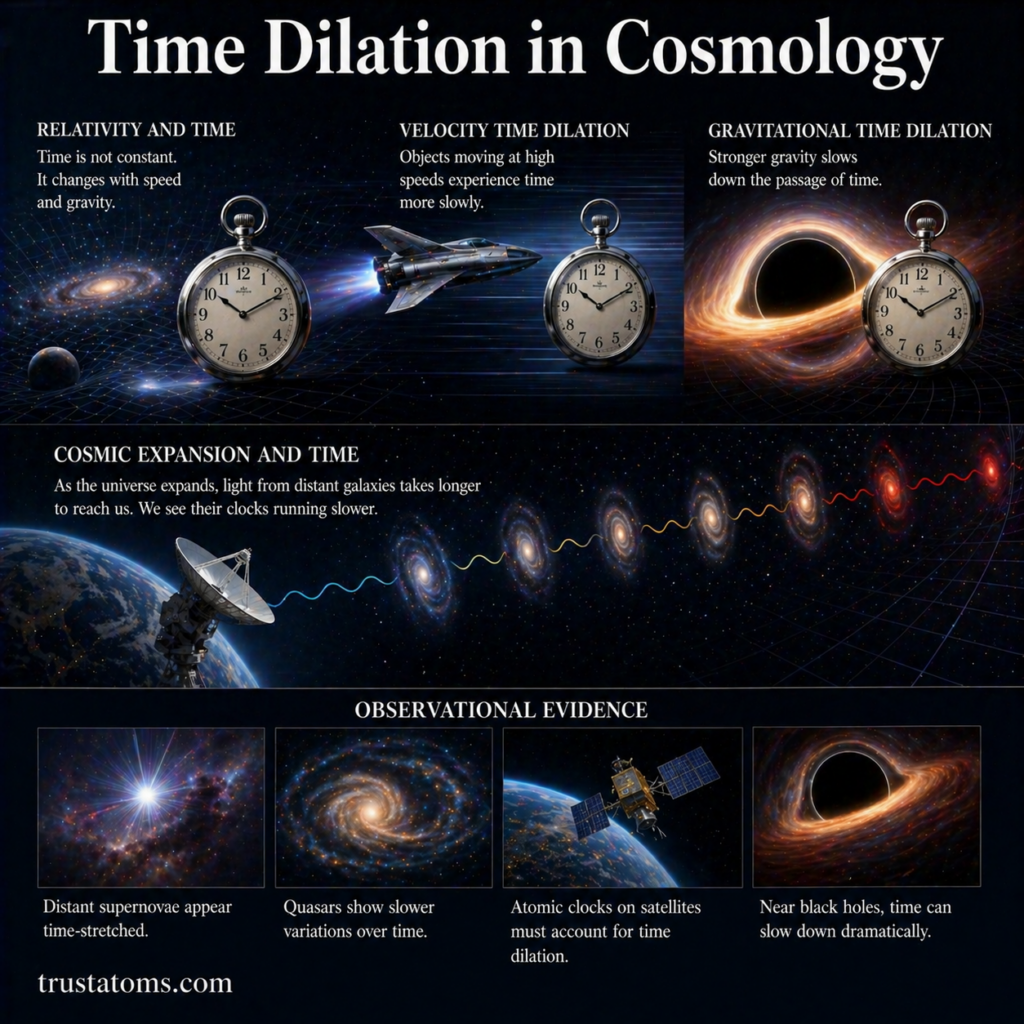
Time Dilation in Cosmology: How Time Changes Across the Universe

Illustration explaining time dilation in cosmology, including effects of velocity, gravity, and cosmic expansion on time.
Time dilation shows how motion, gravity, and cosmic expansion affect the passage of time. trustatoms.com.

Time is often thought of as constant and universal—but in cosmology, that assumption breaks down. Under extreme conditions involving high speeds, strong gravity, and cosmic expansion, time can flow at different rates. This phenomenon is known as time dilation.

Understanding time dilation is essential for explaining how the universe behaves on both small and large scales—from orbiting satellites to the evolution of distant galaxies.

Continue reading “Time Dilation in Cosmology: How Time Changes Across the Universe”

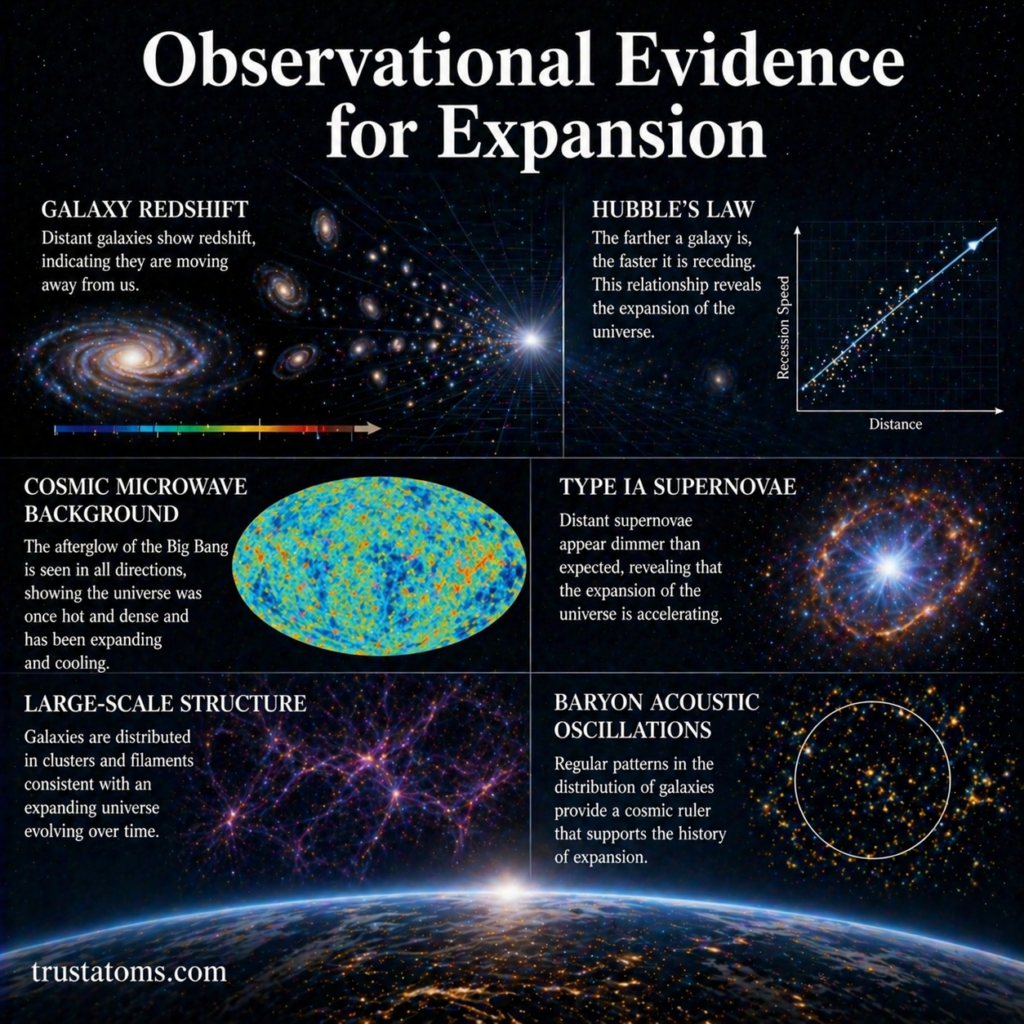
Observational Evidence for Expansion: How We Know the Universe Is Growing

Infographic showing galaxy redshift, Hubble’s Law, cosmic microwave background, supernovae, and large-scale structure as evidence for universe expansion.
Key observations like redshift and cosmic background radiation reveal that the universe is expanding. trustatoms.com.

One of the most important discoveries in modern astronomy is that the universe is expanding. Galaxies are not stationary—they are moving away from each other, and space itself is stretching over time.

This idea is not based on theory alone. It is supported by multiple lines of observational evidence collected over decades. Together, these observations form the foundation of modern cosmology.

Continue reading “Observational Evidence for Expansion: How We Know the Universe Is Growing”

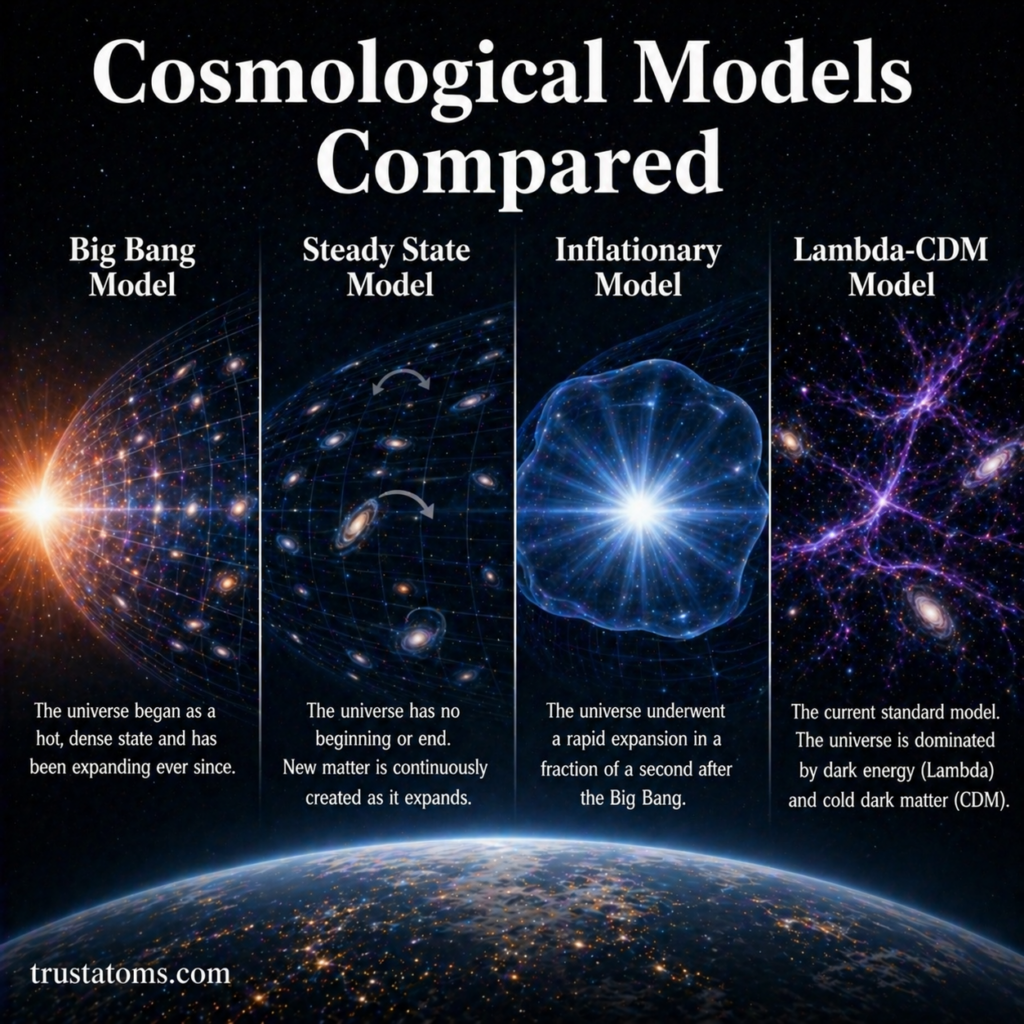
Cosmological Models Compared: Understanding Competing Views of the Universe

Comparison of cosmological models including Big Bang, Steady State, Inflationary, and Lambda-CDM shown in a visual diagram.
A comparison of major cosmological models explaining the origin and evolution of the universe. trustatoms.com.

Cosmology seeks to answer some of the biggest questions in science: How did the universe begin? How is it evolving? What is its ultimate fate? To explore these questions, scientists use cosmological models—theoretical frameworks that describe the structure and behavior of the universe.

Over time, several models have been proposed, tested, refined, or replaced. Comparing these models helps us understand not only what we know about the universe, but also what remains uncertain.

Continue reading “Cosmological Models Compared: Understanding Competing Views of the Universe”

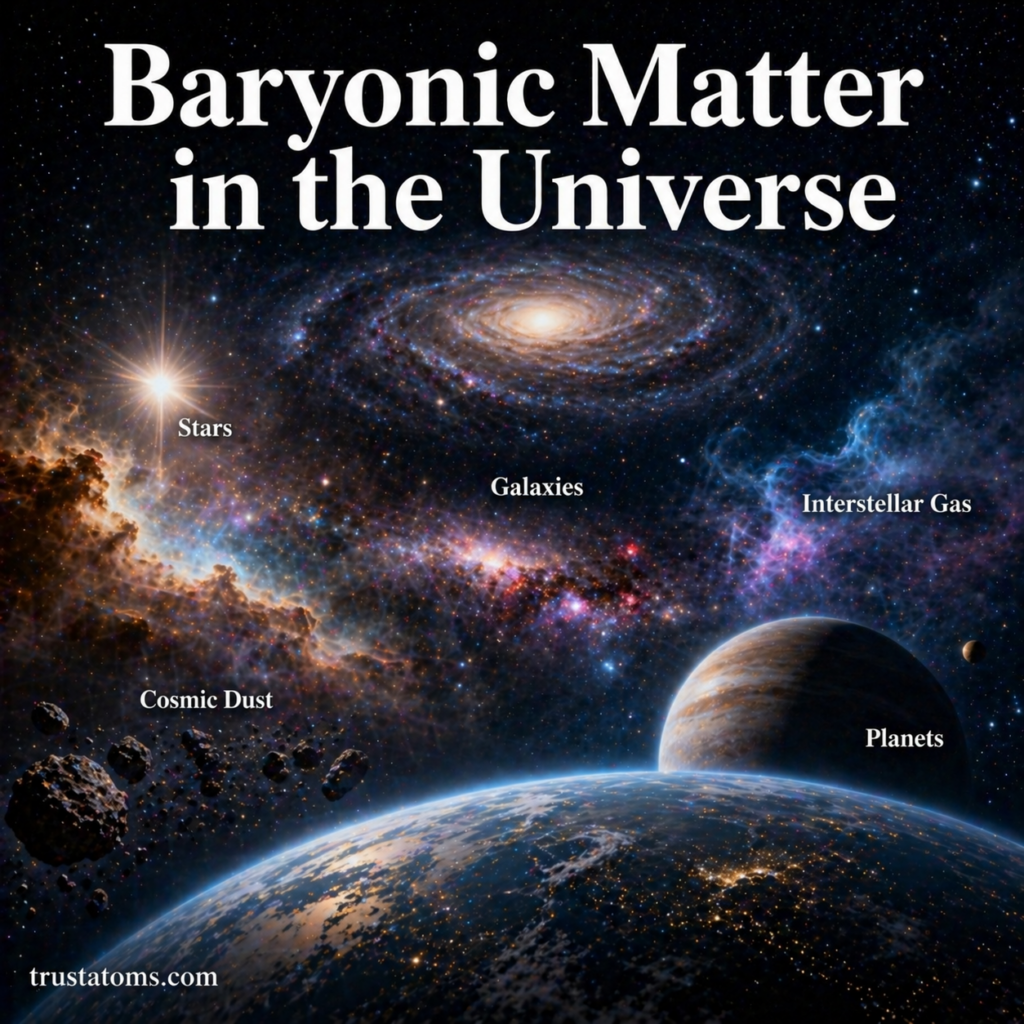
Baryonic Matter in the Universe: The “Ordinary” Matter That Builds Everything

Illustration of baryonic matter showing stars, galaxies, interstellar gas, cosmic dust, and planets in the universe.
Baryonic matter includes stars, galaxies, gas, dust, and planets that make up the visible universe. trustatoms.com.

When we look at stars, planets, and galaxies, we’re seeing only a small fraction of what the universe contains. That visible portion is made of baryonic matter—the “normal” matter that forms everything we can directly observe.

Despite its importance, baryonic matter makes up only a small percentage of the universe’s total mass-energy content. Understanding it is essential for explaining how cosmic structures form and evolve.

Continue reading “Baryonic Matter in the Universe: The “Ordinary” Matter That Builds Everything”

Cosmic Web Structure: The Universe’s Largest-Scale Design

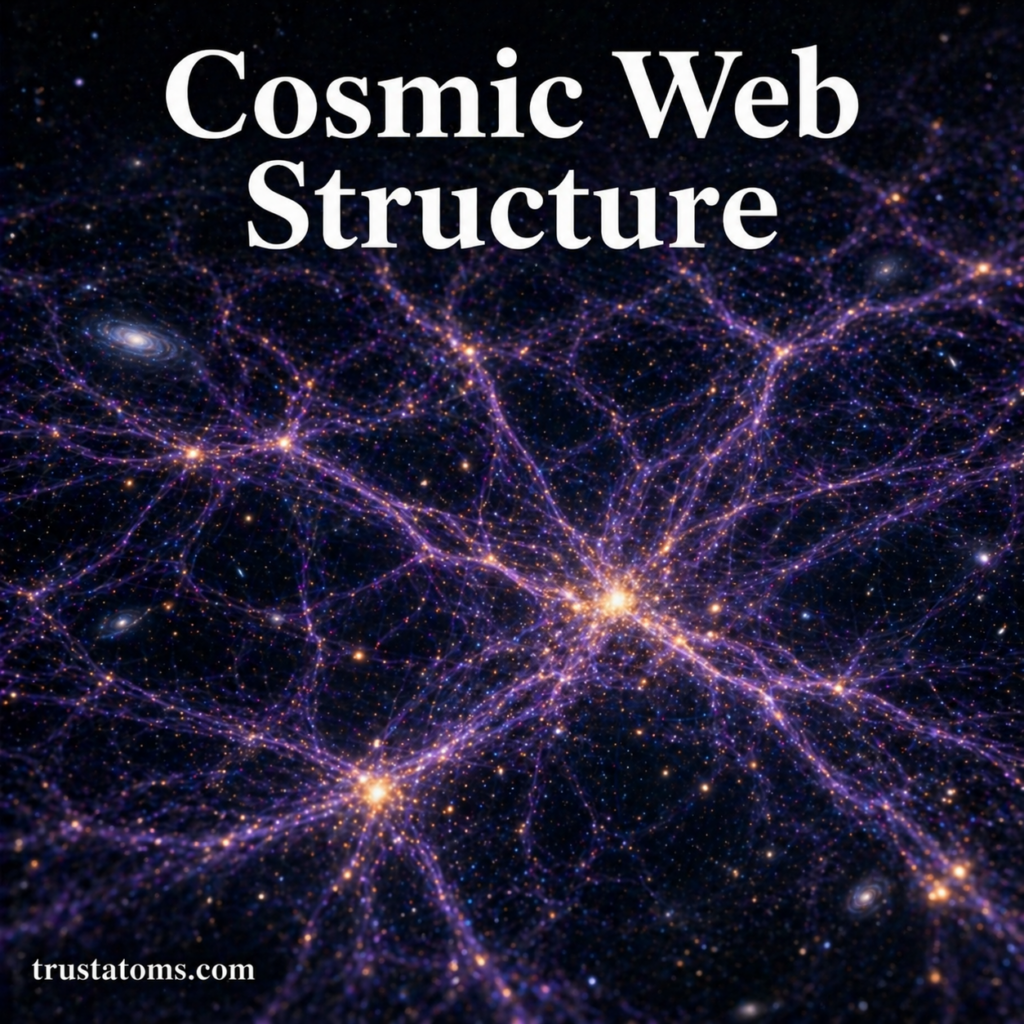
Visualization of the cosmic web showing interconnected galaxy filaments, clusters, and vast empty voids across the universe.
The large-scale cosmic web connecting galaxies through filaments and clusters. trustatoms.com.

On the grandest scales, the universe is not randomly scattered—it’s organized into an enormous, interconnected network known as the cosmic web. This vast structure links galaxies, clusters, and dark matter across billions of light-years, forming a pattern that resembles a three-dimensional web.

Understanding the cosmic web helps astronomers explain how matter is distributed, how galaxies form, and how the universe has evolved over time.

Continue reading “Cosmic Web Structure: The Universe’s Largest-Scale Design”

Gravitational Waves in Cosmology: Ripples That Reveal the Universe

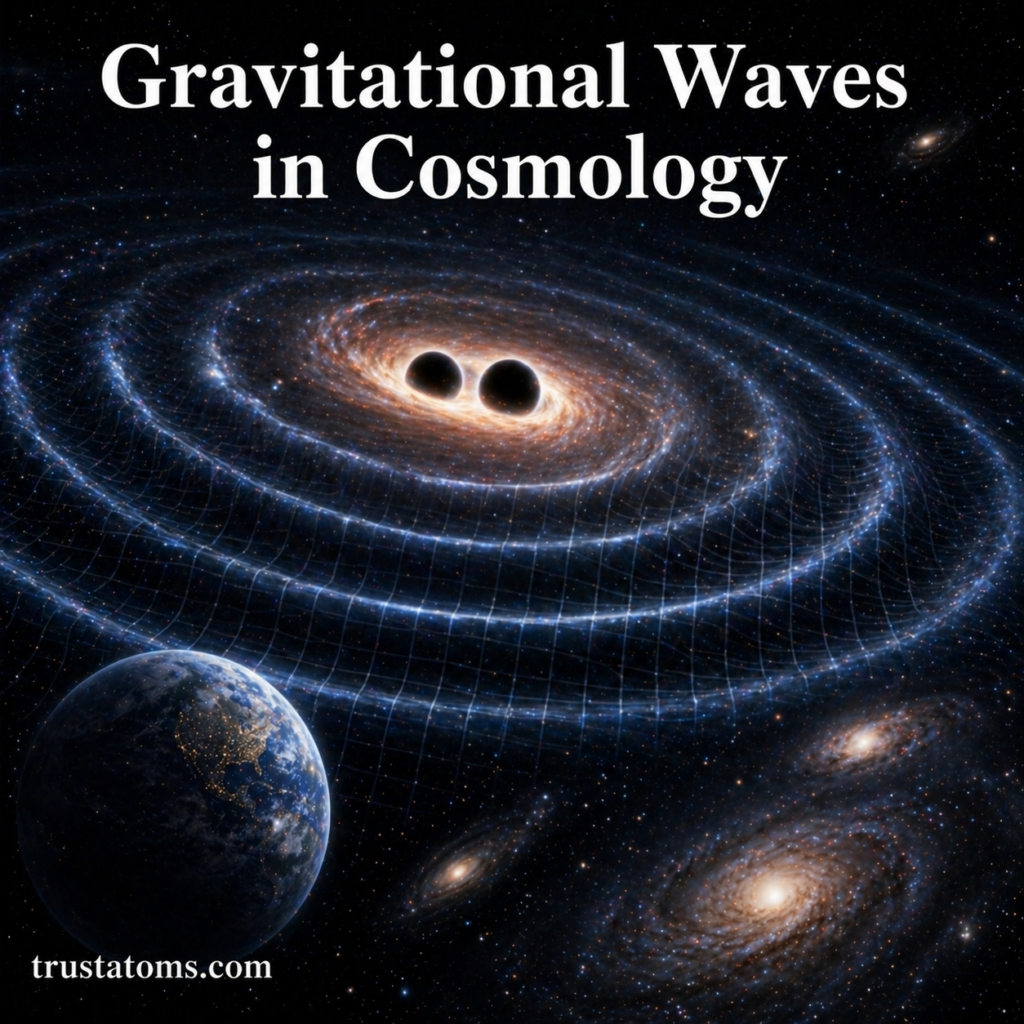
Two merging black holes creating ripples in space-time, illustrating gravitational waves traveling across the universe.
Gravitational waves spreading through space-time from a black hole merger. trustatoms.com.

Gravitational waves are one of the most groundbreaking discoveries in modern astronomy. These faint ripples in the fabric of space-time allow scientists to observe cosmic events that were once completely invisible.

From colliding black holes to the echoes of the early universe, gravitational waves have opened an entirely new way to study cosmology—giving us a deeper understanding of how the universe forms, evolves, and behaves on the largest scales.

Continue reading “Gravitational Waves in Cosmology: Ripples That Reveal the Universe”

Black Holes at Galactic Centers: The Hidden Engines of Galaxies

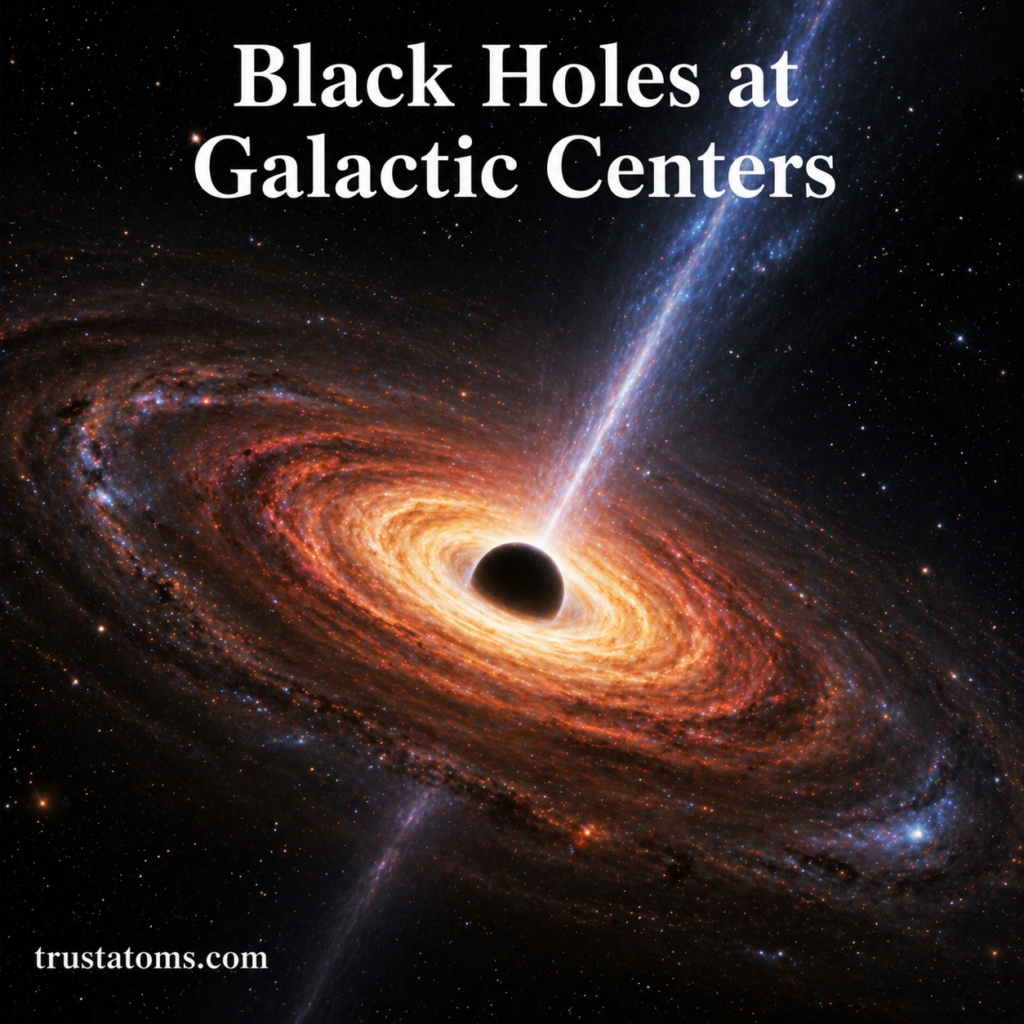
Supermassive black hole at the center of a galaxy with a glowing accretion disk and energy jets in deep space.
A supermassive black hole powering activity at the center of a galaxy. trustatoms.com.

At the heart of nearly every large galaxy lies one of the most mysterious objects in the universe—a supermassive black hole. These cosmic giants, millions to billions of times more massive than the Sun, play a crucial role in shaping the structure, behavior, and evolution of galaxies.

Far from being passive objects, black holes at galactic centers influence everything from star formation to galaxy growth, acting as powerful engines that regulate cosmic environments.

Continue reading “Black Holes at Galactic Centers: The Hidden Engines of Galaxies”