Galaxy Collisions and Mergers: How Galaxies Interact and Evolve

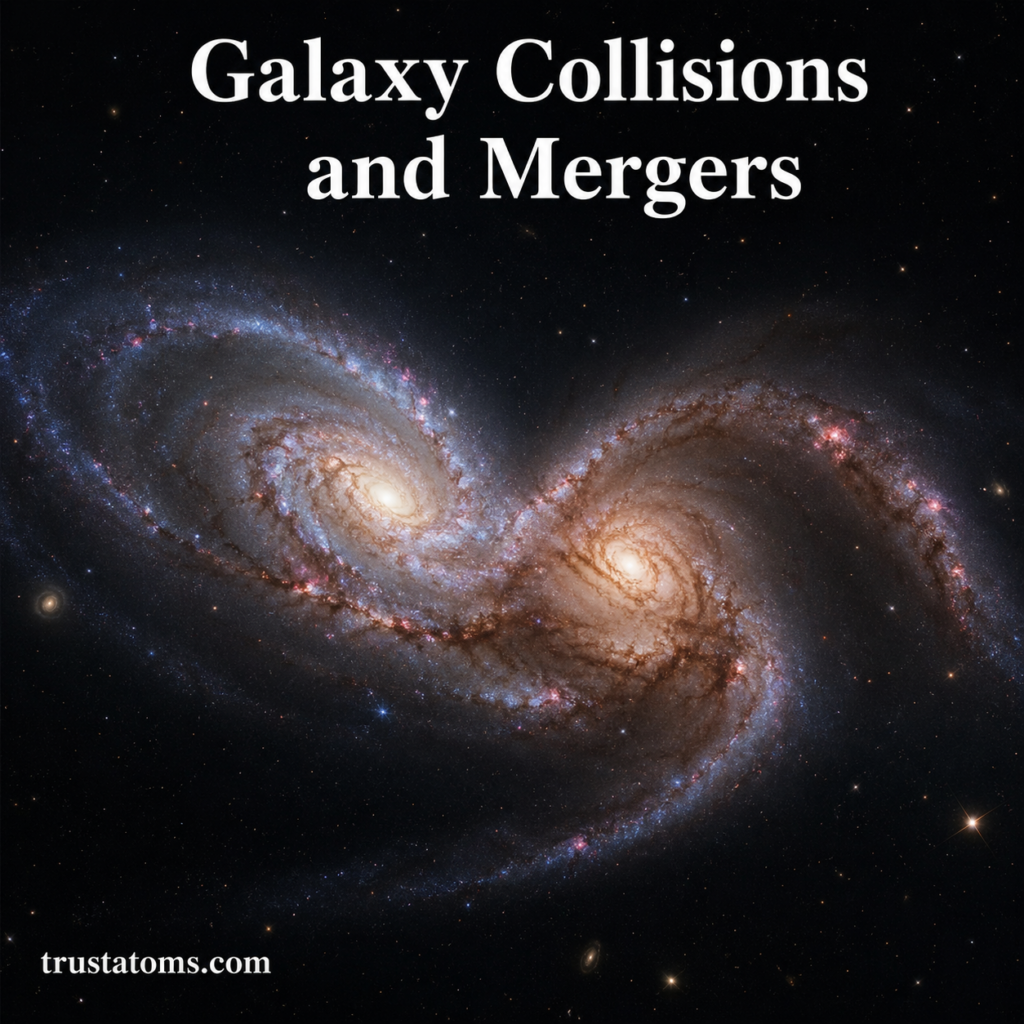
Two spiral galaxies colliding in deep space with bright star formation and tidal arms during a galaxy merger.
Two spiral galaxies interacting and merging in deep space. trustatoms.com.

Galaxies are not isolated islands in space—they constantly interact, influence each other, and sometimes collide in spectacular cosmic events. These encounters, known as galaxy collisions and mergers, play a major role in shaping the structure and evolution of the universe.

Despite the dramatic name, galaxy collisions are not chaotic smash-ups like car crashes. Instead, they unfold over millions or even billions of years, gradually transforming galaxies into entirely new forms.

Continue reading “Galaxy Collisions and Mergers: How Galaxies Interact and Evolve”
Intergalactic Medium

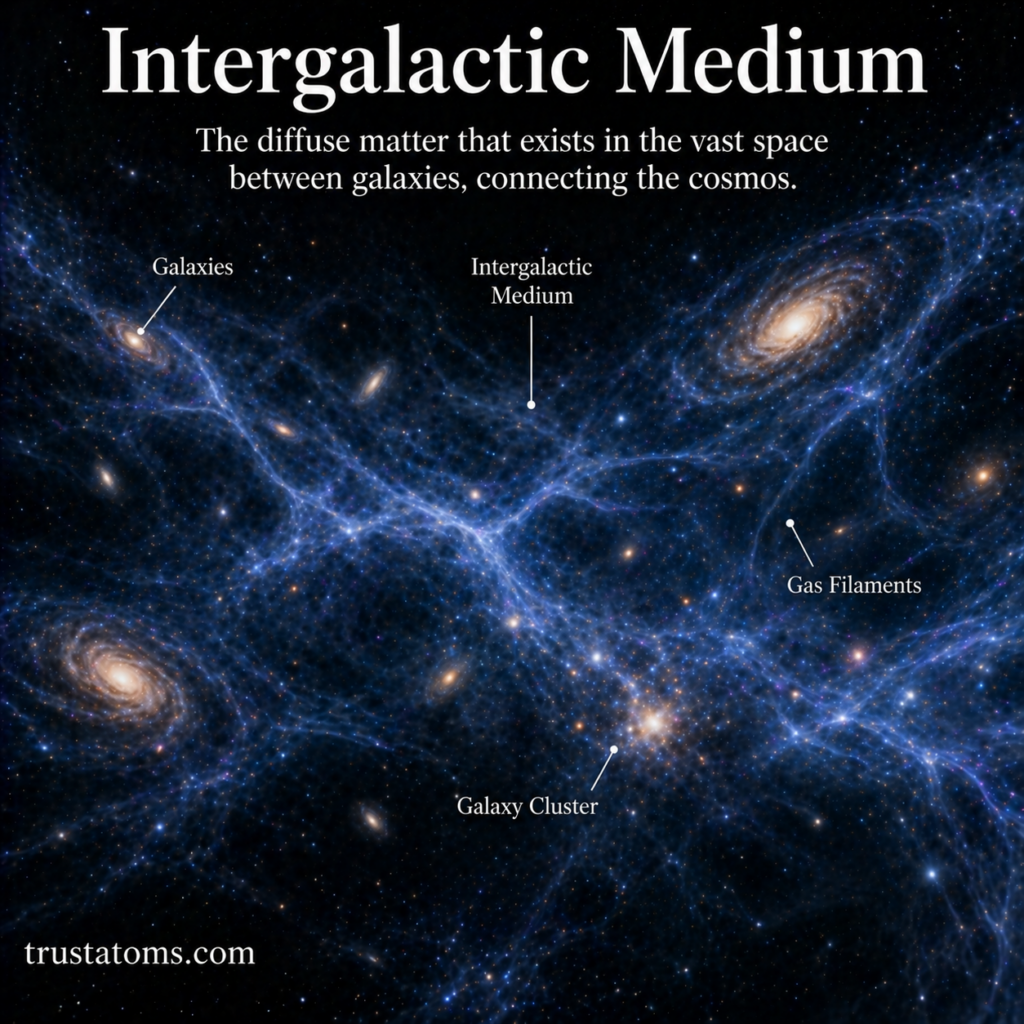
Illustration of the intergalactic medium showing gas filaments connecting galaxies and clusters in the cosmic web.
Visualization of the intergalactic medium forming filaments that connect galaxies across the cosmic web. trustatoms.com.

The intergalactic medium (IGM) is the vast, diffuse matter that exists in the space between galaxies. While galaxies, stars, and planets get most of the attention, the IGM actually contains a significant portion of the universe’s ordinary matter.

Far from being empty, this space is filled with thin gas, mostly hydrogen, that plays a crucial role in the evolution of the universe.

Continue reading “Intergalactic Medium”

Formation of the First Galaxies

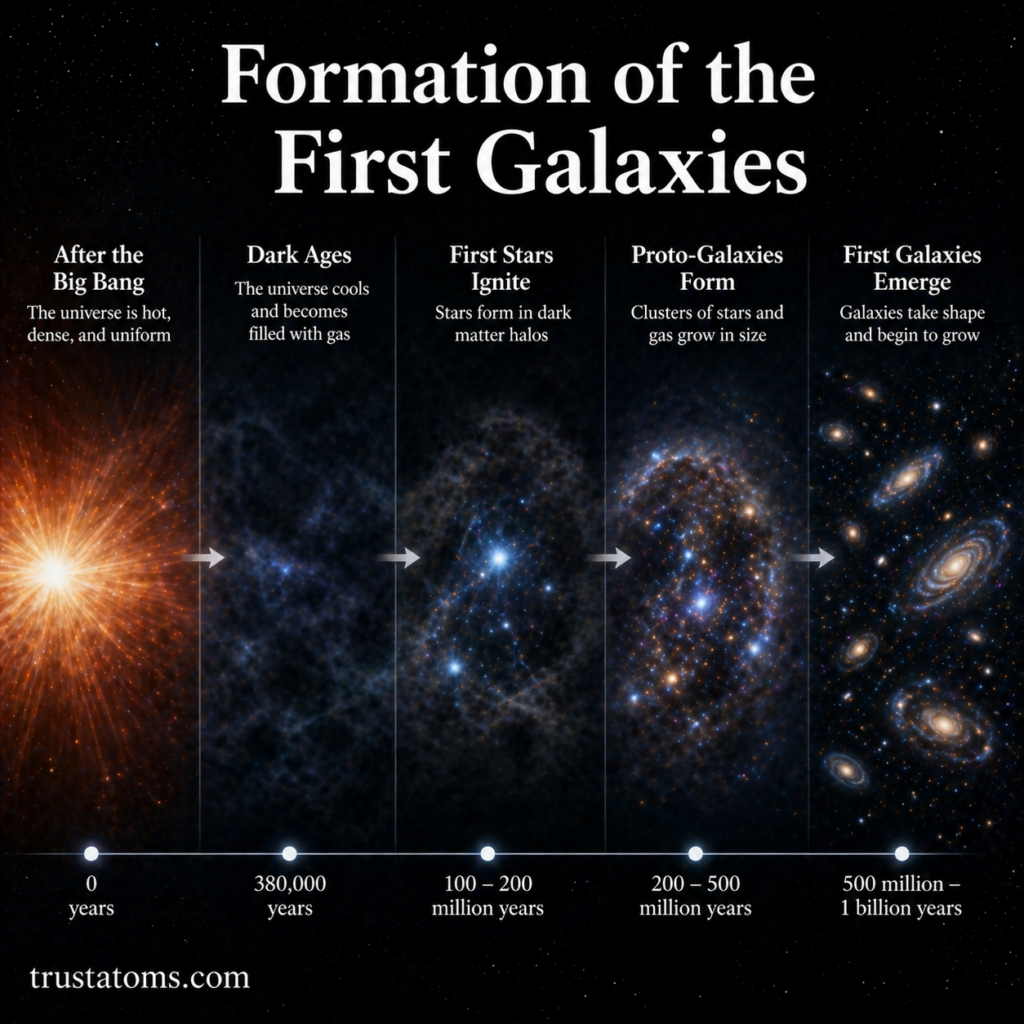
Illustration showing stages from the Big Bang to the formation of the first galaxies with early stars and proto-galaxies.
Visualization of how the first galaxies formed from early stars and proto-galaxies after the Big Bang. trustatoms.com.

The first galaxies mark a major turning point in the history of the universe. After the Big Bang, the cosmos was initially filled with hot plasma, then later cooled into a dark, simple environment of hydrogen and helium gas. Over time, gravity shaped this matter into the first stars and eventually the first galaxies.

Understanding how the first galaxies formed helps scientists trace the origins of structure in the universe—and ultimately, the formation of galaxies like our own.

Continue reading “Formation of the First Galaxies”

Age of the Universe Estimates

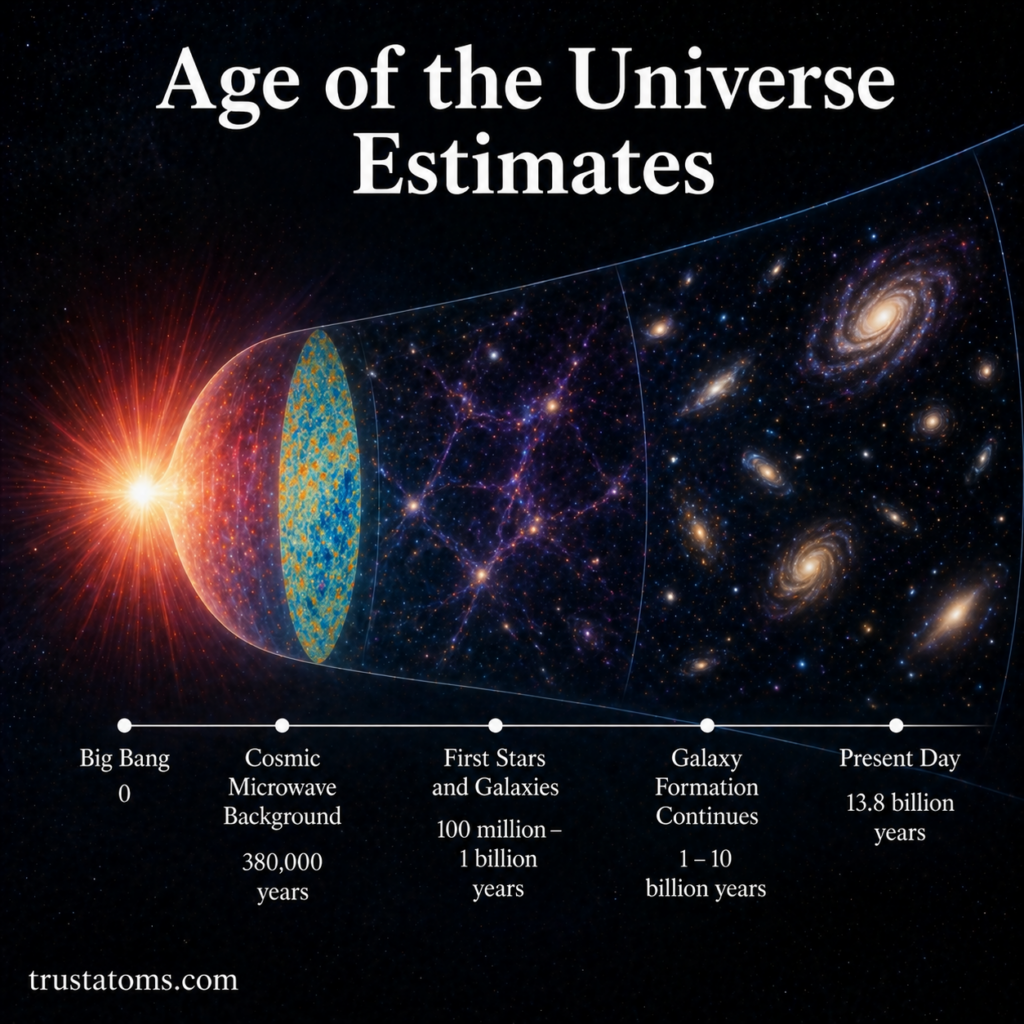
Illustration showing a timeline of the universe from the Big Bang to present day with galaxy formation and cosmic background stages.
Visualization of the universe’s timeline from the Big Bang to the present, highlighting key stages of cosmic evolution. trustatoms.com.

How old is the universe? This question has fascinated scientists for centuries. Today, thanks to modern astronomy and physics, scientists have a well-supported estimate: the universe is approximately 13.8 billion years old.

This estimate comes from multiple independent methods, all pointing to a consistent timeline for the history of the cosmos.

Continue reading “Age of the Universe Estimates”

Multiverse Hypotheses in Cosmology

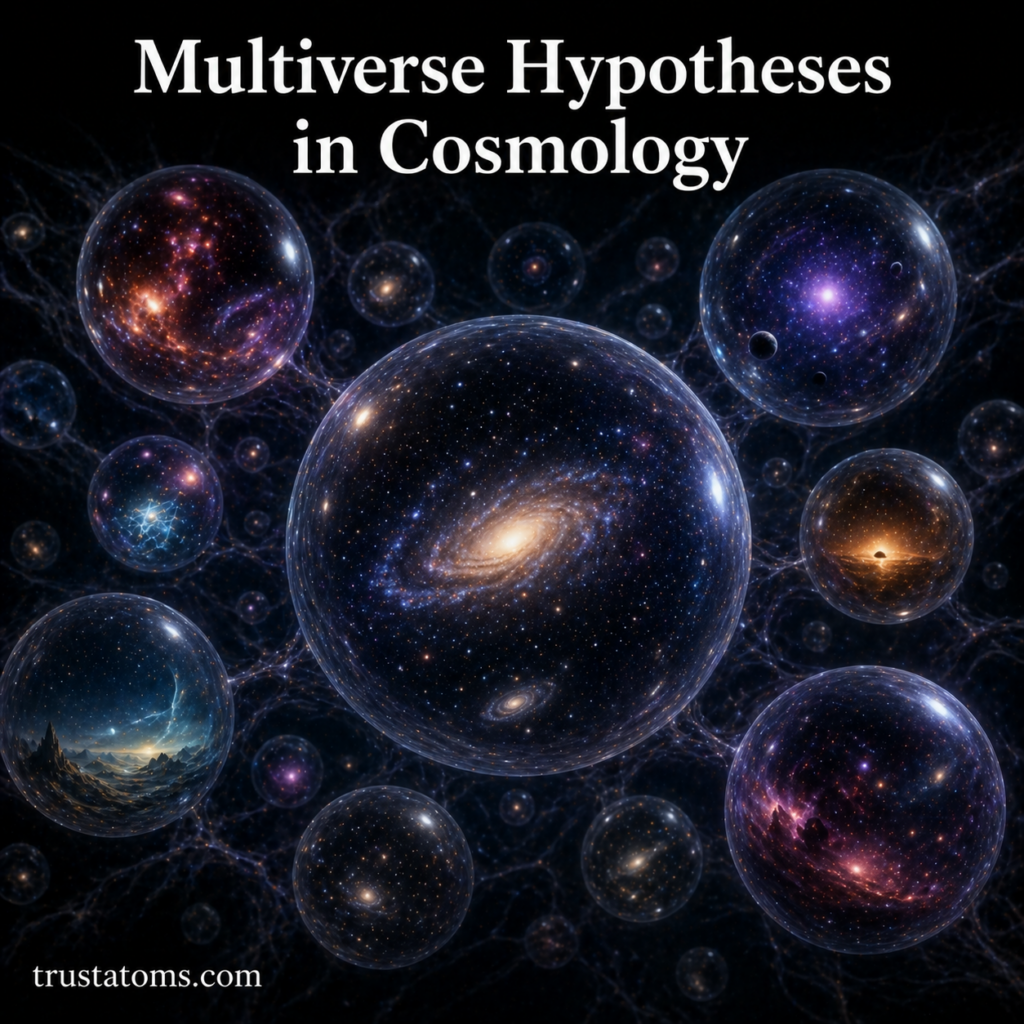
Illustration of multiple bubble universes representing multiverse hypotheses in cosmology with different galaxies inside each sphere.
Conceptual visualization of multiple bubble universes representing multiverse theories in cosmology. trustatoms.com.

The idea that our universe might not be the only one is both fascinating and controversial. In modern cosmology, this concept is explored through multiverse hypotheses, which suggest that multiple—possibly infinite—universes may exist beyond our own.

While still theoretical, multiverse ideas arise naturally from several areas of physics and cosmology, offering possible explanations for some of the universe’s deepest mysteries.

Continue reading “Multiverse Hypotheses in Cosmology”

Dark Energy and Cosmic Acceleration

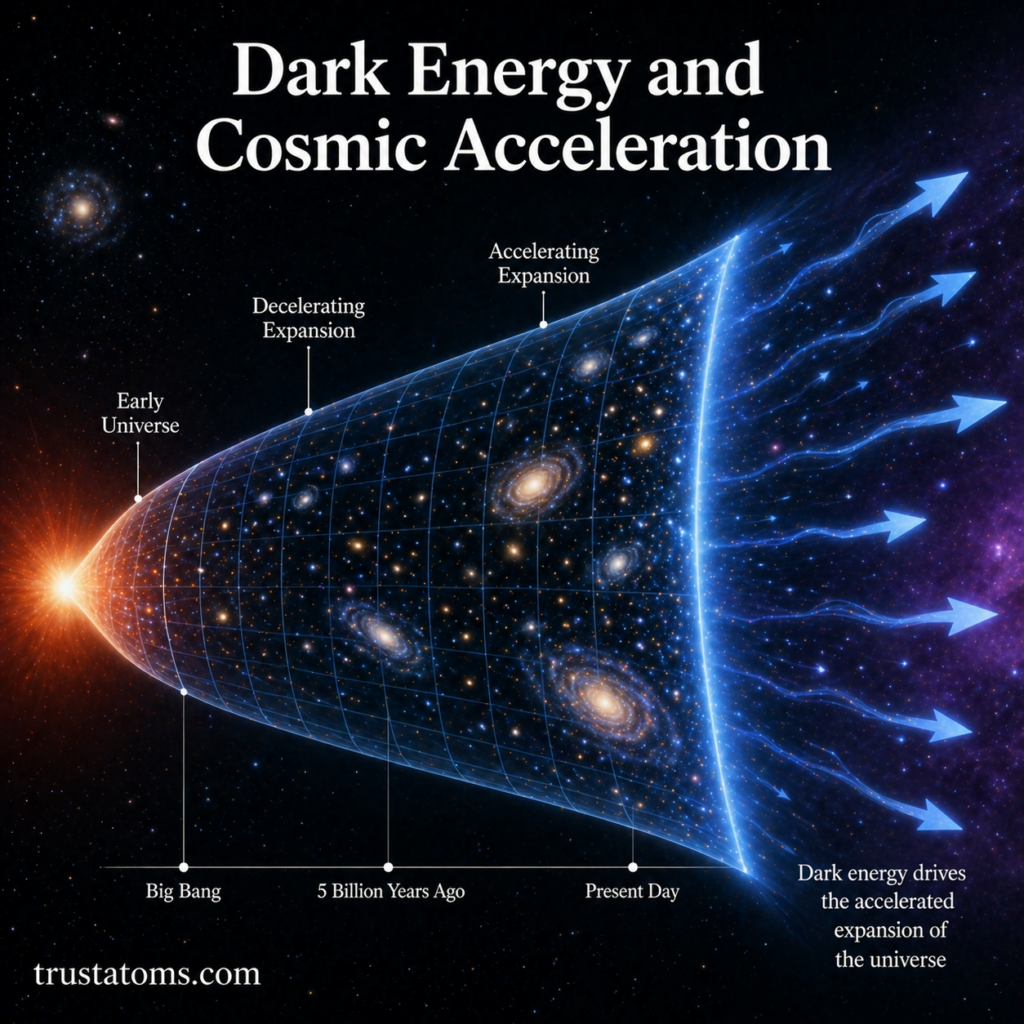
Illustration showing the accelerating expansion of the universe driven by dark energy with galaxies moving apart over time.
Visualization of dark energy driving the accelerated expansion of the universe across cosmic time. trustatoms.com.

The universe is not just expanding—it’s accelerating. Instead of slowing down due to gravity, the expansion of the universe is speeding up over time. This surprising discovery led scientists to propose the existence of dark energy, a mysterious force that makes up most of the universe.

Understanding dark energy is one of the biggest challenges in modern astronomy and cosmology.

Continue reading “Dark Energy and Cosmic Acceleration”

Redshift and the Expanding Universe

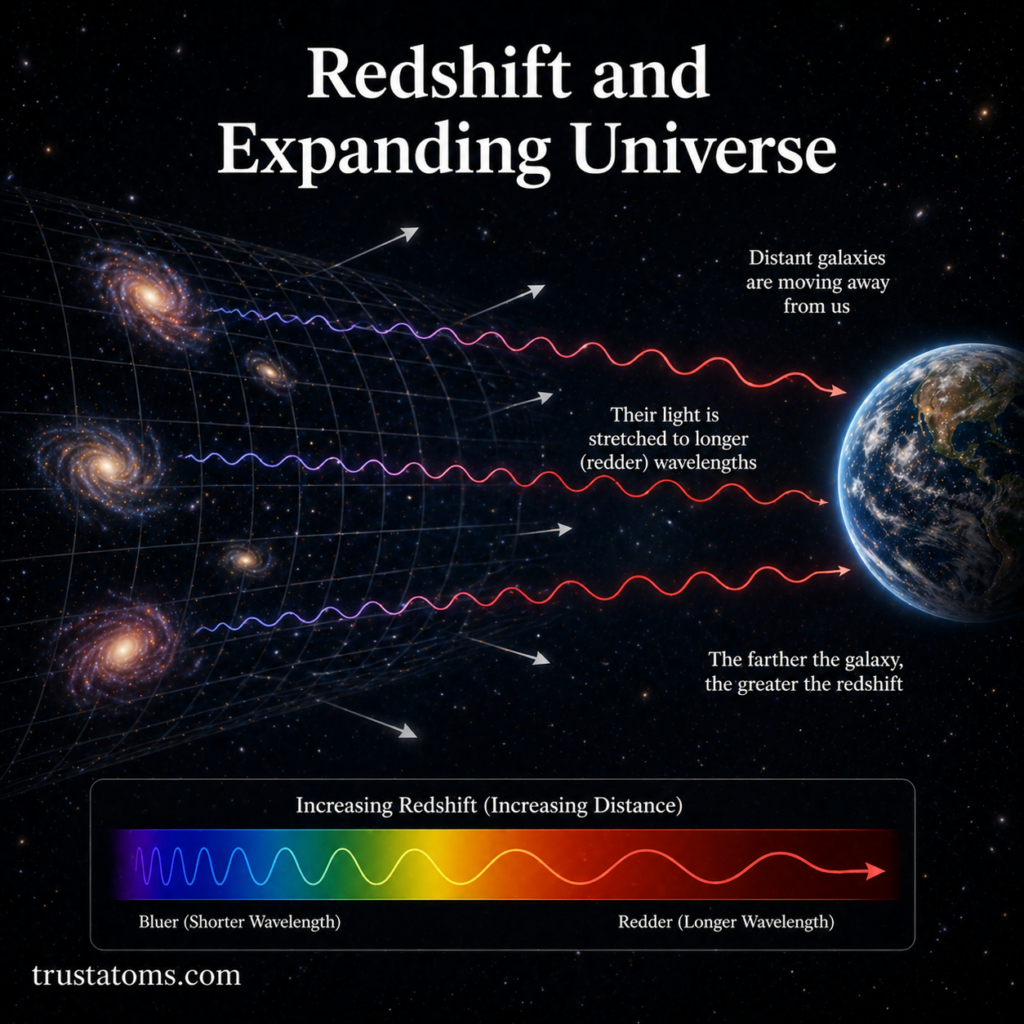
Illustration showing redshift as galaxies move away and light stretches to longer wavelengths in an expanding universe.
Visualization of redshift demonstrating how light stretches as galaxies move away in an expanding universe. trustatoms.com.

The universe is not static—it is constantly expanding. One of the strongest pieces of evidence for this comes from a phenomenon known as redshift, which shows that distant galaxies are moving away from us.

By studying redshift, astronomers have uncovered how the universe is growing, how fast it’s expanding, and even clues about its origin and future.

Continue reading “Redshift and the Expanding Universe”

Cosmic Inflation Theory

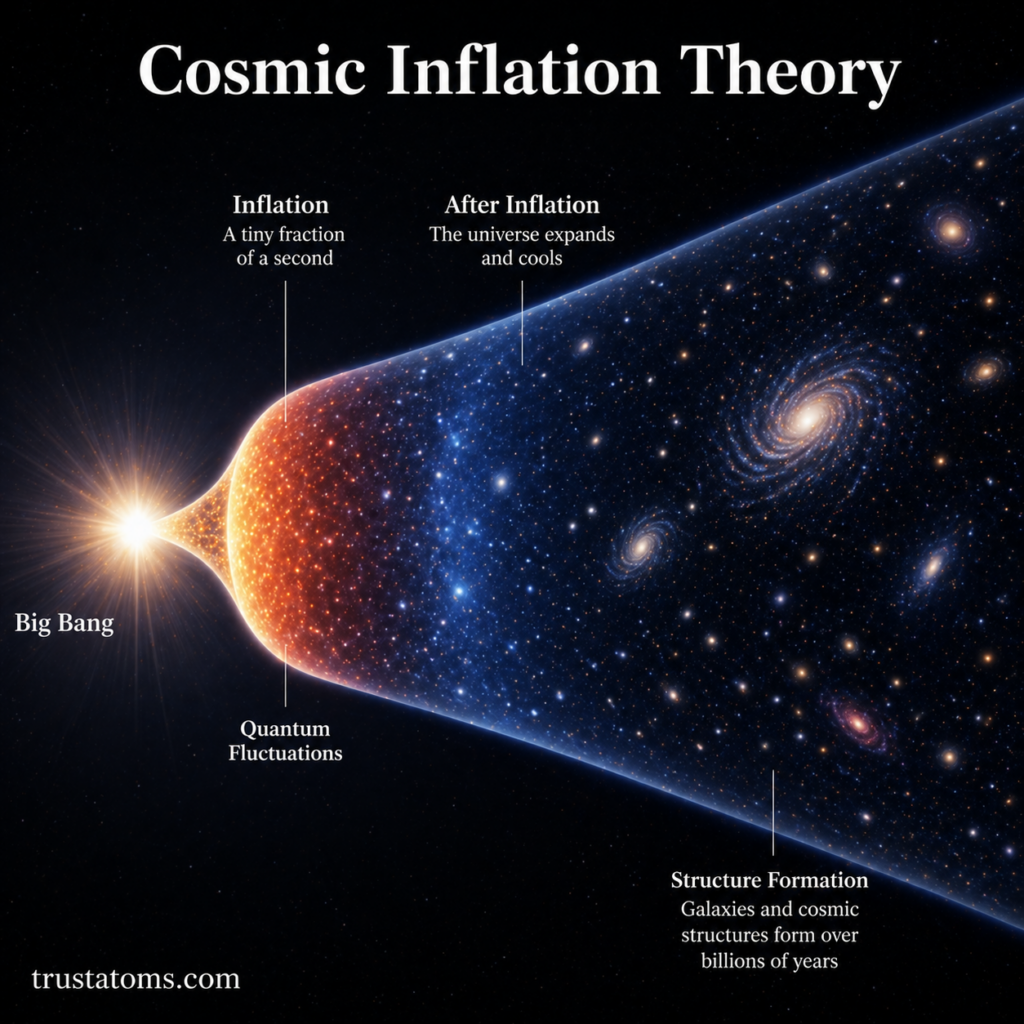
Illustration of cosmic inflation theory showing rapid expansion after the Big Bang leading to galaxy formation.
Visualization of cosmic inflation and the early rapid expansion of the universe leading to large-scale structure. trustatoms.com.

The Cosmic Inflation Theory is a widely accepted scientific explanation for how the universe expanded in its earliest moments. It proposes that just after the Big Bang, the universe underwent an extremely rapid expansion.

This idea helps explain why the universe appears smooth, evenly distributed, and structured on large scales today.

Different philosophical and religious perspectives interpret these findings in various ways. In science, inflation is studied as a physical process based on observation and mathematical models.

Continue reading “Cosmic Inflation Theory”

Large-Scale Structure of the Universe

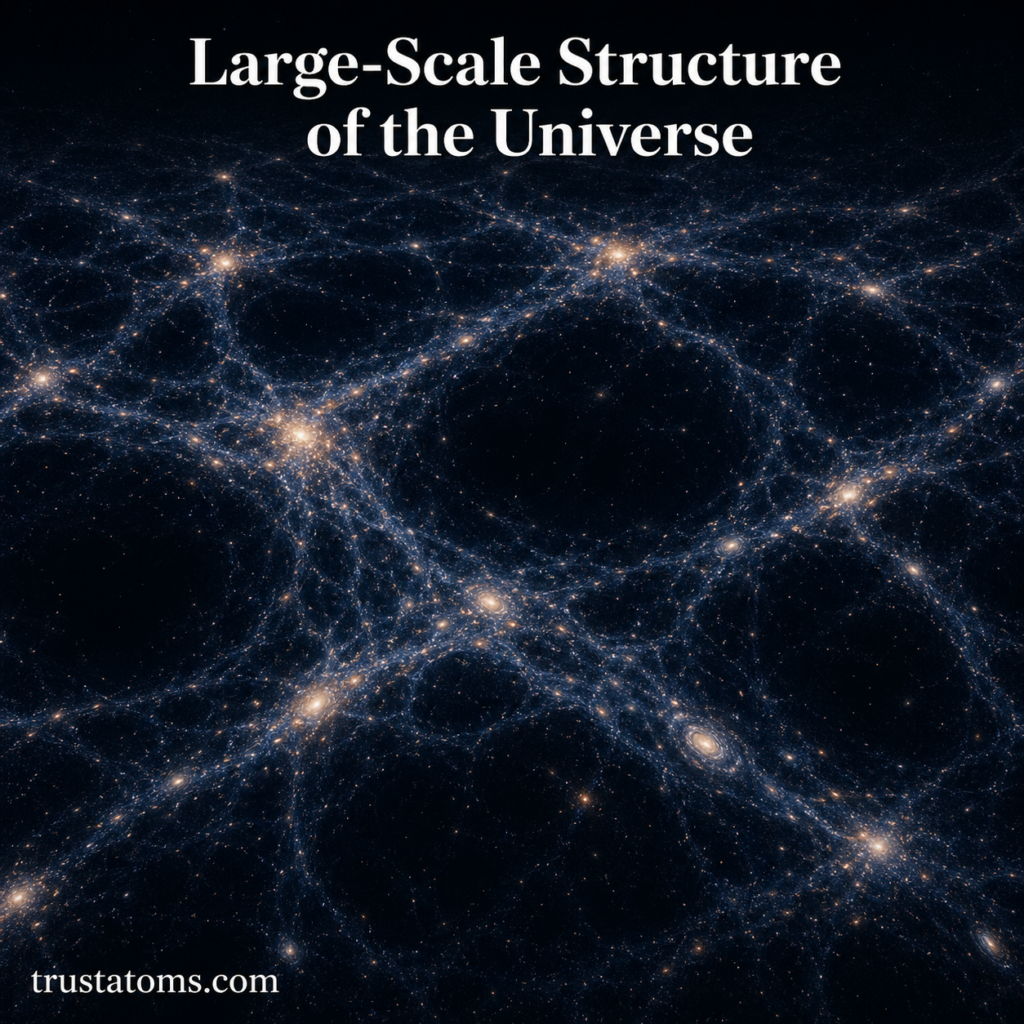
Illustration of the large-scale structure of the universe showing the cosmic web with galaxy clusters, filaments, and voids.
Visualization of the cosmic web highlighting galaxy clusters, filaments, and vast voids. trustatoms.com.

The universe is not random chaos—it has structure on the largest scales imaginable. When astronomers map galaxies across billions of light-years, they discover a vast cosmic web made of clusters, filaments, and enormous empty regions called voids.

Understanding the large-scale structure of the universe helps scientists answer some of the biggest questions: How did everything form? What is the universe made of? And where is it going?

Continue reading “Large-Scale Structure of the Universe”

Cosmic Microwave Background Radiation

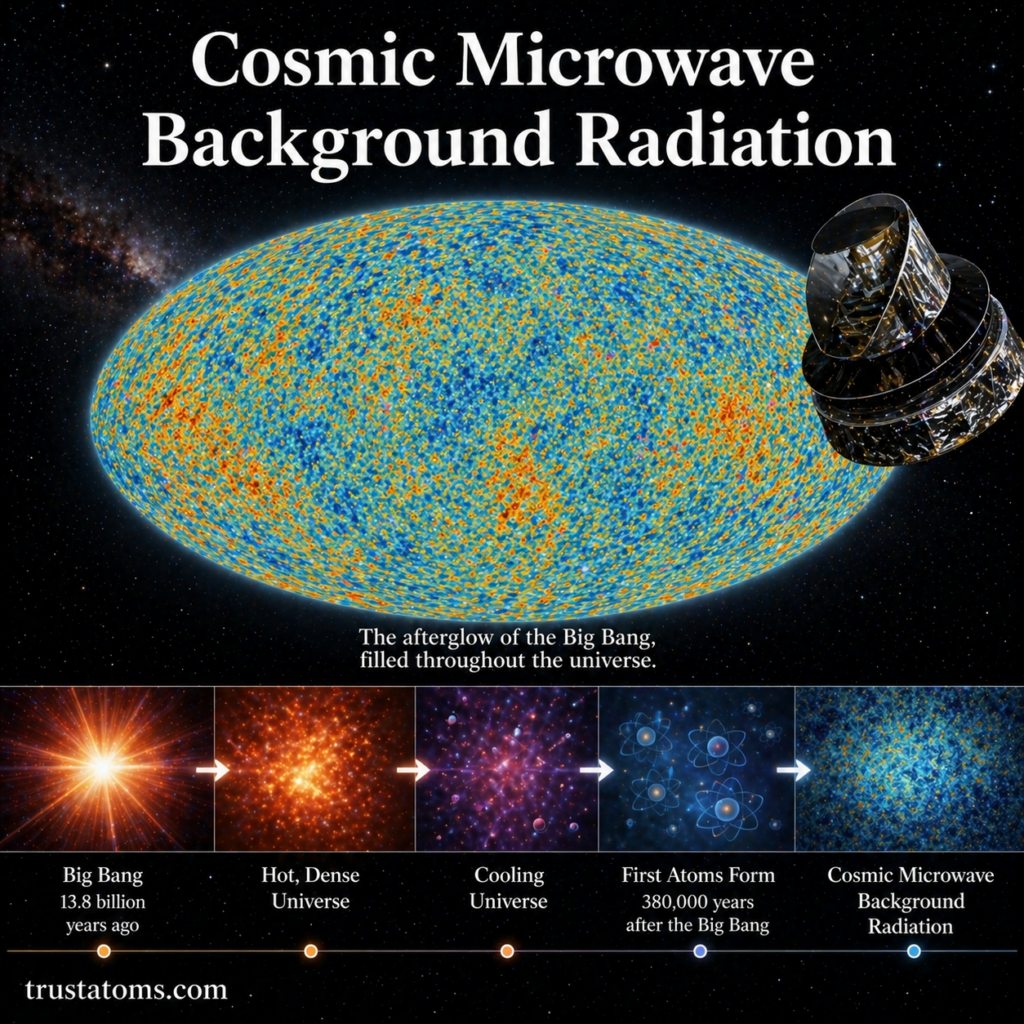
Illustration of the cosmic microwave background showing a full-sky radiation map and the early universe timeline from the Big Bang.
A visual representation of the cosmic microwave background, the afterglow of the early universe following the Big Bang. trustatoms.com

The Cosmic Microwave Background (CMB) is one of the most important discoveries in modern astronomy. It is often described as the afterglow of the early universe, providing a snapshot of what the cosmos looked like shortly after it began.

By studying the CMB, scientists gain valuable insight into the origin, structure, and evolution of the universe.

Continue reading “Cosmic Microwave Background Radiation”