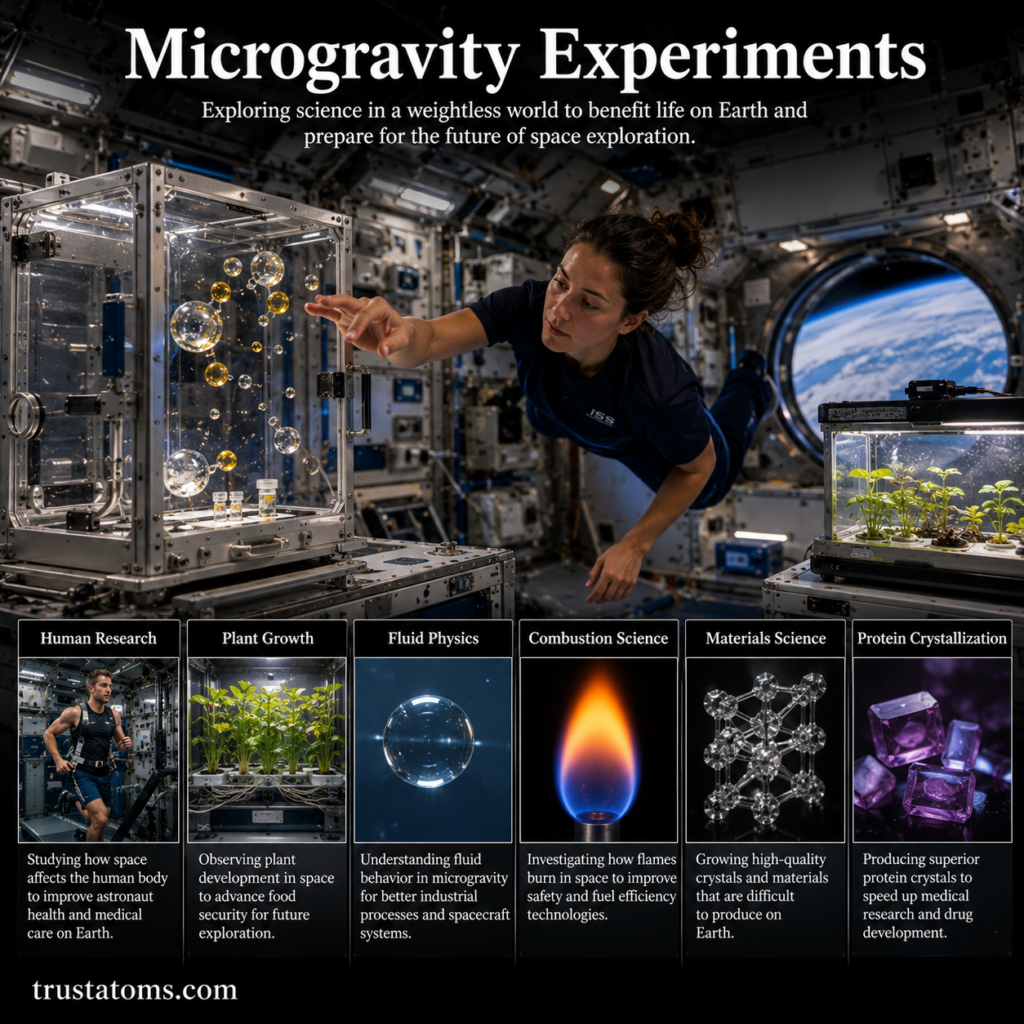
Microgravity experiments are scientific investigations conducted in environments where objects experience very little apparent weight, allowing researchers to observe physical and biological processes without the usual effects of gravity-driven motion. These experiments reveal how fluids, flames, plants, human bodies, and materials behave in space, providing knowledge for future missions and scientific applications on Earth.
Space stations such as the International Space Station (ISS) serve as orbital laboratories where astronauts and researchers perform experiments in biology, medicine, physics, engineering, and materials science. This research also connects with the study of astronomy by helping scientists understand the physical conditions encountered beyond Earth’s surface.
Unlike brief laboratory demonstrations on Earth, orbital experiments can operate under microgravity conditions for extended periods. Scientists use this opportunity to separate gravity-dependent effects from other forces, test engineering systems, and investigate how living organisms adapt to space.
What Is Microgravity?
Microgravity describes conditions in which objects experience extremely small apparent gravitational accelerations relative to their surroundings. It does not mean that gravity has disappeared.
Aboard the ISS, astronauts and nearby objects are continuously falling around Earth together. The station moves forward fast enough that its curved path follows Earth’s curvature, allowing it to remain in orbit rather than falling directly to the ground.
At the ISS’s approximate orbital altitude of 400 kilometers, Earth’s gravitational acceleration remains nearly 90% of its surface value. Astronauts float because they and their spacecraft are in free fall, not because gravity is absent.
The term microgravity also reflects the small residual accelerations caused by spacecraft movements, atmospheric drag, equipment vibrations, and other disturbances.
How Microgravity Changes Everyday Physics
Consider pouring water into a glass on Earth. Gravity pulls the liquid downward, while buoyancy helps air bubbles rise toward the surface. In microgravity, water does not naturally settle at the bottom of a container, and bubbles do not rise through the liquid in the usual way.
Instead, surface tension, adhesion, and other forces become more noticeable. Water can form floating droplets or cling to surfaces, illustrating why spacecraft require specialized fluid-handling systems.
Why Scientists Conduct Microgravity Experiments
Gravity influences many processes studied in terrestrial laboratories. It causes dense materials to settle, drives buoyant circulation in fluids, and affects how organisms sense their surroundings.
By reducing these effects, scientists can observe processes that are difficult to isolate on Earth. Microgravity research helps investigators examine:
- Fundamental physics: How liquids, gases, particles, and forces interact without ordinary gravitational settling.
- Human physiology: How reduced mechanical loading changes muscles, bones, circulation, and balance.
- Biological development: How plants, cells, and microorganisms respond to altered gravitational conditions.
- Materials processing: How crystals, alloys, and other substances form when sedimentation and buoyancy are reduced.
- Spacecraft engineering: How fluids, combustion, cooling, and other systems operate during orbital missions.
These investigations help researchers distinguish the effects of gravity from those of temperature, chemical composition, radiation, and other environmental factors.
Where Microgravity Experiments Take Place
Scientists use several types of facilities to create microgravity conditions. Each provides a different combination of experiment duration, cost, accessibility, and environmental control.
| Research Platform | Typical Microgravity Duration | Common Uses |
|---|---|---|
| International Space Station | Extended experiments lasting days to months or longer | Biology, human health, fluid physics, materials |
| Parabolic aircraft | Approximately 20 seconds per parabola | Equipment testing, fluid experiments, human studies |
| Drop towers | Several seconds | Combustion, fluid physics, instrument testing |
| Sounding rockets | Several minutes | Materials science, physical experiments, technology testing |
The International Space Station
The ISS provides a continuously orbiting research environment where experiments can run for extended periods. Its laboratory facilities support automated instruments, astronaut-operated investigations, and experiments monitored remotely by researchers on Earth.
Long-duration access is especially useful for studying biological changes, crystal growth, and physical processes that develop gradually.
Parabolic Flights and Drop Towers
Parabolic aircraft briefly create free-fall conditions by following carefully controlled flight paths. Researchers use these flights to test equipment, observe fluid behavior, and prepare experiments for orbital missions.
Drop towers provide similar conditions by allowing experiment capsules to fall freely. Although the available time is short, repeated tests can produce useful measurements without launching equipment into orbit.
Major Types of Microgravity Experiments
Microgravity research covers disciplines ranging from medicine to engineering. Each field investigates how removing ordinary gravity-driven effects changes familiar processes.
Human Biology and Medical Research
Astronauts experience physiological changes when their bodies no longer support their weight normally. Researchers monitor muscle strength, bone density, cardiovascular function, immune responses, sleep, and vision.
These studies help scientists develop exercise routines and other countermeasures for long-duration missions. They also provide opportunities to investigate mechanisms involved in muscle wasting, bone loss, and changes in circulation.
Plant Growth and Space Agriculture
Plants respond to gravity through a process called gravitropism, which helps roots grow downward and shoots grow upward. In microgravity, researchers examine how plants use light, moisture, and other signals to guide their development.
Experiments also investigate seed germination, root structure, nutrient delivery, and crop production. Understanding these processes may help future crews grow supplemental food during extended missions.
Fluid Physics Experiments
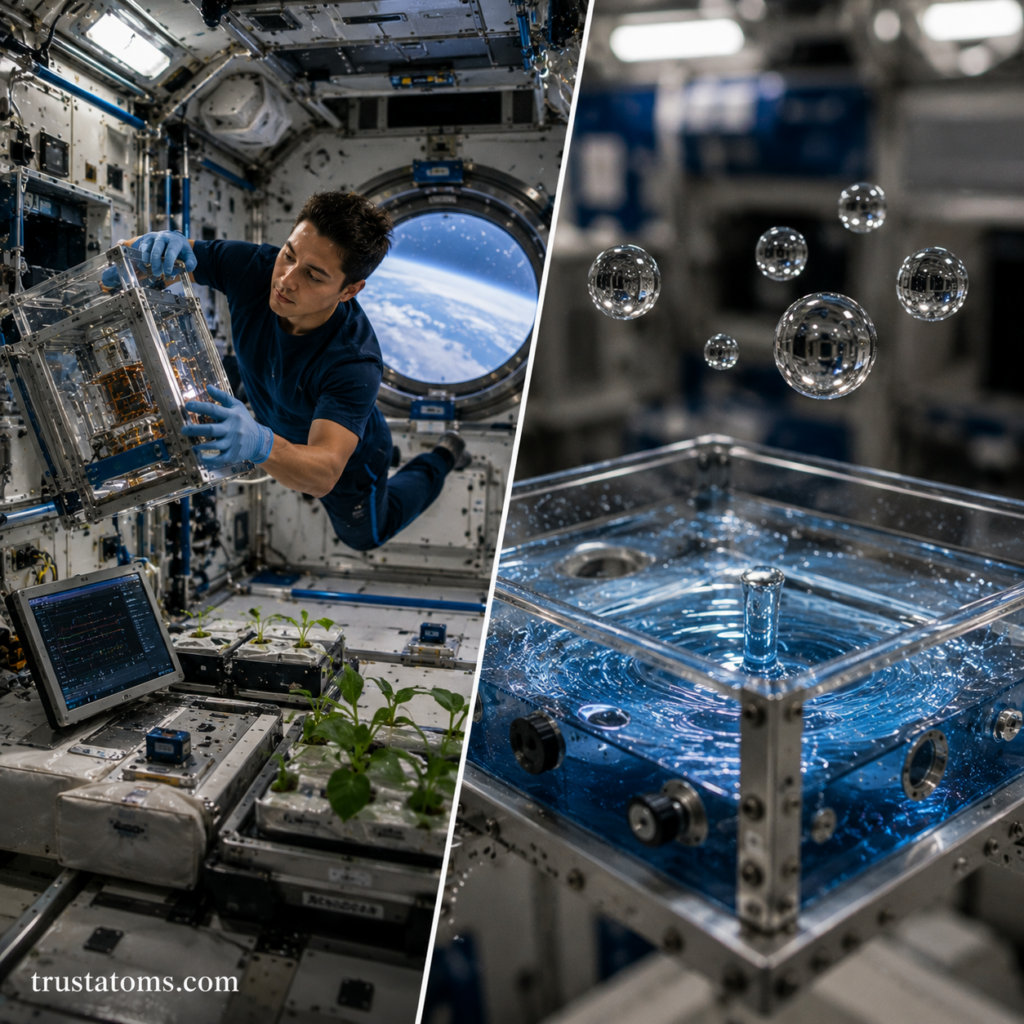
On Earth, gravity drives buoyancy, sedimentation, and many forms of fluid circulation. In microgravity, these effects become much weaker, allowing surface tension and capillary forces to dominate certain situations.
Researchers investigate bubble movement, liquid mixing, boiling, condensation, and fluid transport. Their findings help engineers design fuel tanks, cooling systems, and equipment that must move liquids reliably without conventional gravity-assisted flow.
Combustion and Flame Behavior
Flames behave differently when gravity-driven convection is greatly reduced. On Earth, hot combustion gases rise, drawing fresh oxygen toward a flame. In microgravity, this upward circulation is largely absent.
Under suitable conditions, flames can become more spherical, and oxygen transport may depend more strongly on diffusion. Scientists study these changes to improve spacecraft fire detection, combustion models, and fire suppression systems.
Materials Science and Crystal Growth
Microgravity reduces gravitational settling and buoyancy-driven convection during certain manufacturing processes. This allows researchers to investigate how materials solidify, mix, and develop internal structures.
Experiments include alloy solidification, semiconductor materials, optical fibers, and protein crystallization. Some protein crystal experiments can produce samples useful for structural analysis, although microgravity does not automatically improve every crystal.
Understanding these processes can improve scientific models and potentially guide manufacturing techniques on Earth and in space.
How Microgravity Changes the Human Body
Extended exposure to microgravity affects several body systems because normal mechanical loading and fluid distribution change. These effects are important considerations when planning missions lasting months or longer.
Muscle and Bone Loss
Muscles that normally support posture and movement against gravity perform less work in orbit. Without countermeasures, they can weaken and lose mass.
Bones also experience reduced mechanical loading, which can increase bone mineral loss. Astronauts use resistance exercise and other measures to limit these changes, although maintaining normal musculoskeletal health remains challenging.
Fluid Shifts and Vision Changes
On Earth, gravity contributes to the distribution of blood and other fluids throughout the body. In microgravity, fluids shift toward the head and upper body, sometimes producing facial puffiness and changes in circulation.
Some astronauts develop vision-related changes associated with spaceflight-associated neuro-ocular syndrome. Researchers continue investigating its causes, including possible relationships with fluid shifts and pressure regulation.
Balance and Spatial Orientation
The vestibular system in the inner ear helps detect head movement and orientation relative to gravity. During spaceflight, the brain must adapt to unfamiliar sensory information.
This adjustment can cause temporary disorientation or space motion sickness. Astronauts may also require time to readapt to Earth’s gravity after returning home.
Equipment and Technology Used in Space Research
Microgravity experiments require specialized equipment that can operate safely inside spacecraft. Instruments must remain secured, contain liquids and particles, and function within strict limits on power, space, and crew time.
Research facilities may include sealed experiment chambers, microscopes, cameras, temperature-control systems, biological incubators, and automated sample-handling equipment.
Automation allows some investigations to continue with limited astronaut involvement. Researchers on Earth can receive measurements, monitor equipment, and adjust supported experiment settings through communication systems.
Challenges of Conducting Experiments in Space
Orbital research introduces logistical and technical constraints that are uncommon in ordinary laboratories. Equipment must survive launch, operate reliably, and avoid creating hazards for the spacecraft or its crew.
- Limited resources: Available space, electrical power, cooling capacity, and crew time restrict experiment design.
- Launch conditions: Instruments must withstand vibration, acceleration, and other stresses before reaching orbit.
- Containment: Liquids, powders, biological samples, and combustion products require secure handling.
- Environmental disturbances: Vibrations and spacecraft movements can introduce unwanted accelerations into sensitive experiments.
- Sample return: Some investigations require physical samples to be transported safely back to Earth for laboratory analysis.
Researchers must also consider astronaut preparation. Astronaut Training Programs prepare crews to operate scientific instruments, follow experimental procedures, and respond to equipment problems.
Laboratory operations depend on reliable environmental controls. Life Support Systems in Space explains how spacecraft maintain breathable air, manage water, and support safe working conditions.
Some investigations involve equipment installed outside a spacecraft. Space Suit Engineering addresses the protective systems astronauts need when conducting external operations.
Radiation exposure is another consideration, particularly when interpreting biological results. Radiation Protection in Space examines how shielding and mission planning help manage this environmental hazard.
How Microgravity Research Benefits Life on Earth
Space experiments can improve scientific understanding of processes relevant to terrestrial medicine, engineering, and manufacturing. However, potential applications must be tested independently before researchers can establish practical benefits.
Studies of muscle and bone loss contribute information relevant to understanding physical inactivity and skeletal health. Protein crystallization and cellular experiments may support biomedical research by revealing structural or biological details that are difficult to observe under ordinary conditions.
Fluid physics and combustion studies also improve models used in industrial processes, thermal management, and fire safety. Some spacecraft technologies, including water recovery and environmental monitoring systems, have applications beyond spaceflight.
The Future of Microgravity Experiments
Future research opportunities may expand through commercial orbital laboratories, automated spacecraft, and new research platforms. These facilities could provide additional opportunities to investigate materials, biological systems, and manufacturing processes under sustained microgravity.
Research on the Moon and Mars will introduce another challenge: partial gravity. The Moon’s surface gravity is approximately one-sixth of Earth’s, while Mars has about 38% of Earth’s surface gravity.
Scientists need to determine whether these environments provide enough gravitational loading to maintain human health and support familiar fluid-handling, agricultural, and industrial processes. Results from orbital microgravity experiments provide a starting point, but partial-gravity conditions require additional investigation.
Frequently Asked Questions
Is There Really No Gravity on the International Space Station?
No. Earth’s gravity remains strong at the ISS’s orbital altitude. Astronauts appear weightless because they and the station are continuously falling around Earth together, producing a microgravity environment.
Can Microgravity Experiments Be Performed on Earth?
Yes. Drop towers and parabolic aircraft create brief periods of microgravity through free fall. These facilities are useful for testing equipment and studying short-duration processes, although they cannot reproduce the extended microgravity available aboard orbital laboratories.
Why Do Scientists Grow Plants in Microgravity?
Plant experiments reveal how roots, shoots, water transport, and nutrient uptake respond when normal gravity cues are reduced. The findings help researchers investigate plant biology and develop growing systems that could supplement food supplies during future space missions.
Microgravity experiments reveal how physical and biological processes change when gravity-driven motion and mechanical loading are greatly reduced. Research involving fluids, combustion, plants, human physiology, and materials provides evidence that improves spacecraft design and helps scientists investigate familiar processes from a different perspective. As space exploration expands, these findings will support safer missions and more reliable scientific systems beyond Earth.
Sources: NASA International Space Station Research and Technology; European Space Agency, SciSpacE Research Programme; National Research Council, Recapturing a Future for Space Exploration: Life and Physical Sciences Research for a New Era.