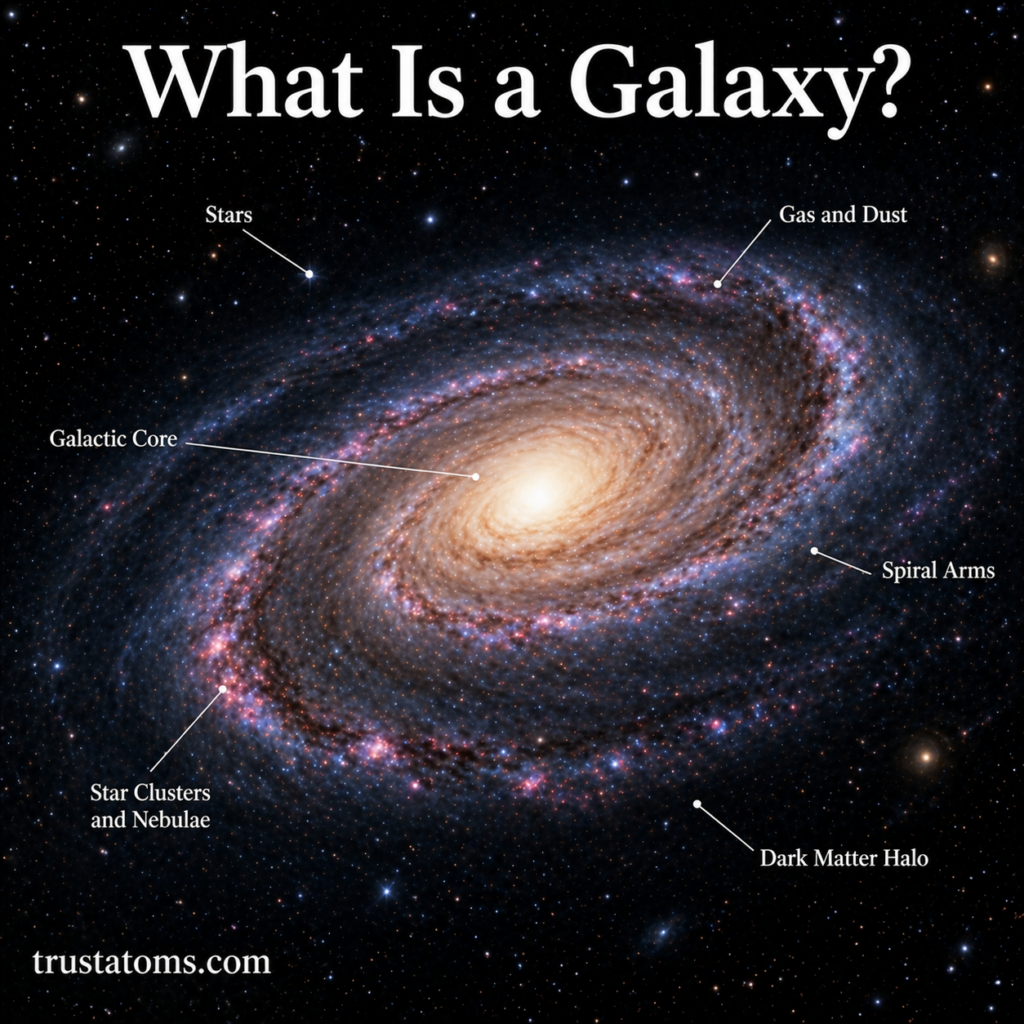
A galaxy is an enormous system of stars, gas, dust, and dark matter held together by gravity. Galaxies range from small systems containing millions of stars to giant galaxies containing trillions, and they are among the largest gravitationally bound structures studied in astronomy.
Our home galaxy, the Milky Way, is just one of billions scattered across the observable universe. Understanding galaxies is a central part of the study of astronomy because they reveal how stars form, how matter is distributed, and how cosmic structures change over time.
A galaxy is much more than a collection of stars. Its components interact through gravity, and processes such as star formation, gas movement, and encounters with neighboring galaxies continually reshape its structure.
What Makes Up a Galaxy?
Although galaxies can look very different, most contain the same basic ingredients. Their appearance depends on how those ingredients are distributed and how they move.
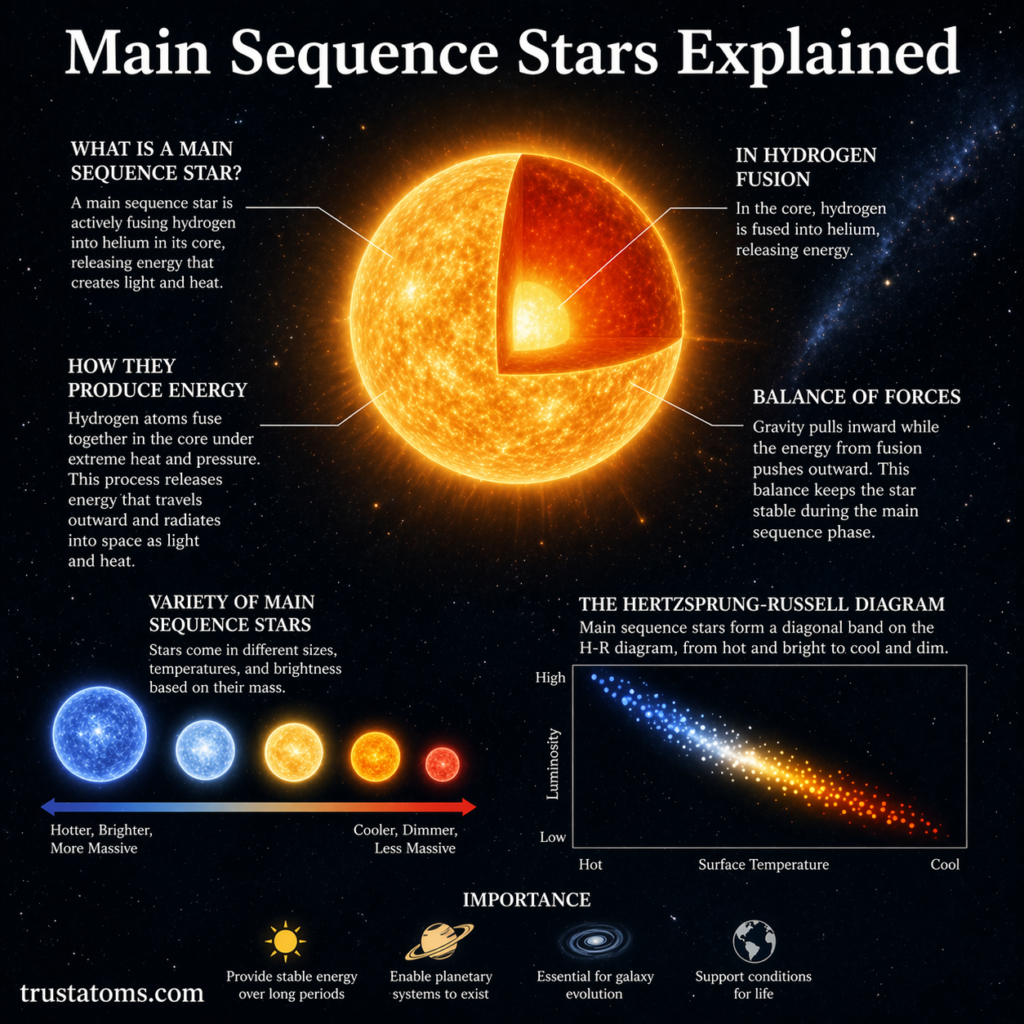
Stars and Stellar Populations
Stars produce most of the visible light associated with galaxies. They vary in mass, temperature, brightness, and age, creating differences in a galaxy’s overall color and appearance.
Young, massive stars often emit intense blue-white light, while older stellar populations generally appear redder. The distribution of these populations helps astronomers reconstruct a galaxy’s star formation history.
Interstellar Gas and Dust
Gas provides the raw material for new stars. Much of this material consists of hydrogen and helium, with smaller amounts of heavier elements produced through earlier generations of stars.
Interstellar dust consists of tiny solid particles that absorb and scatter light. Dense clouds of gas and dust can collapse under gravity, eventually forming new stars and planetary systems.
Star Clusters and Nebulae
Star clusters are groups of stars associated through their formation history and, in many cases, gravitational binding. Globular clusters contain dense populations of predominantly old stars, while open clusters generally contain fewer stars and are often younger.
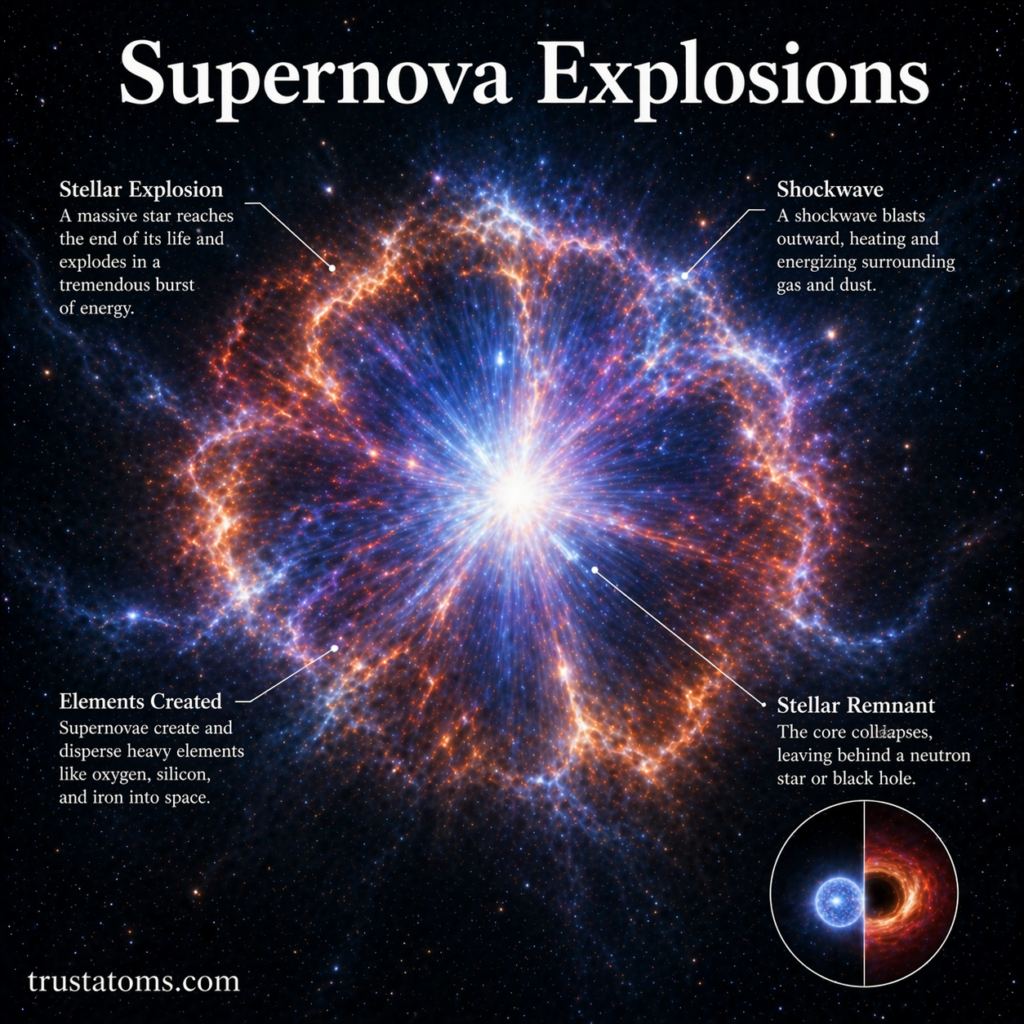
Nebulae are clouds of gas and dust. Some are active star-forming regions, while others contain material expelled by aging stars or stellar explosions.
Dark Matter Halos
Galaxies are surrounded by extended distributions of dark matter. Scientists infer this invisible component from its gravitational effects on stars, gas, and other galaxies.
Dark matter typically accounts for most of the total mass associated with a galaxy’s extended halo, even though ordinary matter produces the light we observe.
For a nearby example of these components, the Andromeda Galaxy Overview examines a large spiral galaxy whose structure can be studied in considerable detail.
Types of Galaxies: Spiral, Elliptical, and Irregular
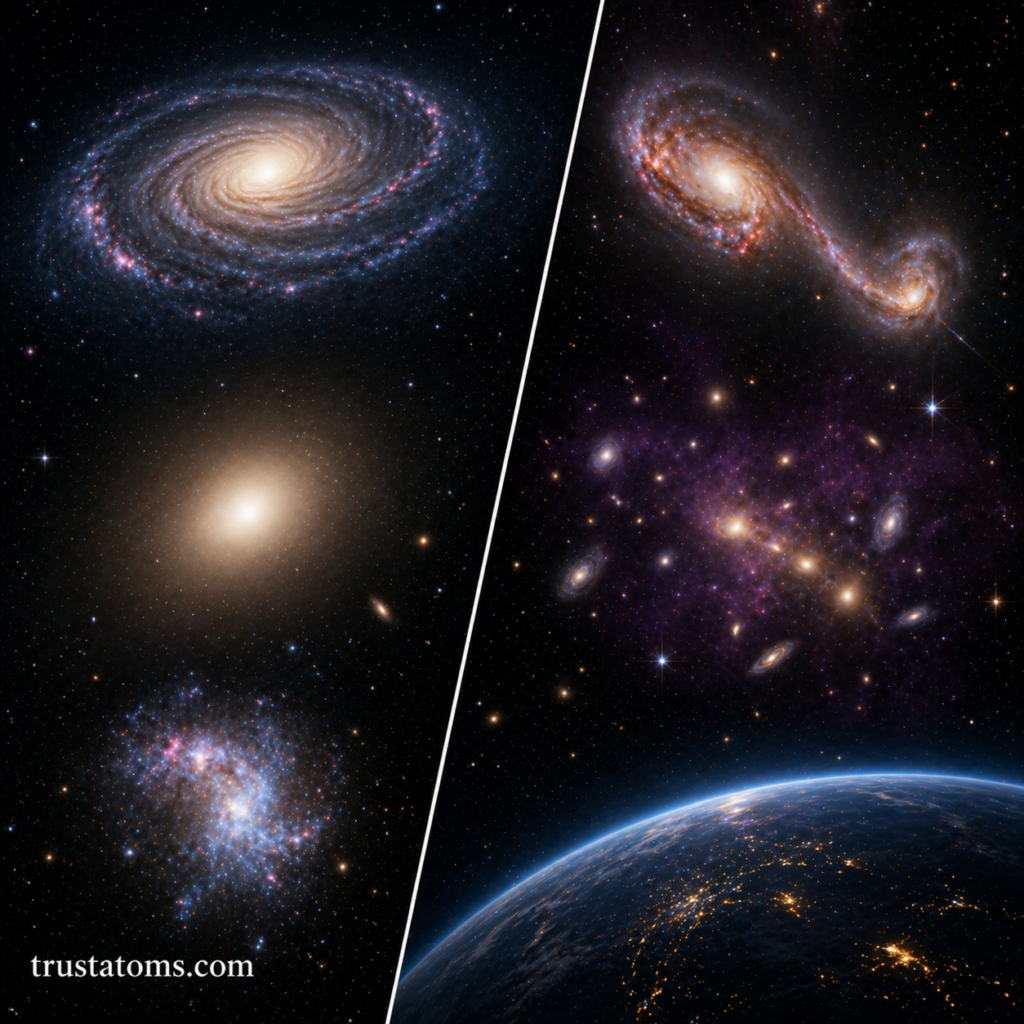
Astronomers classify galaxies partly by their visible shapes, a system known as morphological classification. The three broad categories are spiral, elliptical, and irregular galaxies, although additional classifications describe barred spirals, lenticular galaxies, and other structures.
The distinctions are explored further in Spiral, Elliptical, and Irregular Galaxies, including how appearance relates to star formation and galactic history.
Spiral Galaxies
Spiral galaxies have flattened stellar disks containing spiral arms, along with central regions that are often more densely populated with stars. Their disks frequently contain substantial amounts of gas and dust.
The spiral arms are regions where stars, gas, and dust are concentrated. They commonly contain young, bright stars and active star-forming clouds.
The Milky Way is a barred spiral galaxy, meaning a bar-shaped concentration of stars extends through its central region.
Elliptical Galaxies
Elliptical galaxies appear approximately round or oval and generally lack prominent spiral arms. Many contain predominantly older stars and relatively little cold gas available for forming new stars.
Their sizes vary considerably, from dwarf elliptical systems to enormous galaxies found near the centers of galaxy clusters. Stellar motions in elliptical galaxies are generally less organized into a rotating disk than those in spirals.
Irregular Galaxies
Irregular galaxies do not fit neatly into the spiral or elliptical categories. Some have distorted shapes resulting from gravitational interactions, while others are small systems without well-defined structures.
Many irregular galaxies contain significant gas reservoirs and active star-forming regions. The Large Magellanic Cloud, a satellite galaxy of the Milky Way, is a well-known example.
How Galaxy Types Compare
Galaxy shape offers clues about stellar populations, gas content, and past interactions, but galaxies within the same category can still differ substantially.
| Characteristic | Spiral | Elliptical | Irregular |
|---|---|---|---|
| Typical appearance | Flattened disk with spiral structure | Round or oval | No regular overall shape |
| Stellar populations | Young and old stars | Often dominated by older stars | Varied, often including young stars |
| Cold gas and dust | Often abundant | Usually relatively limited | Often significant |
| Star formation | Common in disks | Often low | Can be active |
| Example | Milky Way | Messier 87 | Large Magellanic Cloud |
These categories are descriptive rather than fixed evolutionary stages. A galaxy can change its structure through mergers, gas loss, and internal processes, but not every elliptical galaxy necessarily began as a spiral.
How Big Is a Galaxy?
Galaxy sizes vary enormously. Some dwarf galaxies span only a few thousand light-years, while the visible stellar regions of large galaxies can extend across hundreds of thousands of light-years.
A light-year is the distance light travels through a vacuum in one year, approximately 9.46 trillion kilometers. Astronomers use this unit because ordinary distances become impractical when describing galaxies.
The Milky Way’s main stellar disk is approximately 100,000 light-years across, although its stars, gas, and dark matter extend beyond the most commonly quoted disk diameter.
Worked Example: How Long Would Light Take to Cross the Milky Way?
Suppose a beam of light travels in a straight line across a distance of 100,000 light-years, approximately the diameter of the Milky Way’s main stellar disk.
- One light-year is the distance light travels in one year.
- The distance across the disk is approximately 100,000 light-years.
- At the speed of light, crossing that distance would take approximately 100,000 years.
For comparison, sunlight takes approximately eight minutes to reach Earth. The difference illustrates how much larger a galaxy is than the distances within our solar system.
Even a spacecraft traveling at a substantial fraction of the speed of light would require an extraordinarily long time to cross a galaxy. Current spacecraft travel far more slowly.
How Galaxies Form and Change Over Time
According to the standard cosmological model, galaxies developed from small variations in matter density in the early universe. Observations of the cosmic microwave background and the distribution of galaxies provide evidence for these initial differences.
Regions containing slightly more matter experienced stronger gravitational attraction. Dark matter accumulated into growing structures, while ordinary gas collected within their gravitational potential wells.
As gas cooled and became sufficiently dense, stars formed. Over time, collections of stars, gas, and dark matter developed into galaxies.
Galaxies continued growing by attracting gas and merging with smaller systems. These processes remain active throughout the observable universe.
Galaxy Mergers and Interactions
When galaxies pass close to one another, their gravitational forces can distort stellar disks, create tidal tails, and redirect gas toward central regions.
Interactions sometimes trigger bursts of star formation by compressing gas. Major mergers can also transform the structure of the participating galaxies.
Despite the term galaxy collision, direct collisions between individual stars are uncommon because the distances separating stars are enormous relative to their sizes.
Galaxy Groups and Clusters
Galaxies are not distributed randomly throughout space. Gravity organizes many of them into groups and clusters, which form part of a larger network of cosmic filaments and voids.
Galaxy groups generally contain relatively small collections of gravitationally associated galaxies. Galaxy clusters can contain hundreds or thousands of galaxies, along with hot gas and substantial amounts of dark matter.
The Milky Way belongs to the Local Group, which also includes Andromeda, the Triangulum Galaxy, and numerous smaller galaxies.
Groups and clusters can themselves belong to larger-scale associations. The relationships among these structures are examined in Galaxy Clusters and Superclusters.
Unlike many individual galaxy clusters, superclusters are not necessarily gravitationally bound as complete systems. They often describe broad regions within the cosmic web rather than single objects that will remain together indefinitely.
How Dark Matter Shapes Galaxies
Dark matter does not emit, absorb, or reflect detectable light in the way ordinary matter does. Its presence is inferred primarily from gravitational observations.
One important line of evidence comes from galaxy rotation curves. In many spiral galaxies, stars and gas far from the center orbit faster than expected if gravity came only from the visible matter.
Extended dark matter halos help explain these orbital speeds. Additional evidence comes from gravitational lensing and the motions of galaxies within clusters.
Dark matter also influences galaxy formation. In the standard cosmological model, dark matter structures provide gravitational environments where ordinary gas can accumulate and form stars.
Scientists have not yet established the particle identity of dark matter. Its gravitational effects are well supported, but determining its fundamental nature remains an active area of research.
Supermassive Black Holes at Galactic Centers
Many large galaxies contain supermassive black holes in their central regions. These objects can have masses ranging from millions to billions of times the Sun’s mass.
The Milky Way contains Sagittarius A*, a central black hole with a mass of approximately four million Suns.
Although a supermassive black hole strongly affects nearby matter, it does not supply the gravitational force holding an entire galaxy together. Stars, gas, and dark matter collectively determine the galaxy’s large-scale gravitational behavior.
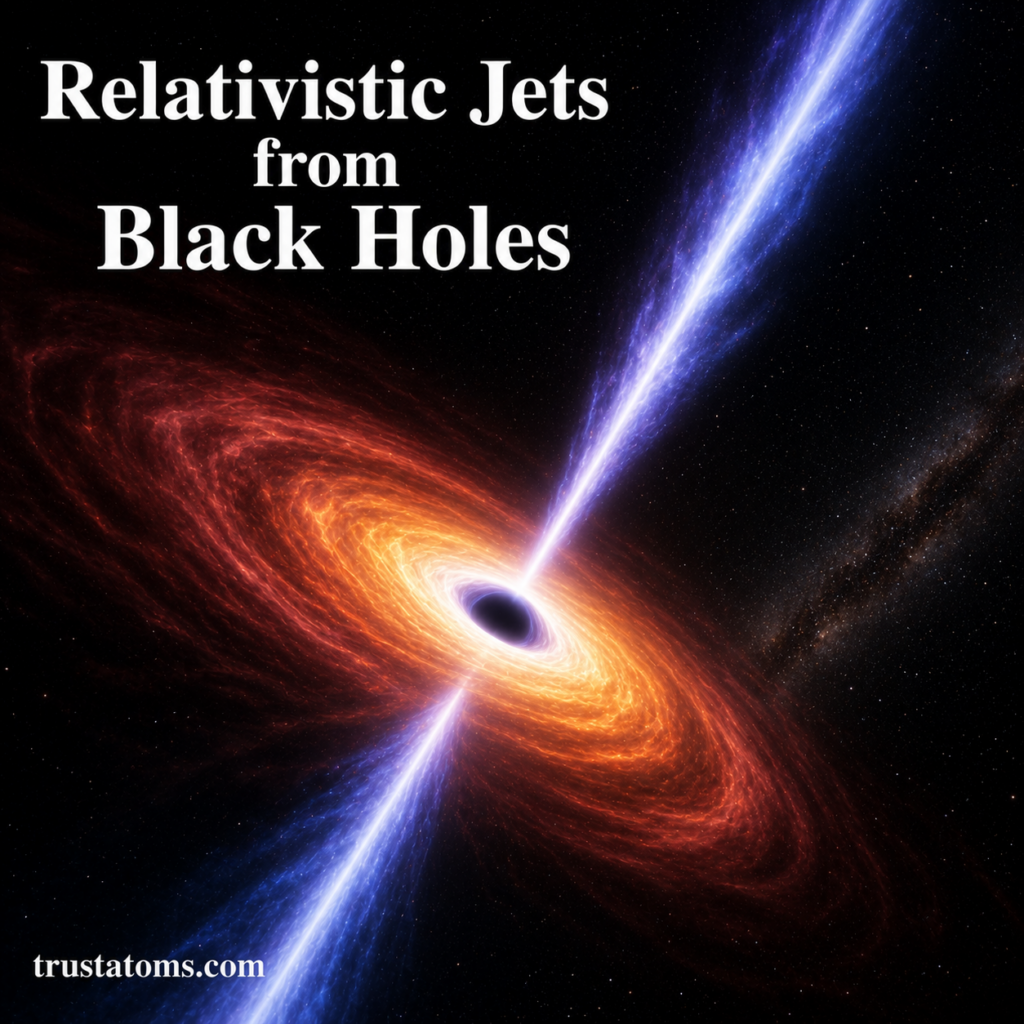
When gas falls toward an actively feeding black hole, it can become extremely hot and emit enormous amounts of radiation. Some active galactic nuclei also produce powerful jets.
These processes are explored in Black Holes at Galactic Centers, including how energetic activity can influence gas and star formation within a galaxy.
How Astronomers Study Distant Galaxies
Astronomers observe galaxies across multiple wavelengths because different forms of radiation reveal different physical components.
- Visible light: Reveals stars, galaxy shapes, and many regions of active star formation.
- Infrared radiation: Helps detect cooler material and stars obscured by dust.
- Radio waves: Reveal certain gas distributions and energetic galactic activity.
- X-rays: Trace extremely hot gas, energetic black hole environments, and other high-energy processes.
Astronomers also analyze galaxy spectra to estimate chemical composition, stellar populations, and motion. Redshift measurements help determine how light from distant galaxies has been stretched by cosmic expansion.
Because light takes time to travel, observing distant galaxies also means observing them as they existed in the past. This allows scientists to investigate how galaxy populations changed throughout cosmic history.
Common Misconceptions About Galaxies
Misconception 1: Every Galaxy Looks Like the Milky Way
Galaxies have many shapes and sizes. Some contain prominent spiral arms, others have smooth elliptical structures, and irregular galaxies lack a simple overall form.
Misconception 2: A Galaxy’s Central Black Hole Holds Everything Together
A central black hole dominates gravity only within a comparatively small region around it. The combined mass of stars, gas, and dark matter determines the gravitational structure of the galaxy as a whole.
Misconception 3: Galaxies Are Mostly Empty of Matter
Stars are separated by enormous distances, but galaxies also contain diffuse gas, dust, stellar remnants, and extended dark matter halos. Much of their mass is not visible in ordinary photographs.
Misconception 4: Galaxy Collisions Usually Mean Stars Crashing Together
Galaxy interactions primarily involve gravitational changes to the motions of stars and gas. Direct stellar collisions are rare because individual stars occupy only a tiny fraction of the volume within a galaxy.
Frequently Asked Questions
What is a galaxy in simple terms?
A galaxy is a huge collection of stars, gas, dust, and dark matter held together by gravity. Galaxies can contain millions to trillions of stars and vary greatly in size and shape.
How many galaxies are in the universe?
Astronomers estimate that the observable universe contains at least hundreds of billions of galaxies, with some estimates reaching into the trillions when very faint galaxies are included. The exact number remains uncertain because many distant galaxies are too faint to detect directly.
What galaxy is Earth located in?
Earth is located in the Milky Way, a barred spiral galaxy. Our solar system lies within its disk, approximately 26,000 light-years from the galactic center.
What is the difference between a galaxy and a solar system?
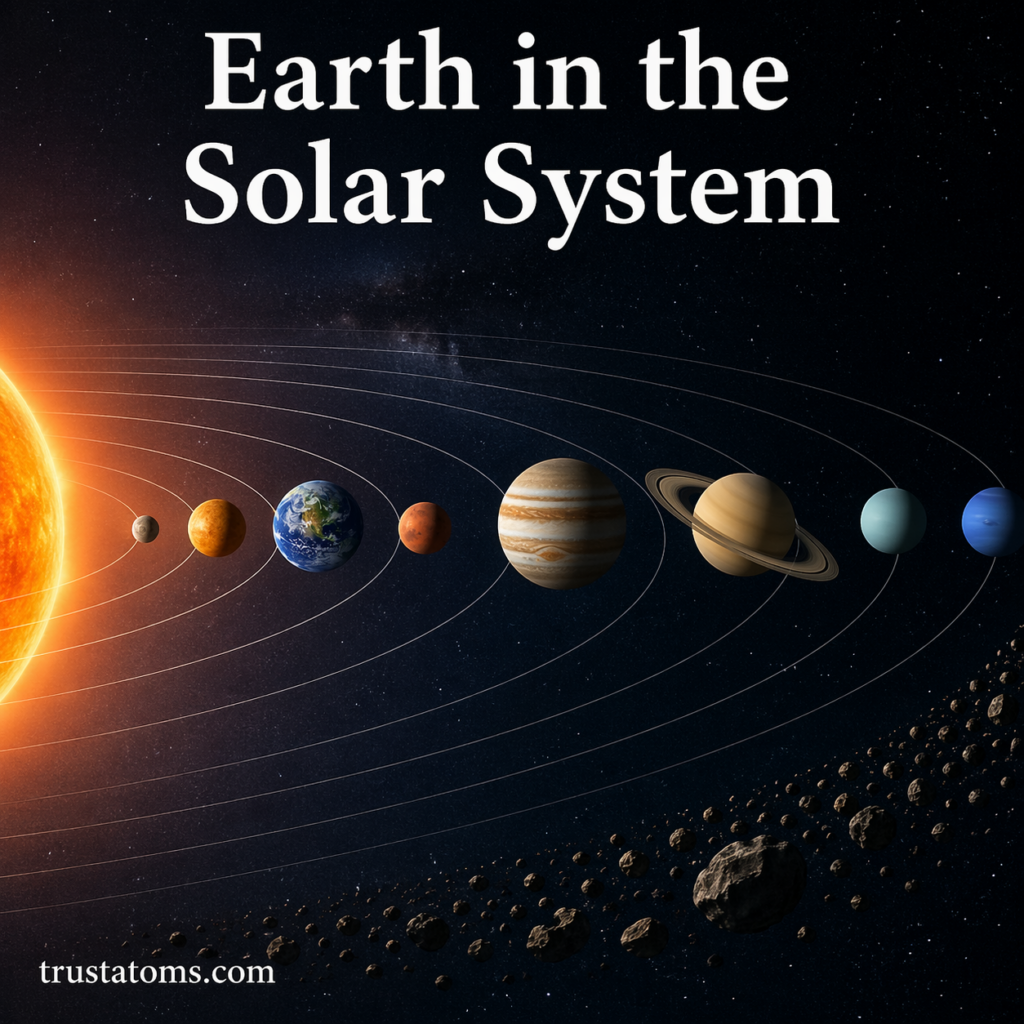
A solar system consists of a star and objects gravitationally associated with it, such as planets, moons, and smaller bodies. A galaxy contains enormous numbers of stars and planetary systems, along with gas, dust, and dark matter.
Can galaxies collide with each other?
Yes. Galaxies can interact gravitationally, pass through one another, or merge into larger systems. These encounters may distort their shapes and change their rates of star formation, although direct collisions between individual stars are uncommon.
Galaxies are gravitational systems whose visible structures reveal only part of their total matter. Their stars, gas, dark matter, and central regions evolve through processes that astronomers can investigate using observations across the electromagnetic spectrum. Studying galaxies connects the formation of individual stars with the development of the universe’s largest structures.
Sources: OpenStax Astronomy 2e; NASA Science; European Space Agency; Barbara Ryden and Bradley M. Peterson, Foundations of Astrophysics.