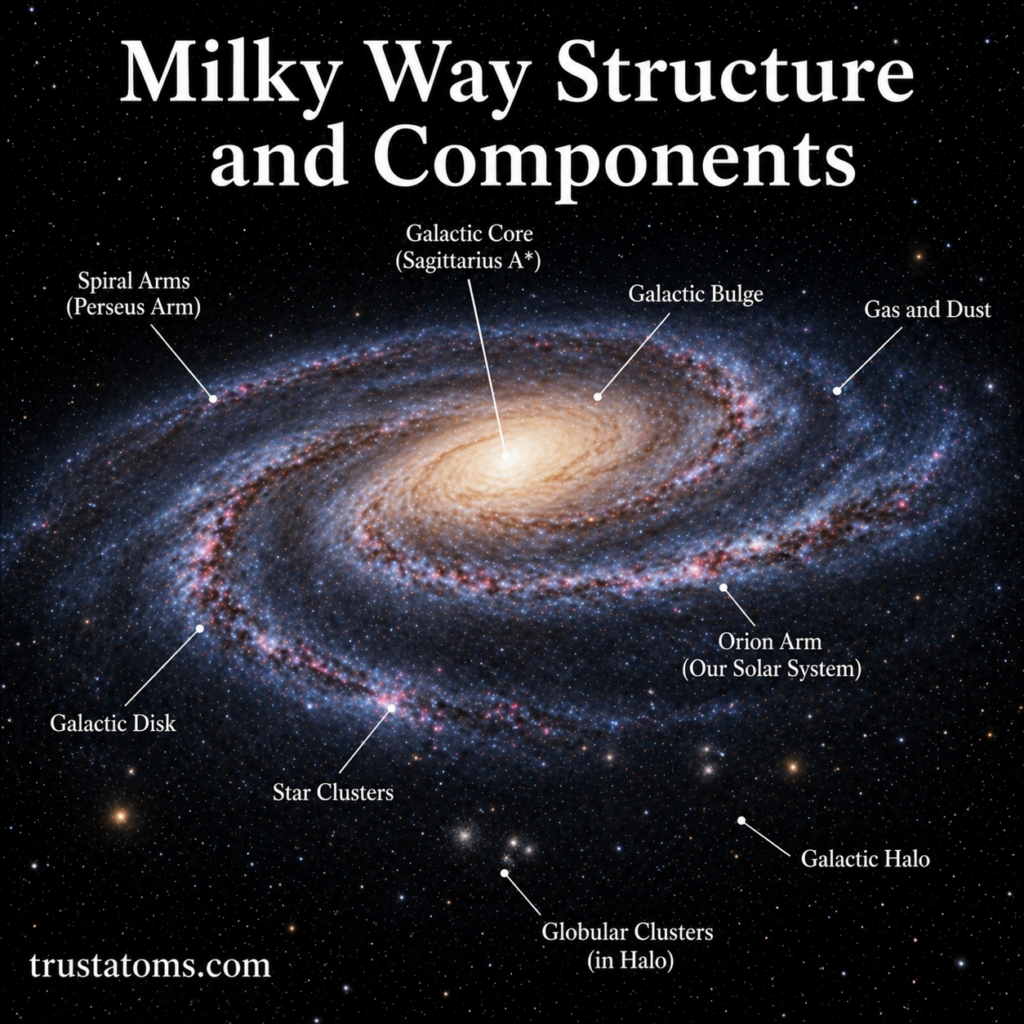
The Milky Way is a barred spiral galaxy made up of a central bulge, a flattened disk containing spiral arms, a surrounding stellar halo, and an extensive dark matter halo. These interconnected components contain the stars, gas, dust, and gravitational structure that shape our galaxy and determine how material moves through it.
The Milky Way is our home galaxy—a vast spiral system containing hundreds of billions of stars, extensive clouds of gas and dust, and an enormous amount of dark matter. Understanding its structure helps researchers studying astronomy and the universe determine where our Solar System belongs and how galaxies develop over time.
Overview of the Milky Way Galaxy
The Milky Way is classified as a barred spiral galaxy because its central region contains an elongated bar of stars, with spiral arms extending through the surrounding disk. Viewed from outside, it would resemble a flattened, rotating system with a bright central concentration.
Astronomers estimate that the Milky Way contains roughly 100–400 billion stars. Its main stellar disk spans approximately 100,000 light-years, although its outer boundaries are difficult to define precisely. Scientists have also identified stellar populations indicating that parts of the galaxy formed more than 13 billion years ago.
Our Solar System lies approximately 26,000 light-years from the galactic center, within a smaller spiral structure called the Orion Spur. We observe the Milky Way from inside its disk rather than from a distant viewpoint.
For comparison, the neighboring Andromeda galaxy is another large spiral system. The Andromeda Galaxy Overview explains how its structure compares with that of our own galaxy.
The Galactic Center and Sagittarius A*
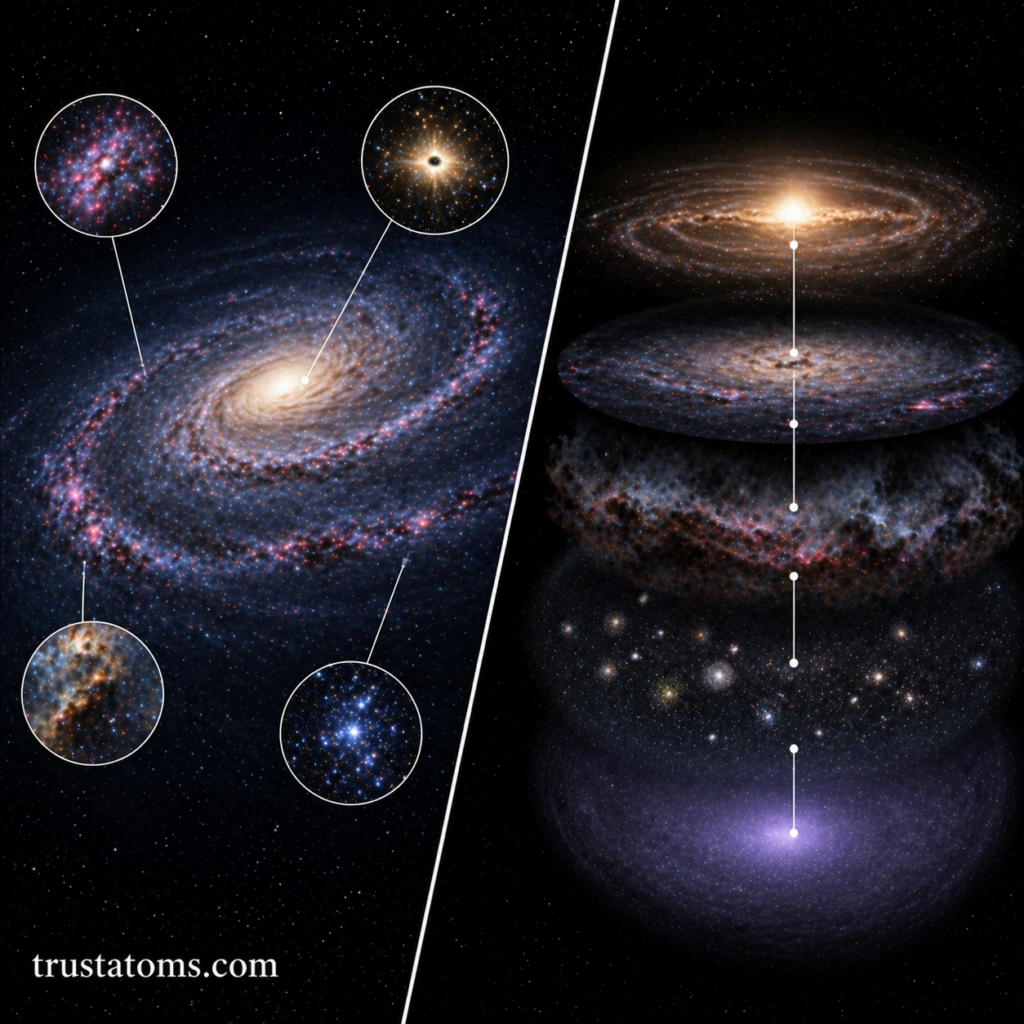
The galactic center is a densely populated region containing stars, gas, dust, and strong gravitational interactions. Much of its visible light is obscured by intervening dust, so astronomers study it using infrared, radio, and other wavelengths.
At the center lies Sagittarius A*, a supermassive black hole with a mass of approximately four million Suns. Scientists established its presence by tracking stars moving rapidly around an apparently invisible central object.
Sagittarius A* strongly influences nearby stars and gas, but it does not control the motion of the entire galaxy by itself. The combined gravitational effects of stars, gas, and dark matter determine the Milky Way’s large-scale structure.
The Central Bulge and Galactic Bar
Surrounding the innermost galactic center is a dense concentration of stars called the bulge. The Milky Way’s bulge has a boxy or peanut-shaped structure associated with its central stellar bar.
The bulge contains many older stars, although its stellar populations vary in age and chemical composition. Compared with the outer disk, stars in this region are more densely concentrated and follow a wider range of orbital paths.
The central bar is an elongated distribution of stars that rotates through the galaxy. Its gravitational influence can redistribute gas and affect stellar orbits, helping shape the inner disk and surrounding spiral patterns.
The Galactic Disk: Where Most Visible Structure Lies
The galactic disk is a broad, flattened region containing many of the Milky Way’s stars, along with much of its cold gas and dust. It includes the spiral arms, molecular clouds, open star clusters, and numerous regions where new stars form.
Astronomers distinguish between two overlapping stellar components:
- Thin disk: Contains many younger stars, substantial interstellar gas, and active star-forming regions concentrated near the galactic plane.
- Thick disk: Contains a larger proportion of older stars whose distribution extends farther above and below the galactic plane.
The disk rotates around the galactic center, but its stars do not move as a single rigid structure. Their orbital speeds and paths depend on the galaxy’s gravitational field.
Spiral Arms and Star-Forming Regions
The Milky Way’s spiral arms are curved regions containing concentrations of gas, dust, young stars, and stellar nurseries. They make the galaxy’s spiral structure recognizable, although mapping them is difficult because we observe them from within the disk.
Major named structures include the Perseus Arm, Sagittarius Arm, and Scutum-Centaurus Arm. The Orion Spur, sometimes called the Local Arm, contains our Solar System.
Spiral arms are not fixed collections of stars moving together indefinitely. Stars can enter and leave spiral regions as they orbit, while the arms themselves reflect complex patterns in the disk’s density and motion.
The Milky Way belongs to a broader family of galactic shapes discussed in Spiral, Elliptical, and Irregular Galaxies.
The Stellar Halo Surrounding the Disk
The stellar halo is a diffuse, roughly spherical distribution of stars surrounding the Milky Way’s central regions and disk. Its stars are far more widely separated than those in the disk, making the halo difficult to observe directly.
Many halo stars are old and have relatively low abundances of heavy elements. Their chemical compositions and orbital motions provide evidence about the galaxy’s early formation and its interactions with smaller galaxies.
The halo also contains stellar streams: elongated groups of stars that can form when the Milky Way’s gravity disrupts smaller galaxies or star clusters. These streams help astronomers reconstruct past galactic mergers.
The Milky Way’s Dark Matter Halo
Beyond the visible stellar structures lies a much larger halo dominated by dark matter. This material does not emit, absorb, or reflect light in a way that telescopes can directly detect, but its gravitational effects are measurable.
Evidence for dark matter includes the orbital speeds of stars and gas, which cannot be fully explained by the gravity of visible material alone. The motions of distant halo objects and satellite galaxies provide additional constraints.
Current models indicate that dark matter accounts for most of the Milky Way’s total mass. Its halo extends far beyond the bright stellar disk and influences how smaller galaxies and stellar streams move around the Milky Way.
Star Clusters in the Milky Way
The galaxy contains two main types of star clusters.
Open Star Clusters
Open clusters are relatively loose groups of stars that generally formed together from the same molecular cloud. They are common in the galactic disk and often contain young stars, although some open clusters survive for billions of years.
Globular Star Clusters
Globular clusters are densely packed, gravitationally bound collections containing thousands to millions of stars. Many orbit within the galactic halo and contain ancient stellar populations.
By comparing the ages, compositions, and motions of cluster stars, astronomers can investigate how different parts of the Milky Way developed.
Gas, Dust, and the Formation of New Stars
Interstellar gas and dust are concentrated primarily in the galactic disk. Cold molecular clouds contain material that can collapse under gravity, producing new stars and, in some cases, planetary systems.
Dust grains absorb and scatter visible light, obscuring distant regions of the Milky Way. Infrared and radio observations help astronomers investigate structures hidden behind these clouds.
Massive young stars can illuminate surrounding gas, creating emission nebulae. Stellar winds and supernova explosions also disturb interstellar material, sometimes dispersing clouds and sometimes compressing nearby gas.
How the Milky Way Rotates
The Milky Way rotates differentially, meaning objects at different distances from the galactic center do not all complete their orbits in the same amount of time.
The Sun travels around the galactic center at roughly 220–240 kilometers per second and takes approximately 225–250 million years to complete one orbit. This interval is sometimes called a galactic year.
As a concrete example, light travels from the Sun to Earth in about eight minutes, but light from the galactic center takes roughly 26,000 years to reach us. These distances illustrate why mapping the entire Milky Way requires observations of objects far beyond our immediate stellar neighborhood.
Astronomers use measurements of stellar positions, distances, velocities, and chemical compositions to reconstruct the galaxy’s three-dimensional structure. Missions such as the European Space Agency’s Gaia observatory have greatly improved measurements of stellar motion.
Frequently Asked Questions
Where Is Earth Located in the Milky Way?
Earth is located within the Solar System, which lies in the Orion Spur of the Milky Way’s disk. The Sun is approximately 26,000 light-years from the galactic center, well outside the dense central bulge.
What Is at the Center of the Milky Way?
The center contains a dense concentration of stars, gas, and dust surrounding Sagittarius A*, a supermassive black hole with a mass of approximately four million Suns. The black hole strongly affects nearby objects, while the galaxy’s larger-scale motion depends on its overall mass distribution.
How Do Scientists Know the Milky Way Is a Spiral Galaxy?
Astronomers map the positions and motions of stars, gas clouds, and star-forming regions using visible-light, infrared, and radio observations. These measurements reveal a flattened rotating disk, a central stellar bar, and curved concentrations of gas and young stars consistent with a barred spiral galaxy.
The Milky Way is not a single uniform collection of stars but a layered system whose disk, bulge, spiral arms, and halos have distinct structures and histories. Studying their motions and chemical compositions helps astronomers identify where stars formed, how smaller galaxies were absorbed, and how invisible matter shapes galactic motion. Together, these observations provide a detailed picture of the galaxy that contains our Solar System.
Sources: NASA Imagine the Universe; European Space Agency Gaia Mission; Binney and Tremaine, Galactic Dynamics.