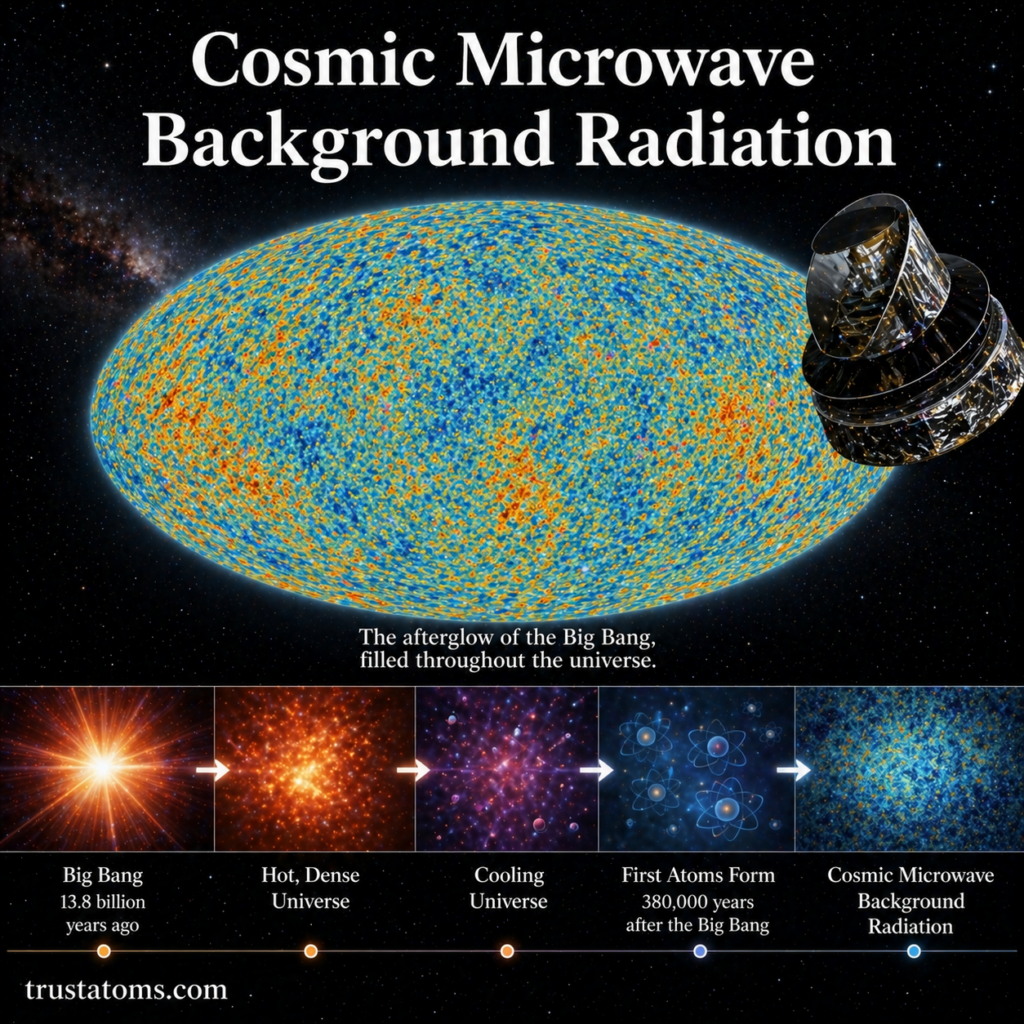
Cosmic microwave background radiation (CMB) is faint electromagnetic radiation that fills the universe and provides evidence of its early hot, dense state. According to the standard Big Bang model, this radiation began traveling freely approximately 380,000 years after the universe’s early expansion began, making it the oldest electromagnetic light astronomers can directly observe.
Today, the CMB has an average temperature of approximately 2.725 kelvin, just above absolute zero. Studying its temperature, spectrum, and tiny variations allows researchers in astronomy and cosmology to investigate the universe’s composition, expansion history, and the origins of large-scale cosmic structure.
What Is Cosmic Microwave Background Radiation?
The cosmic microwave background is a nearly uniform field of microwave radiation detectable in every direction across the sky. It represents light that last scattered from matter when the early universe cooled enough for neutral atoms to form.
Unlike radiation produced by individual stars or galaxies, the CMB originates from a much earlier stage of cosmic history. Its measured spectrum closely matches the thermal radiation expected from a nearly perfect blackbody.
For a broader introduction to this ancient radiation and its scientific significance, see the cosmic background radiation overview.
Scientists combine CMB observations with galaxy measurements and other evidence to calculate cosmological parameters. These measurements contribute to estimates of the universe’s age, which place it at approximately 13.8 billion years within the standard cosmological model.
The CMB also helps researchers evaluate different cosmological models compared against observed patterns rather than relying on theoretical assumptions alone.
How the Cosmic Microwave Background Formed
According to the hot Big Bang model, the early universe contained an extremely hot mixture of particles and radiation. Free electrons scattered photons repeatedly, preventing light from traveling substantial distances without interacting with matter.
As the universe expanded, its temperature decreased. Eventually, conditions allowed electrons to combine with atomic nuclei, primarily forming neutral hydrogen and helium atoms.
This period is commonly called recombination, although it involved the first widespread formation of neutral atoms rather than atoms combining again after an earlier neutral phase.
With far fewer free electrons available to scatter photons, the universe became increasingly transparent. Radiation could then travel across enormous distances, creating what scientists call the surface of last scattering.
The photons released from their frequent interactions with matter during this transition are the radiation observed today as the CMB.
Why Ancient Light Appears as Microwaves Today
The radiation associated with the surface of last scattering originally had a much higher temperature than the CMB measured today. At that time, the universe was approximately 3,000 kelvin, and the radiation was concentrated at much shorter wavelengths.
As space expanded, the wavelengths of traveling photons increased. This process, called cosmological redshift, reduced the energy of individual photons and shifted the radiation toward the microwave region of the electromagnetic spectrum.
A concrete example shows the scale of this change. The universe has expanded by a factor of approximately 1,100 since the CMB was released. A photon originally traveling with a wavelength of one micrometer would therefore have a wavelength of approximately 1.1 millimeters today.
This example illustrates wavelength stretching rather than describing the entire CMB spectrum. The actual radiation contains a broad distribution of wavelengths corresponding to its present temperature.
How Scientists Discovered the Cosmic Microwave Background

In 1965, Arno Penzias and Robert Wilson reported an unexpected microwave signal while working with a sensitive radio antenna at Bell Telephone Laboratories.
The signal persisted regardless of the direction in which they pointed the antenna. After investigating possible sources of interference, they recognized that the unexplained radiation was consistent with a cosmic background.
At approximately the same time, researchers at Princeton University were preparing to search for radiation predicted by hot-universe cosmological models. The two groups connected the observation with the theoretical prediction.
Penzias and Wilson received the 1978 Nobel Prize in Physics for their discovery. The finding provided powerful observational support for the hot Big Bang model because it matched the expectation that radiation from an earlier, hotter universe should remain detectable.
What Tiny Temperature Differences Reveal
Although the CMB is remarkably uniform, its temperature varies slightly across the sky. After accounting for the much larger apparent temperature pattern caused by our motion relative to the CMB, the remaining primordial variations are typically only tens of microkelvin.
These differences reflect variations in the density and gravitational conditions of the early universe. Over time, gravity amplified some of these variations, contributing to the development of galaxies and galaxy clusters.
The near-uniform temperature also raises a scientific question: why do regions separated by enormous distances have such similar properties?
This question is explored through the horizon problem in the universe. Cosmic inflation is one proposed explanation, suggesting that regions now widely separated were once close enough to share similar physical conditions.
By analyzing the size and distribution of temperature fluctuations, astronomers can estimate the amounts of ordinary matter, dark matter, and other components used in cosmological models.
Mapping the Cosmic Microwave Background
Specialized telescopes measure microwave radiation across the sky and separate the CMB signal from emissions produced by dust, gas, and other sources within our galaxy.
Methods used in cosmic background light mapping allow scientists to construct detailed maps of temperature differences and polarization patterns.
Three major space missions transformed these measurements:
| Mission | Major Contribution |
|---|---|
| COBE | Measured the CMB’s precise blackbody spectrum and detected large-scale temperature variations. |
| WMAP | Produced detailed full-sky measurements that improved estimates of cosmological parameters. |
| Planck | Measured temperature and polarization patterns with greater sensitivity and angular resolution. |
These missions established increasingly precise measurements of the CMB’s statistical properties. Ground-based and balloon-borne experiments continue investigating smaller-scale features and polarization signals.
What the CMB Tells Scientists About the Universe
The CMB provides several independent tests of modern cosmological models. Its measurements help researchers investigate:
- Cosmic composition: The relative amounts of ordinary matter, dark matter, and dark energy inferred within a cosmological model.
- Spatial geometry: Whether the observable universe is consistent with flat, positively curved, or negatively curved space.
- Early density variations: The initial patterns from which large-scale cosmic structures developed.
- Expansion history: Constraints on the universe’s evolution when combined with other astronomical measurements.
- Early-universe physics: Tests of proposed processes such as cosmic inflation and possible primordial gravitational waves.
These conclusions depend on combining observations with physical models. The CMB does not independently reveal every property of the universe, and scientists continue testing whether the standard cosmological model fully explains the available evidence.
Can the Cosmic Microwave Background Be Seen or Heard?
Human eyes cannot detect microwave radiation because its wavelengths lie outside the visible spectrum. Scientists use radio receivers, microwave detectors, and specialized telescopes to measure it.
Colorful CMB maps are therefore visual representations of measured temperature differences rather than ordinary photographs. Their colors are assigned to make extremely small variations easier to distinguish.
The CMB is also not sound traveling through space. Although scientists can convert measurements into audible signals for educational purposes, the radiation itself consists of electromagnetic waves.
The Big Bang Evidence and Beliefs About Creation
According to the scientific explanation supported by modern cosmological observations, the cosmic microwave background is radiation from an early stage when the universe was hot, dense, and becoming transparent. Its measured spectrum and temperature variations strongly support the hot Big Bang model, while scientists continue investigating details of the universe’s earliest conditions.
Religious traditions approach questions of cosmic origins in different ways. Many hold that God created the universe and life. Young-earth creationists generally believe Earth and the universe are thousands of years old and interpret scientific evidence differently. Old-earth creationists accept scientific estimates of cosmic and terrestrial ages while believing God created the universe. Theistic evolution accepts scientific ages and biological evolution as processes through which God created life.
Science examines testable natural explanations through observation, measurement, and prediction. Faith perspectives also address questions of purpose, meaning, and creation. People hold different views about how these approaches relate, but religious interpretations are distinct from the empirical evidence used to evaluate cosmological models.
Frequently Asked Questions
Is the cosmic microwave background the oldest light in the universe?
It is the oldest electromagnetic radiation that astronomers can directly observe from the early universe. Light existed before the CMB was released, but the hot plasma scattered photons so frequently that ordinary electromagnetic observations cannot reveal conditions from that earlier period directly.
Does the cosmic microwave background prove the Big Bang?
The CMB provides strong observational evidence supporting the hot Big Bang model, especially because its nearly perfect blackbody spectrum matches theoretical predictions. Scientific models are evaluated through multiple independent observations rather than a single measurement, so astronomers also examine cosmic expansion, primordial element abundances, and galaxy distributions.
Is the cosmic microwave background still changing?
Yes. As the universe expands, CMB photon wavelengths continue to stretch and the radiation’s average temperature gradually decreases. Its observable patterns also change over cosmological timescales, although these changes are generally too small to notice during a human lifetime.
The cosmic microwave background preserves a measurable record of the universe when neutral atoms first formed and radiation began traveling freely across space. Its temperature variations help scientists reconstruct the conditions that preceded galaxy formation, while precise measurements constrain the universe’s composition and expansion history. Continued observations may reveal additional details about early-universe physics that existing cosmological models have not yet resolved.
Sources: NASA, Wilkinson Microwave Anisotropy Probe educational resources on the cosmic microwave background; Planck Collaboration, “Planck 2018 Results. VI. Cosmological Parameters” (2020); John C. Mather and George F. Smoot, Nobel Prize in Physics 2006 scientific background on cosmic microwave background measurements.