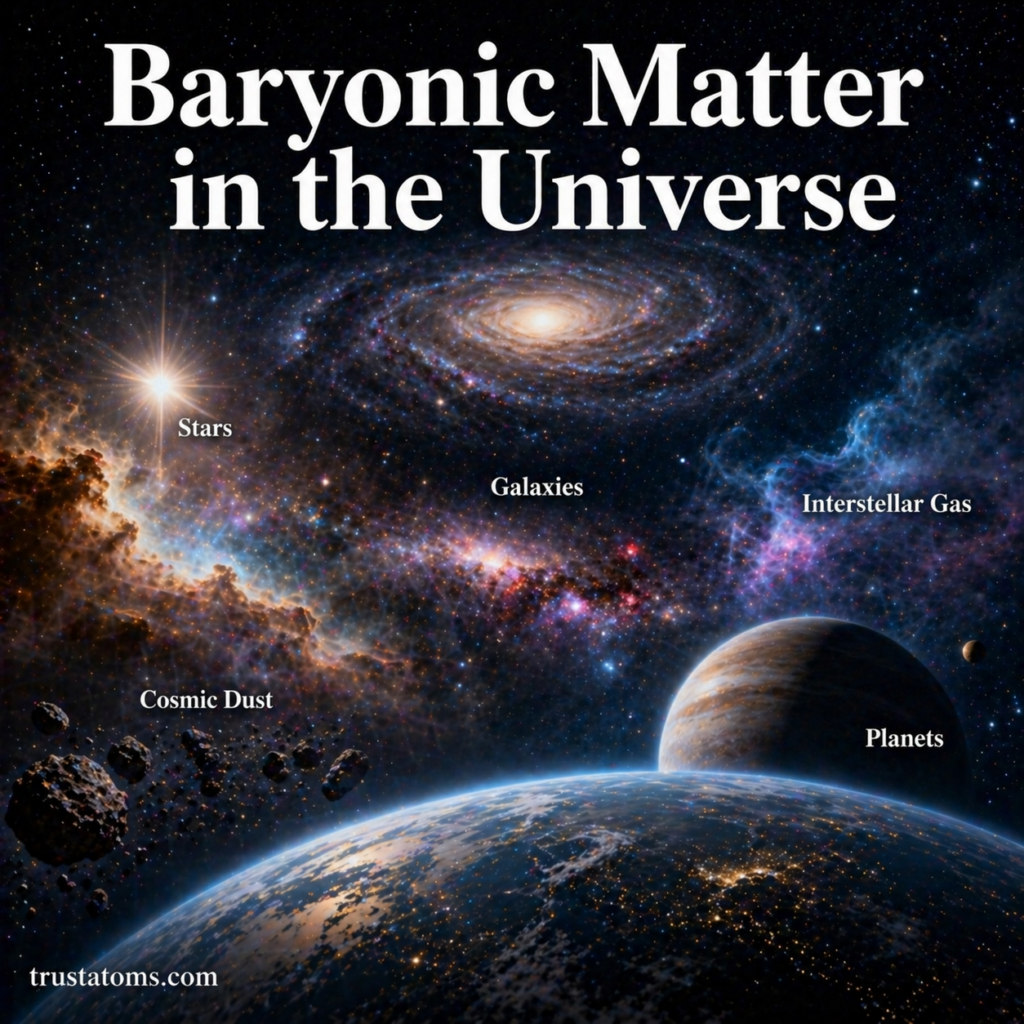
Baryonic matter is the ordinary matter made primarily from protons and neutrons that forms atoms, stars, planets, gas, and living organisms. Although it makes up everything familiar in our surroundings, baryonic matter accounts for only about 5% of the universe’s total mass-energy content.
In the study of astronomy, understanding baryonic matter helps scientists explain how galaxies form, how stars produce light, and where the universe’s ordinary matter is distributed. Much of this material is not contained in bright stars but exists as diffuse gas that can be difficult to detect.
By measuring baryonic matter and comparing it with dark matter and dark energy, astronomers can investigate the physical processes responsible for cosmic structures.
What Is Baryonic Matter?
Baryonic matter is matter containing baryons, a family of subatomic particles that includes protons and neutrons. These particles form atomic nuclei, which combine with electrons to create atoms.
Hydrogen, helium, oxygen, carbon, and iron are examples of elements built from baryonic matter. Their atoms can combine into molecules and larger structures, producing everything from interstellar clouds to rocky planets.
Common examples include:
- Stars and stellar remnants
- Planets, moons, and asteroids
- Interstellar gas and cosmic dust
- Gas between galaxies
- Plants, animals, and human bodies
Scientists commonly use the term ordinary matter for this material, although electrons themselves are leptons rather than baryons. Electrons are included when describing the atoms and plasma associated with ordinary matter.
How Much of the Universe Is Baryonic Matter?
Measurements of the cosmic microwave background and other cosmological observations indicate that ordinary matter represents only a small portion of the universe’s total mass-energy density.
According to the standard cosmological model, the approximate composition is:
- 5% ordinary matter: Atoms, gas, stars, planets, and related material.
- 27% dark matter: Matter inferred primarily through its gravitational effects.
- 68% dark energy: The component associated with the observed accelerated expansion of the universe.
These percentages describe the universe’s total mass-energy content, not the number of objects or the volume of space occupied by each component.
A Simple Example of Cosmic Composition
Imagine representing the universe’s total mass-energy content with 100 equally sized blocks. Approximately five blocks would represent ordinary matter, 27 would represent dark matter, and 68 would represent dark energy.
Even though the five ordinary-matter blocks represent everything from stars to living organisms, most of the universe’s mass-energy budget belongs to components that scientists investigate through indirect measurements.
The Building Blocks of Ordinary Matter
Baryonic matter forms increasingly complex structures through interactions among fundamental particles.
- Quarks: Fundamental particles that combine to form protons and neutrons.
- Protons and neutrons: Baryons that make up ordinary atomic nuclei.
- Atomic nuclei: Structures containing protons and, except for ordinary hydrogen nuclei, neutrons.
- Atoms: Nuclei surrounded by electrons.
- Molecules and larger structures: Combinations of atoms that form gases, liquids, solids, and astronomical objects.
The strong nuclear interaction binds quarks within baryons and helps hold atomic nuclei together. Electromagnetic interactions govern much of the behavior of atoms, molecules, and light.
Where Baryonic Matter Exists in Galaxies
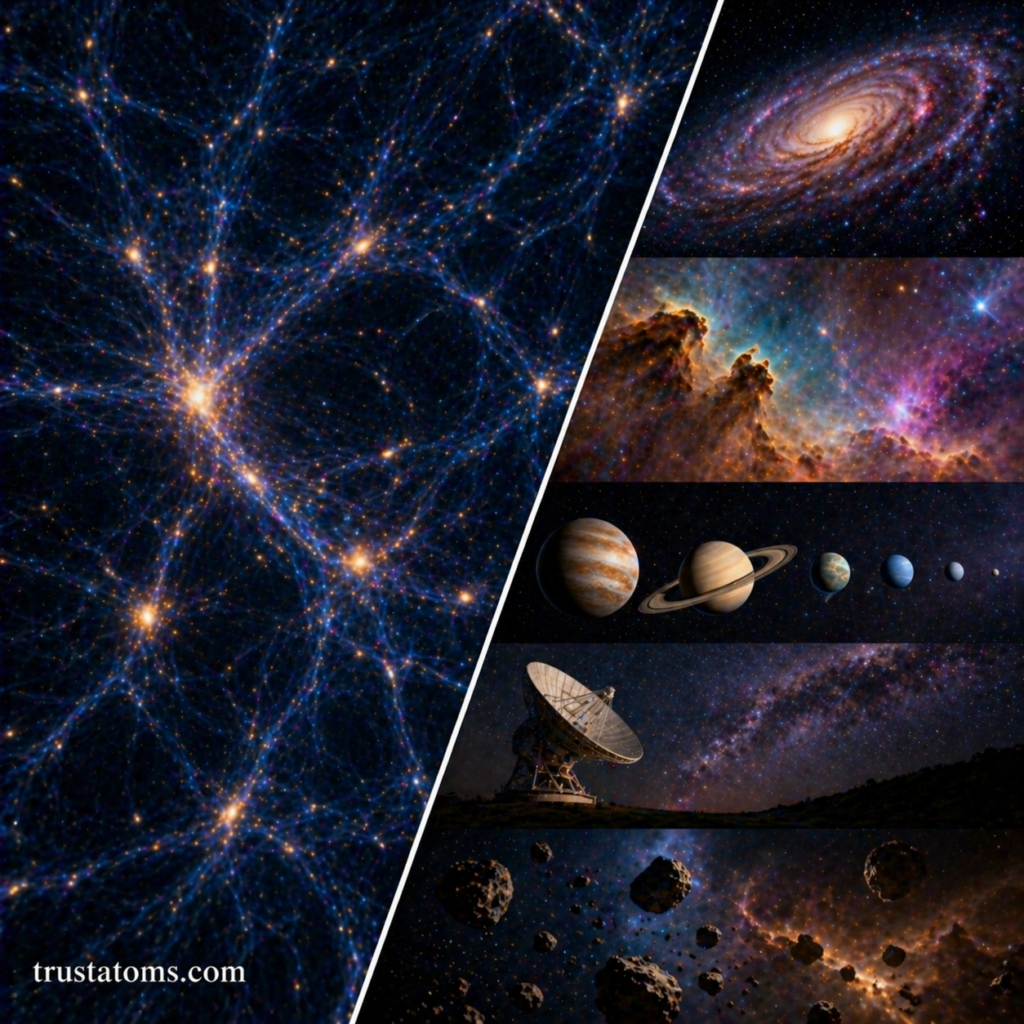
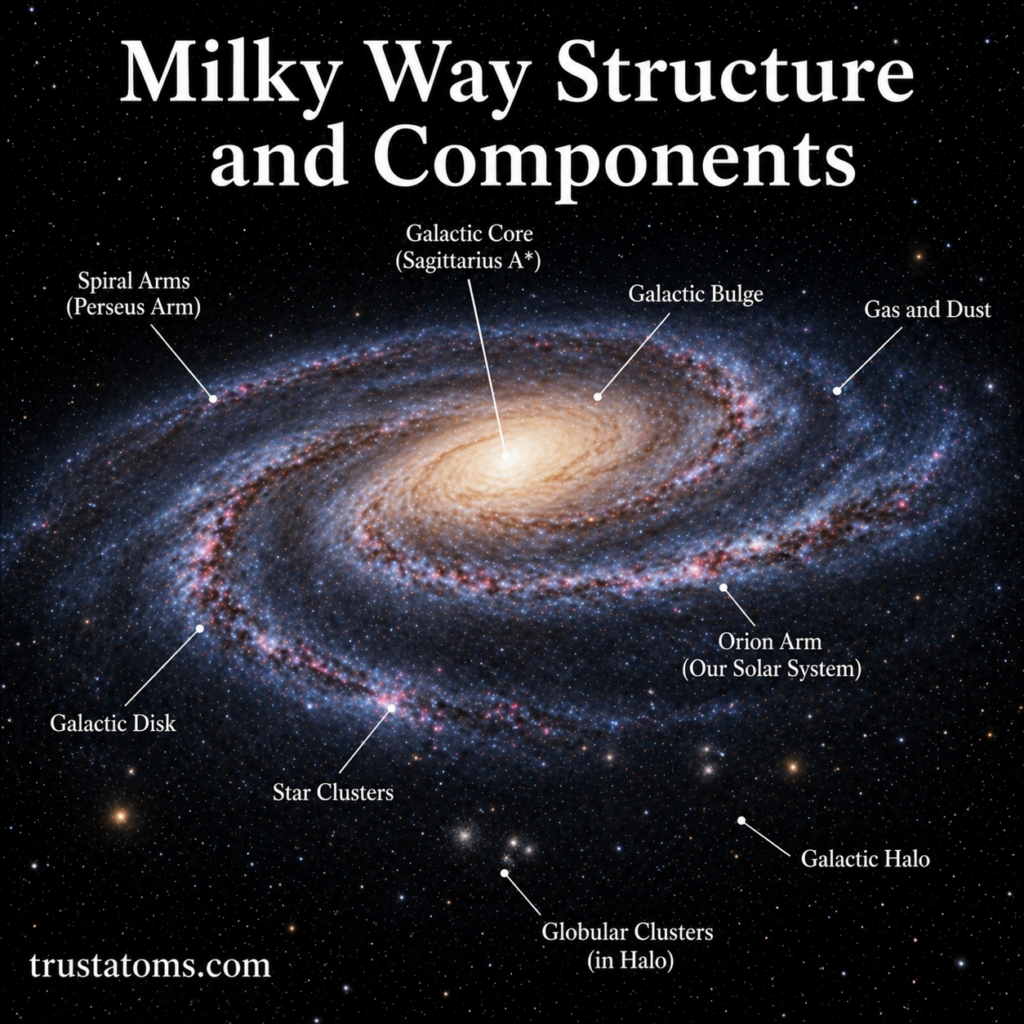
Within galaxies, baryonic matter exists in several forms. Stars are among the most visible examples because they produce radiation through processes occurring in their interiors and atmospheres.
However, galaxies also contain substantial quantities of gas. Neutral hydrogen can be detected through radio observations, while ionized gas produces radiation at various wavelengths.
Cosmic dust consists of tiny solid particles containing elements such as carbon, oxygen, silicon, and iron. Dust absorbs and scatters some starlight while emitting radiation at infrared wavelengths.
Galaxies also contain compact stellar remnants, including white dwarfs and neutron stars. Their matter remains baryonic even when compressed to extremely high densities.
The Missing Baryon Problem
For years, astronomers found less ordinary matter in nearby galaxies and observable gas than cosmological measurements predicted should exist.
This discrepancy became known as the missing baryon problem. It did not mean that ordinary matter had disappeared, but that a substantial fraction was difficult to detect using available observations.
Research has provided increasing evidence that much of this previously unaccounted-for material exists in diffuse gas between galaxies.
Important locations include:
- Warm-hot intergalactic gas distributed along cosmic filaments
- Diffuse material surrounding galaxies
- Intergalactic medium at very high temperatures
Some of this gas reaches temperatures of hundreds of thousands to millions of degrees. Despite being hot, its extremely low density makes it difficult to observe directly.
Astronomers investigate this material through absorption signatures, ultraviolet and X-ray observations, and measurements involving radio signals from distant sources. These methods have strengthened the evidence for diffuse baryons outside galaxies.
Baryonic Matter and the Early Universe
According to the Big Bang model, the early universe was extremely hot and dense. As it expanded and cooled, conditions allowed protons and neutrons to form and participate in nuclear reactions.
During the first few minutes, primordial nucleosynthesis produced much of the universe’s initial helium, along with hydrogen nuclei and small quantities of other light nuclei.
Approximately 380,000 years after the Big Bang, according to standard cosmological calculations, the universe cooled enough for neutral atoms to form efficiently. This allowed radiation to travel much more freely through space.
Baryonic matter played a key role in the formation of the first structures. Gravity gradually concentrated gas into denser regions, where the earliest stars and galaxies could develop.
Evidence for dark matter suggests that invisible mass concentrations helped establish the gravitational environments in which ordinary matter accumulated. Understanding Dark Matter Evidence helps explain why scientists include this component in models of early structure formation.
These processes contributed to the development of the Cosmic Web Structure, a network of filaments, clusters, and comparatively empty regions extending across enormous distances.
How Baryonic Matter Interacts with Physical Forces
Unlike dark matter, baryonic matter interacts through multiple forces.
Gravity attracts matter and influences the formation of stars, planets, and galaxies. Electromagnetic interactions allow ordinary matter to absorb, emit, and scatter radiation.
The strong nuclear interaction binds quarks into baryons and contributes to nuclear stability. The weak interaction participates in certain radioactive processes and nuclear reactions, including processes associated with stellar energy production.
Because ordinary matter can exchange energy through radiation and collisions, gas clouds can cool, contract, and form dense structures. This behavior differs from the predominantly gravitational interactions attributed to dark matter in standard cosmological models.
Baryonic Matter Compared with Dark Matter
Baryonic matter and dark matter both contribute to gravity, but they behave differently in important ways.
| Property | Baryonic Matter | Dark Matter |
|---|---|---|
| Composition | Ordinary matter containing protons and neutrons | Unknown physical composition |
| Interaction with light | Can emit, absorb, and scatter radiation | No established significant electromagnetic interaction |
| Cosmic abundance | About 5% of total mass-energy | About 27% of total mass-energy |
| Typical structures | Stars, gas, planets, and dust | Extended gravitational halos and large-scale concentrations |
Scientists infer dark matter through effects such as galaxy rotation, gravitational lensing, and the distribution of cosmic structures. Ordinary matter can be investigated through many additional methods because it interacts with electromagnetic radiation.
How Baryonic Matter Forms Stars and Planets
Stars begin forming when sufficiently dense regions of gas clouds collapse under gravity. As material gathers, pressure and temperature increase within the developing protostar.
When conditions become suitable, sustained hydrogen fusion can begin in the stellar core. The resulting energy helps support the star against gravitational collapse.
Planets form from material in disks surrounding young stars. Dust particles can combine into larger bodies, while gas and gravitational interactions influence the development of planetary systems.
Elements produced by earlier generations of stars contribute to the formation of rocky planets and complex chemistry. In this way, ordinary matter connects stellar evolution with the materials found on Earth.
How Astronomers Observe Baryonic Matter
Different forms of ordinary matter require different observation methods because temperature, density, and chemical composition affect the radiation they produce or absorb.
- Optical telescopes: Detect visible radiation from stars and illuminated gas.
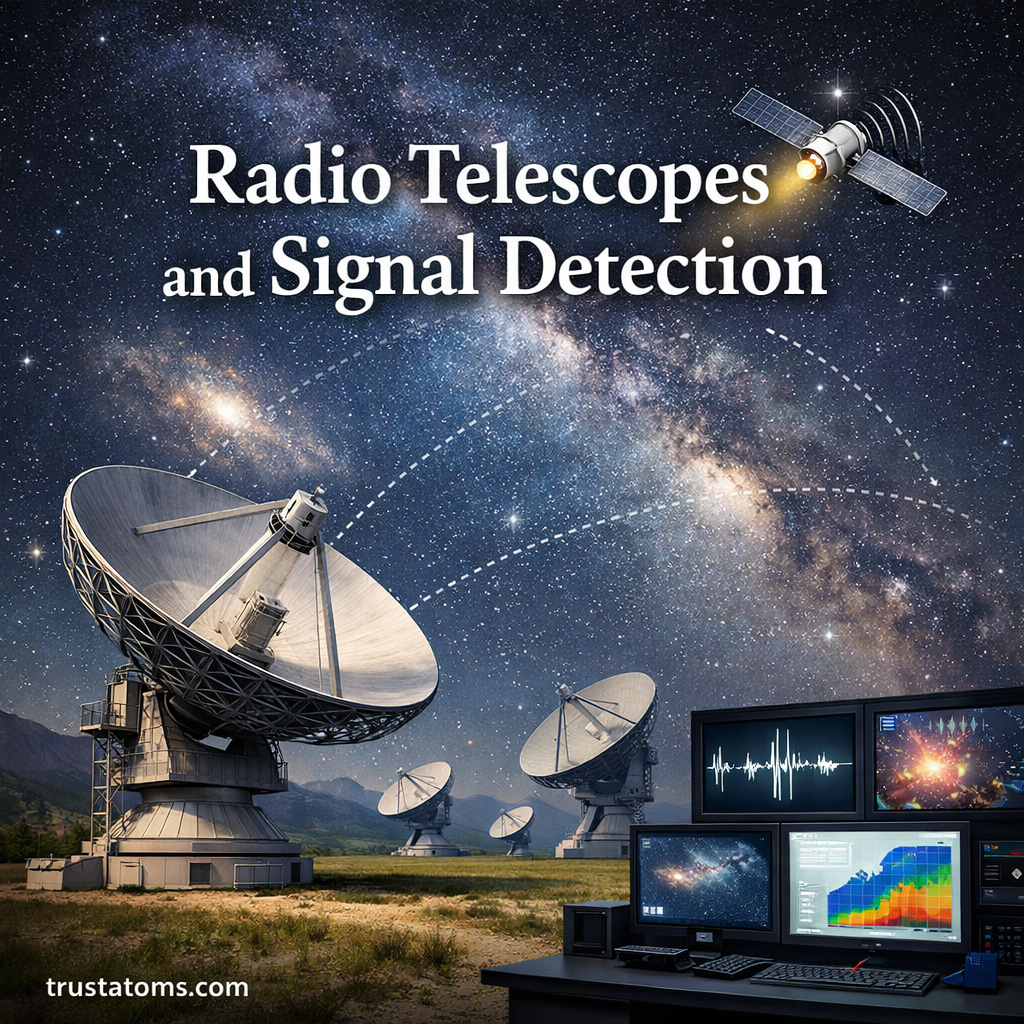
- Radio telescopes: Observe emissions such as the 21-centimeter line from neutral hydrogen.
- Infrared telescopes: Study cool dust and regions obscured at visible wavelengths.
- X-ray telescopes: Investigate extremely hot gas in galaxy clusters and other energetic environments.
- Spectroscopy: Identifies chemical elements and measures physical conditions through spectral features.
Combining observations across multiple wavelengths helps researchers estimate where ordinary matter exists and how it moves between stars, galaxies, and intergalactic space.
Frequently Asked Questions
Is baryonic matter the same as ordinary matter?
In astronomy, baryonic matter is commonly used to describe ordinary matter made from atoms and related material. Strictly speaking, baryons are particles such as protons and neutrons, while electrons belong to a different particle family.
Why does baryonic matter make up only 5% of the universe?
Cosmological observations indicate that ordinary matter contributes approximately 5% of the universe’s total mass-energy density. Dark matter and dark energy account for most of the remainder, although their fundamental physical nature remains under investigation.
Where is most baryonic matter found?
Much of the universe’s ordinary matter exists as diffuse gas rather than in stars and planets. Significant quantities are found in material surrounding galaxies and in the intergalactic gas distributed through the cosmic web.
Baryonic matter represents only a small fraction of the universe’s mass-energy content, yet it forms the atoms, stars, planets, and gas that astronomers can investigate through electromagnetic radiation. By tracing ordinary matter inside and between galaxies, scientists can test models of cosmic structure formation and better understand how visible material interacts with the universe’s less directly observable components.
Sources: OpenStax, Astronomy 2e; Planck Collaboration, Planck 2018 Results VI: Cosmological Parameters; NASA, Imagine the Universe educational resources.