Supermassive Black Holes

Illustration of a supermassive black hole with a glowing accretion disk and powerful jets extending into space.
Visualization of a supermassive black hole at the center of a galaxy, surrounded by a bright accretion disk and energetic jets. trustatoms.com.

At the center of nearly every large galaxy lies one of the most extreme objects in the universe: a supermassive black hole. These cosmic giants contain millions to billions of times the mass of the Sun and exert a powerful influence over their surroundings.

Despite their name, black holes are not empty voids—they are incredibly dense regions where gravity is so strong that nothing, not even light, can escape.

Continue reading “Supermassive Black Holes”
Novae and Recurrent Outbursts

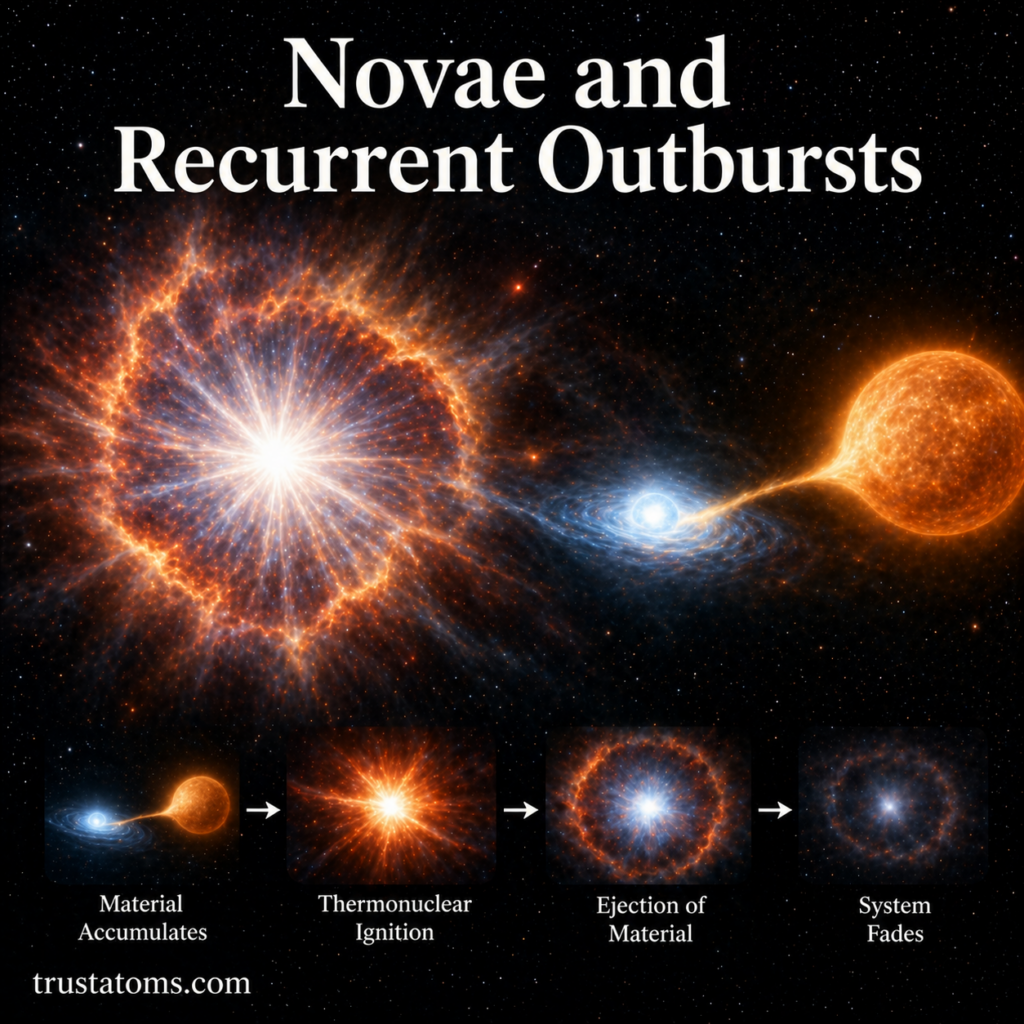
Illustration of a nova explosion in a binary star system showing a white dwarf pulling material from a companion star and ejecting it outward.
Visualization of a nova event where a white dwarf accumulates material from a companion star, leading to a thermonuclear outburst. trustatoms.com.

Not all stellar explosions are the same. While supernovae often steal the spotlight, novae are more subtle—but still incredibly powerful—events that occur in binary star systems. Even more fascinating, some stars don’t just erupt once—they do it repeatedly over time.

These recurring explosions, known as recurrent novae, reveal important insights into how stars interact, evolve, and recycle matter in the universe.

Continue reading “Novae and Recurrent Outbursts”

Stellar Winds and Mass Loss

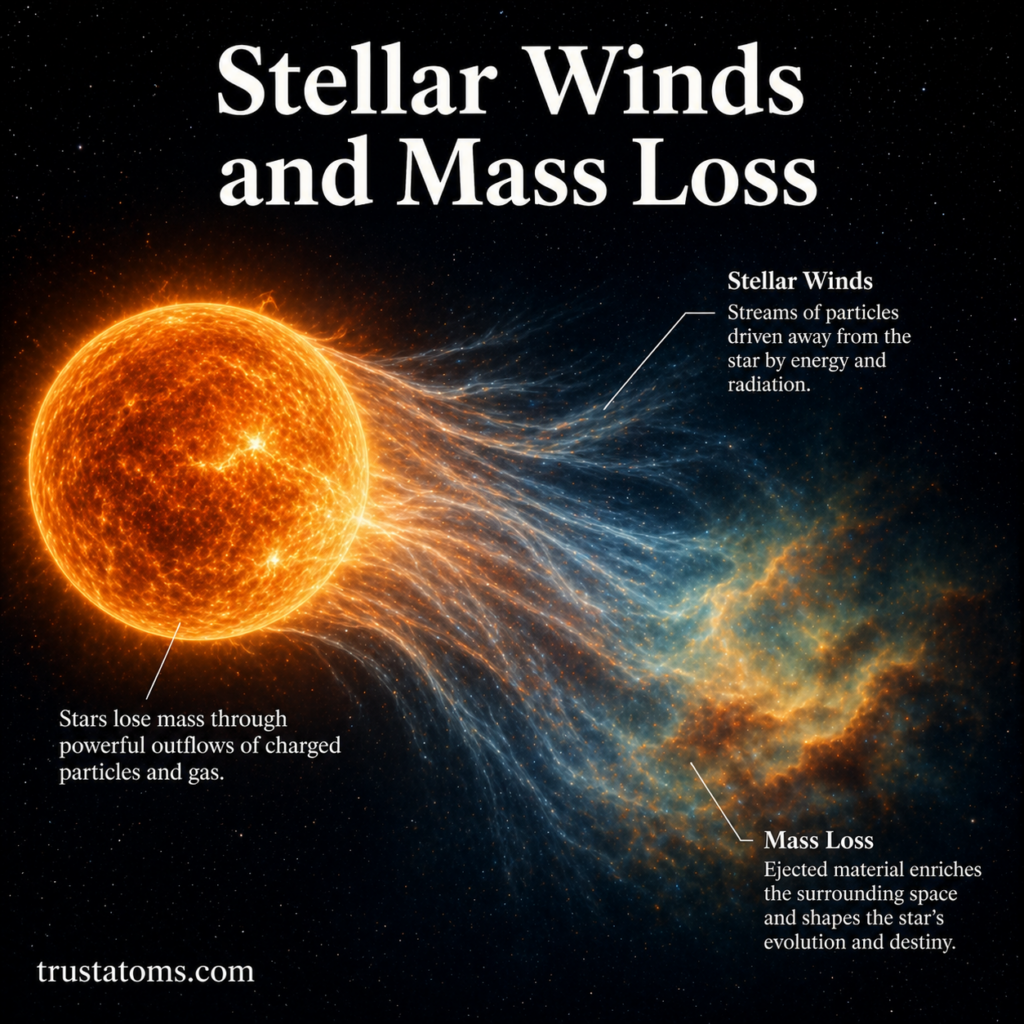
Illustration of a star emitting stellar winds and losing mass into space, showing streams of gas flowing outward into surrounding nebula.
Visualization of stellar winds carrying mass away from a star and enriching the surrounding space environment. trustatoms.com.

Stars are not as stable as they may appear. Throughout their lives, they continuously lose material into space through powerful outflows known as stellar winds. This process—called mass loss—plays a major role in how stars evolve, how long they live, and how they ultimately die.

From gentle particle streams to intense, high-speed outbursts, stellar winds shape both the star itself and the surrounding universe.

Continue reading “Stellar Winds and Mass Loss”

Mass and Stellar Lifespan

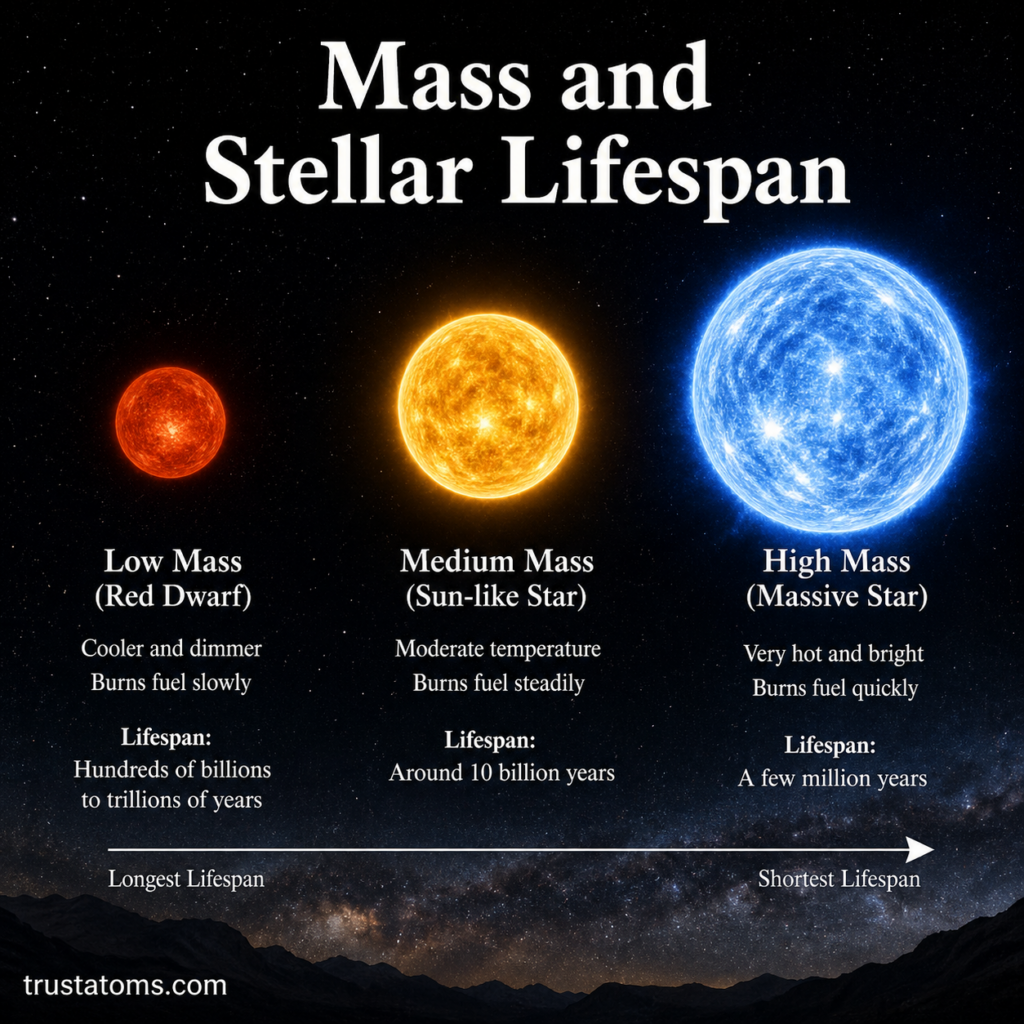
Illustration showing the relationship between stellar mass and lifespan with low, medium, and high mass stars compared.
Diagram comparing how a star’s mass affects its lifespan, from long-living red dwarfs to short-lived massive stars. trustatoms.com.

Stars may look similar when you glance up at the night sky, but their lives are dramatically different. The single most important factor that determines how a star forms, evolves, and dies is its mass.

From short-lived cosmic giants to long-lasting red dwarfs, mass dictates everything about a star’s lifespan. Understanding this relationship helps explain why some stars burn out quickly while others persist for billions—or even trillions—of years.

Continue reading “Mass and Stellar Lifespan”

Metallicity in Stellar Composition

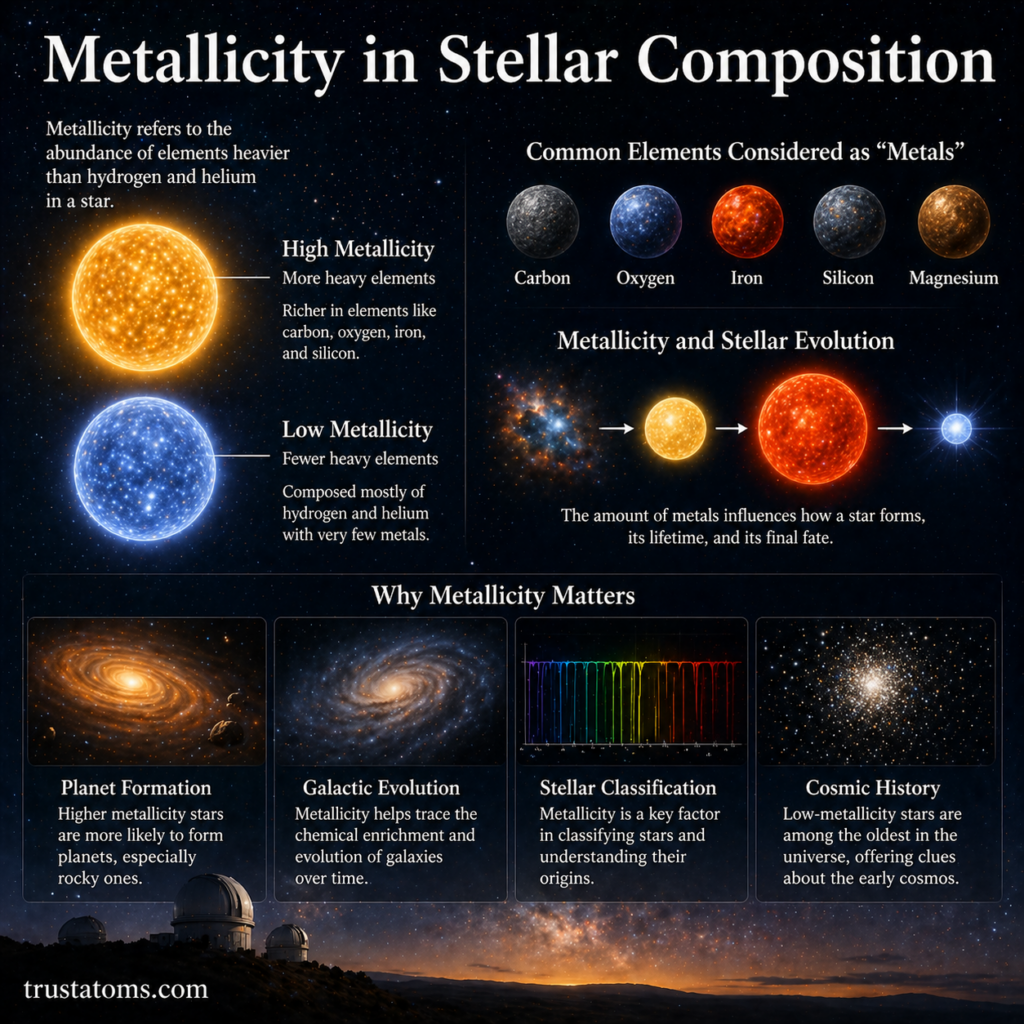
Illustration showing high and low metallicity stars with common heavy elements like carbon, oxygen, and iron.
Metallicity describes the abundance of heavy elements in stars, influencing their evolution and potential for planet formation. trustatoms.com.

In astronomy, the term metallicity has a very different meaning than it does in everyday language. While metals on Earth refer to elements like iron or copper, astronomers define “metals” as all elements heavier than hydrogen and helium.

Understanding metallicity is essential for studying how stars form, evolve, and contribute to the chemical history of the universe.

Continue reading “Metallicity in Stellar Composition”

Hertzsprung–Russell Diagram

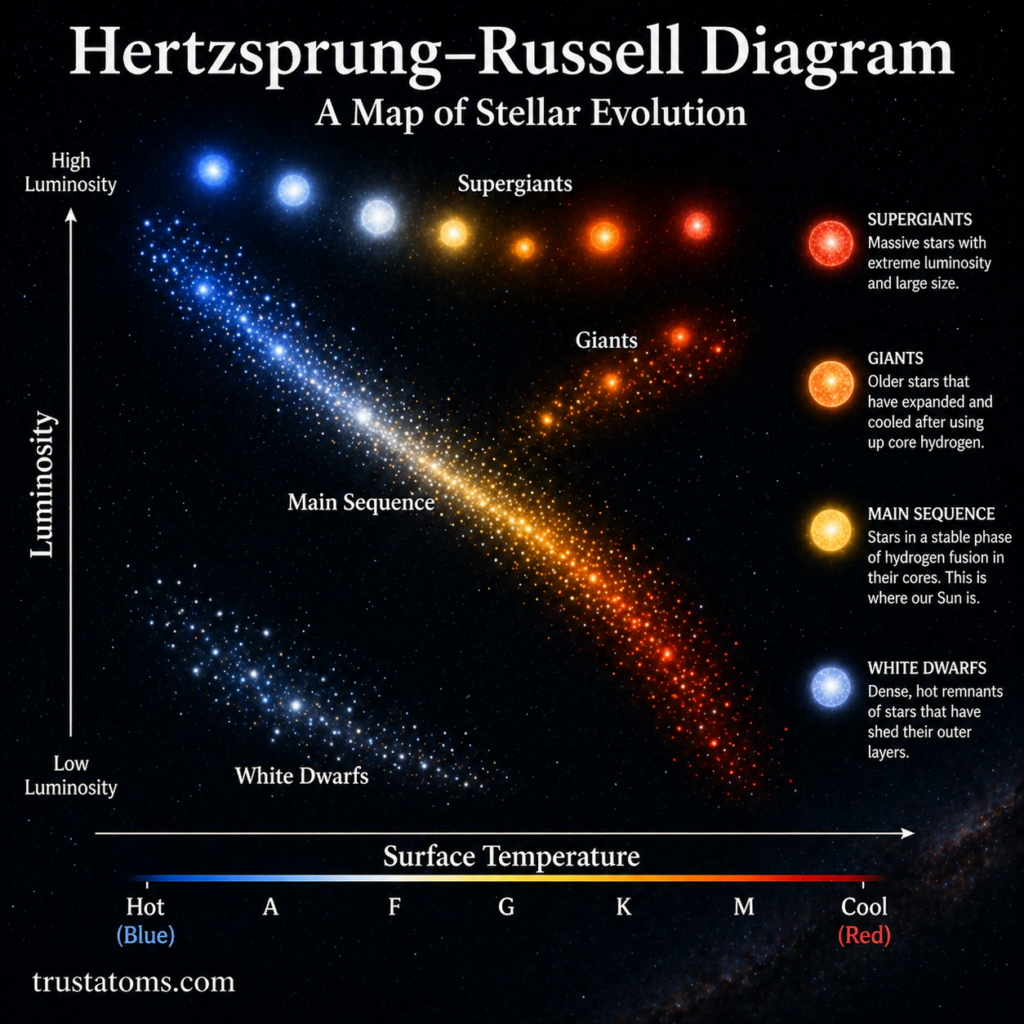
Illustration of the Hertzsprung–Russell diagram showing main sequence, giants, supergiants, and white dwarfs by luminosity and temperature.
The Hertzsprung–Russell diagram maps stars by luminosity and temperature, revealing their life stages and evolution. trustatoms.com.

The Hertzsprung–Russell diagram (H–R diagram) is one of the most important tools in astronomy. It allows scientists to classify stars and understand how they evolve over time by comparing their brightness and temperature.

At first glance, it may look like a simple graph—but it reveals the entire life story of stars.

Continue reading “Hertzsprung–Russell Diagram”

Luminosity and Stellar Magnitude

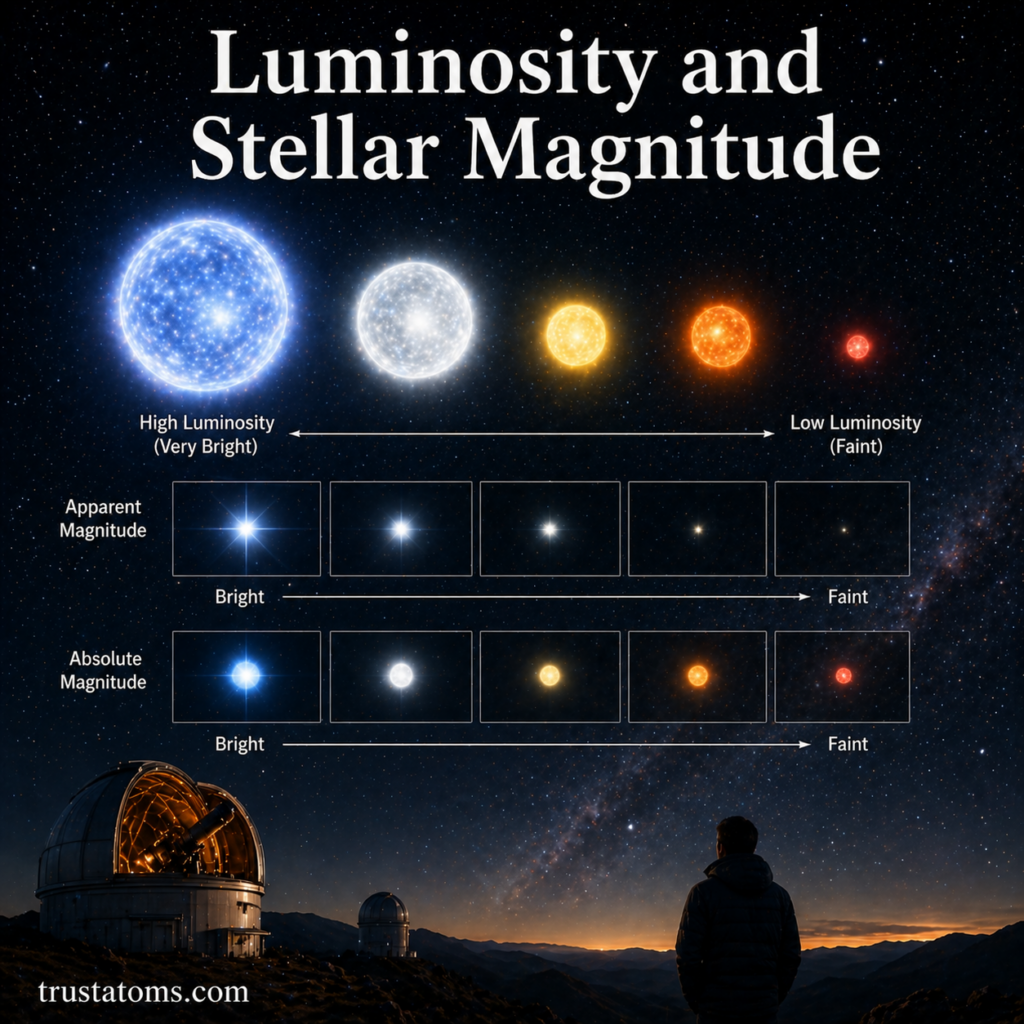
Illustration comparing stellar luminosity with apparent and absolute magnitude using stars of different brightness levels.
Luminosity and stellar magnitude help astronomers compare how bright stars truly are versus how bright they appear from Earth. trustatoms.com.

When we look at the night sky, some stars appear brighter than others. But what we see from Earth doesn’t always reflect a star’s true power. To understand how bright stars really are, astronomers use two key concepts: luminosity and stellar magnitude.

These measurements help scientists compare stars, determine distances, and better understand how stars evolve over time.

Continue reading “Luminosity and Stellar Magnitude”

Variable Stars and Brightness Changes

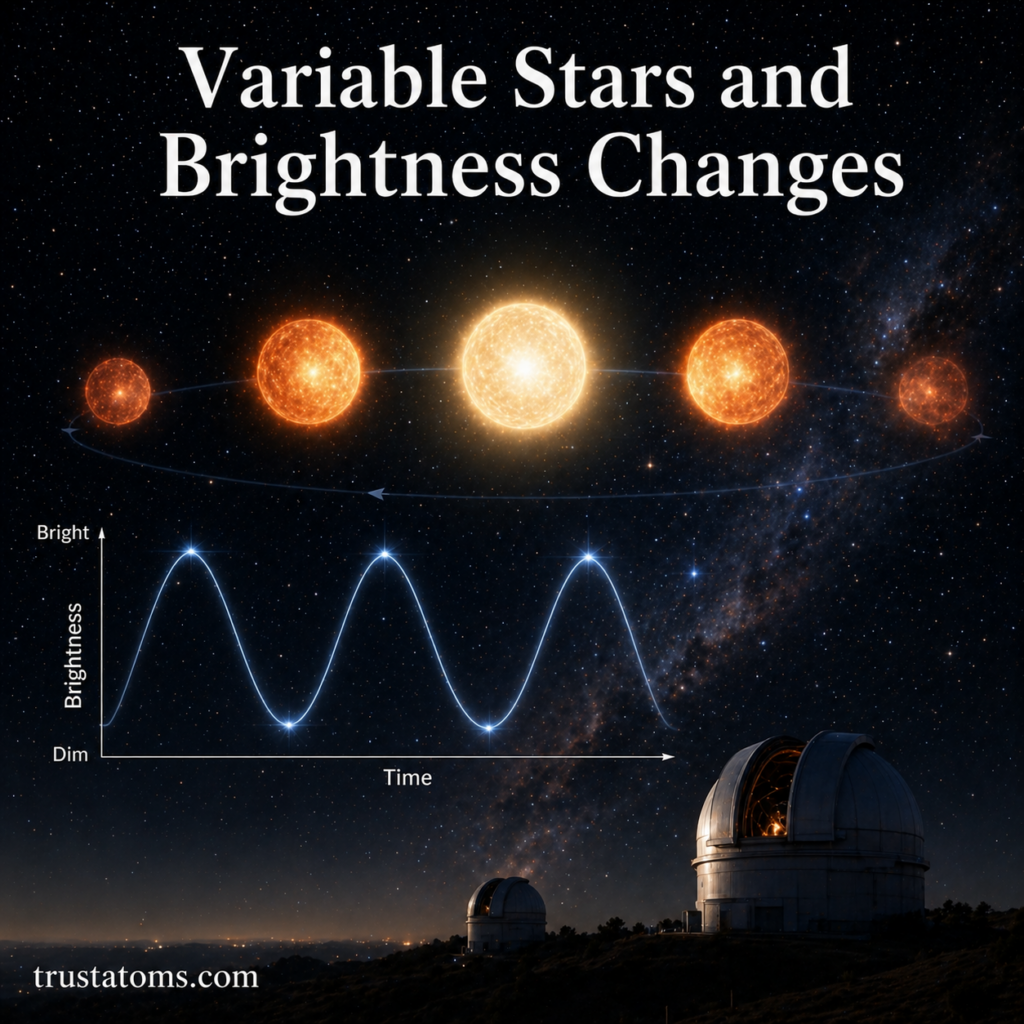
Illustration showing variable stars changing brightness over time with a light curve graph and observatory in the foreground.
Variable stars change in brightness over time, often following predictable patterns that astronomers track using light curves. trustatoms.com.

Not all stars shine with a constant brightness. Some stars vary in how much light they emit over time—these are known as variable stars. Their brightness can change due to internal processes or external factors, making them incredibly valuable tools for astronomers.

By studying variable stars, scientists can measure distances, understand stellar evolution, and even map the structure of galaxies.

Continue reading “Variable Stars and Brightness Changes”

Star Clusters and Associations

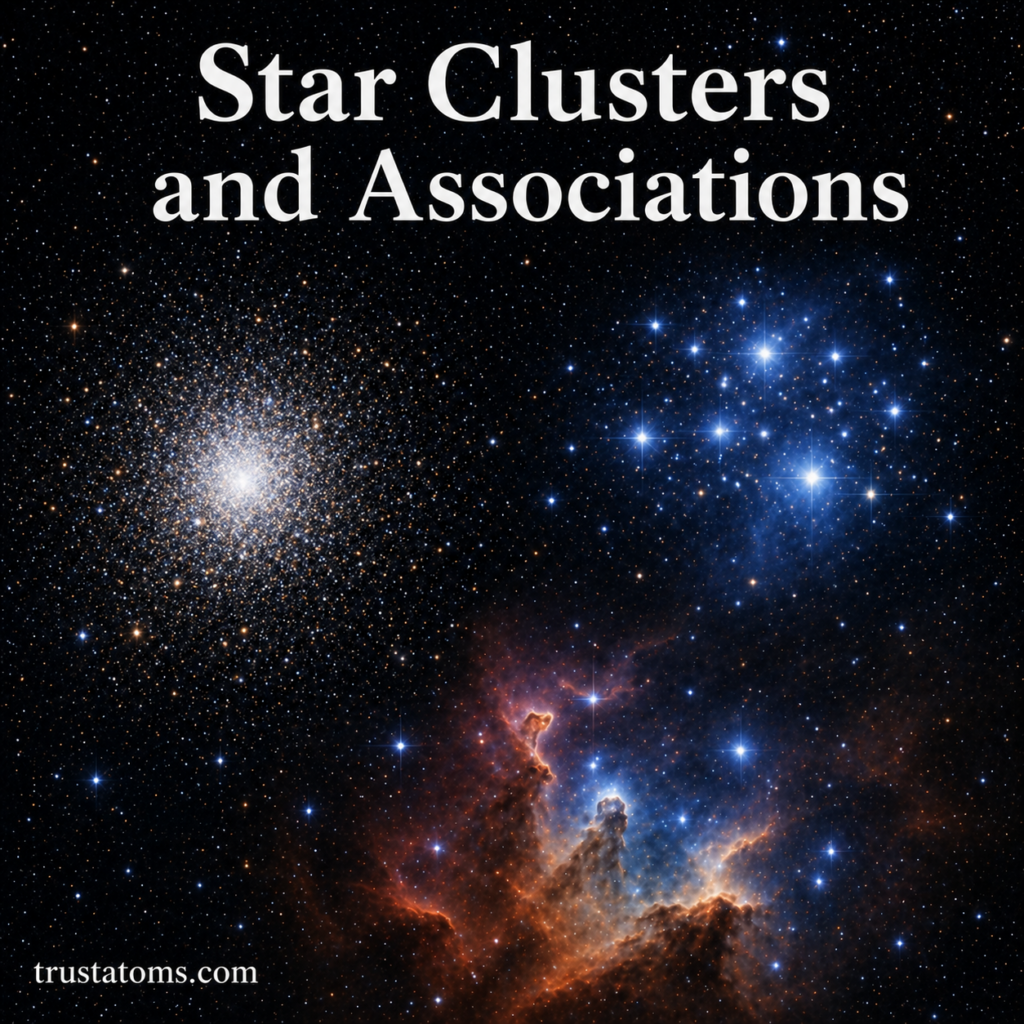
Illustration of globular and open star clusters with surrounding nebula representing stellar associations in space.
Star clusters and associations form within vast clouds of gas and dust, creating diverse groupings of stars across the galaxy. trustatoms.com.

Stars are rarely born in isolation. Instead, they often form in groups within vast clouds of gas and dust. These groups are known as star clusters and stellar associations, and they provide valuable insight into how stars evolve over time.

By studying these groupings, astronomers can better understand stellar lifecycles, galactic structure, and the history of the universe.

Continue reading “Star Clusters and Associations”

Binary Star Systems

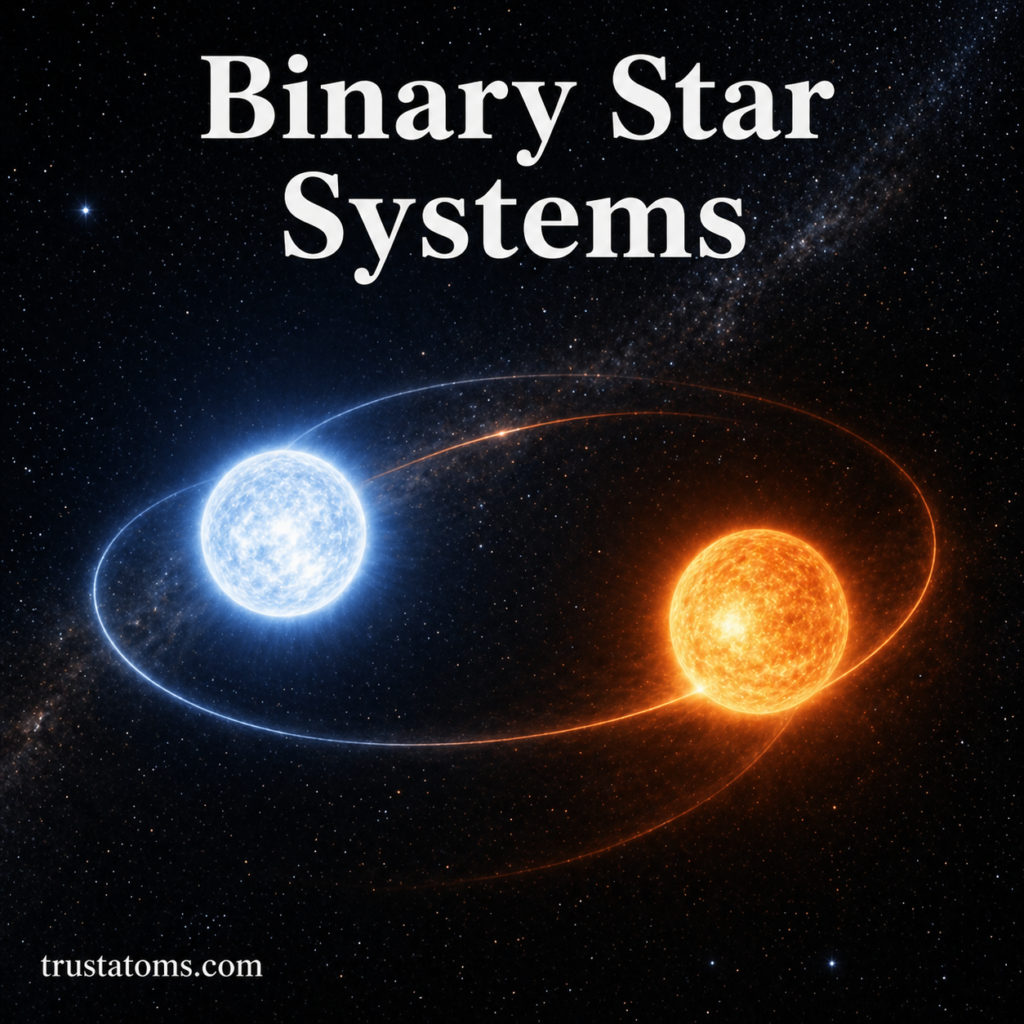
Illustration of two stars orbiting each other in a binary star system with visible orbital paths in space.
Two stars orbit a shared center of mass in a binary star system, demonstrating their gravitational relationship. trustatoms.com.

Most people picture a single star when they think about stellar systems, but in reality, many stars exist in pairs. These are known as binary star systems, where two stars are gravitationally bound and orbit a common center of mass.

Binary systems are incredibly important in astronomy because they allow scientists to measure stellar properties like mass, size, and luminosity with remarkable accuracy.

Continue reading “Binary Star Systems”