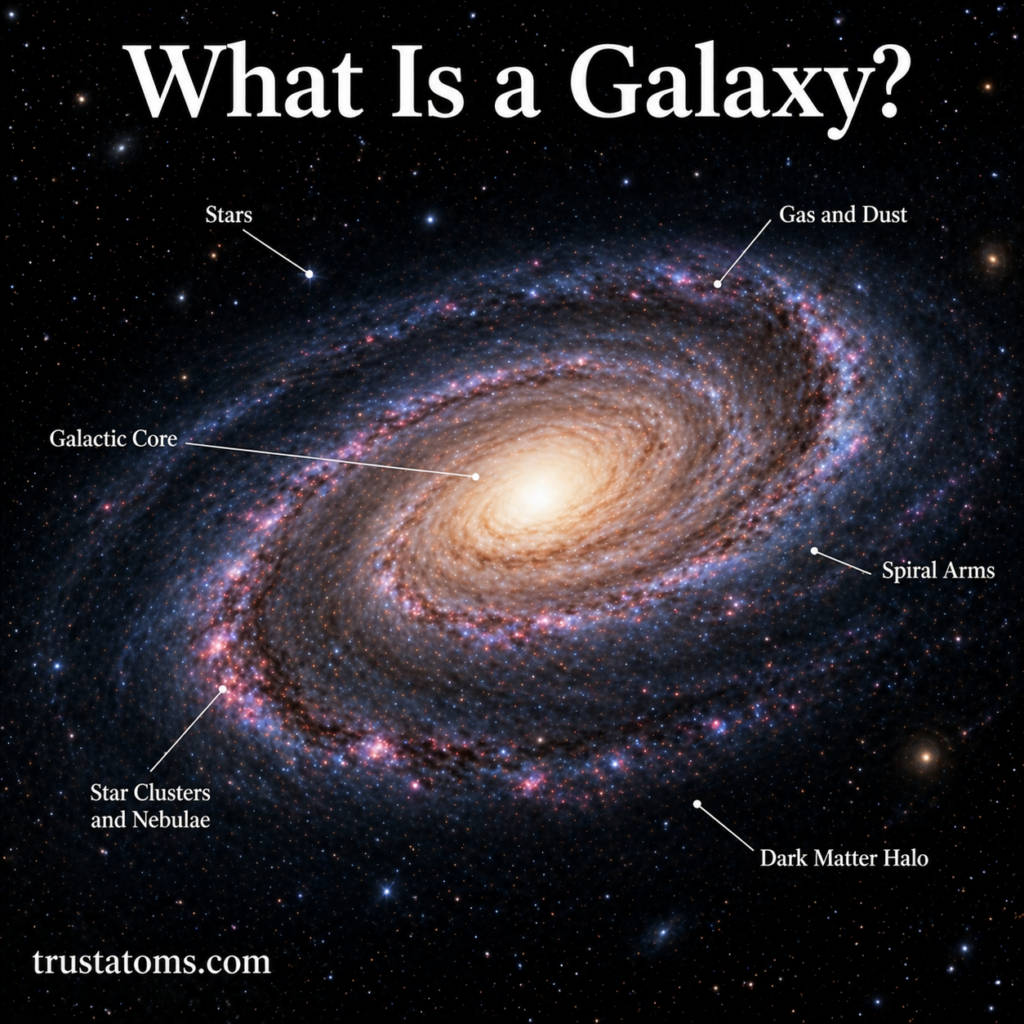
What Is a Galaxy?

Illustration of a spiral galaxy labeled with core, spiral arms, stars, gas, and dark matter halo.
A spiral galaxy showing its core, arms, and key components that make up a galaxy. trustatoms.com.

A galaxy is a vast system of stars, gas, dust, and dark matter bound together by gravity. These enormous structures are the building blocks of the universe, each containing anywhere from millions to trillions of stars.

Our home galaxy, the Milky Way, is just one of billions scattered across the observable universe.

Continue reading “What Is a Galaxy?”
Stellar Evolution Pathways Compared

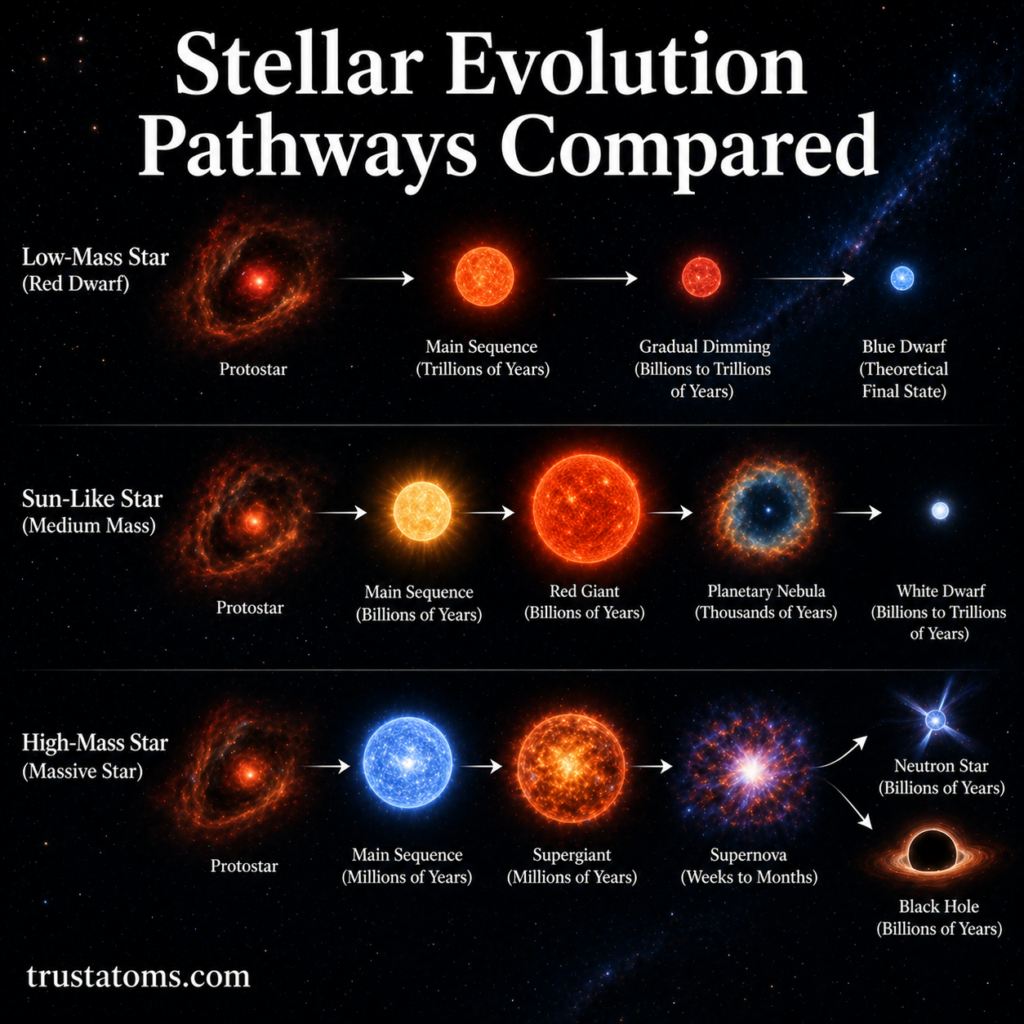
Diagram comparing the life cycles of low-mass, Sun-like, and massive stars from formation to final stages.
A visual comparison of stellar evolution pathways, showing how stars of different masses evolve and end their life cycles. trustatoms.com.

Stars are not eternal—they are born, evolve, and eventually die. However, not all stars follow the same life path. A star’s mass determines how it evolves, how long it lives, and how it ends its life.

By comparing stellar evolution pathways, astronomers can better understand the diversity of stars in the universe and predict their ultimate fates.

Continue reading “Stellar Evolution Pathways Compared”

Red Dwarfs and Longevity

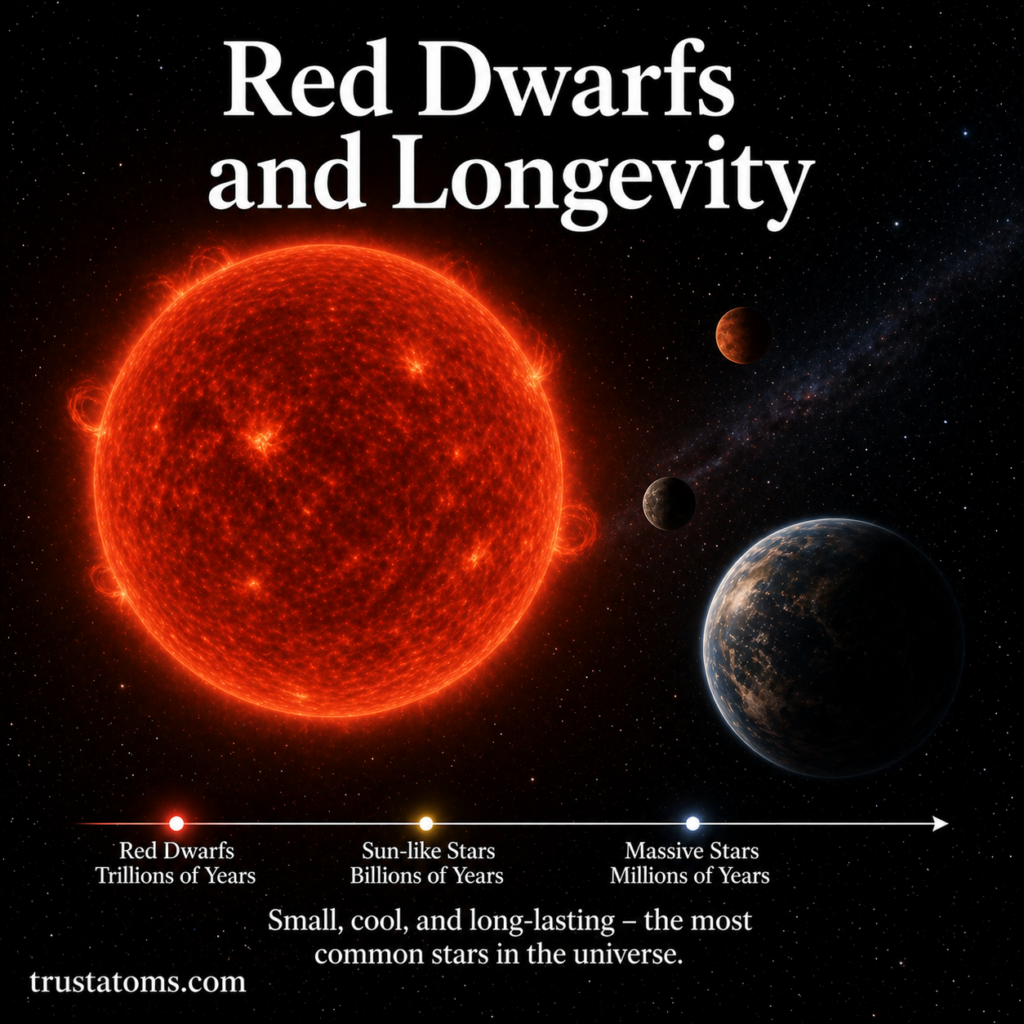
Illustration of a red dwarf star with nearby planets showing long stellar lifespan compared to other star types.
A red dwarf star illustrating its slow-burning nature and extremely long lifespan compared to larger stars. trustatoms.com.

Red dwarfs are the most common stars in the universe—and also the longest-lived. While massive stars burn bright and die young, red dwarfs take the opposite approach: they burn slowly, steadily, and can last for trillions of years.

Their incredible longevity makes them a key focus in astronomy, especially when studying the future of the universe and the potential for long-term planetary systems.

Continue reading “Red Dwarfs and Longevity”

Radiation Pressure in Stars

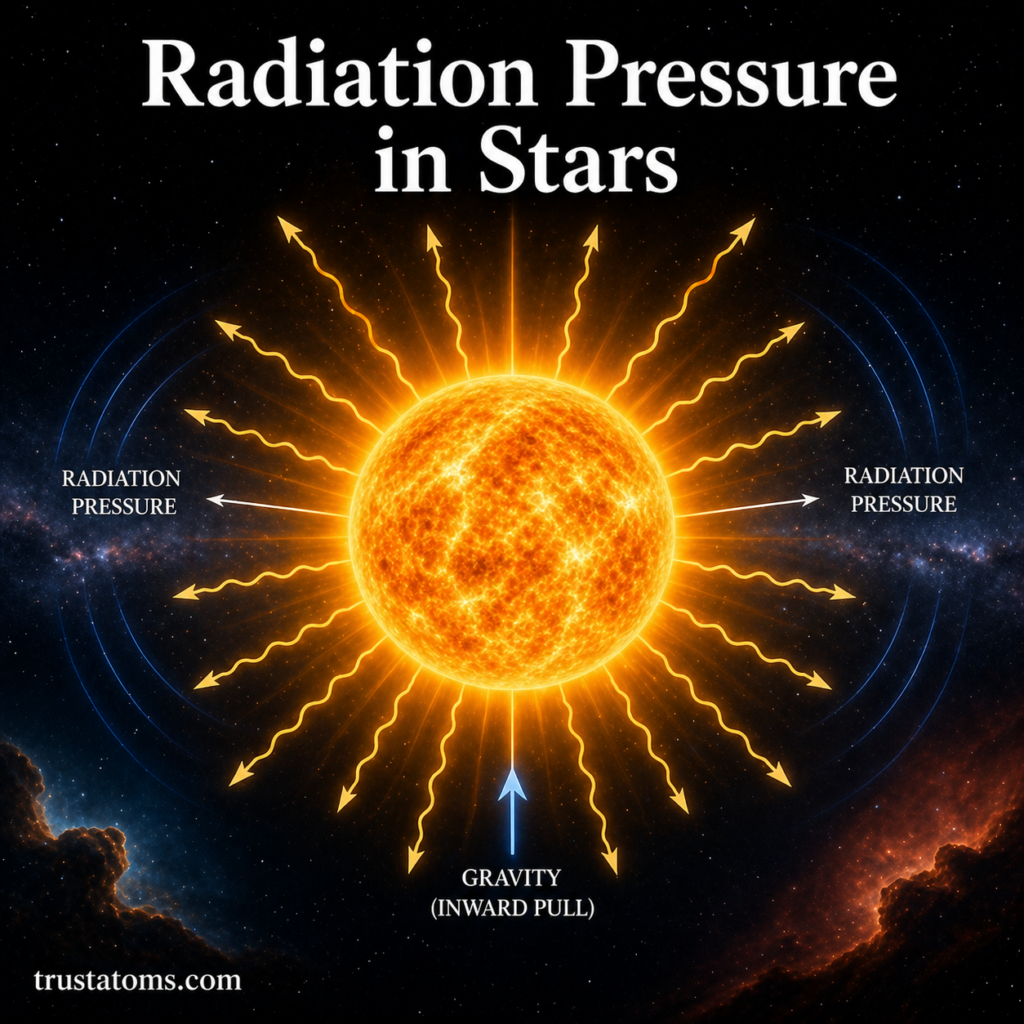
Illustration of a star emitting outward radiation pressure balanced by inward gravitational force in space.
A star demonstrating the balance between outward radiation pressure and inward gravity. trustatoms.com.

Stars shine because of powerful processes happening deep within their cores. While gravity constantly pulls matter inward, another force pushes outward—radiation pressure. This balance between inward gravity and outward pressure is what keeps stars stable for millions or even billions of years.

Radiation pressure plays a crucial role in how stars form, evolve, and eventually die. In the most massive stars, it can even dominate over gravity and shape their ultimate fate.

Continue reading “Radiation Pressure in Stars”

Stellar Rotation and Magnetic Fields

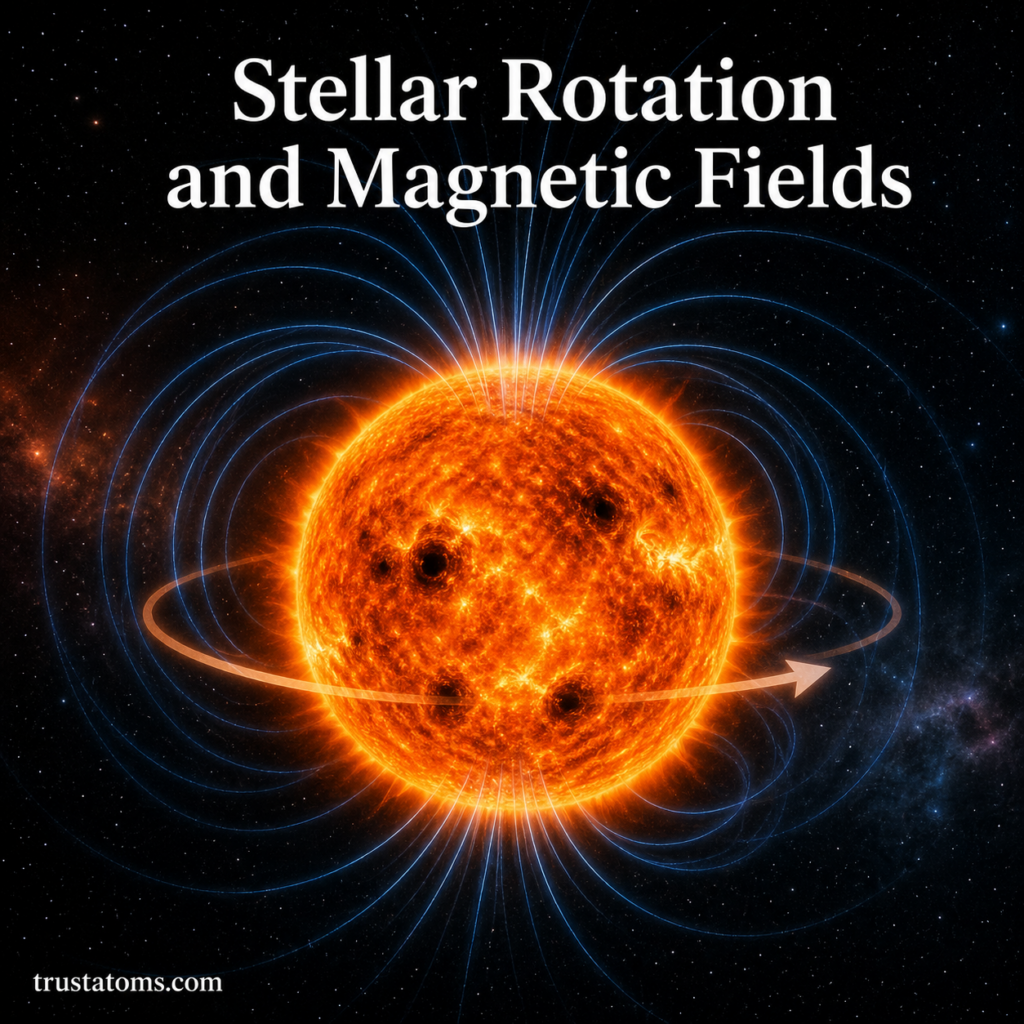
Illustration of a rotating star with visible magnetic field lines and directional rotation arrow in space.
A rotating star demonstrating how magnetic fields form and extend into space. trustatoms.com.

Stars are not static objects—they spin. This rotation plays a major role in shaping a star’s magnetic field, surface activity, and long-term evolution. From gentle spins like our Sun to rapidly rotating young stars, stellar rotation is deeply connected to phenomena like sunspots, stellar flares, and even space weather.

Understanding how rotation and magnetism interact helps astronomers explain everything from stellar lifecycles to the environments of surrounding planets.

Continue reading “Stellar Rotation and Magnetic Fields”

Interstellar Medium and Gas Clouds

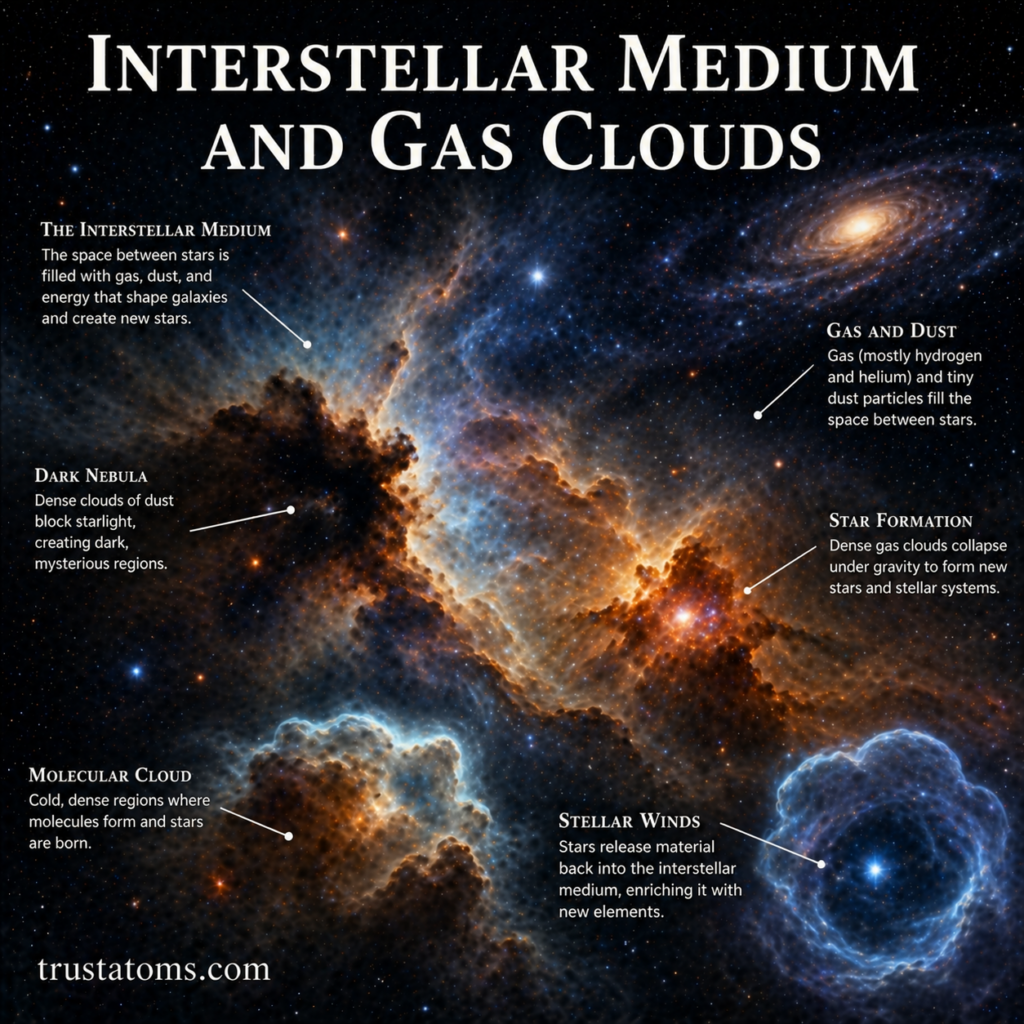
Illustration of the interstellar medium showing gas clouds, nebulae, and regions of star formation in space.
Visualization of the interstellar medium, highlighting gas clouds, dust, and regions where new stars are formed. trustatoms.com.

Between the stars lies a vast, often overlooked component of the universe: the interstellar medium (ISM). Far from being empty, this space is filled with gas, dust, and energetic particles that play a crucial role in the life cycle of stars and galaxies.

From star formation to cosmic recycling, the interstellar medium connects nearly every major process in astronomy.

Continue reading “Interstellar Medium and Gas Clouds”

Cosmic Element Formation in Stars

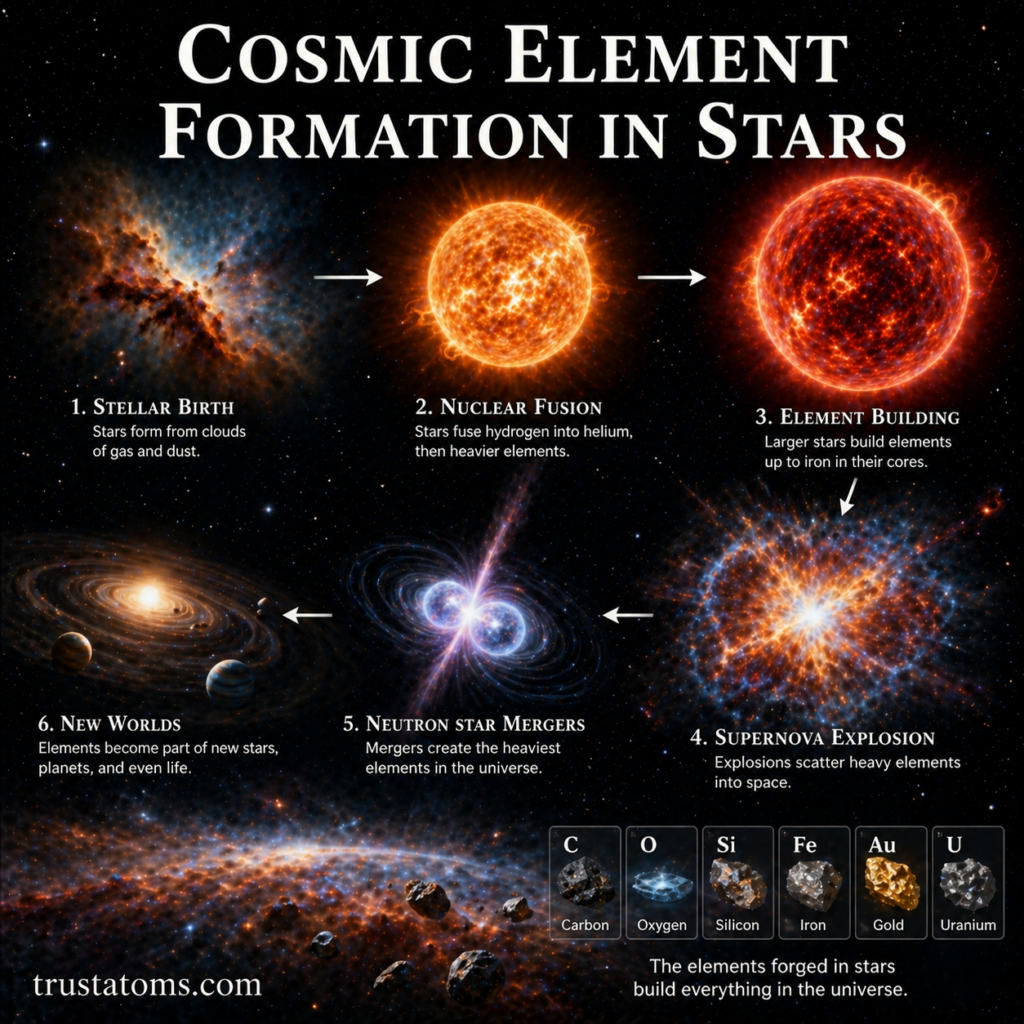
Illustration showing how elements form in stars through fusion, supernova explosions, and neutron star mergers.
Visualization of cosmic element formation, showing how stars create elements through fusion and explosive events like supernovae and mergers. trustatoms.com.

Every atom in your body—except hydrogen—was forged in the heart of a star. From the carbon in your cells to the iron in your blood, the elements that make up the universe are products of stellar processes that span billions of years.

This process, known as nucleosynthesis, explains how simple particles formed after the Big Bang evolved into the rich chemical diversity we see today.

Continue reading “Cosmic Element Formation in Stars”

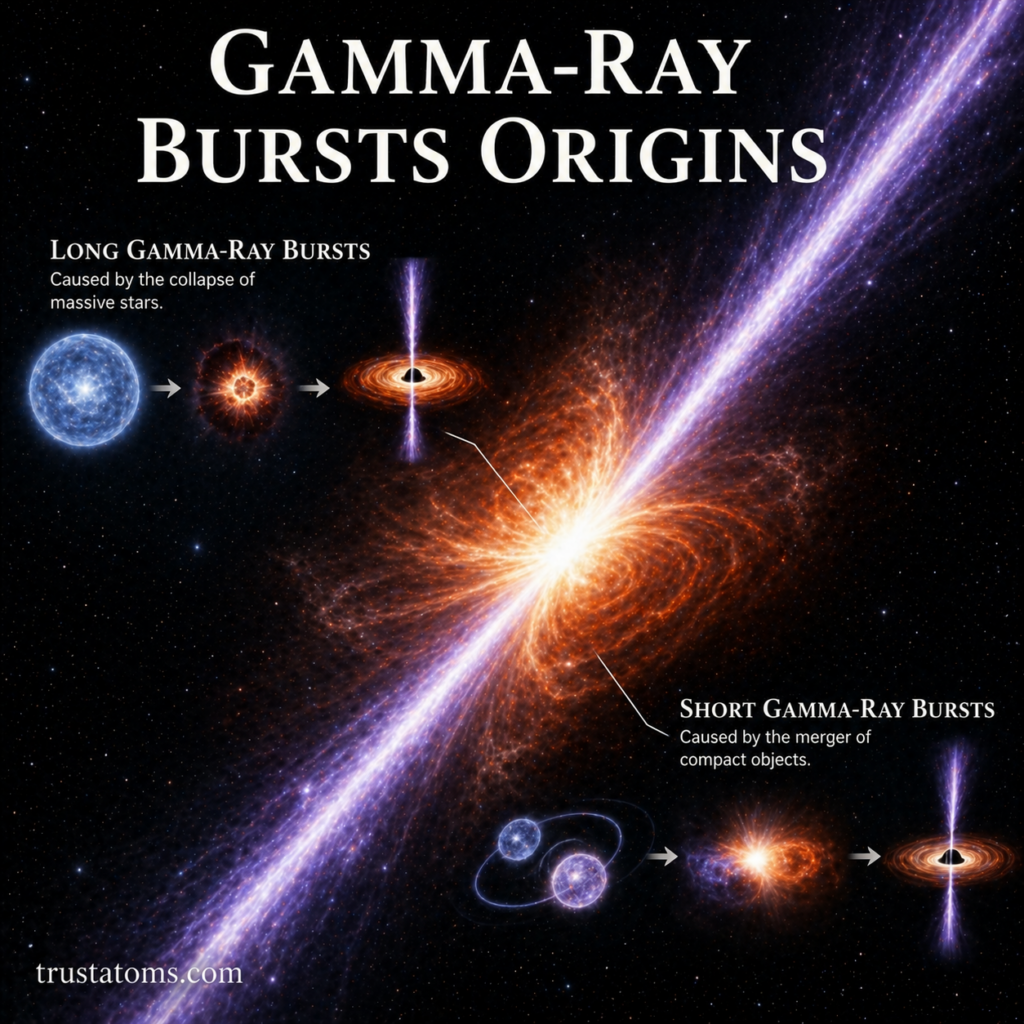
Gamma-Ray Bursts Origins

Illustration showing the origins of gamma-ray bursts from collapsing massive stars and merging neutron stars with powerful energy jets.
Visualization of gamma-ray burst origins, highlighting long bursts from collapsing stars and short bursts from neutron star mergers. trustatoms.com.

Gamma-ray bursts (GRBs) are the most powerful explosions ever observed in the universe. In just a few seconds, they can release more energy than the Sun will produce over its entire lifetime.

Discovered by accident in the late 20th century, these intense flashes of gamma radiation have become one of the most fascinating—and mysterious—phenomena in astronomy. Understanding where they come from helps scientists explore the most extreme conditions in the cosmos.

Continue reading “Gamma-Ray Bursts Origins”

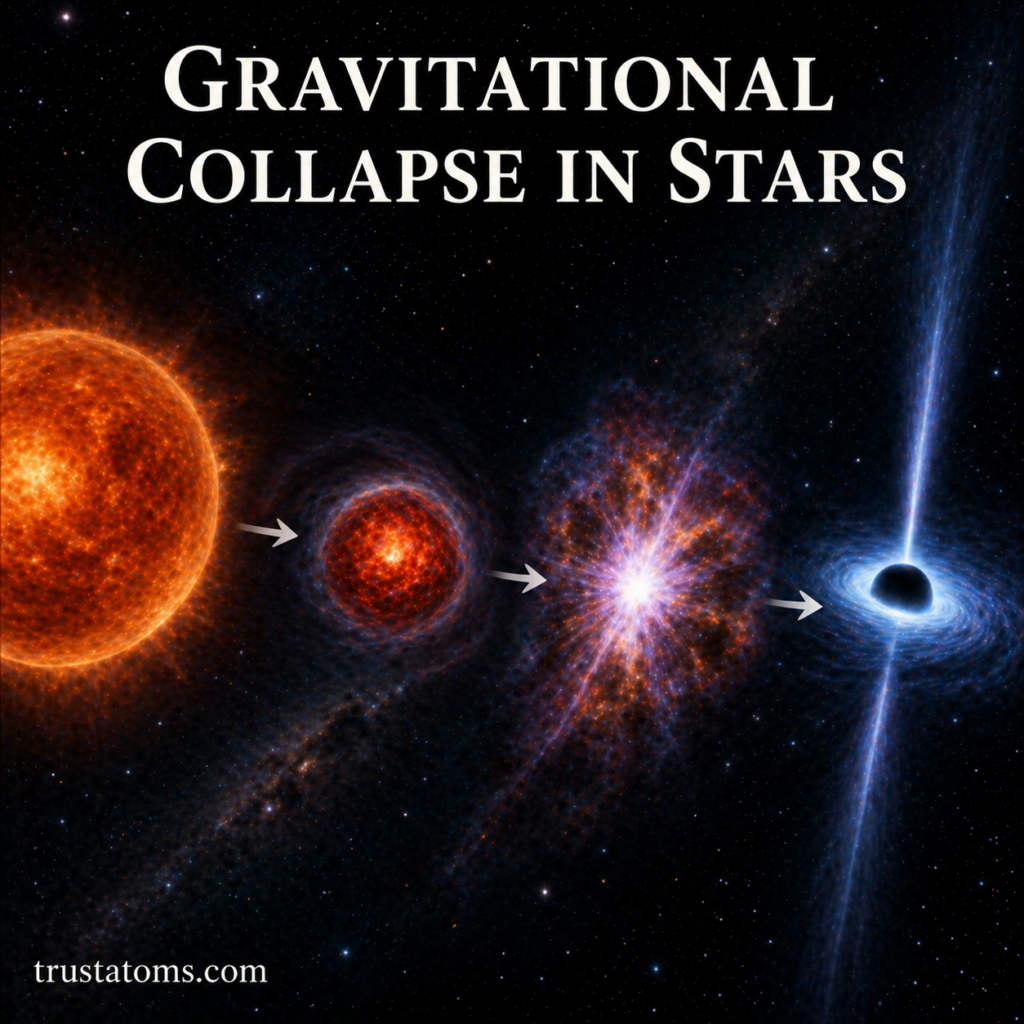
Gravitational Collapse in Stars

Illustration showing the stages of gravitational collapse in a star from stable star to supernova and compact object formation.
Visualization of gravitational collapse in stars, showing the transition from a stable star to collapse, explosion, and compact remnant. trustatoms.com.

Stars spend most of their lives in a delicate balance between two opposing forces: outward pressure from nuclear fusion and inward pull from gravity. But when that balance breaks, gravity takes over—and the result is one of the most dramatic processes in the universe: gravitational collapse.

This process is responsible for the formation of some of the most extreme objects known, including white dwarfs, neutron stars, and black holes.

Continue reading “Gravitational Collapse in Stars”

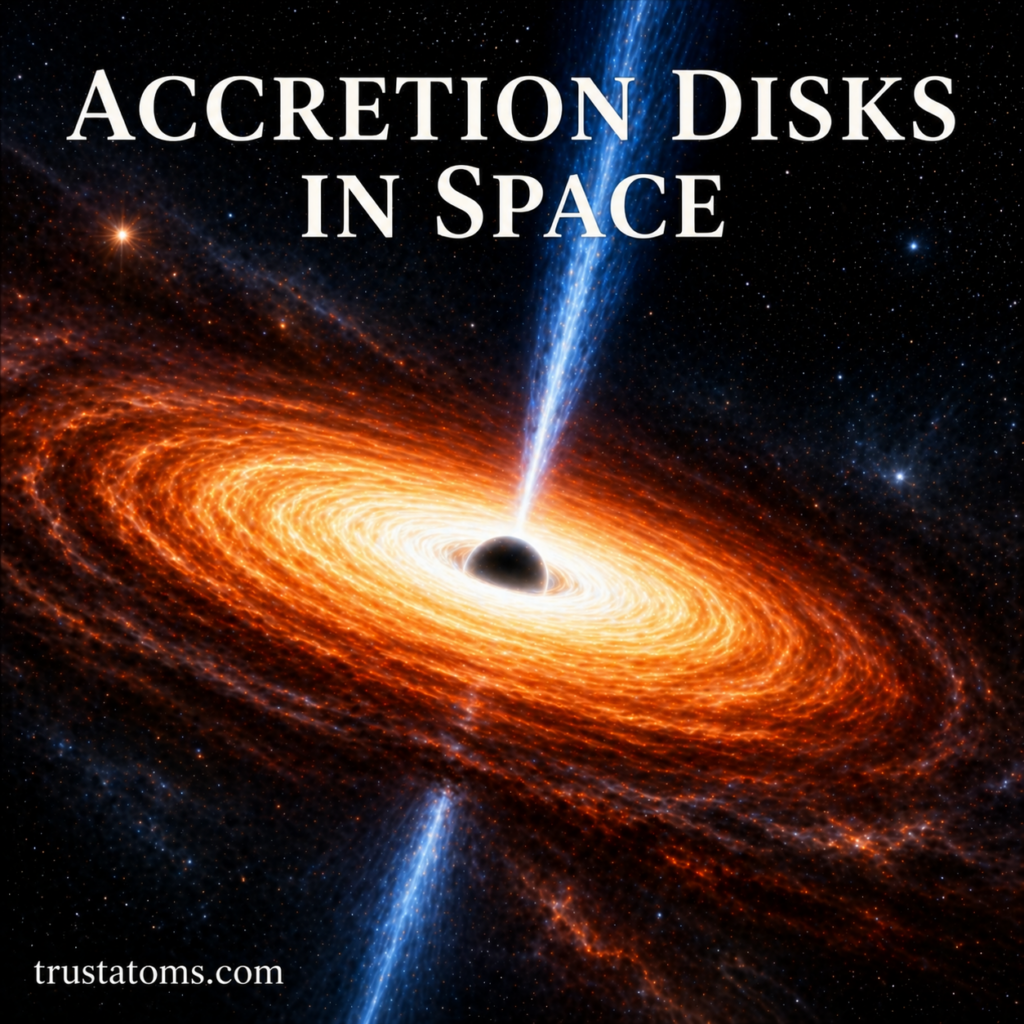
Accretion Disks in Space

Illustration of a glowing accretion disk surrounding a central black hole with bright jets extending into space.
Visualization of an accretion disk forming around a compact object, with heated material spiraling inward and energetic jets extending outward. trustatoms.com.

Across the universe, some of the most energetic and visually striking structures are not stars or galaxies—but swirling disks of matter spiraling into them. These are known as accretion disks, and they play a crucial role in how cosmic objects grow, emit energy, and evolve.

From newborn stars to supermassive black holes, accretion disks are found in a wide range of environments, acting as engines of both creation and destruction.

Continue reading “Accretion Disks in Space”