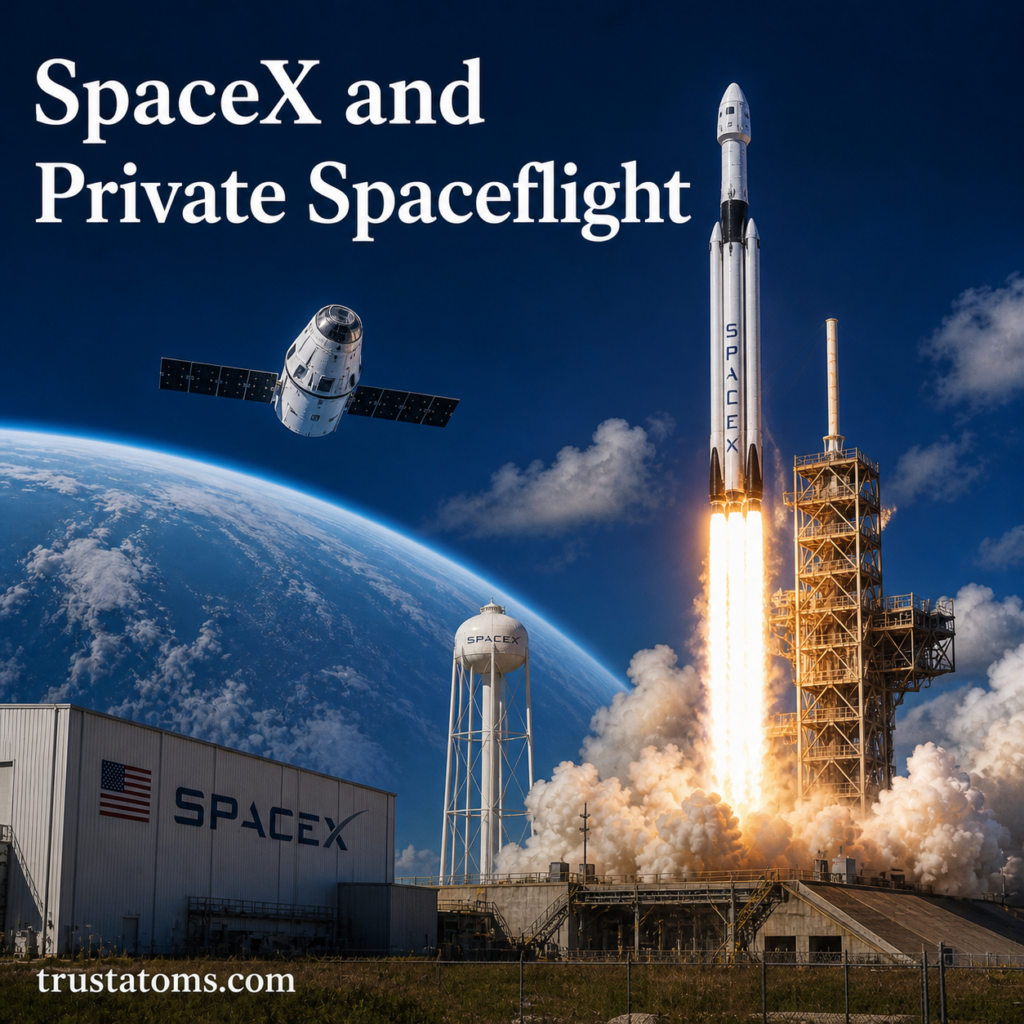
SpaceX is a private aerospace company that develops rockets and spacecraft for launching satellites, transporting astronauts, and supporting space exploration. Its reusable Falcon 9 rocket and Dragon spacecraft have helped expand commercial access to orbit while demonstrating how private companies can work alongside government space agencies.
Private spaceflight has changed how missions are financed, developed, and operated. Beyond supporting satellite communications and scientific research, commercial launch services provide new opportunities for astronomy and space science by transporting instruments and spacecraft beyond Earth’s atmosphere.
What Is Private Spaceflight?
Private spaceflight refers to space transportation and missions developed or operated by commercial organizations. These companies may serve private customers, government agencies, universities, or international research institutions.
Commercial space activities include several types of missions:
- Satellite launches: Delivering communications, navigation, weather, and scientific satellites into orbit.
- Cargo transportation: Carrying supplies, experiments, and equipment to orbital facilities.
- Crewed missions: Transporting professional astronauts and private participants into space.
- Exploration technology: Developing spacecraft and launch systems intended for missions beyond Earth orbit.
Commercial human spaceflight builds on decades of government-led achievements. The development of private crew transportation adds another chapter to the history of human spaceflight milestones, including the first orbital missions and long-duration stays aboard space stations.
How SpaceX Entered the Space Industry
Space Exploration Technologies Corporation, commonly known as SpaceX, was founded in 2002 by Elon Musk. Its stated objectives included reducing space transportation costs and developing technology that could eventually support human missions to Mars.
The company’s first orbital launch vehicle, Falcon 1, experienced three unsuccessful launch attempts before successfully reaching orbit in September 2008. This achievement demonstrated that a privately developed liquid-fueled rocket could reach Earth orbit.
SpaceX subsequently developed Falcon 9, a larger rocket designed to transport satellites and spacecraft. Partnerships with NASA helped establish commercial cargo transportation and later crewed missions to the International Space Station.
SpaceX Rockets and Spacecraft
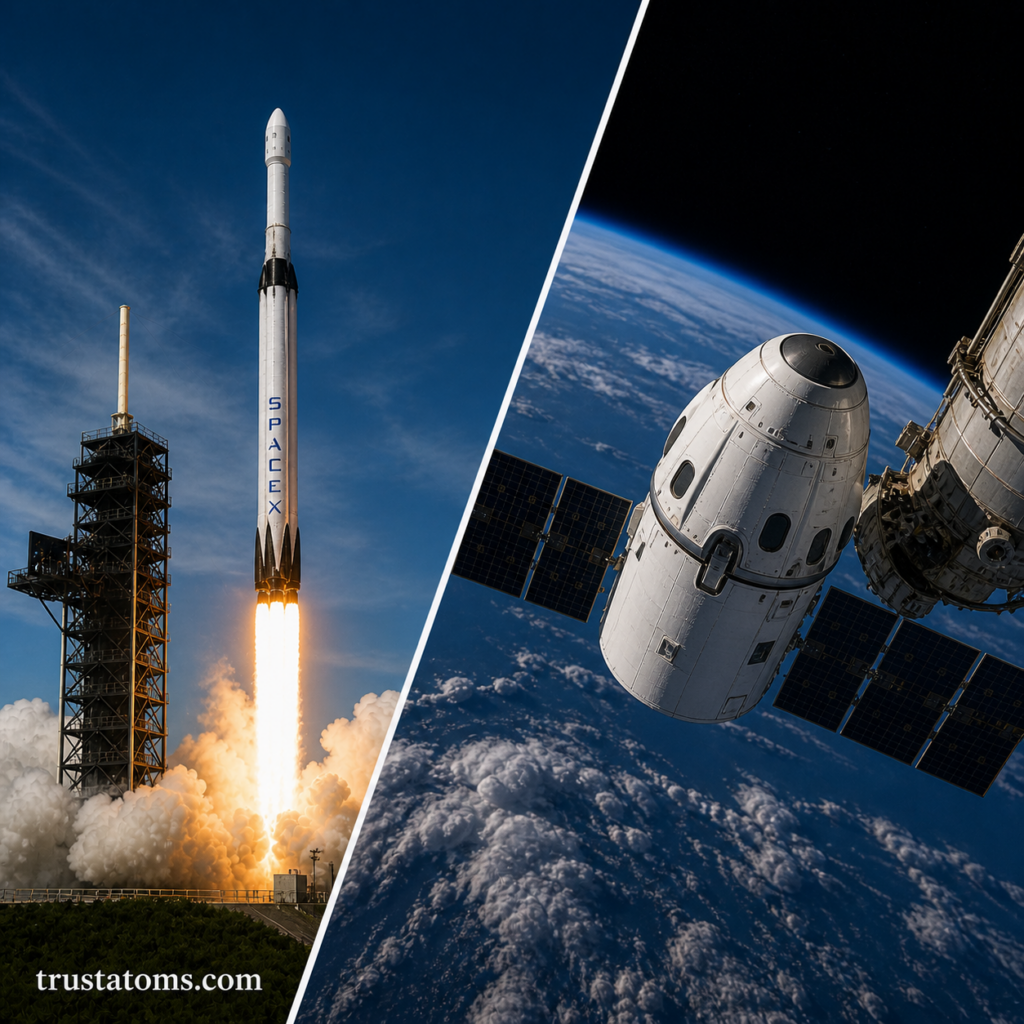
SpaceX operates several launch and spacecraft systems designed for different payloads and missions. Its best-established technologies include reusable Falcon boosters and Dragon capsules.
Falcon 9 and Reusable Rocket Boosters
One of SpaceX’s biggest achievements is the development of reusable rockets, particularly the Falcon 9.
Falcon 9 is a two-stage rocket whose first stage can return to Earth after separating from the upper stage. Depending on mission requirements, the booster may land on a ground-based landing pad or an autonomous drone ship at sea.
Recovered boosters undergo inspection, maintenance, and preparation before another flight. Reusing major hardware can reduce the need to manufacture a completely new first stage for every mission, although recovery operations and refurbishment still involve costs.
Dragon: Cargo and Astronaut Transportation
Dragon is a spacecraft family developed to transport cargo and people. Cargo Dragon delivers supplies and scientific experiments, while Crew Dragon carries astronauts and other authorized passengers.
In May 2020, SpaceX launched NASA astronauts Robert Behnken and Douglas Hurley aboard Crew Dragon during the Demo-2 mission. The flight marked the first crewed orbital launch by a commercially developed and operated spacecraft.
Falcon Heavy and Larger Payloads
Falcon Heavy combines three Falcon-derived first-stage boosters to provide greater launch capability than Falcon 9. Its design supports missions involving heavier spacecraft or payloads requiring substantial launch energy.
The rocket made its first flight in February 2018. Its additional lifting capability provides another option for commercial satellites and government missions with demanding launch requirements.
A Concrete Example: How Rocket Reuse Changes Launch Operations
Consider two hypothetical rockets scheduled to complete ten missions each. If the first rocket discards its first-stage booster after every launch, ten separate boosters are needed to complete those flights.
If the second rocket successfully reuses one booster for all ten missions, it can complete the same number of launches with one first-stage booster, provided the hardware remains serviceable and mission requirements permit recovery.
This comparison does not mean launch costs fall by 90%. Upper stages, fuel, inspections, personnel, transportation, and launch infrastructure still contribute to expenses. However, spreading the manufacturing cost of a major rocket component across multiple missions can improve launch economics.
How NASA and SpaceX Work Together
Commercial spaceflight has expanded partly through partnerships between private companies and government agencies. NASA has used commercial contracts to support spacecraft development and purchase transportation services.
Two important programs illustrate this approach:
- Commercial Orbital Transportation Services: Helped demonstrate privately developed cargo transportation capabilities for low Earth orbit.
- Commercial Crew Program: Supported the development and certification of commercial systems capable of transporting astronauts to and from the International Space Station.
NASA establishes mission and safety requirements for the services it purchases, while commercial providers develop and operate their transportation systems under applicable contracts and regulations.
The Rise of Commercial Space Travel
Government agencies led many early spaceflight achievements, including the first satellites, human orbital flights, and lunar landings. The History of Space Exploration shows how launch technology developed through scientific programs, national space agencies, and increasingly commercial activities.
NASA’s reusable orbiter program also influenced later spacecraft engineering. The Space Shuttle Program History provides context for understanding earlier approaches to reusable spacecraft and their operational challenges.
Commercial transportation now supports a space environment involving multiple countries and organizations. International Collaboration in Space remains essential for coordinating research, operating shared facilities, and managing activities beyond national borders.
Satellite Launches and Global Communications
Commercial launch providers transport satellites used for telecommunications, Earth observation, navigation, and scientific measurements. Organizations can purchase launch services rather than develop an entire rocket program themselves.
SpaceX also operates Starlink, a satellite network designed to provide internet connectivity through spacecraft in low Earth orbit. Large satellite constellations can expand communications coverage but introduce additional orbital management challenges.
Private Human Spaceflight
Commercial crew vehicles have enabled privately funded orbital missions involving participants outside traditional government astronaut programs. Such flights require extensive training, medical evaluation, spacecraft preparation, and mission support.
Private orbital travel remains expensive and technically demanding. It should not be confused with routine commercial aviation, where vehicles operate under substantially different conditions and risk profiles.
Benefits and Limitations of Private Spaceflight
Commercial participation can create competition and encourage companies to develop different approaches to spacecraft design, manufacturing, and launch operations.
Potential advantages include greater launch availability, reusable hardware, specialized services, and more opportunities for universities and businesses to place equipment in space.
However, these benefits depend on actual mission performance and economics. Private ownership alone does not guarantee lower costs, better reliability, or faster development.
Safety, Space Debris, and Regulation
Spaceflight remains hazardous regardless of whether a mission is operated by a government agency or a commercial company. Launch vehicles carry large quantities of propellant, spacecraft encounter extreme environments, and failures can threaten crews or people on the ground.
Growing satellite populations also increase concerns about orbital congestion. Collisions can create debris that threatens other spacecraft, making tracking, collision avoidance, and responsible disposal important.
In the United States, the Federal Aviation Administration regulates commercial launch and reentry activities. Other agencies oversee areas such as communications and certain satellite operations, while international agreements establish broader responsibilities for space activities.
Starship and the Future of Private Space Exploration
SpaceX is developing Starship as a large transportation system intended to support substantial payloads and future missions beyond low Earth orbit. Its design goals include reusing both the Super Heavy booster and the Starship upper stage.
NASA has also selected a Starship-based lunar lander design for its Artemis program. Achieving planned lunar operations requires demonstrating capabilities such as reliable spacecraft operation, propellant transfer, and safe landing procedures.
Longer-term concepts include expanded orbital infrastructure and human missions to Mars. These remain ambitious development goals rather than established routine transportation services.
Frequently Asked Questions
Is SpaceX a private company or a government agency?
SpaceX is a privately held aerospace company, not a government agency. It develops commercial launch vehicles and spacecraft while also performing missions under contracts with NASA and other government customers.
Can SpaceX rockets be reused?
Yes. Falcon 9 first-stage boosters can land after launch and fly again following inspection and preparation. The upper stage is not routinely recovered, so Falcon 9 is considered a partially reusable launch system.
Does private spaceflight replace NASA?
No. NASA continues to conduct scientific research, develop exploration programs, and establish requirements for government missions. Commercial companies provide transportation systems and other services that complement these activities.
SpaceX has demonstrated how reusable boosters, commercial spacecraft, and government partnerships can expand access to Earth orbit. The next stage of private spaceflight will depend on maintaining safety, managing orbital traffic, and proving that increasingly complex systems can operate reliably over repeated missions.
Sources: NASA, Commercial Crew Program and Commercial Orbital Transportation Services resources; Federal Aviation Administration, Commercial Space Transportation resources; SpaceX, Falcon 9, Dragon, and Starship technical resources.