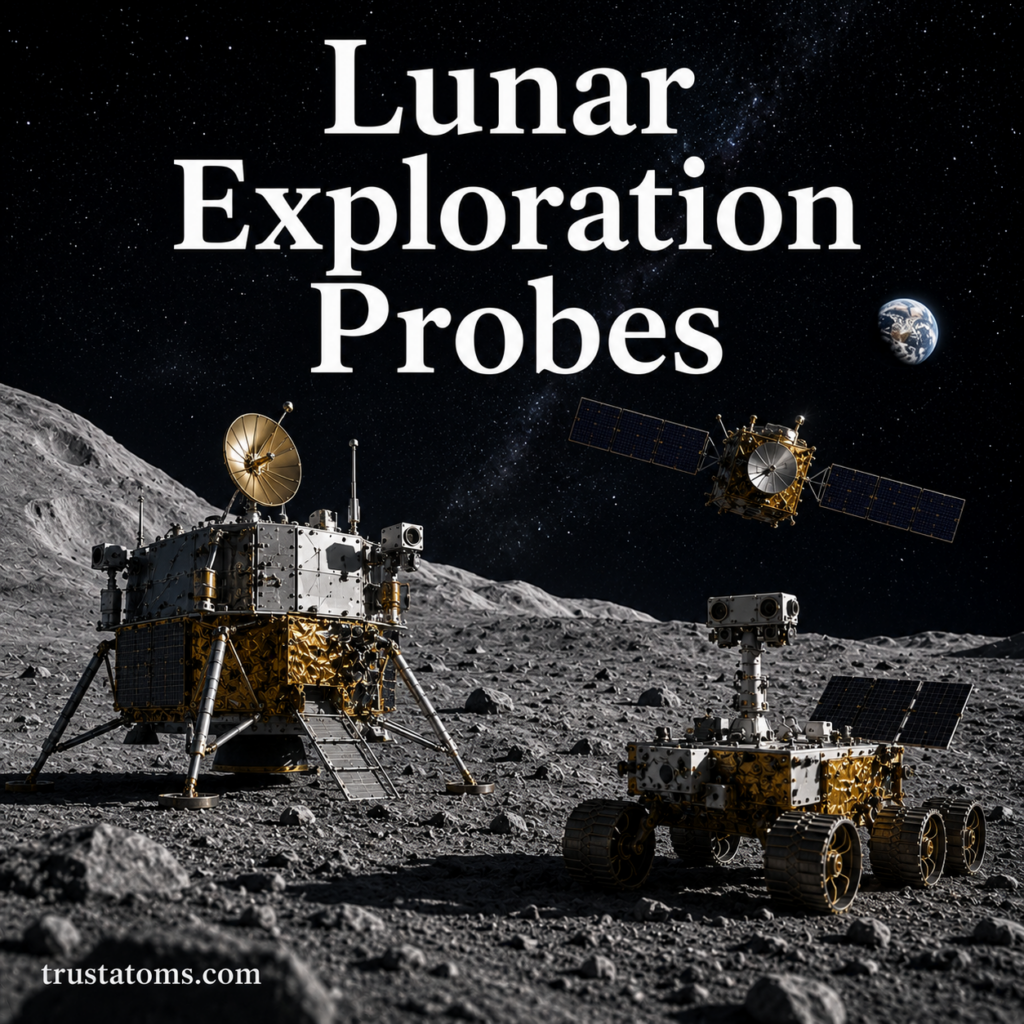
Lunar exploration probes have played a critical role in expanding humanity’s understanding of the Moon. These robotic spacecraft have mapped the lunar surface, studied its composition, searched for water ice, and prepared the way for future human missions.
From early flyby missions to modern orbiters and landers, lunar probes continue to provide valuable scientific discoveries about Earth’s closest celestial neighbor.
What Are Lunar Exploration Probes?
Lunar exploration probes are robotic spacecraft designed to study the Moon without carrying human crews.
These probes can:
- Orbit the Moon
- Land on the lunar surface
- Collect scientific data
- Capture high-resolution images
- Analyze soil and minerals
Because robotic probes can operate in harsh environments without life-support systems, they are ideal for long-term lunar exploration.
Why Scientists Explore the Moon
The Moon is an important scientific target for several reasons.
Understanding Lunar History
Studying the Moon helps scientists learn about:
- The formation of the solar system
- Early planetary evolution
- Ancient impact events
Preparing for Human Missions
Lunar probes help identify:
- Safe landing sites
- Available resources
- Environmental hazards
Searching for Water Ice
Water ice discovered near the Moon’s poles may support:
- Future astronaut missions
- Fuel production
- Long-term lunar bases
Testing Space Technologies
The Moon serves as a testing ground for:
- Robotic systems
- Landing technologies
- Surface operations
Types of Lunar Exploration Probes
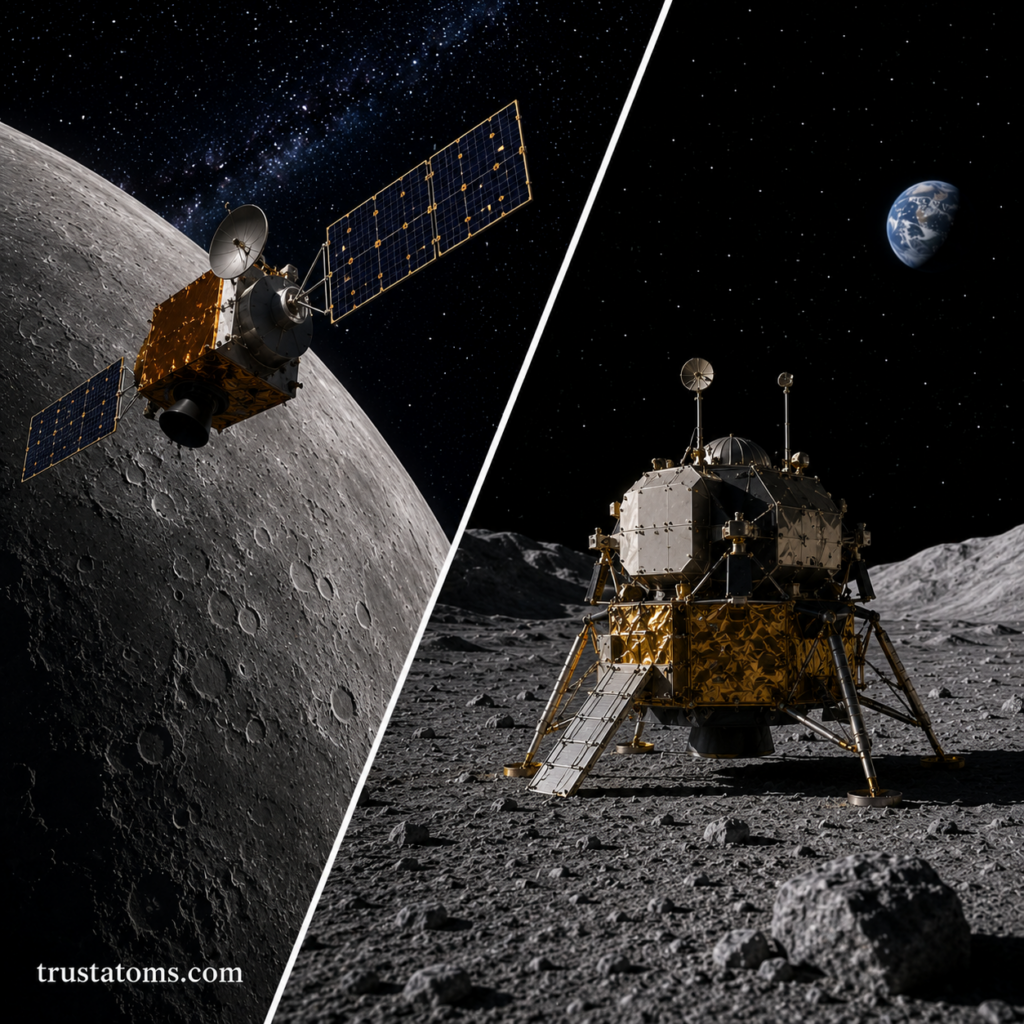
Different mission designs allow scientists to study the Moon in multiple ways.
Flyby Probes
Flyby missions pass near the Moon to collect quick observations.
These missions helped:
- Capture early lunar photographs
- Measure radiation and gravity
Orbiters
Orbiters circle the Moon and gather large-scale scientific data.
Their tasks include:
- Surface mapping
- Mineral analysis
- Monitoring temperature and terrain
Landers
Landers descend directly onto the lunar surface.
They perform experiments involving:
- Soil composition
- Seismic activity
- Environmental conditions
Rovers
Lunar rovers are mobile robotic vehicles used to explore the Moon’s terrain.
They can:
- Travel across the surface
- Analyze rocks and dust
- Carry scientific instruments
How Lunar Missions Work
Lunar exploration missions involve several carefully planned stages.
1. Launch
The spacecraft launches aboard a rocket from Earth.
2. Lunar Transfer
The probe travels through space toward the Moon.
3. Orbit or Descent
Depending on the mission:
- Orbiters enter lunar orbit
- Landers begin descent to the surface
4. Surface Operations
Landers and rovers collect scientific data and transmit it back to Earth.
5. Data Transmission
Information is sent using radio communication systems and Earth-based tracking networks.
Key Discoveries from Lunar Probes
Lunar missions have produced major scientific breakthroughs.
Discovery of Water Ice
- Ice deposits found in permanently shadowed craters
- Important for future exploration plans
Detailed Lunar Maps
Orbiters created highly accurate maps of:
- Mountains
- Craters
- Lava plains
Surface Composition
Probes discovered minerals and elements that reveal:
- The Moon’s volcanic history
- Geological evolution
Internal Structure
Seismic experiments improved understanding of:
- The Moon’s crust
- Mantle and core structure
Technologies Used in Lunar Exploration
Modern lunar probes rely on advanced engineering systems.
Autonomous Navigation
- Allows probes to maneuver independently
- Important during landing sequences
Scientific Instruments
Examples include:
- Cameras
- Spectrometers
- Ground-penetrating radar
Power Systems
Most lunar probes use:
- Solar panels
- Batteries for nighttime operations
Communication Systems
- Transmit scientific data to Earth
- Support mission control operations
Challenges of Exploring the Moon
Although the Moon is relatively close to Earth, lunar exploration still presents many challenges.
Extreme Temperatures
- Very hot during lunar day
- Extremely cold during lunar night
Rough Terrain
- Craters and rocks create landing hazards
- Dust can damage equipment
Radiation Exposure
- No protective atmosphere
- Electronics must withstand radiation
Limited Energy
- Long lunar nights reduce solar power availability
Modern Lunar Exploration Efforts
Lunar exploration has entered a new era with renewed international interest.
Robotic Missions
Countries and private companies continue launching:
- Orbiters
- Landers
- Small robotic rovers
Lunar Resource Studies
Scientists are researching:
- Water extraction
- Oxygen production from lunar soil
- Sustainable resource use
International Collaboration
Multiple nations are participating in lunar programs to:
- Share technology
- Expand scientific knowledge
- Prepare for long-term exploration
The Future of Lunar Probes
Future lunar exploration missions are expected to become more advanced and ambitious.
Upcoming Goals
- Establish robotic research stations
- Explore polar regions in greater detail
- Support future human settlements
Advanced Robotics
Next-generation probes may include:
- AI-assisted navigation
- Autonomous drilling systems
- Swarm robotics
Human and Robotic Cooperation
Robotic probes will likely prepare the Moon for future astronauts by:
- Mapping terrain
- Delivering supplies
- Testing habitats and equipment
Why Lunar Exploration Matters
Exploring the Moon offers benefits beyond lunar science itself.
Scientific Advancement
- Helps explain the history of Earth and the solar system
Technological Innovation
- Drives improvements in robotics and aerospace engineering
Space Exploration Preparation
- Serves as a stepping stone for Mars and deep-space missions
Inspiration and Education
- Encourages interest in science, astronomy, and engineering
Final Thoughts
Lunar exploration probes have transformed humanity’s understanding of the Moon and continue to shape the future of space exploration. Through orbiters, landers, and rovers, scientists are uncovering valuable insights about lunar history, resources, and the potential for long-term exploration.
As technology advances, robotic lunar missions will remain essential for preparing humanity’s next steps beyond Earth.