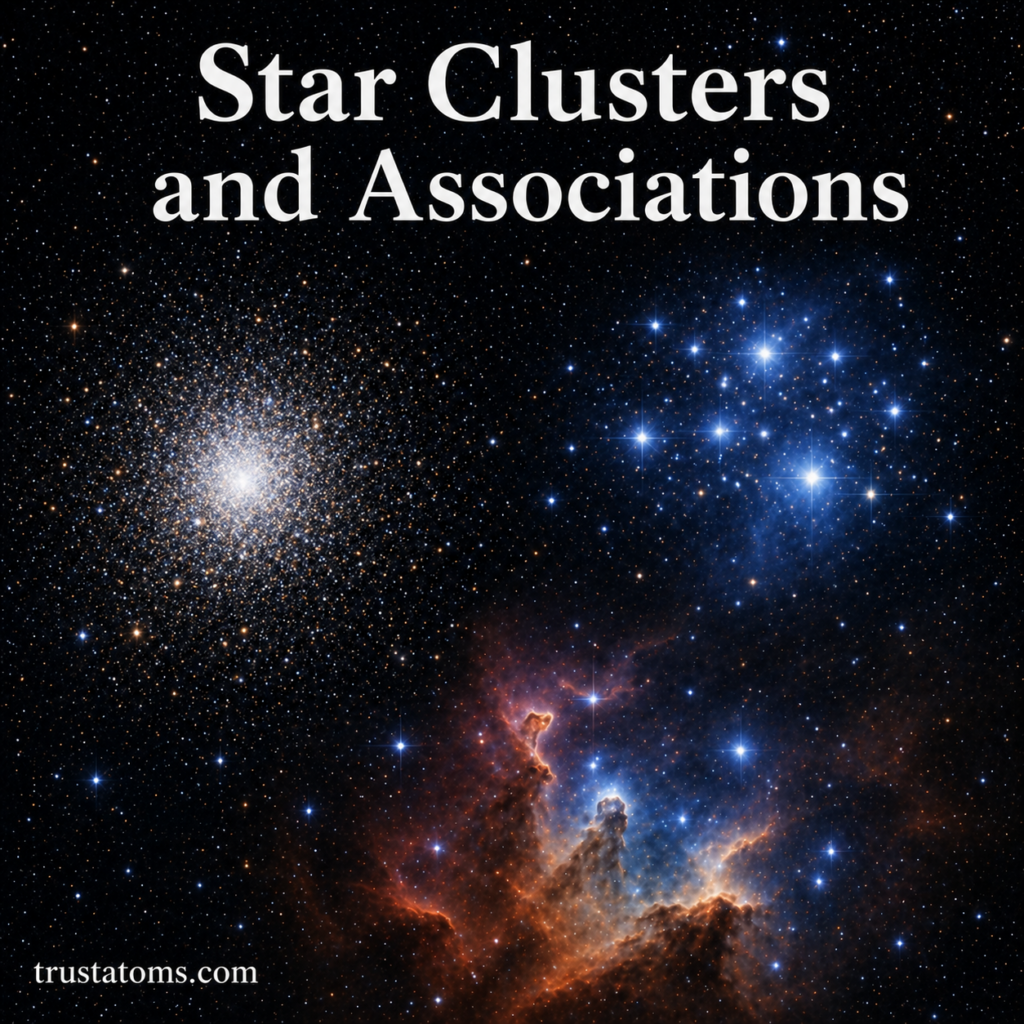
Star clusters are groups of stars held together by gravity, while stellar associations are groups of stars that share a common origin but are loosely bound or unbound. Both help astronomers understand how stars form together, develop over time, and spread throughout galaxies.
Many stars form within large clouds of gas and dust rather than in complete isolation. In the study of astronomy, these stellar groupings provide evidence about star formation, stellar ages, and the structure of galaxies.
What Are Star Clusters?
A star cluster is a collection of stars that remain gravitationally connected. Many cluster members formed from the same molecular cloud, giving them approximately similar ages and initial chemical compositions.
Because their stars share a common history, clusters provide useful environments for comparing stellar properties. Astronomers can examine how stars of different masses develop under broadly similar starting conditions.
Star clusters exist within galaxies, but they should not be confused with galaxy clusters, which contain entire galaxies. Galaxy Clusters and Superclusters explains these much larger structures.
Clusters are also found beyond the Milky Way. The Andromeda Galaxy Overview introduces a neighboring spiral galaxy containing extensive populations of stars and star clusters.
The Two Main Types of Star Clusters
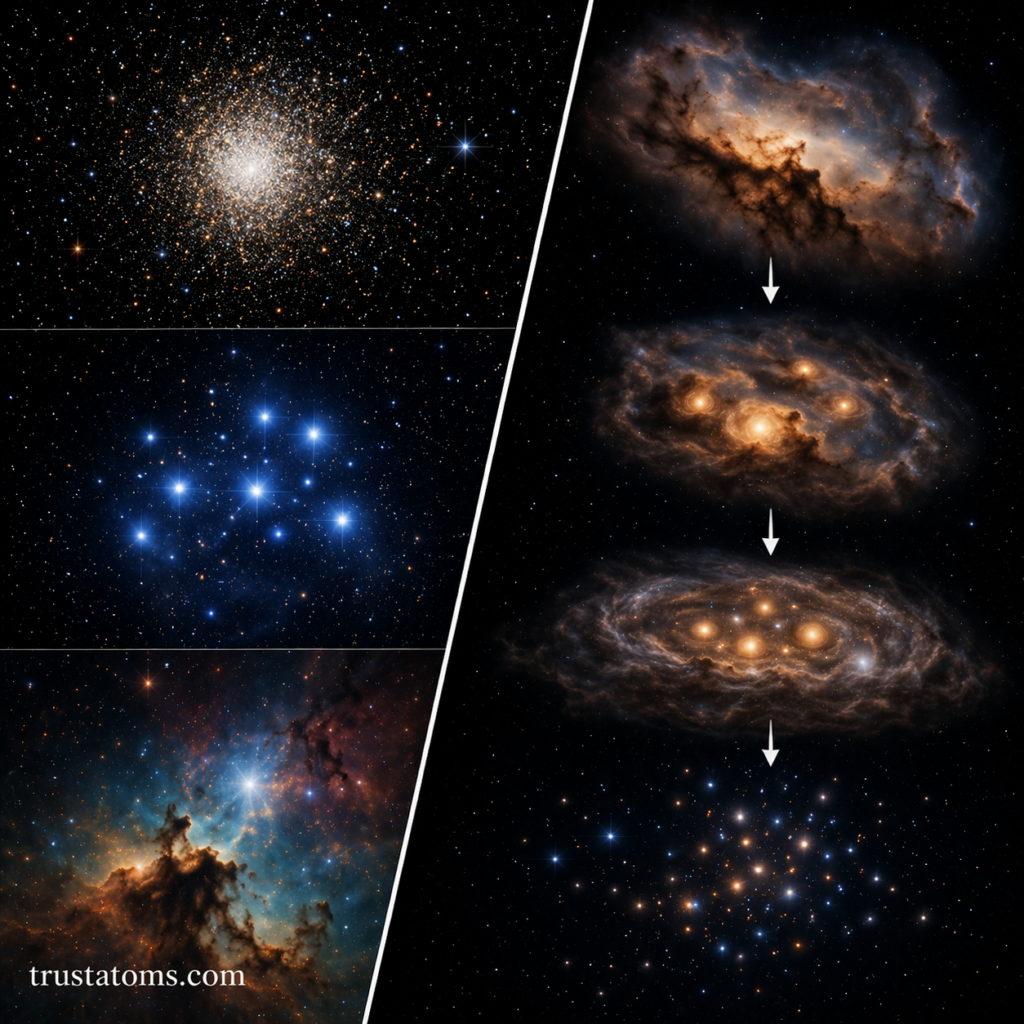
Astronomers commonly distinguish between open clusters and globular clusters. These categories differ in structure, stellar populations, and location within galaxies.
Open Clusters
Open clusters are relatively loosely bound groups of stars found primarily in the disk of a galaxy. They often contain dozens to thousands of stars distributed across an irregularly shaped region.
Many open clusters are young and contain bright, blue stars, although some survive for billions of years. Their relatively low stellar densities make them vulnerable to gravitational disturbances from nearby stars and molecular clouds.
Well-known examples include the Pleiades and Hyades, both visible in the constellation Taurus. These clusters are useful for studying stellar ages, distances, and the relationships between stars formed together.
Globular Clusters
Globular clusters are densely packed, approximately spherical collections containing tens of thousands to millions of stars. Their strong gravitational binding allows many to remain intact for billions of years.
Most globular clusters associated with the Milky Way contain predominantly old stars. Scientists estimate that many formed more than 10 billion years ago, based on measurements of their stellar populations and comparisons with stellar evolution models.
Globular clusters are commonly found in galactic halos, extending well beyond the main stellar disks. Messier 13, also called the Hercules Globular Cluster, is a prominent example visible through small telescopes.
What Are Stellar Associations?
Stellar associations are groups of stars that formed in related star-forming environments but are not strongly held together by their mutual gravity. Their members generally move apart over time.
Associations can extend across much larger regions than compact star clusters. They often contain young stars that still lie near the gas clouds where they formed.
These environments are closely connected to Stellar Nurseries and Nebulae, where dense regions of molecular gas collapse to produce new stars.
Types of Stellar Associations
Astronomers classify several kinds of stellar associations according to the stars and surrounding material they contain.
OB Associations
OB associations contain young, massive O-type and B-type stars. These stars are extremely hot and luminous, producing substantial ultraviolet radiation.
Because massive stars consume their nuclear fuel rapidly, their presence indicates recent star formation. OB associations help astronomers locate young stellar populations and investigate how massive stars affect nearby gas.
T Associations
T associations contain groups of T Tauri stars, which are young, low-mass stars still approaching the main-sequence stage of their development.
These stars are often associated with molecular clouds and may retain disks of gas and dust. Studying them helps scientists investigate the early stages of stellar and planetary system formation.
R Associations
R associations are groups of stars associated with reflection nebulae. These nebulae become visible when nearby starlight scatters off surrounding dust grains.
Unlike emission nebulae, which glow because gas emits radiation, reflection nebulae primarily scatter existing light. Their presence can reveal young stars embedded within dusty environments.
How Star Clusters and Associations Form
Most young stellar groupings originate within giant molecular clouds. These cold clouds contain gas and dust that can become concentrated into dense regions under gravity.
The general formation process involves several stages:
- Cloud fragmentation: Dense regions within a molecular cloud develop smaller concentrations of gas.
- Gravitational collapse: Some concentrations become dense enough to collapse and form protostars.
- Stellar development: Young stars gain mass and begin evolving toward stable hydrogen fusion.
- Gas removal: Stellar radiation, winds, and other processes disperse some remaining cloud material.
- Group evolution: Depending on their mass, density, and motions, stars may remain bound or gradually separate.
Not every group forms a lasting cluster. The initial distribution of stars, the amount of gas removed, and the surrounding gravitational environment all influence whether the group survives.
Comparing Star Clusters and Associations
The main difference is gravitational binding. Bound clusters can remain recognizable for long periods, while unbound associations spread into the surrounding stellar population.
| Characteristic | Open Clusters | Globular Clusters | Stellar Associations |
|---|---|---|---|
| Gravitational binding | Generally bound | Strongly bound | Weakly bound or unbound |
| Typical structure | Loose, irregular grouping | Dense, roughly spherical | Widely distributed stars |
| Typical stellar ages | Often young, but variable | Usually very old | Generally young |
| Common location | Galactic disks | Galactic halos | Star-forming regions |
| Long-term behavior | May gradually disperse | Can survive billions of years | Usually disperses relatively quickly |
A Real Example: The Pleiades Star Cluster
The Pleiades, also known as the Seven Sisters, is an open star cluster approximately 440 light-years from Earth. It contains hundreds of stars, although only a handful are easily visible without optical equipment.
Astronomers estimate that the cluster is roughly 100 million years old. Its bright blue stars are especially noticeable because massive, hot stars emit substantial amounts of blue light.
Imagine comparing two Pleiades members: one relatively massive and one similar in mass to the Sun. Because both formed at approximately the same time, their differences in brightness and temperature help reveal how stellar mass affects development.
This shared age makes the Pleiades a useful natural laboratory for testing stellar evolution models.
How Stellar Groups Change Over Time
Open clusters gradually lose members through internal gravitational encounters and disturbances from their surroundings. Some disperse relatively quickly, while others survive for billions of years.
Globular clusters are generally more resistant to disruption because of their large masses and high stellar densities. Nevertheless, they slowly evolve through interactions among stars and gravitational forces from their host galaxies.
Stellar associations usually disperse as their members follow slightly different paths through space. Over time, these stars become increasingly difficult to distinguish from the surrounding galactic population.
What Star Clusters Reveal About Stellar Evolution
Stars within a cluster often formed during a relatively short period and share similar initial chemical compositions. This allows astronomers to compare stars with different masses while reducing some uncertainties about their starting conditions.
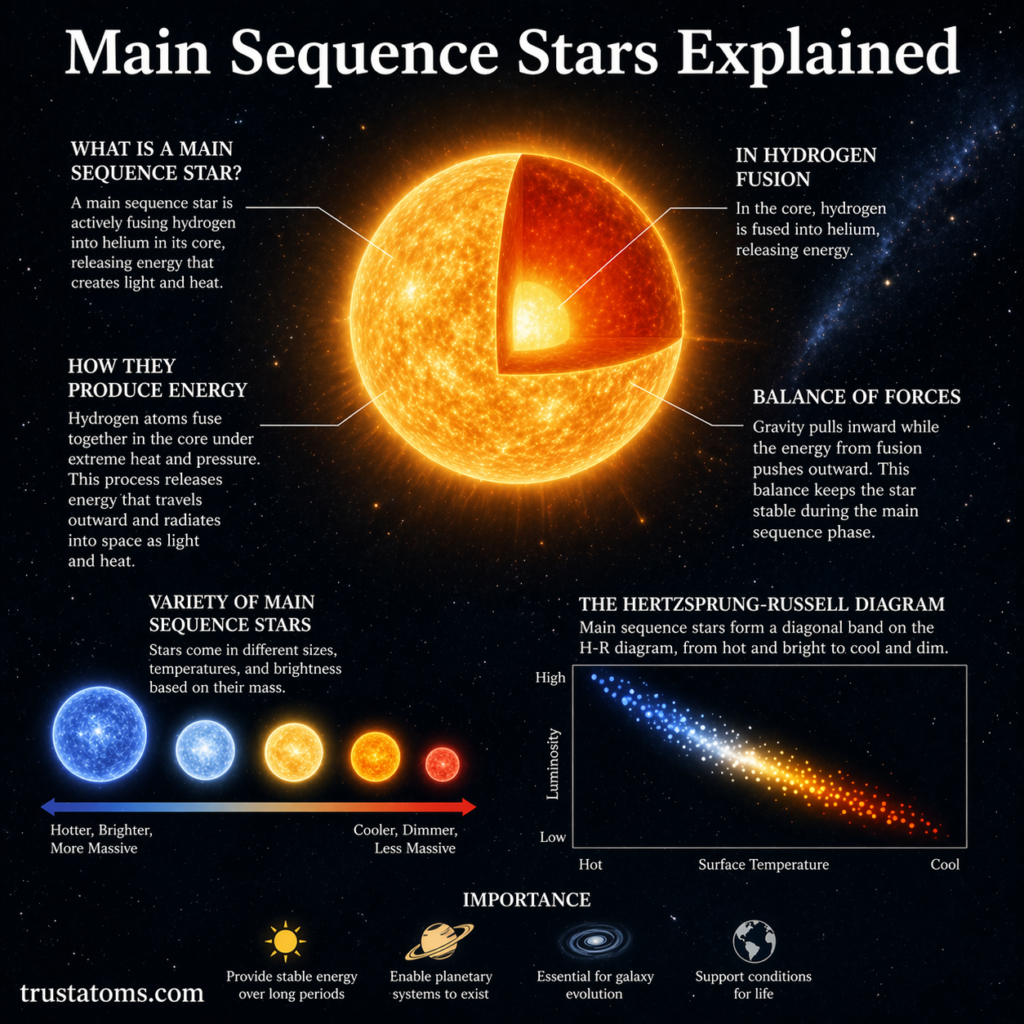
One important method involves plotting stellar brightness against temperature on a Hertzsprung-Russell diagram. The point where stars begin leaving the main sequence helps researchers estimate a cluster’s age.
Clusters also support distance measurements and studies of stellar chemistry. Comparing nearby and distant clusters helps scientists investigate how stellar populations vary across a galaxy.
Star Clusters in the Milky Way
The Milky Way contains numerous open clusters, globular clusters, and stellar associations. Open clusters and young associations are concentrated mainly in the disk, while globular clusters are distributed through the halo and central regions.
These structures help map the Milky Way and reveal its evolutionary history.
By measuring cluster positions, motions, ages, and chemical compositions, astronomers can investigate past star formation and the assembly of different galactic components.
Frequently Asked Questions
What is the difference between a star cluster and a stellar association?
A star cluster is a gravitationally bound group of stars, while a stellar association is a more loosely connected group whose members are generally moving apart. Both can contain stars formed in the same region.
Are all stars in a cluster the same age?
Not exactly. Many clusters contain stars that formed within a relatively short interval, making their ages similar. However, some stellar systems show evidence of more complicated formation histories or multiple stellar populations.
Can star clusters eventually disappear?
Yes. Gravitational interactions can gradually remove stars from clusters until the original grouping becomes difficult to recognize. Dense globular clusters can survive much longer than many loosely bound open clusters.
Star clusters and associations preserve evidence of how stars form and move through galaxies. Their different densities, ages, and gravitational structures help astronomers reconstruct stellar histories and test models of star formation. Studying both lasting clusters and dispersing associations reveals how stars gradually become part of a galaxy’s wider population.
Sources: NASA, Hubble Space Telescope educational resources on star clusters; European Space Agency, Gaia mission resources on stellar clusters and associations; Carroll and Ostlie, An Introduction to Modern Astrophysics.