An accretion disk is a rotating, flattened structure of gas, dust, or plasma that surrounds an astronomical object as material gradually moves inward under gravity. These disks form when infalling matter retains angular momentum, causing it to orbit rather than fall directly toward the central object.
Accretion disks occur around forming stars, white dwarfs, neutron stars, and black holes. Understanding their behavior is an important part of the study of astronomy because disks help explain how celestial objects gain mass and release energy.
From newborn stars to supermassive black holes, accretion disks are found in a wide range of environments, acting as pathways through which matter moves toward a central object while transferring angular momentum outward.
What Is an Accretion Disk?
An accretion disk is a rotating collection of matter whose particles orbit a central object while gradually transferring angular momentum. As some material loses angular momentum, it can move closer to the center.
The disk forms because incoming material usually has sideways motion. Instead of falling directly inward, it settles into orbit. Interactions within the disk allow some matter to move inward while other material carries angular momentum outward.
Accretion disks occur around compact stellar remnants and young stars. Particularly luminous disks can surround feeding supermassive black holes in Active Galactic Nuclei, where radiation from the surrounding material may dominate the galaxy’s central brightness.
How Accretion Disks Form
Disk formation requires gravity, orbiting material, and a mechanism for redistributing angular momentum.
- Material approaches a central object: Gas or dust moves inward under gravitational attraction.
- Angular momentum prevents direct infall: Sideways motion causes material to orbit rather than travel straight toward the center.
- Interactions produce a flattened structure: Collisions and other processes dissipate energy, helping matter settle into a rotating disk.
- Angular momentum moves outward: Internal stresses allow some gas to migrate inward while angular momentum is transported through the disk.
- Gravitational energy is released: As material moves into deeper gravitational regions, energy can be converted into heat and radiation.
The process does not require every particle to follow a perfect circular orbit. Real disks contain turbulence, temperature variations, magnetic fields, and complex gas flows.
Why Accretion Disks Become Hot and Bright
Material orbiting closer to a central object generally moves faster than material farther away. Interactions between neighboring regions of the disk redistribute angular momentum and convert some orbital energy into heat.
The resulting radiation depends on the disk’s temperature, density, and central object. Cooler disks around young stars emit strongly at infrared wavelengths, while hot disks around compact objects can produce ultraviolet radiation and X-rays.
In some actively feeding black hole systems, radiation from accreting material can exceed the combined starlight of the surrounding galaxy. The brightness comes from matter outside the black hole, not from light escaping its event horizon.
Types of Accretion Disks in Space
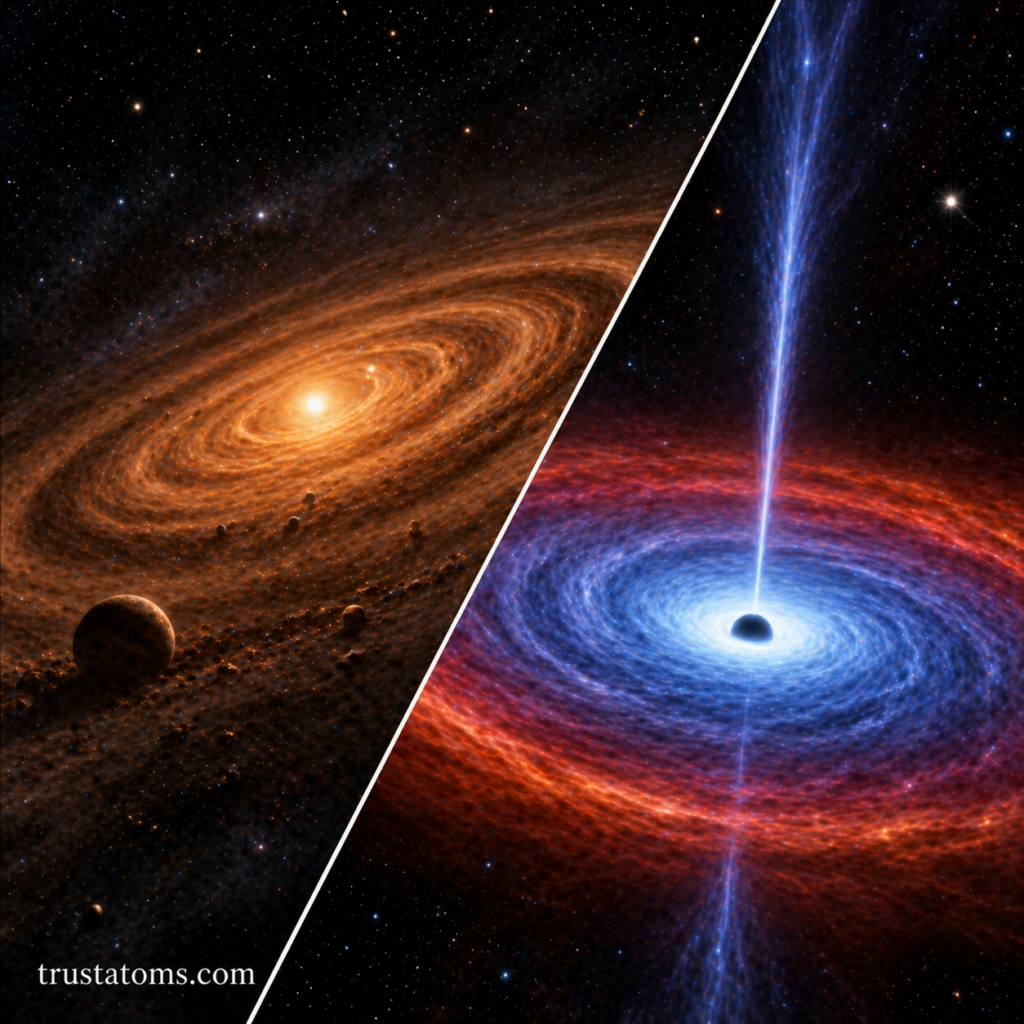
Accretion Disks Around Black Holes
Black hole accretion disks form when surrounding gas has enough angular momentum to orbit before crossing the event horizon. Gas near the inner disk can reach extremely high temperatures and produce energetic radiation.
The disk remains outside the black hole. Once material crosses the event horizon, it cannot send light or other signals back to distant observers.
Disks Around Young Stars
Young stars commonly form with surrounding disks of gas and dust. These structures can supply material to the growing star while also providing environments where solid particles collide, accumulate, and eventually form larger bodies.
Such disks are often called protoplanetary disks. They are generally much cooler than the inner regions of black hole accretion disks, and their gas and dust can evolve over millions of years.
Disks Around White Dwarfs and Neutron Stars
In some binary systems, a compact object draws gas from a companion star. The transferred material can form an accretion disk before reaching the white dwarf or neutron star.
Accretion onto white dwarfs can contribute to nova outbursts under suitable conditions. Accreting neutron stars can emit intense X-rays, sometimes revealing rapid changes associated with their rotation or magnetic fields.
How Angular Momentum and Magnetic Fields Control Accretion
Angular momentum makes accretion more complicated than simple gravitational free fall. Orbiting gas cannot move steadily inward unless it transfers angular momentum elsewhere.
In many ionized disks, magnetic turbulence helps transport angular momentum. One important mechanism is the magnetorotational instability, which can develop when magnetic fields interact with different orbital speeds at different distances from the center.
Scientists often describe these internal stresses using an effective viscosity. This does not mean ordinary molecular friction alone controls the disk; magnetic and turbulent processes can dominate the transport.
Worked Example: Orbital Speed in an Accretion Disk
Consider two small parcels of gas orbiting a star with the Sun’s mass. One is located at Earth’s average orbital distance, approximately 150 million kilometers, while the other orbits at half that distance.
For nearly circular orbits dominated by the central star’s gravity, orbital speed is inversely proportional to the square root of orbital radius.
- At Earth’s orbital distance, the circular orbital speed is approximately 30 kilometers per second.
- Moving to half that radius increases the speed by a factor of the square root of 2, approximately 1.41.
- The inner gas therefore orbits at approximately 42 kilometers per second.
This difference illustrates why neighboring regions of an accretion disk experience differential rotation. Such motion, together with magnetic fields and turbulence, helps drive the redistribution of angular momentum.
Accretion Disks and Relativistic Jets
Some accreting systems produce narrow jets of fast-moving plasma extending along the rotation axis of the central region. These jets are associated with organized magnetic fields and the transfer of energy and angular momentum.
Jets are not an inevitable feature of every accretion disk. Their formation depends on conditions such as magnetic field structure, accretion behavior, and the properties of the central object.
In certain black hole systems, jet material travels at speeds approaching the speed of light. The physical mechanisms and observations are discussed in Relativistic Jets from Black Holes.
Accretion Disks in Galaxy Centers
Many large galaxies contain central supermassive black holes, but not all are actively consuming substantial amounts of surrounding gas. When enough material reaches the central region, an accretion disk can develop and produce intense radiation.
These active systems can influence nearby gas through radiation, winds, and sometimes jets. Their activity can affect how gas cools and forms stars within the host galaxy.
The relationship between accretion and galactic activity is examined further in Black Holes at Galactic Centers.
What Happens to Material in an Accretion Disk?
Not all disk material reaches the central object. Some gas moves inward and is accreted, while other material may be carried outward or expelled in winds.
In young stellar systems, part of the disk’s solid material can become incorporated into planets, moons, asteroids, and smaller bodies. In compact-object systems, matter moving inward may release substantial radiation before reaching the central object.
These different outcomes depend on the disk’s composition, temperature, magnetic properties, and surrounding environment.
Frequently Asked Questions
What is an accretion disk in simple terms?
An accretion disk is a rotating disk of matter surrounding an astronomical object. Material within the disk can gradually move inward as angular momentum is transferred outward, allowing the central object to gain mass.
Why do accretion disks glow?
Accretion disks can glow because gravitational energy is converted into heat as matter moves inward. Their radiation ranges from infrared light in relatively cool disks to ultraviolet light and X-rays in much hotter systems.
Can an accretion disk exist without a black hole?
Yes. Accretion disks also occur around forming stars, white dwarfs, and neutron stars. The central object determines many of the disk’s physical conditions, but black holes are not required for disk formation.
Accretion disks form when gravity draws in rotating matter while internal stresses redistribute its angular momentum. Their temperatures and emissions vary widely, from relatively cool planet-forming environments to the intensely radiating regions around compact objects. Studying these disks reveals how stars and black holes gain mass and how some astronomical systems launch energetic outflows.
Sources: NASA Science; European Space Agency; Bradley W. Carroll and Dale A. Ostlie, An Introduction to Modern Astrophysics.