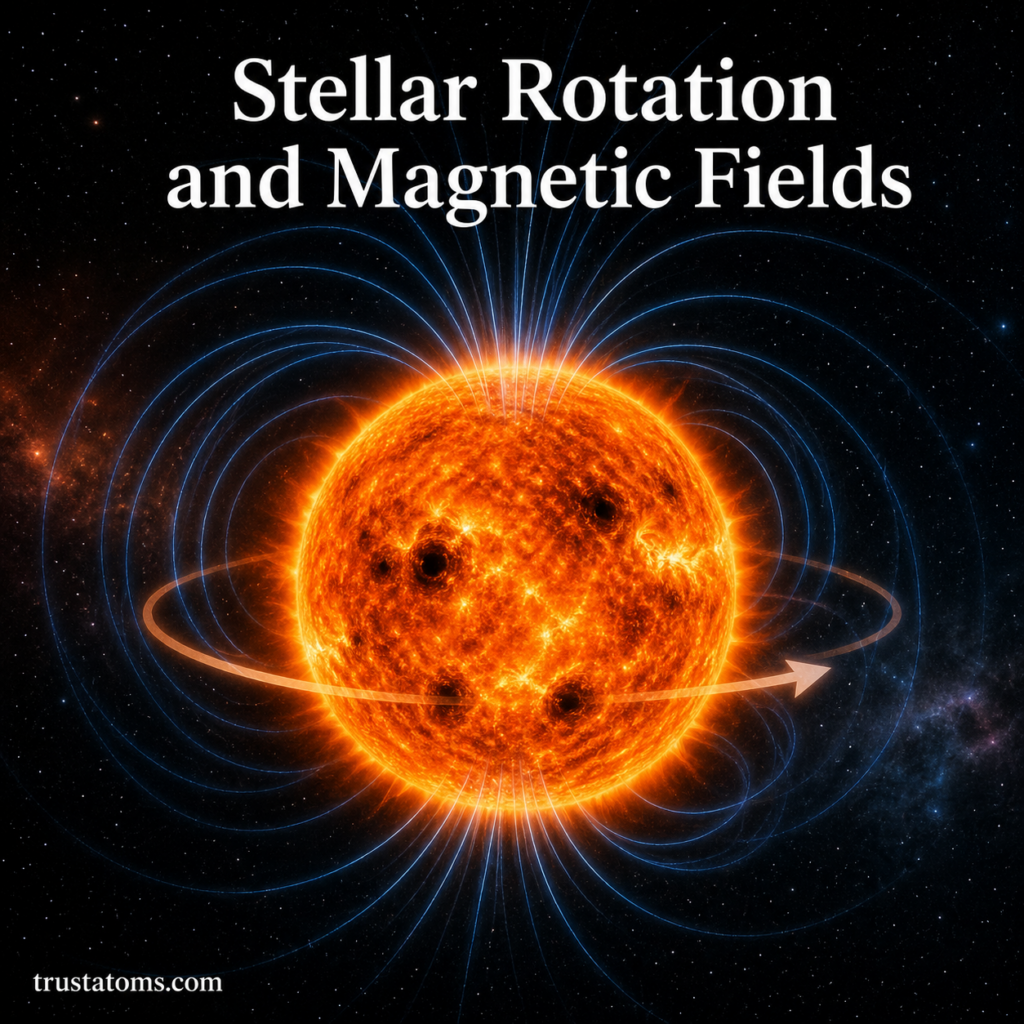
Stellar rotation influences how magnetic fields develop, how frequently stars produce flares, and how their activity changes with age. In many stars, rotating and circulating electrically charged plasma generates magnetic fields that produce starspots, energetic eruptions, and stellar winds.
Understanding the relationship between rotation and magnetism is an important part of the study of astronomy. From gentle spins like our Sun to rapidly rotating young stars, stellar rotation is deeply connected to phenomena like sunspots, stellar flares, and even space weather.
What Is Stellar Rotation?
Stellar rotation describes how a star spins around its axis. Astronomers measure rotation using the time required for one complete turn or the speed of material moving around the star’s equator.
Unlike Earth, which rotates approximately once every 24 hours, stars exhibit a wide range of rotation periods. Some complete a rotation in hours, while others take weeks or months.
The Sun provides a familiar example. Its equatorial regions rotate approximately once every 25 days relative to distant stars, while regions near its poles take roughly 35 days. This variation occurs because the Sun consists of plasma rather than a rigid solid.
Rotation also varies with stellar mass, age, and internal structure. Many young low-mass stars rotate rapidly before gradually slowing. The relationship between stellar activity and long lifetimes is especially interesting when examining Red Dwarfs and Longevity.
Rotation can influence mixing, mass loss, and internal development. These effects complement the mass-dependent outcomes described in Stellar Evolution Pathways Compared.
However, rotation is not the primary force preventing a star from collapsing. Gravity is mainly balanced by internal pressure, including gas pressure and, in some stars, significant radiation pressure. The distinction is explained further in Radiation Pressure in Stars.
How Rotation Helps Generate Stellar Magnetic Fields
Stars contain plasma, a state of matter consisting of electrically charged particles. When this conducting material moves, it interacts with magnetic fields and can help generate and maintain them.
In many stars, magnetic fields are sustained through a process called the stellar dynamo. Rotation and internal plasma motion work together to organize and amplify magnetic fields.
- Plasma circulation: Convection transports hot material outward and cooler material inward within certain stellar regions.
- Rotational influence: Rotation affects the organization of plasma flows and can produce differential rotation.
- Magnetic amplification: Moving conductive material stretches, twists, and redistributes existing magnetic fields.
- Continued regeneration: Under suitable conditions, these interactions maintain magnetic activity over long periods.
Not every stellar magnetic field is generated in exactly the same way. Some stars possess large-scale fields that may be remnants of earlier evolutionary stages rather than products of a contemporary convection-driven dynamo.
Magnetic fields become even more extreme in certain neutron stars. Magnetars and Extreme Magnetic Fields examines compact stellar remnants whose magnetic strengths greatly exceed those of ordinary stars.
Differential Rotation and Magnetic Activity
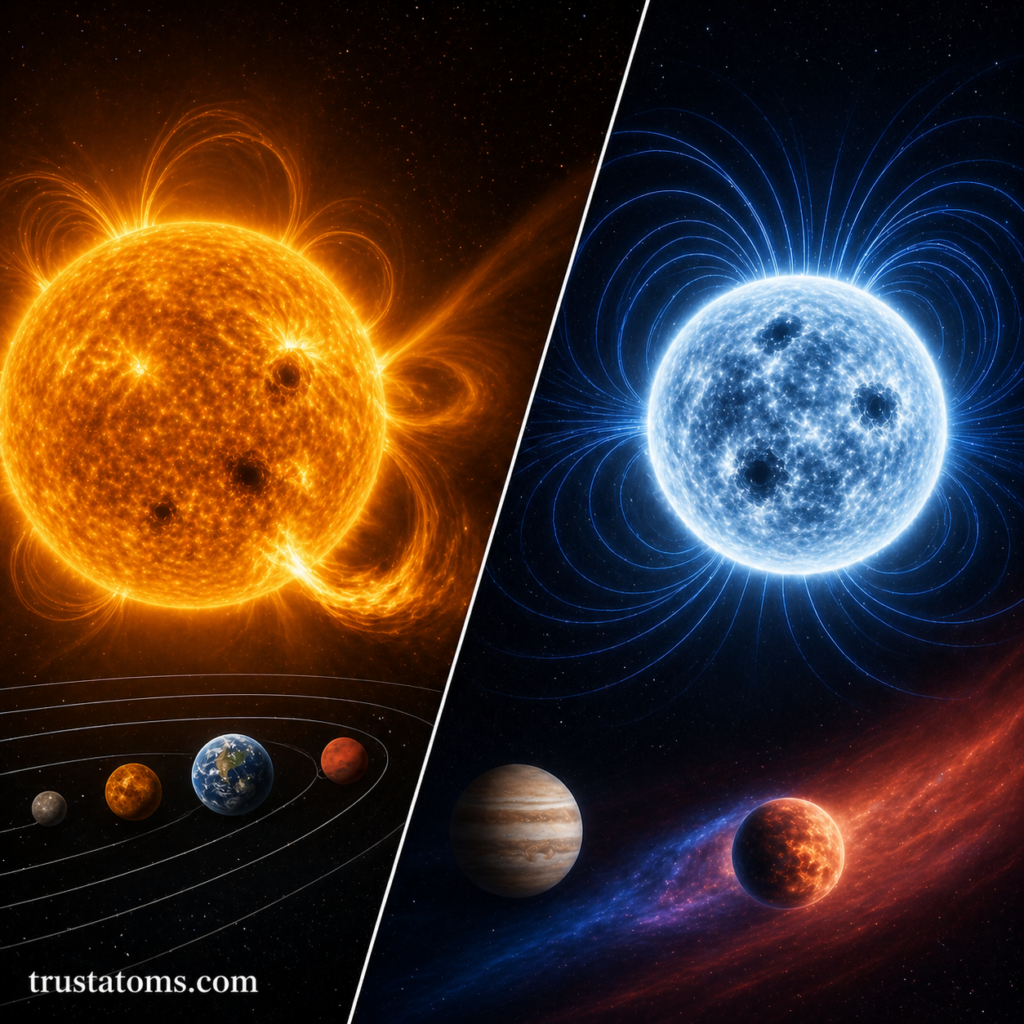
Differential rotation occurs when different regions of a star rotate at different angular speeds. This movement can stretch and distort magnetic fields, contributing to complex magnetic structures.
Magnetic energy can accumulate as field structures become increasingly stressed. When magnetic reconnection occurs, magnetic field configurations change rapidly, converting stored energy into heat, particle acceleration, and radiation.
These processes contribute to several observable phenomena:
- Stellar flares: Sudden releases of magnetic energy that produce bursts of electromagnetic radiation.
- Coronal mass ejections: Large expulsions of magnetized plasma from stellar outer atmospheres.
- Starspots: Relatively cool surface regions associated with concentrated magnetic fields.
Although rotation influences these events, magnetic activity also depends on convection, stellar structure, and the configuration of magnetic fields.
How Starspots Reveal Stellar Rotation
Starspots are regions where strong magnetic fields interfere with the normal transport of heat toward a star’s surface. These areas are cooler than their surroundings and therefore appear darker in visible light.
As a spotted star rotates, its brightness may decrease when large spots face an observer and increase as they rotate out of view. Astronomers can analyze these repeating brightness changes to estimate stellar rotation periods.
For example, if a star shows a repeating brightness pattern approximately every five days, the pattern may indicate a rotation period near five days. Researchers must account for multiple spots, spot evolution, and other possible causes before interpreting the signal.
Starspots can also reveal differences in surface rotation. If spots at different latitudes move at different rates, their changing patterns provide evidence of differential rotation.
Why Many Stars Rotate More Slowly as They Age
Many stars with substantial outer convective regions gradually lose angular momentum through magnetic braking. Their magnetic fields interact with escaping stellar winds, allowing the winds to carry angular momentum away.
As angular momentum is lost, rotation generally slows. This often reduces magnetic activity, although the relationship varies with stellar mass and internal structure.
Astronomers use the connection between rotation and age in a technique called gyrochronology. By comparing stellar rotation periods with those of stars whose ages are independently estimated, researchers can approximate the ages of certain stars.
However, gyrochronology is not equally reliable for every star. Very young stars, evolved stars, and some older stars can depart from simple rotational aging relationships.
Rapidly Rotating Stars and Extreme Magnetic Environments
Young stars often retain substantial angular momentum from their formation. Some rotate much faster than the Sun and exhibit frequent magnetic activity, including powerful flares.
Compact stellar remnants can rotate even faster. Neutron stars form when the cores of certain massive stars collapse, concentrating matter into extremely small volumes.
Conservation of angular momentum helps explain why some neutron stars rotate rapidly. The Crab Pulsar, for example, completes approximately 30 rotations every second.
Despite this remarkable speed, neutron-star magnetism differs from the convection-driven magnetic activity commonly studied in ordinary stars. Their dense interiors, strong fields, and evolutionary histories require specialized physical models.
How Stellar Magnetism Affects Nearby Planets
Stellar magnetic activity influences the radiation and charged-particle environments surrounding planets. Strong flares can temporarily increase ultraviolet and X-ray radiation, while stellar winds and eruptions interact with planetary magnetic fields and upper atmospheres.
Possible consequences include atmospheric heating, changes in atmospheric chemistry, and atmospheric escape under suitable conditions. The severity depends on the planet’s distance, atmosphere, magnetic environment, and the star’s activity.
For planets orbiting close to active red dwarfs, repeated energetic events may create challenging atmospheric conditions. However, stellar activity alone does not determine whether a planet can retain an atmosphere or support life.
The Sun as an Example of a Stellar Magnetic Cycle
The Sun offers the most detailed observations of a stellar magnetic dynamo. Its activity rises and falls over an approximately 11-year sunspot cycle, while its global magnetic polarity typically reverses near each activity maximum.
A complete magnetic polarity cycle therefore takes approximately 22 years. During periods of heightened activity, solar flares and coronal mass ejections become more frequent.
These events can disturb Earth’s magnetosphere, producing geomagnetic storms that sometimes affect satellites, radio communications, navigation systems, and electrical infrastructure.
By observing the Sun’s rotation, magnetic fields, and activity cycles, astronomers gain a detailed reference for interpreting magnetic behavior on other stars.
Frequently Asked Questions
Do faster-rotating stars always have stronger magnetic fields?
No. Faster rotation is often associated with stronger magnetic activity in stars with convective regions, but the relationship is not unlimited. Magnetic activity can reach a saturation level, and different stellar structures produce different magnetic behaviors.
Can astronomers measure how fast a distant star rotates?
Yes. Astronomers estimate rotation using repeating brightness variations caused by starspots and spectral line broadening caused by the motion of the stellar surface. Spectroscopic measurements generally provide projected rotational velocity rather than the full equatorial speed.
Will the Sun eventually stop rotating?
The Sun is expected to continue losing angular momentum, but it will not simply stop rotating. Its rotation will also change as its internal structure and size evolve, particularly during its future red giant phase.
Stellar rotation helps organize the plasma motions that sustain magnetic fields, while magnetic winds can gradually alter a star’s spin. Studying these linked processes explains observable activity such as starspots and flares, improves estimates of stellar ages, and helps astronomers evaluate the radiation environments surrounding planets.
Sources: Carroll and Ostlie, An Introduction to Modern Astrophysics; NASA Solar Dynamics Observatory; OpenStax Astronomy 2e.