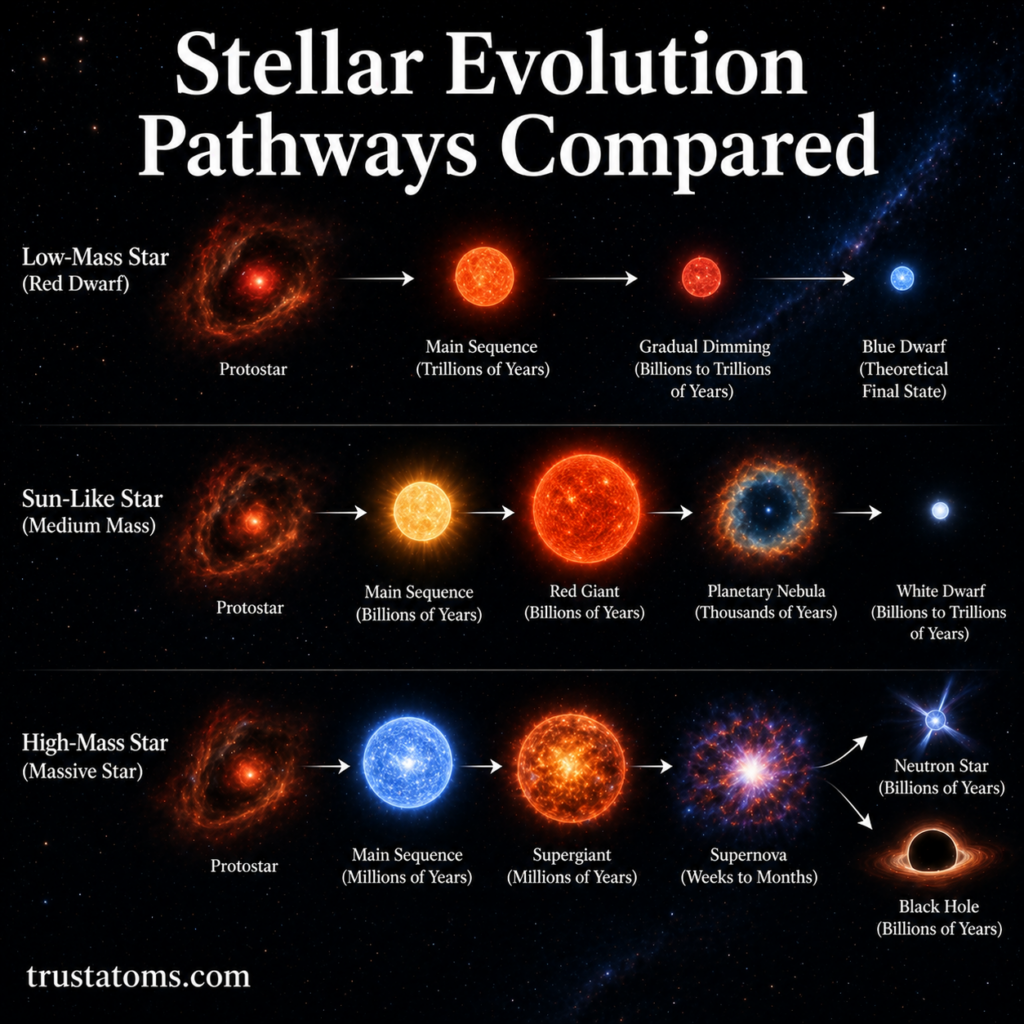
Stellar evolution pathways differ mainly because a star’s initial mass determines how quickly it consumes nuclear fuel and what happens when that fuel runs out. Low-mass stars can shine for trillions of years, Sun-like stars eventually become white dwarfs, and massive stars may collapse into neutron stars or black holes.
These differences help explain why stars vary so widely in brightness, temperature, and lifespan. Comparing their development is an essential part of the study of astronomy, allowing scientists to connect observations of young stars, aging giants, and stellar remnants.
What Determines a Star’s Evolution?
A star’s initial mass is the strongest predictor of its evolutionary pathway. Greater mass produces stronger gravitational compression, which generally raises core temperatures and accelerates nuclear fusion.
This creates a surprising relationship: massive stars contain more hydrogen fuel, yet they typically exhaust it much faster than smaller stars. Their higher energy output comes at the expense of a shorter lifespan.
Chemical composition, rotation, mass loss, and interactions with companion stars can also change a star’s development. However, initial mass provides the clearest starting point for comparing typical stellar pathways.
The Birth of All Stars
Stars form within cold, dense regions of molecular clouds containing mostly hydrogen and helium, along with small amounts of dust. Gravity causes portions of these clouds to contract, creating growing concentrations of material.
- Cloud collapse: Gravity draws gas toward a dense central region.
- Protostar formation: Accumulating material heats the developing star.
- Core heating: Increasing pressure and temperature prepare the core for sustained hydrogen fusion.
- Main-sequence arrival: Sustained hydrogen fusion begins, establishing a relatively stable period of stellar life.
During the main sequence, outward pressure balances the inward pull of gravity. The duration and characteristics of this stage vary enormously with mass. Understanding main sequence stars provides the foundation for explaining how their later evolutionary paths diverge.
Low-Mass Stars (Red Dwarfs)
Red dwarfs are small, relatively cool stars with masses approximately 0.08 to 0.5 times that of the Sun. They consume hydrogen slowly, producing much less light than larger stars.
The smallest red dwarfs are fully convective, meaning circulating material can transport hydrogen throughout much of the star. This efficient fuel mixing helps explain their extraordinary longevity. For a closer comparison of fuel consumption and lifetime, see Mass and Stellar Lifespan.
Proxima Centauri, the nearest known star to the Sun, is a red dwarf. Models predict that the smallest hydrogen-burning stars can survive for trillions of years, far longer than the universe’s approximately 13.8-billion-year age estimated from cosmological observations.
Because none have completed their expected lifetimes, their final evolutionary stages remain theoretical. Some models predict that very low-mass stars will eventually become hotter blue dwarfs before ending as white dwarfs, without undergoing core-collapse supernovae.
These predicted remnants differ from the well-observed white dwarfs produced by stars closer to the Sun’s mass. The article White Dwarfs and Stellar Remnants explains how these compact stellar objects form and cool.
Sun-Like Stars: Red Giants and White Dwarfs
Stars approximately the Sun’s mass spend billions of years converting hydrogen into helium in their cores. The Sun’s total main-sequence lifetime is estimated at roughly 10 billion years.
When core hydrogen becomes depleted, the core contracts while hydrogen continues fusing in a surrounding shell. The outer layers expand, transforming the star into a red giant.
Later, helium fusion produces carbon and oxygen in the core. Eventually, the star sheds its outer layers, sometimes creating a glowing planetary nebula. The remaining exposed core becomes a dense white dwarf supported by electron degeneracy pressure.
Unlike a massive star, an isolated Sun-like star does not normally experience a core-collapse supernova. Its white dwarf gradually cools over immense timescales.
Massive Stars: Supergiants and Core Collapse
Stars born with roughly eight or more solar masses generally follow a more energetic pathway. Their high core temperatures allow rapid hydrogen consumption, often limiting their lifetimes to millions or tens of millions of years.
After hydrogen depletion, sufficiently massive stars can fuse progressively heavier elements. Advanced burning stages may produce an onion-like internal structure, with different nuclear reactions occurring in separate layers.
In stars that develop iron-rich cores, fusion can no longer provide enough energy to support the core against gravity. Core collapse may trigger a supernova, ejecting stellar material into surrounding space.
Depending on the collapsing core’s properties and subsequent evolution, the remnant may become a neutron star or black hole. Not every massive star produces a bright supernova; some may collapse with a weak or unsuccessful explosion.
The Crab Pulsar is an observed neutron star within the Crab Nebula, providing an example of the compact remnants associated with massive stellar explosions.
Stellar Lifespans and End States Compared
Consider three stars forming at approximately the same time: a small red dwarf, a star resembling the Sun, and a massive star containing 20 solar masses. Although they begin with similar basic ingredients, their futures differ dramatically.
| Characteristic | Red Dwarf | Sun-Like Star | Massive Star |
|---|---|---|---|
| Example mass | 0.1 solar masses | 1 solar mass | 20 solar masses |
| Approximate main-sequence lifespan | Trillions of years | 10 billion years | Several million years |
| Energy output | Low | Moderate | Extremely high |
| Later evolution | Slow, theoretically predicted changes | Red giant and outer-layer ejection | Advanced fusion and possible core collapse |
| Expected final remnant | White dwarf | White dwarf | Neutron star or black hole |
These values illustrate broad patterns rather than exact predictions. Stellar composition, rotation, mass loss, and binary interactions can substantially modify lifetimes and outcomes.
How Stellar Endings Differ
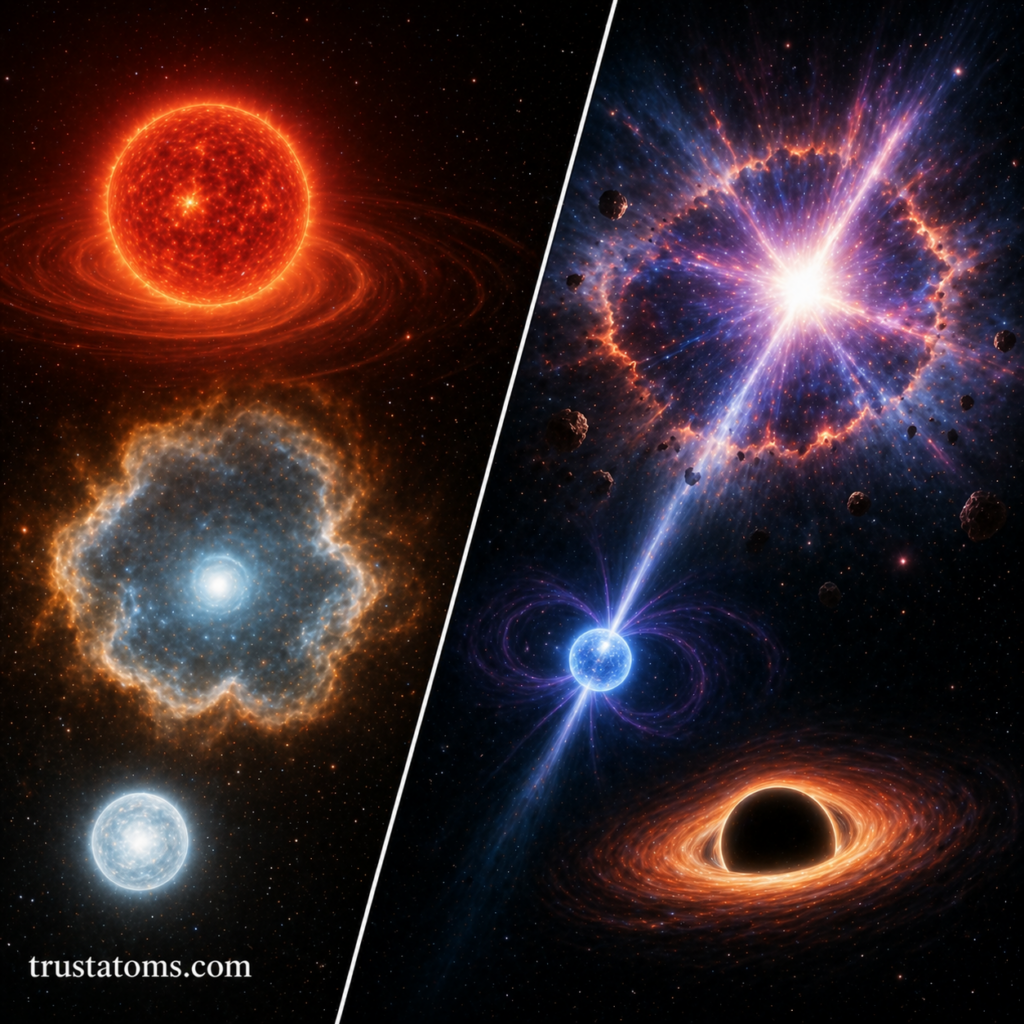
White dwarfs, neutron stars, and black holes represent very different outcomes of stellar evolution. A white dwarf contains matter compressed into an Earth-sized object, while a neutron star packs greater mass into a region only tens of kilometers across.
Black holes form when gravitational collapse produces a region bounded by an event horizon, beyond which light cannot escape. The precise outcome depends on factors including core mass, mass loss, and the physics of collapse.
How Stellar Evolution Changes Galaxies
Stellar evolution also determines how chemical elements circulate through galaxies. Aging stars return material to interstellar space through stellar winds and expelled outer layers. Massive stars can release additional elements through powerful explosions.
This recycled material contributes to later generations of stars and planetary systems. Astronomers study stellar populations and remnants to reconstruct the histories of galaxies and investigate how their chemical compositions change.
Frequently Asked Questions
Why do massive stars die sooner than smaller stars?
Massive stars have hotter, denser cores and consume hydrogen much faster. Although they begin with more fuel, their dramatically higher fusion rates shorten their lifetimes.
Will the Sun eventually become a black hole?
No. The Sun lacks the mass required for the core-collapse pathway that can produce a black hole. Scientists expect it to expand into a red giant, lose its outer layers, and leave behind a white dwarf.
Have astronomers observed a red dwarf reach the end of its life?
No. According to stellar evolution models, the smallest red dwarfs require trillions of years to exhaust their hydrogen. The universe is not yet old enough for these stars to have completed their predicted evolution.
From slow-burning red dwarfs to explosive supernovae, each pathway contributes to the structure and chemistry of the universe. Research from institutions like the Harvard-Smithsonian Center for Astrophysics continues to reveal how these life cycles connect to the broader cosmic story.
The central distinction is that stellar mass influences both the rate of nuclear fusion and the final remnant. Comparing stars across different mass ranges helps astronomers explain observed stellar populations, predict their future development, and understand how generations of stars enrich interstellar space.
Sources: Carroll and Ostlie, An Introduction to Modern Astrophysics; NASA Imagine the Universe, Stellar Evolution; OpenStax Astronomy 2e.