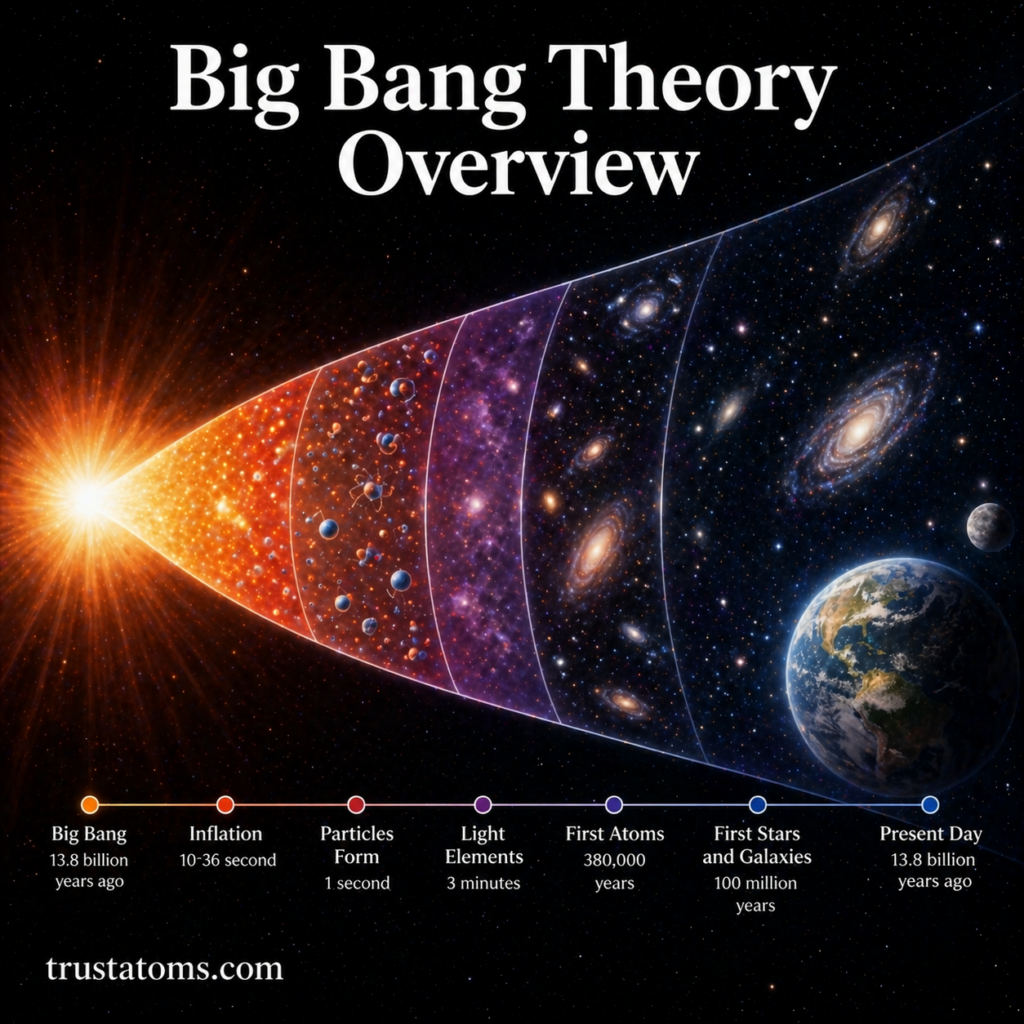
Big Bang Theory Overview

Illustration of the Big Bang theory timeline showing the universe expanding from an early hot dense state to modern galaxies and planets.
A visual timeline of the Big Bang theory, illustrating the expansion of the universe from its origin to the present day. trustatoms.com

The Big Bang Theory is the most widely accepted scientific explanation for the origin of the universe. It proposes that the universe began about 13.8 billion years ago from an extremely hot, dense state and has been expanding ever since.

At the same time, many people explore the origins of the universe through religious or philosophical perspectives, such as creationism. These perspectives focus more on meaning, purpose, and the role of a creator.

Understanding both viewpoints requires recognizing that they address different kinds of questions.

Continue reading “Big Bang Theory Overview”
Cosmic Expansion and Hubble’s Law

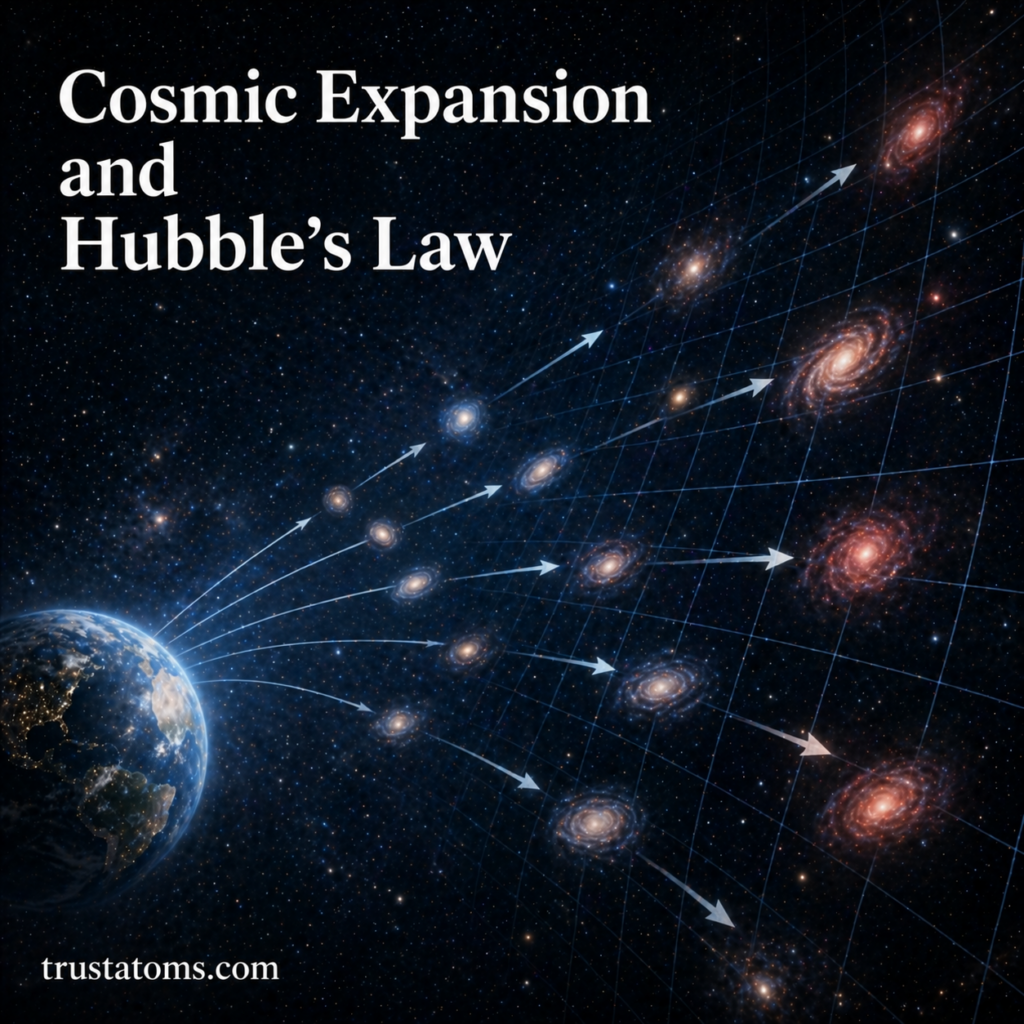
Illustration of galaxies moving away from Earth in an expanding universe, demonstrating cosmic expansion and Hubble’s Law.
A visual representation of cosmic expansion, showing galaxies receding from Earth as space expands according to Hubble’s Law. trustatoms.com

The universe is not static—it is constantly expanding. One of the most important discoveries in modern astronomy is that galaxies are moving away from each other, stretching space itself. This phenomenon, known as cosmic expansion, is described by a fundamental principle called Hubble’s Law.

Understanding cosmic expansion helps explain the origin, evolution, and future of the universe.

Continue reading “Cosmic Expansion and Hubble’s Law”

Quasars and Distant Light Sources

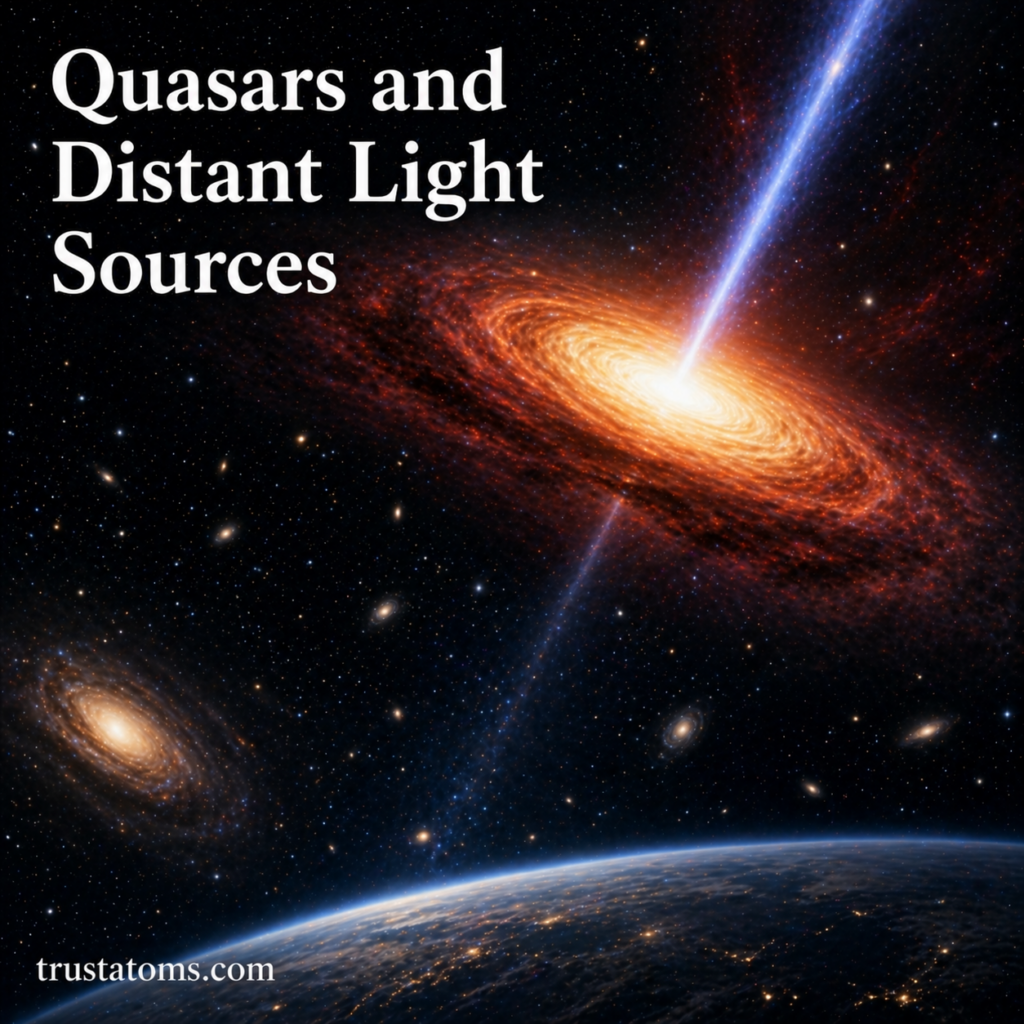
Illustration of a quasar with a bright accretion disk and powerful jet emitting light across space with distant galaxies in the background.
A visual depiction of a quasar acting as a distant light source, powered by a supermassive black hole and emitting intense radiation. trustatoms.com

The universe is filled with extraordinary objects, but few are as powerful or mysterious as quasars. These incredibly bright sources of energy can outshine entire galaxies and are visible from billions of light-years away.

By studying quasars and other distant light sources, astronomers can look back in time and uncover the history of the universe itself.

Continue reading “Quasars and Distant Light Sources”

Active Galactic Nuclei

Illustration of an active galactic nucleus with a supermassive black hole, glowing accretion disk, and powerful jets extending into space.
A visual representation of an active galactic nucleus showing a supermassive black hole, accretion disk, and energetic jets. trustatoms.com

At the centers of many galaxies lie incredibly energetic regions known as Active Galactic Nuclei (AGN). These cosmic powerhouses outshine entire galaxies and are driven by some of the most extreme physics in the universe.

From blazing quasars to powerful jets of radiation, AGN provide crucial insight into how galaxies evolve and how supermassive black holes influence their surroundings.

Continue reading “Active Galactic Nuclei”

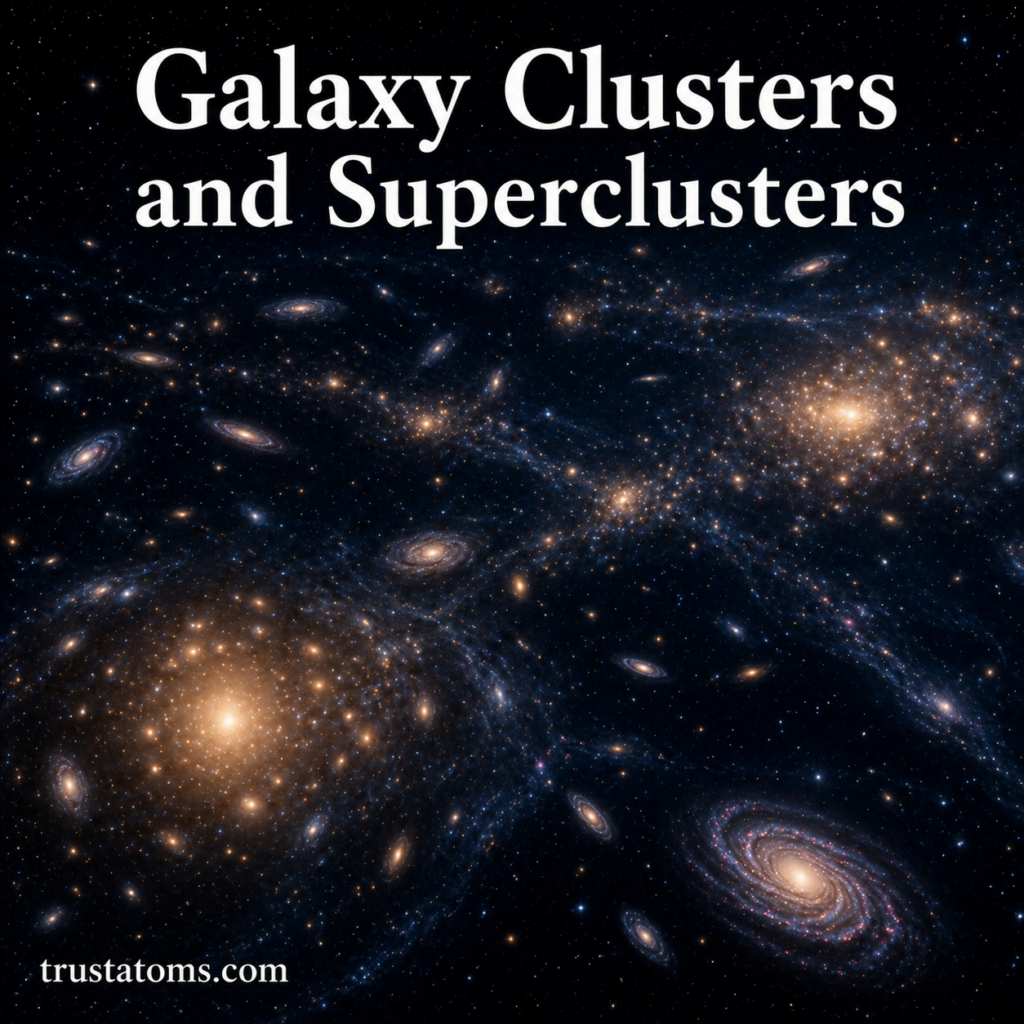
Galaxy Clusters and Superclusters

Illustration showing multiple galaxy clusters and superclusters connected across a cosmic web with glowing galaxies and dense regions.
A visual representation of galaxy clusters and superclusters forming part of the large-scale cosmic web structure. trustatoms.com

The universe is structured on an unimaginable scale, far beyond individual stars and even galaxies. At the largest levels, galaxies group together into vast systems known as clusters and superclusters—forming a cosmic web that stretches across billions of light-years.

Understanding these structures helps astronomers map the universe, study gravity, and uncover the role of dark matter and dark energy.

Continue reading “Galaxy Clusters and Superclusters”

Andromeda Galaxy Overview

Illustration of the Andromeda Galaxy showing its spiral structure with a bright core and star-filled background.
A detailed illustration of the Andromeda Galaxy highlighting its spiral arms and luminous core. trustatoms.com

The Andromeda Galaxy is the closest large spiral galaxy to our own Milky Way—and one of the most fascinating objects in the night sky. Visible to the naked eye under dark conditions, Andromeda offers a rare glimpse into the structure, history, and future of galaxies like our own.

In this guide, we’ll explore what the Andromeda Galaxy is, its key characteristics, how to observe it, and what it reveals about the universe.

Continue reading “Andromeda Galaxy Overview”

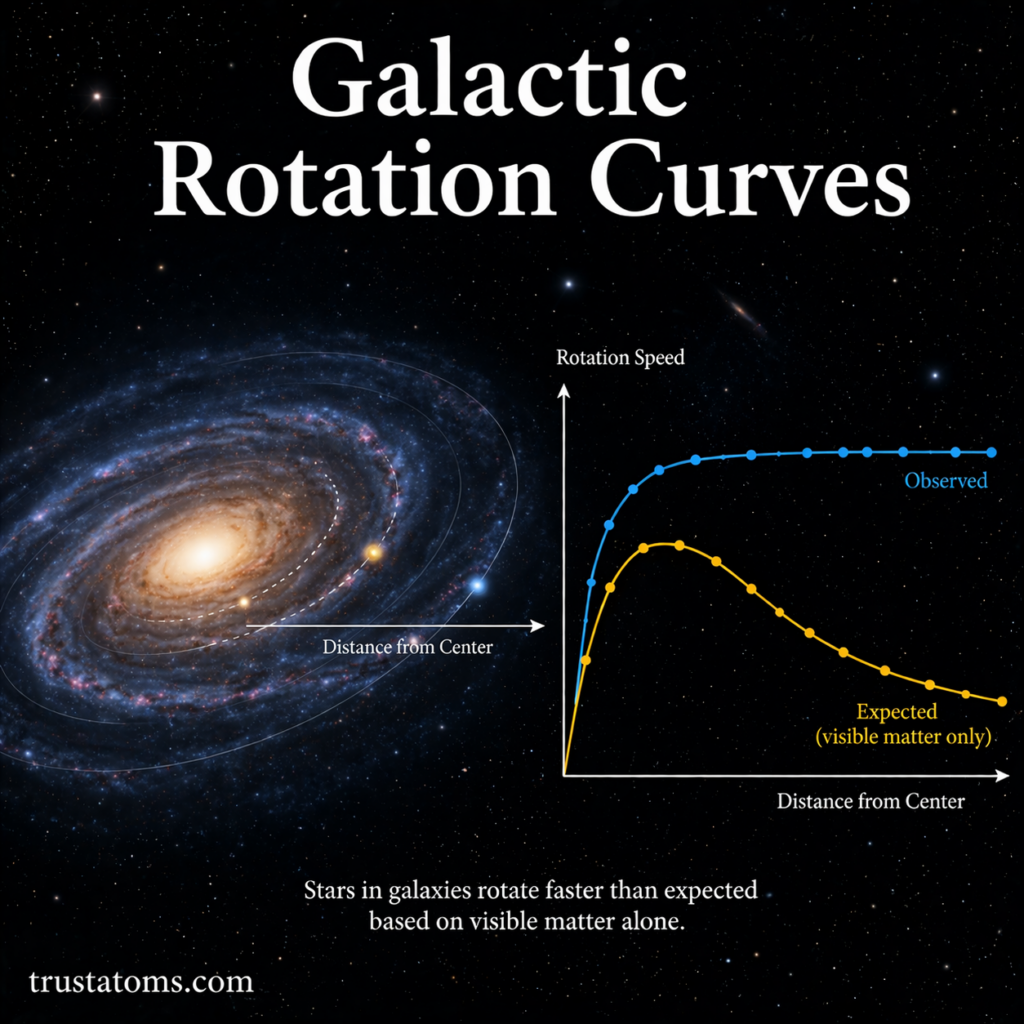
Galactic Rotation Curves

Illustration of a galaxy with a rotation curve graph comparing observed and expected orbital speeds.
A galaxy and rotation curve graph showing how stars move faster than expected due to unseen mass. trustatoms.com.

Galaxies are not just collections of stars—they are dynamic systems in motion. One of the most important tools astronomers use to study this motion is the galactic rotation curve. These curves reveal how stars and gas move within a galaxy and have led to one of the most surprising discoveries in modern astronomy: the existence of dark matter.

Continue reading “Galactic Rotation Curves”

Dark Matter in Galaxies

Illustration of a spiral galaxy surrounded by a dark matter halo showing invisible mass holding the galaxy together.
A galaxy surrounded by a dark matter halo, illustrating the unseen mass that holds galaxies together. trustatoms.com.

Galaxies are held together by more than what we can see. While stars, gas, and dust make up the visible parts of a galaxy, most of its mass is actually made of something invisible—dark matter.

Dark matter does not emit, absorb, or reflect light, making it impossible to observe directly. Yet its gravitational effects are essential for explaining how galaxies form, rotate, and stay intact.

Continue reading “Dark Matter in Galaxies”

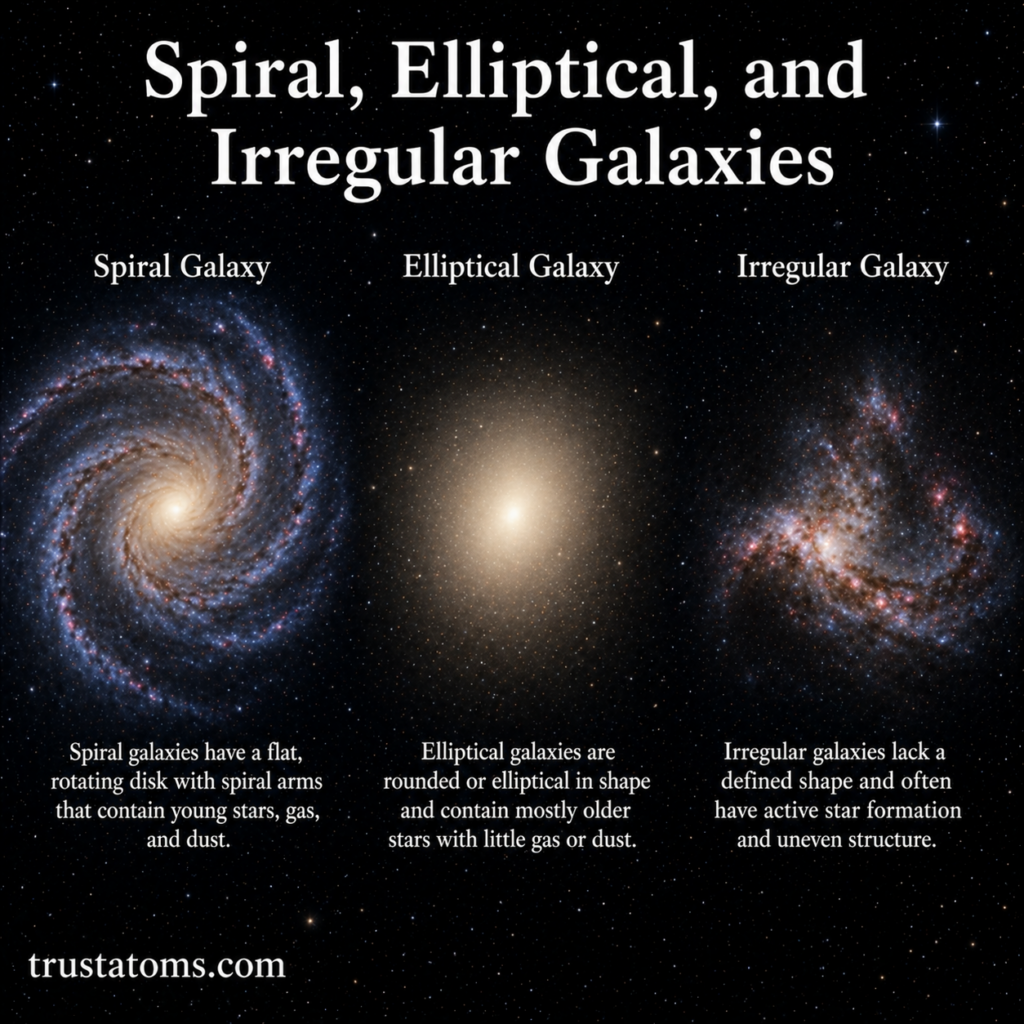
Spiral, Elliptical, and Irregular Galaxies

Comparison illustration showing spiral, elliptical, and irregular galaxy shapes and structures.
A visual comparison of spiral, elliptical, and irregular galaxies, highlighting their different shapes and structures. trustatoms.com.

Galaxies come in a wide variety of shapes and sizes, but most fall into three main categories: spiral, elliptical, and irregular. These classifications help astronomers understand how galaxies form, evolve, and interact over time.

Each type has distinct features, stellar populations, and levels of activity, offering clues about its history and future.

Continue reading “Spiral, Elliptical, and Irregular Galaxies”

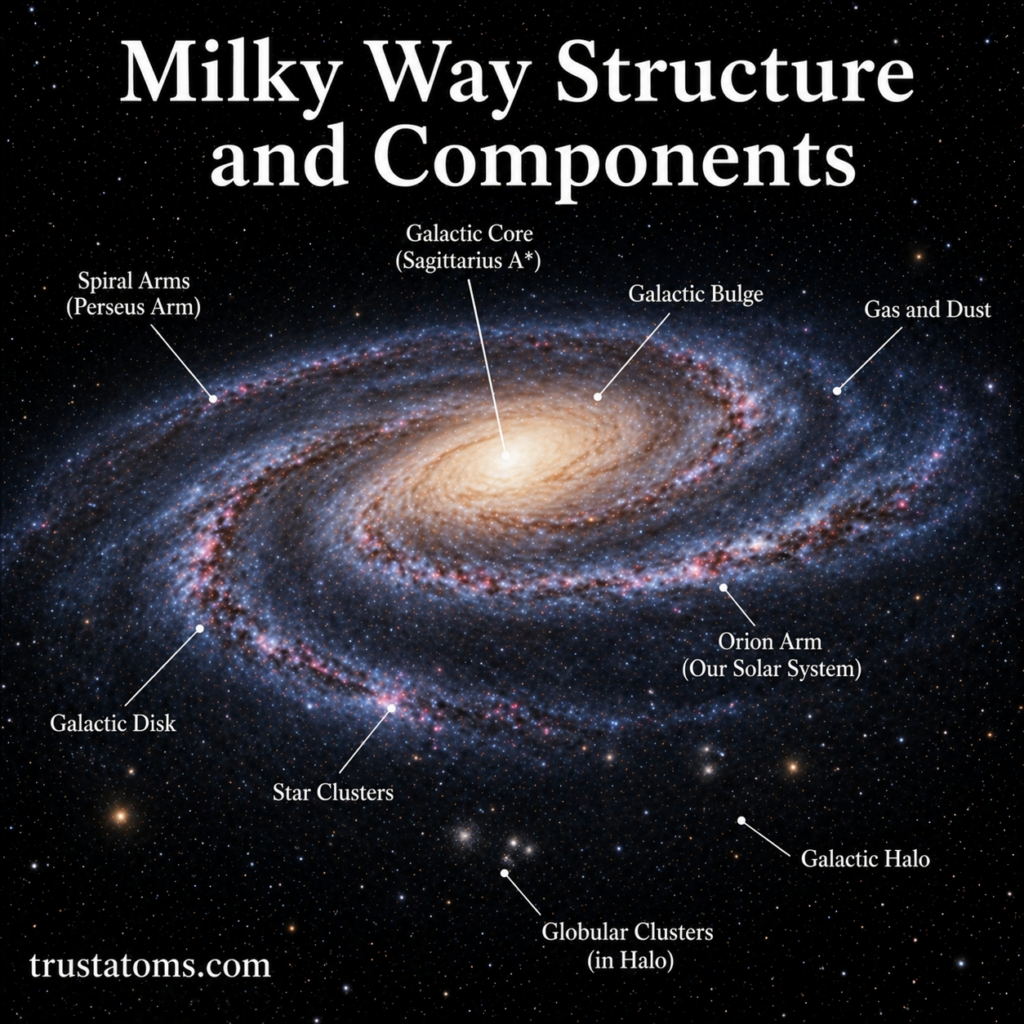
Milky Way Structure and Components

Diagram of the Milky Way galaxy labeled with core, bulge, spiral arms, disk, halo, and star clusters.
A labeled view of the Milky Way highlighting its core, spiral arms, disk, and surrounding halo. trustatoms.com.

The Milky Way is our home galaxy—a vast spiral system containing hundreds of billions of stars, extensive clouds of gas and dust, and an enormous amount of dark matter. Understanding its structure helps astronomers map our place in the universe and study how galaxies form and evolve.

Continue reading “Milky Way Structure and Components”