Binary star systems consist of two stars gravitationally bound together, orbiting around a shared center of mass called the barycenter. These systems are common throughout the Milky Way and allow astronomers to measure stellar masses, study gravitational interactions, and understand how stars evolve.
In the study of astronomy, binary stars provide some of the most reliable measurements of stellar properties. By tracking how two stars move around each other, scientists can calculate their masses and investigate physical processes that are difficult to observe in isolated stars.
Some binary systems contain two ordinary stars separated by enormous distances. Others are close enough to exchange gas, produce intense radiation, or experience explosive events.
What Are Binary Star Systems?
A binary star system contains two stars held together by their mutual gravitational attraction. Neither star necessarily remains stationary. Instead, both move around their common center of mass.
The stars may have similar masses or differ considerably in size, temperature, and brightness. Their separation can range from distances comparable to the sizes of the stars themselves to thousands of astronomical units.
Some close binaries experience material flowing from one star toward its companion. In systems containing an accreting white dwarf, this process can produce events studied in novae and recurrent outbursts.
Other binary interactions can contribute to certain types of supernova explosions, particularly when a white dwarf undergoes a thermonuclear disruption.
Binary systems involving stellar-mass black holes differ from the environments described in black holes at galactic centers, where supermassive black holes can contain millions or billions of solar masses.
The Four Main Types of Binary Star Systems
Astronomers classify binary stars according to how their orbital motion or gravitational effects are detected. These observational categories can overlap, meaning one system may belong to more than one category.
Visual Binary Stars
Visual binaries are systems in which telescopes can distinguish the two stars individually. Repeated observations reveal changes in their relative positions, allowing astronomers to reconstruct their orbits.
These systems are especially useful when accurate distance measurements are available because their orbital dimensions can then be calculated.
Spectroscopic Binary Stars
Spectroscopic binaries are detected through periodic changes in the wavelengths of spectral lines. As a star moves toward Earth, its spectral lines shift toward shorter wavelengths; motion away produces a shift toward longer wavelengths.
This Doppler effect reveals orbital motion even when the stars cannot be resolved separately through a telescope.
Eclipsing Binary Stars
Eclipsing binaries have orbital orientations that cause one star to pass in front of the other from Earth’s viewpoint.
The resulting periodic decreases in brightness produce a light curve. By studying the timing, duration, and depth of these eclipses, astronomers can estimate stellar sizes and orbital properties.
Astrometric Binary Stars
In an astrometric binary, the motion of a visible star reveals the gravitational influence of an unseen companion. Precise position measurements show that the visible star follows a small orbital path rather than moving uniformly across the sky.
The hidden companion may be a faint star or a compact stellar remnant. Additional observations help determine its nature.
How Binary Star Systems Form
Many binary systems form when a collapsing cloud of gas fragments into multiple dense regions. Each region can develop into a protostar, with the forming stars remaining gravitationally bound.
A simplified formation sequence involves:
- Cloud collapse: Gravity causes a dense region within a molecular cloud to contract.
- Fragmentation: The collapsing material separates into two or more gravitational concentrations.
- Protostar formation: Gas accumulates around the developing stellar objects.
- Orbital development: The stars remain gravitationally bound while their orbits evolve through interactions with surrounding material.
Some binaries can also develop through gravitational interactions involving existing stars, especially in dense stellar environments. However, capturing an unrelated star into a stable binary generally requires energy to be transferred elsewhere.
How Two Stars Orbit Their Shared Barycenter
The barycenter is the center of mass around which both stars orbit. Its location depends on the masses of the two stars.
If both stars have equal masses, the barycenter lies halfway between them. When one star is more massive, the barycenter lies closer to that star.
Example: Two Stars with Different Masses
Imagine a binary system containing one star with twice the mass of its companion. If the stars are separated by 3 astronomical units, their barycenter lies 1 astronomical unit from the more massive star and 2 astronomical units from the less massive star.
Both stars orbit this point, but the lighter star follows a larger path. This example assumes the stated separation at a particular moment; in an elliptical orbit, the separation changes throughout the orbital cycle.
Kepler’s laws and Newton’s law of gravitation describe these motions. Measurements of orbital periods and separations allow astronomers to calculate the combined mass of a binary system.
How Binary Stars Exchange Matter
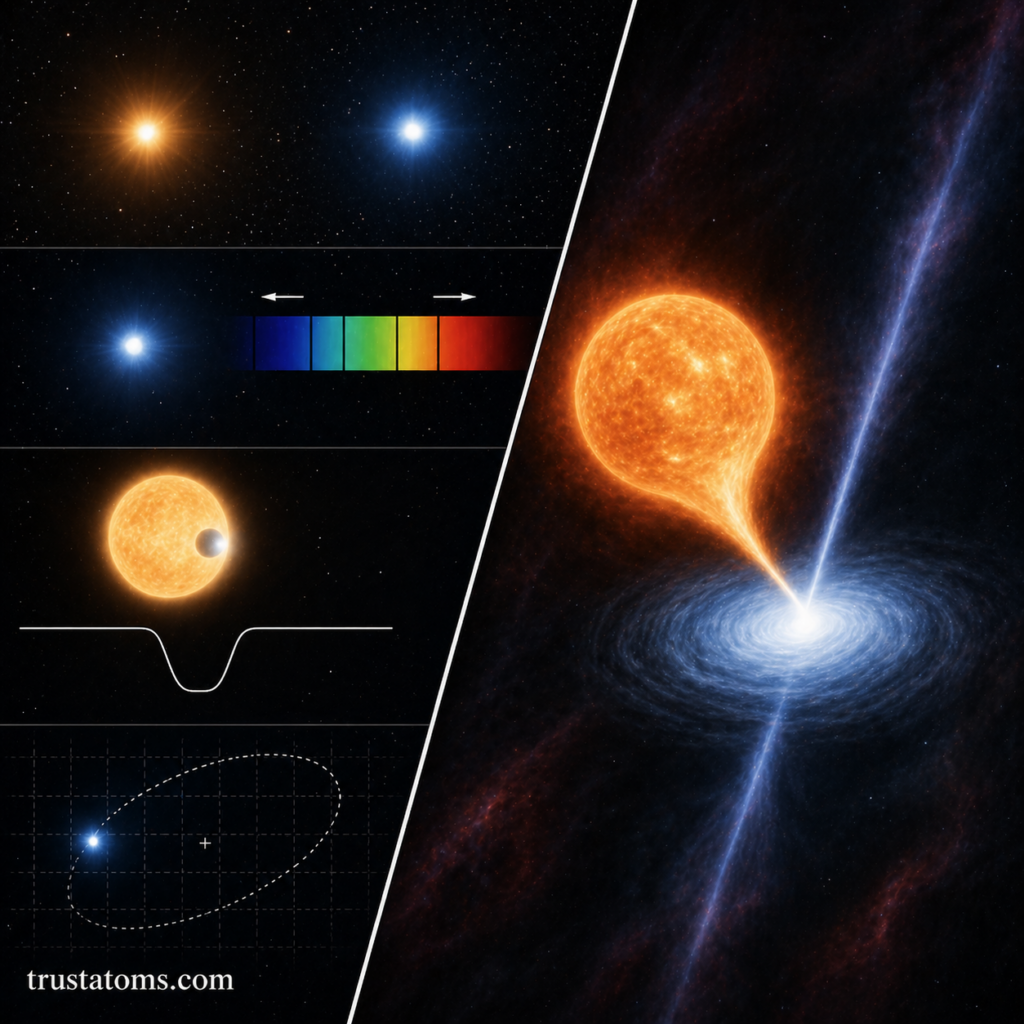
Close binary systems can interact when one star expands enough for material from its outer layers to flow toward its companion.
This commonly occurs through Roche-lobe overflow. A Roche lobe is the region surrounding a star within which material is gravitationally associated with that star in the rotating binary system.
When an expanding star fills its Roche lobe, gas can cross toward the companion. Depending on the system, this material may form an accretion disk before reaching the receiving object.
Other interactions include stellar winds, tidal distortion, and changes in orbital separation. These processes can substantially alter how both stars develop.
Binary Stars and Stellar Evolution
Stars in close binary systems may follow different evolutionary paths from isolated stars because they can lose or gain material.
A star that loses much of its outer envelope may expose its hot interior earlier than expected. Its companion may gain mass, affecting its temperature, brightness, and remaining lifetime.
Some systems eventually contain compact objects described in white dwarfs and stellar remnants. A white dwarf receiving hydrogen-rich material from a companion can undergo surface nuclear reactions that produce a nova.
Massive stars may leave neutron stars or black holes after their final evolutionary stages. The processes discussed in black holes from stellar collapse help explain how some binary systems acquire compact companions.
Binary interactions are also important in models of Type Ia supernovae, although scientists continue investigating the different evolutionary pathways that can produce these explosions.
Extreme Binary Systems with Compact Objects
Some binaries contain neutron stars, black holes, or white dwarfs instead of two ordinary hydrogen-fusing stars.
- X-ray binaries: Systems in which gas accreting onto a compact object becomes extremely hot and produces X-rays.
- Double neutron-star binaries: Two neutron stars orbiting each other, sometimes gradually losing orbital energy through gravitational radiation.
- Black hole binaries: Systems containing two black holes or a black hole with a stellar companion.
- White dwarf binaries: Systems that may experience mass transfer, nova eruptions, or other interactions.
When two sufficiently compact objects spiral together and merge, they can generate gravitational waves detectable by specialized observatories. Such measurements provide information about gravity under extreme conditions.
Why Binary Stars Help Astronomers Measure Stellar Mass
Stellar mass strongly influences a star’s luminosity, internal structure, and evolution. However, measuring the mass of an isolated star usually requires indirect methods.
Binary systems provide a more direct approach. By measuring orbital motion and applying gravitational laws, astronomers can determine stellar masses.
Systems that are both eclipsing and spectroscopic are particularly useful because their light curves and orbital velocities can reveal individual masses and radii with relatively few assumptions.
These measurements help scientists test theoretical models and improve estimates of stellar properties throughout the galaxy.
How Common Are Binary Star Systems?
Binary and multiple-star systems are widespread, but their frequency depends on stellar mass and the population being studied.
Massive stars are especially likely to have stellar companions. Lower-mass stars are less frequently found in multiple systems, although many still belong to binaries.
The Sun is currently a single star, but that does not make it exceptionally unusual among stars of similar mass. Studying both single and multiple stars helps astronomers understand the full range of stellar environments.
Frequently Asked Questions
Can planets orbit binary star systems?
Yes. Some planets orbit one star within a binary system, while circumbinary planets orbit both stars. Whether an orbit remains stable depends on the stars’ separation, orbital eccentricity, and the planet’s distance from them.
Do binary stars always orbit at the same distance?
No. Binary stars can follow elliptical orbits, causing their separation to change during each revolution. In a circular orbit, their separation remains constant.
Can two stars in a binary system collide?
Yes. Some close binary stars eventually merge after orbital evolution, mass transfer, or other interactions. Mergers involving compact objects can release substantial energy and produce gravitational waves.
Binary star systems reveal how gravity connects the motion and evolution of neighboring stars. Their measurable orbits help astronomers determine stellar masses, while close interactions explain phenomena ranging from mass transfer and nova eruptions to compact-object mergers.
Sources: OpenStax, Astronomy 2e; Encyclopaedia Britannica, Binary Star; NASA, Imagine the Universe educational resources.