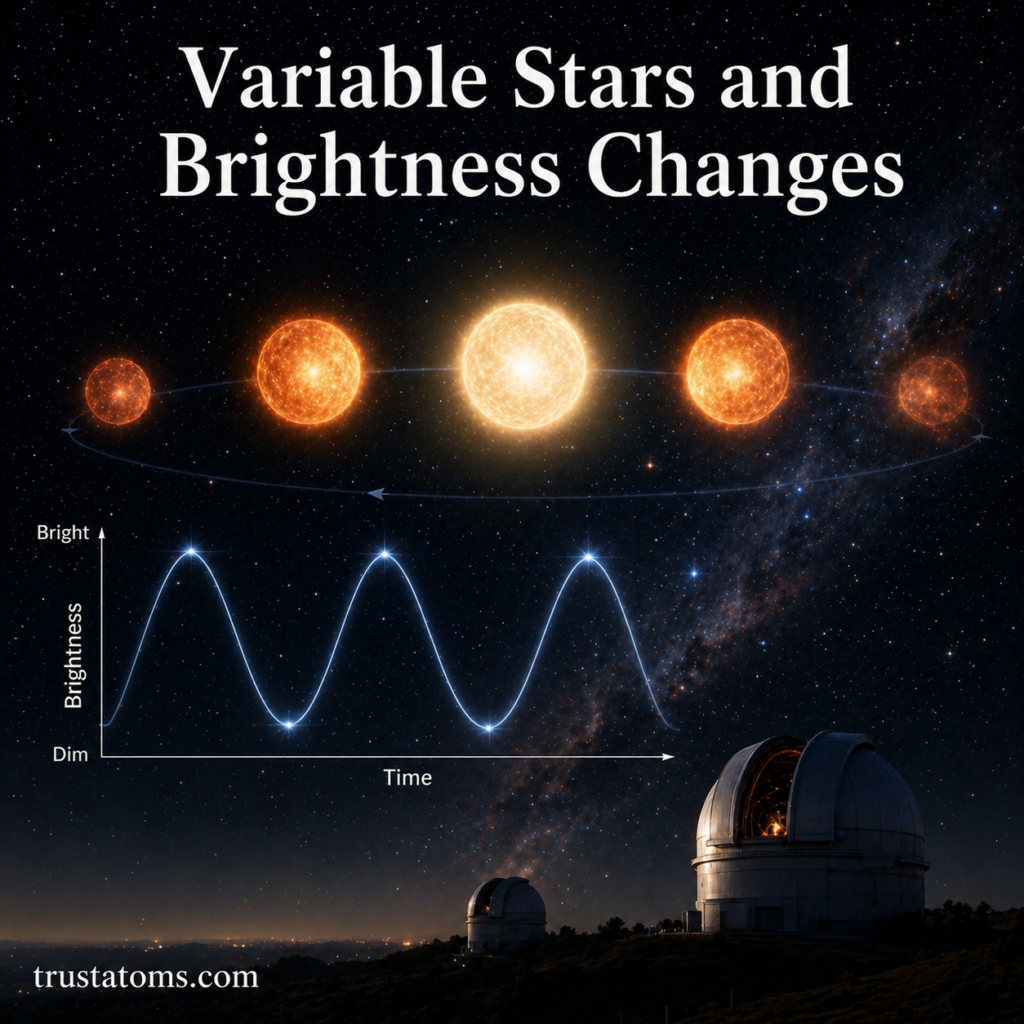
Variable stars are stars whose observed brightness changes over time because of physical changes within the stars or effects such as eclipses and rotation. Astronomers measure these changes to investigate stellar properties, identify binary systems, and calculate distances across space.
Some variable stars brighten and dim in predictable cycles, while others change irregularly or experience sudden outbursts. Understanding their behavior is an important part of modern astronomy because patterns in starlight can reveal information that a single observation cannot provide.
What Are Variable Stars?
A variable star is a star whose apparent brightness changes measurably over time. These variations can last seconds, hours, days, months, or years, depending on their underlying cause.
Astronomers distinguish between apparent brightness, which describes how bright a star looks from Earth, and luminosity, which describes the total energy it emits per second. Luminosity and Stellar Magnitude explains how scientists quantify these properties.
Not every change in apparent brightness means a star is producing more or less energy. Sometimes another object blocks its light, or rotation brings darker regions into view.
Distance also affects observed brightness. Techniques described in Parallax and Stellar Measurement help astronomers determine distances to nearby stars and establish reliable brightness measurements.
Some variable stars also undergo changes associated with material escaping their atmospheres. These processes connect stellar variability with Stellar Winds and Mass Loss.
Why Do Stars Change Brightness?
Variable stars are generally divided into two categories based on whether their brightness changes originate within the star or result from viewing effects.
Intrinsic Variability: Changes Within the Star
Intrinsic variable stars change their light output because their physical properties or energy production vary.
Some repeatedly expand and contract, causing changes in surface temperature and luminosity. Others experience magnetic flares, eruptions, or changes associated with stellar evolution.
Extrinsic Variability: Changes in What We See
Extrinsic variable stars appear to change brightness because of external geometry or viewing conditions rather than a change in their overall energy output.
For example, one star in a binary system may temporarily block light from its companion. A rotating star with large dark spots can also appear brighter or dimmer as different regions face Earth.
Main Types of Variable Stars
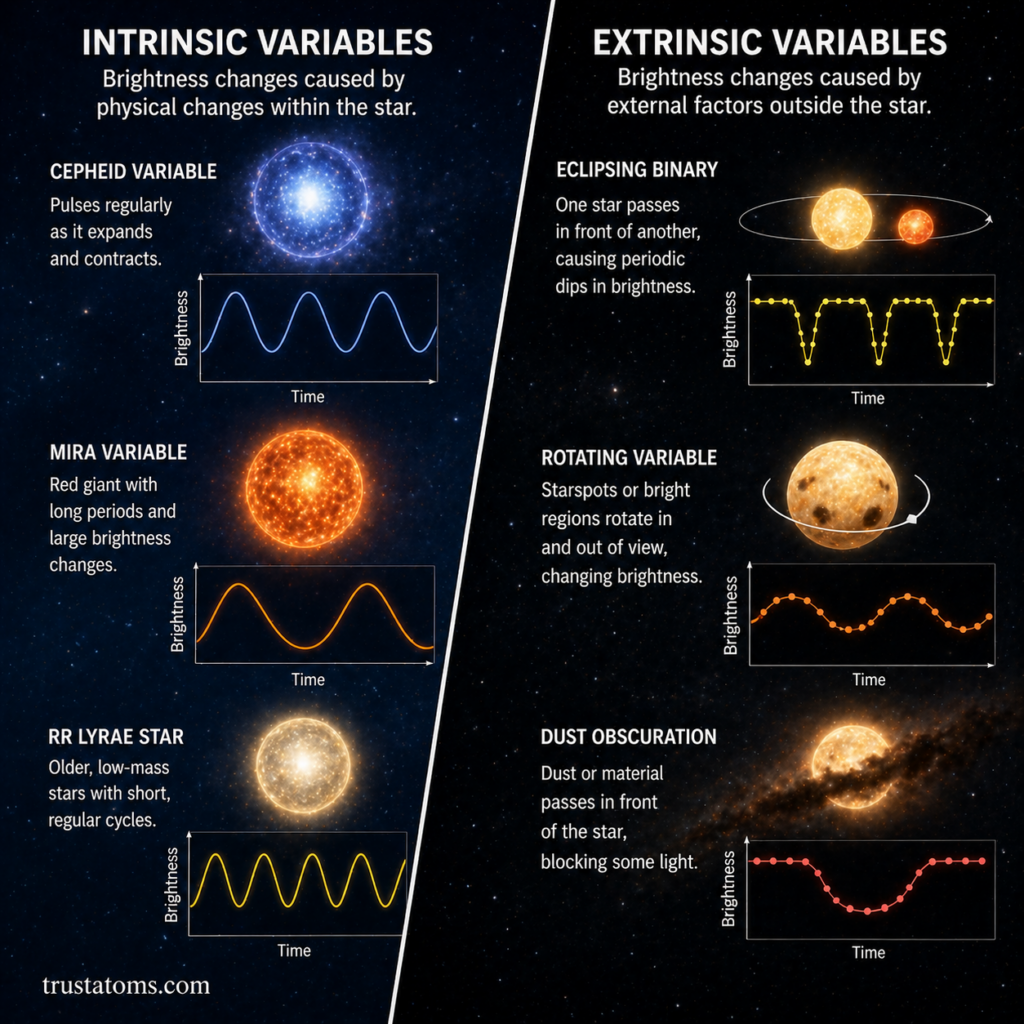
Different variable stars produce recognizable brightness patterns. Astronomers classify them using their periods, amplitudes, spectra, and physical characteristics.
Cepheid Variables
Cepheids are pulsating stars that expand and contract in regular cycles. Classical Cepheids have a well-established relationship between their pulsation periods and intrinsic luminosities, making them useful for measuring astronomical distances.
RR Lyrae Stars
RR Lyrae stars are older pulsating stars commonly found in globular clusters. Their periods are typically shorter than one day, and their predictable behavior makes them useful distance indicators for old stellar populations.
Mira Variables
Mira variables are evolved, cool giant stars that undergo large brightness changes over periods typically lasting hundreds of days. Their pulsations are associated with changing stellar structure and extended atmospheres.
Eclipsing Binary Stars
An eclipsing binary contains two stars orbiting each other in a plane aligned closely enough with our viewpoint that one periodically passes in front of the other.
These eclipses produce repeating dips in brightness. Their timing and depth help astronomers investigate the stars’ sizes, orbital periods, and other properties.
Flare Stars and Rotating Variables
Flare stars can brighten suddenly when magnetic activity releases energy. Rotating variables, meanwhile, show periodic changes as surface spots or other uneven features move into and out of view.
Light Curves: Tracking Brightness Changes
A light curve is a graph showing an object’s brightness over time. Astronomers construct these graphs by repeatedly measuring starlight and comparing observations taken at different times.
Light curves reveal several useful characteristics:
- Period: The time required for a repeating brightness pattern.
- Amplitude: The difference between maximum and minimum brightness.
- Shape: Whether brightness changes smoothly, sharply, or irregularly.
- Stability: Whether the pattern remains consistent across repeated observations.
For example, a pulsating star may produce a repeating rise and fall, while an eclipsing binary often shows distinct dips when one star blocks another.
Light curves can also help researchers distinguish stellar variability from other astronomical measurements. Studies such as Galactic Rotation Curves use different observational data, including orbital speeds, to investigate how matter is distributed within galaxies.
Cepheid Variables and Measuring Distance
One of the most important uses of variable stars is measuring distances in space.
Classical Cepheid variables follow a period-luminosity relationship: stars with longer pulsation periods generally have greater intrinsic luminosities.
Astronomers measure a Cepheid’s pulsation period, use a calibrated relationship to estimate its intrinsic luminosity, and compare that value with its observed brightness to calculate distance.
A Numerical Example of Stellar Brightness
Suppose two otherwise identical stars emit the same amount of light, but one is twice as far from Earth as the other. Because brightness follows the inverse-square law, the more distant star appears only one-quarter as bright.
This relationship allows astronomers to estimate distance when a star’s intrinsic luminosity is known. Real Cepheid measurements also require careful calibration and corrections for effects such as interstellar dust.
Cepheid distances have helped establish the scale of nearby galaxies and calibrate other methods used to investigate the expansion of the universe.
What Brightness Changes Reveal About Stellar Evolution
Variable stars provide evidence about conditions inside stars and how those conditions change during different stages of stellar evolution.
Pulsation periods can reveal information about stellar density and internal structure. Long-period variability in evolved giants can indicate changes in their outer layers, while sudden flares reveal magnetic activity.
Some stars exhibit multiple pulsation periods simultaneously. By analyzing these patterns, astronomers can investigate internal oscillations using techniques related to asteroseismology.
Observations collected over many years are especially useful because they can reveal gradual changes that shorter studies might miss.
How Astronomers Observe Variable Stars
Variable stars are studied using ground-based telescopes, space observatories, and instruments that measure the intensity of incoming light.
Astronomers often compare a target star with nearby stars of known or stable brightness. This method, called differential photometry, helps reduce errors caused by changing observing conditions.
Professional surveys monitor large numbers of stars, while amateur astronomers contribute repeated observations of bright variables. Long-term monitoring is particularly useful for stars whose brightness changes over months or years.
Space telescopes can measure extremely small brightness variations without interference from Earth’s atmosphere, allowing researchers to detect subtle stellar oscillations.
Frequently Asked Questions
Do all variable stars change brightness regularly?
No. Some variable stars have highly regular pulsation or eclipse cycles, while others show irregular changes, sudden flares, or combinations of multiple patterns. Their behavior depends on the physical processes responsible for the variation.
Can variable stars be observed without a telescope?
Yes. Some bright variable stars, including Mira and Algol under suitable observing conditions, can show noticeable brightness changes to the unaided eye. Comparing their brightness with nearby stars over several nights can reveal these variations.
How do variable stars help astronomers measure distances?
Certain pulsating stars, particularly classical Cepheids and RR Lyrae stars, have properties that allow astronomers to estimate their intrinsic luminosities. Comparing intrinsic luminosity with observed brightness provides a way to calculate distance.
Variable stars turn changes in starlight into measurable evidence about stellar structure, orbital motion, and distance. Their light curves distinguish regular pulsations from eclipses, flares, and other processes, while calibrated Cepheid measurements help establish distances to nearby galaxies. Continued observations allow astronomers to track how these stars behave and change over time.
Sources: American Association of Variable Star Observers (AAVSO), Variable Star Classification and Observing Resources; NASA, Imagine the Universe! Variable Stars educational resources; Carroll and Ostlie, An Introduction to Modern Astrophysics.