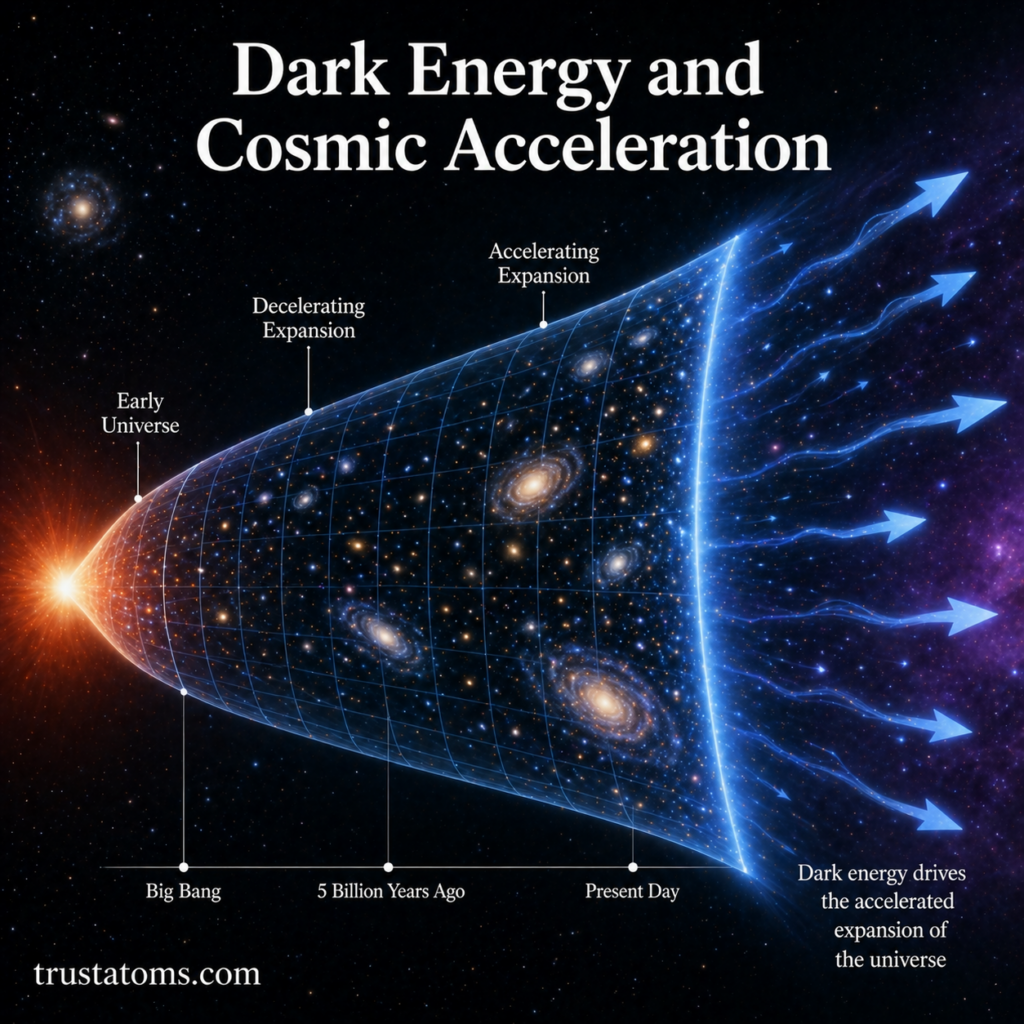
Dark energy is the name scientists give to the unknown component thought to explain why the universe’s expansion is accelerating. Cosmic acceleration means that the expansion of space is speeding up over time, causing sufficiently distant, gravitationally unbound galaxies to separate at an increasing rate.
Discovered through observations of distant exploding stars, this acceleration changed how scientists understand the universe’s history and future. Today, researchers in astronomy and cosmology investigate whether dark energy is a constant property of space or evidence of physics that remains undiscovered.
What Is Dark Energy?
Dark energy is an inferred component of the universe associated with accelerated cosmic expansion. Unlike ordinary matter, it does not appear to gather into stars, planets, or galaxies.
Scientists have not directly detected dark energy as a particle or identified its underlying physical nature. It is detected through its effects on cosmic expansion, particularly through measurements of how the universe’s expansion rate has changed.
According to the standard Lambda-CDM cosmological model, dark energy accounts for approximately 68% of the universe’s total energy density. Dark matter contributes about 27%, while ordinary matter accounts for roughly 5%.
These percentages describe the universe’s energy budget within that model, not the proportion of visible objects made from each component.
Several explanations remain under investigation. The article on dark energy theories examines the cosmological constant, evolving energy fields, and alternative gravitational models.
How Scientists Discovered Cosmic Acceleration
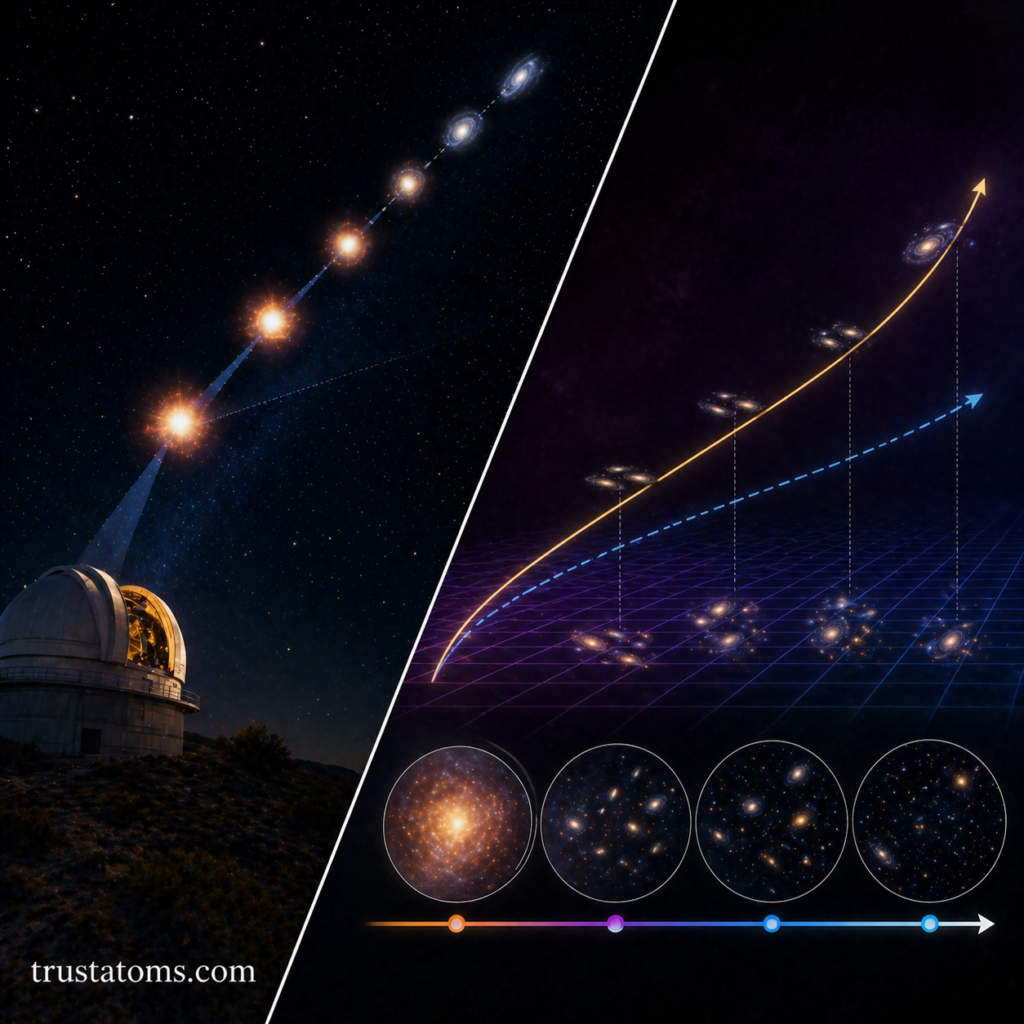
In 1998, two independent research teams reported evidence that cosmic expansion had accelerated during the universe’s recent history. Their conclusions came from measurements of distant Type Ia supernovae.
These stellar explosions are useful distance indicators because their intrinsic brightness can be estimated after accounting for differences between individual events.
Astronomers compared each supernova’s observed brightness with its redshift, which indicates how much the universe expanded while its light traveled toward Earth.
The distant supernovae appeared dimmer than expected in models where cosmic expansion was slowing as previously anticipated. The results indicated that the universe had undergone accelerated expansion.
Saul Perlmutter, Brian Schmidt, and Adam Riess received the 2011 Nobel Prize in Physics for work associated with this discovery.
How Dark Energy Produces Accelerating Expansion
Under Einstein’s general relativity, the expansion of the universe depends on its energy density and pressure, not simply on the gravitational attraction of ordinary matter.
In the simplest dark energy model, space contains a constant energy density associated with negative pressure. This combination can cause the cosmic scale factor, which describes the overall size of the universe, to accelerate.
This does not mean dark energy acts like a wind pushing galaxies through space. Instead, it affects how distances between sufficiently separated objects change as the universe expands.
Gravity still holds many structures together. Dark energy does not cause Earth to drift away from the Sun or the stars within the Milky Way to separate through cosmic expansion.
A Numerical Example of Cosmic Expansion
Hubble’s law provides a useful starting point for understanding how distance relates to cosmic expansion.
Suppose two distant galaxies are separated by 100 megaparsecs, approximately 326 million light-years. Using an illustrative Hubble constant of 70 kilometers per second per megaparsec, their recession speed due to expansion would be approximately 7,000 kilometers per second.
If their separation were 200 megaparsecs at the same cosmic time, the corresponding recession speed would be approximately 14,000 kilometers per second.
This example illustrates how greater distances correspond to greater recession speeds. Cosmic acceleration is a separate concept: it describes how the expansion of the universe changes over time.
To establish acceleration, scientists must compare observations from different periods of cosmic history rather than measure recession speeds at only one moment.
The Role of the Cosmological Constant
The cosmological constant, represented by the Greek letter Lambda, is the simplest explanation for dark energy within general relativity.
Albert Einstein introduced this term in 1917 while developing a model of a static universe. In modern cosmology, a positive cosmological constant represents an energy density that remains unchanged as space expands.
When combined with cold dark matter, this explanation forms the Lambda-CDM model, the standard framework for describing cosmic expansion and large-scale structure.
The article Cosmological Models Compared explains how this framework differs from historical alternatives and proposals involving early-universe inflation.
Although the cosmological constant fits many observations, scientists do not know why it has its measured value. Explaining that value remains a major problem connecting cosmology and quantum physics.
Evidence for Dark Energy Beyond Supernovae
The case for dark energy does not depend on supernova measurements alone. Several independent observations help constrain the universe’s expansion history and composition.
Cosmic Microwave Background
The cosmic microwave background contains patterns established when the early universe became transparent. Measurements of these patterns constrain the universe’s geometry and matter content, helping scientists evaluate models that include dark energy.
Baryon Acoustic Oscillations
Sound waves in the early universe left a characteristic scale in the distribution of matter. Astronomers use this scale as a reference for measuring distances and tracing expansion across cosmic history.
Galaxy Clustering and Gravitational Lensing
Dark energy affects how cosmic structures grow. Measurements of galaxy distributions and the gravitational distortion of light help researchers test whether structure formation matches the predictions of different cosmological models.
For a broader explanation of how redshifts and distance measurements establish that space is expanding, see observational evidence for expansion.
Dark matter must also be included when interpreting these observations because its gravity influences galaxy formation and clustering. The findings covered in dark matter evidence explain why scientists distinguish this matter component from dark energy.
Dark Energy Versus Dark Matter
Despite their similar names, dark energy and dark matter describe different components of the standard cosmological model.
| Property | Dark Energy | Dark Matter |
|---|---|---|
| Main effect | Associated with accelerated cosmic expansion | Produces gravitational attraction and helps structures form |
| Distribution | Approximately uniform in the simplest model | Concentrated around galaxies and clusters |
| Approximate share of total energy density | 68% | 27% |
| Physical identity | Unknown | Unknown |
Dark matter helps explain why galaxies rotate as observed and why massive cosmic structures develop. Dark energy explains a different observation: the acceleration of the universe’s large-scale expansion.
What Dark Energy Means for the Universe’s Future
The universe’s long-term evolution depends partly on whether dark energy remains constant or changes over time.
- Continued accelerated expansion: If dark energy behaves like a cosmological constant, distant gravitationally unbound galaxies will become increasingly separated.
- Big Freeze: Under continued expansion, star formation eventually declines and the universe becomes progressively colder and darker over extremely long timescales.
- Big Rip: Some speculative models involving increasingly strong dark energy predict that expansion could eventually disrupt gravitationally bound structures.
The Big Rip is not a prediction of the standard cosmological constant model. Current observations favor continued expansion, but the exact behavior of dark energy over the distant future remains uncertain.
How Future Observations Could Clarify Dark Energy
Scientists are investigating whether dark energy’s properties remain constant across cosmic history. The answer could help distinguish a cosmological constant from models involving evolving fields or modified gravity.
The Dark Energy Spectroscopic Instrument measures redshifts for large numbers of galaxies and quasars. The European Space Agency’s Euclid mission studies galaxy distributions and gravitational lensing, while NASA’s Nancy Grace Roman Space Telescope is designed to provide complementary measurements.
Some combinations of recent observations have suggested that dark energy might evolve, but these indications are not conclusive. Researchers continue checking whether such results reflect new physics, measurement uncertainties, or statistical fluctuations.
Frequently Asked Questions
Does dark energy make everything in the universe move apart?
No. Cosmic expansion mainly affects distances on sufficiently large scales. Gravity and other forces hold systems such as galaxies, solar systems, planets, and atoms together, so they do not expand along with the universe.
Has dark energy been directly observed?
Scientists have observed cosmic acceleration, but they have not directly identified the physical substance or mechanism responsible. Dark energy is inferred from measurements of expansion and the distribution of matter.
Is the universe expanding faster every year?
Cosmic acceleration means the universe’s scale factor has a positive acceleration during its current expansion phase. It does not necessarily mean the Hubble parameter increases every year; in the standard model, that parameter can decrease while expansion still accelerates.
Dark energy provides the leading explanation for the accelerated expansion revealed by distant supernovae and supported by other cosmological measurements. The cosmological constant describes these observations successfully, but scientists have not established what dark energy physically is. Future measurements of expansion and galaxy growth will test whether its behavior remains constant or requires a different explanation.
Sources: NASA, dark energy and cosmology educational resources; Planck Collaboration, “Planck 2018 Results. VI. Cosmological Parameters” (2020); Nobel Prize in Physics 2011, scientific background on the discovery of accelerating cosmic expansion.