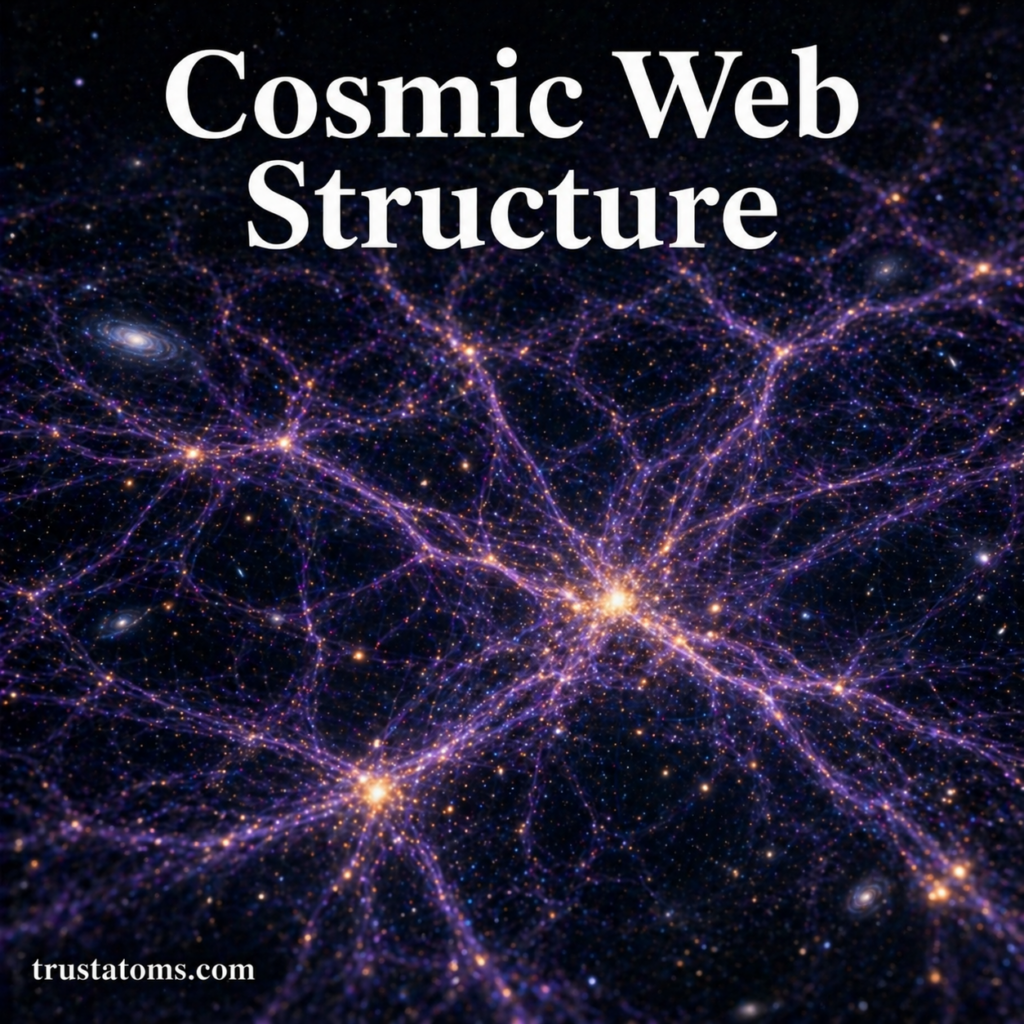
On the grandest scales, the universe is not randomly scattered—it’s organized into an enormous, interconnected network known as the cosmic web. This vast structure links galaxies, clusters, and dark matter across billions of light-years, forming a pattern that resembles a three-dimensional web.
Understanding the cosmic web helps astronomers explain how matter is distributed, how galaxies form, and how the universe has evolved over time.
What Is the Cosmic Web?
The cosmic web is the large-scale structure of the universe, made up of filaments, nodes, and voids.
Core Components
- Filaments – Long, thread-like structures of galaxies and dark matter
- Nodes – Dense regions where filaments intersect (galaxy clusters)
- Voids – Vast empty spaces with very few galaxies
This structure spans the entire observable universe and represents the distribution of both visible matter and dark matter.
How the Cosmic Web Formed
The cosmic web began forming shortly after the Big Bang due to tiny fluctuations in matter density.
Formation Process
- Small density differences existed in the early universe
- Gravity pulled matter toward denser regions
- Matter accumulated into filaments and clusters
- Voids expanded as matter moved outward
Over billions of years, this process created the large-scale structure we observe today.
The Role of Dark Matter
Dark matter plays a crucial role in shaping the cosmic web.
Why It Matters
- Provides the gravitational framework for structure formation
- Makes up most of the universe’s total mass
- Attracts normal (visible) matter into filaments and clusters
Without dark matter, the cosmic web as we know it would not exist.
Filaments: The Highways of the Universe
Filaments are the most prominent features of the cosmic web.
Characteristics of Filaments
- Stretch across hundreds of millions of light-years
- Contain galaxies, gas, and dark matter
- Connect galaxy clusters like bridges
Galaxies often form and evolve along these filaments, making them essential pathways for matter flow.
Galaxy Clusters and Nodes
Where filaments intersect, massive structures known as nodes or galaxy clusters form.
Features of Nodes
- Extremely dense regions
- Contain hundreds to thousands of galaxies
- Host large amounts of hot gas and dark matter
These are some of the most massive structures in the universe.
Cosmic Voids: The Empty Regions
Between filaments lie enormous voids.
Key Properties
- Very low density of galaxies
- Can span tens to hundreds of millions of light-years
- Continue expanding over time
Although they appear empty, voids still contain dark matter and faint traces of gas.
How Scientists Observe the Cosmic Web
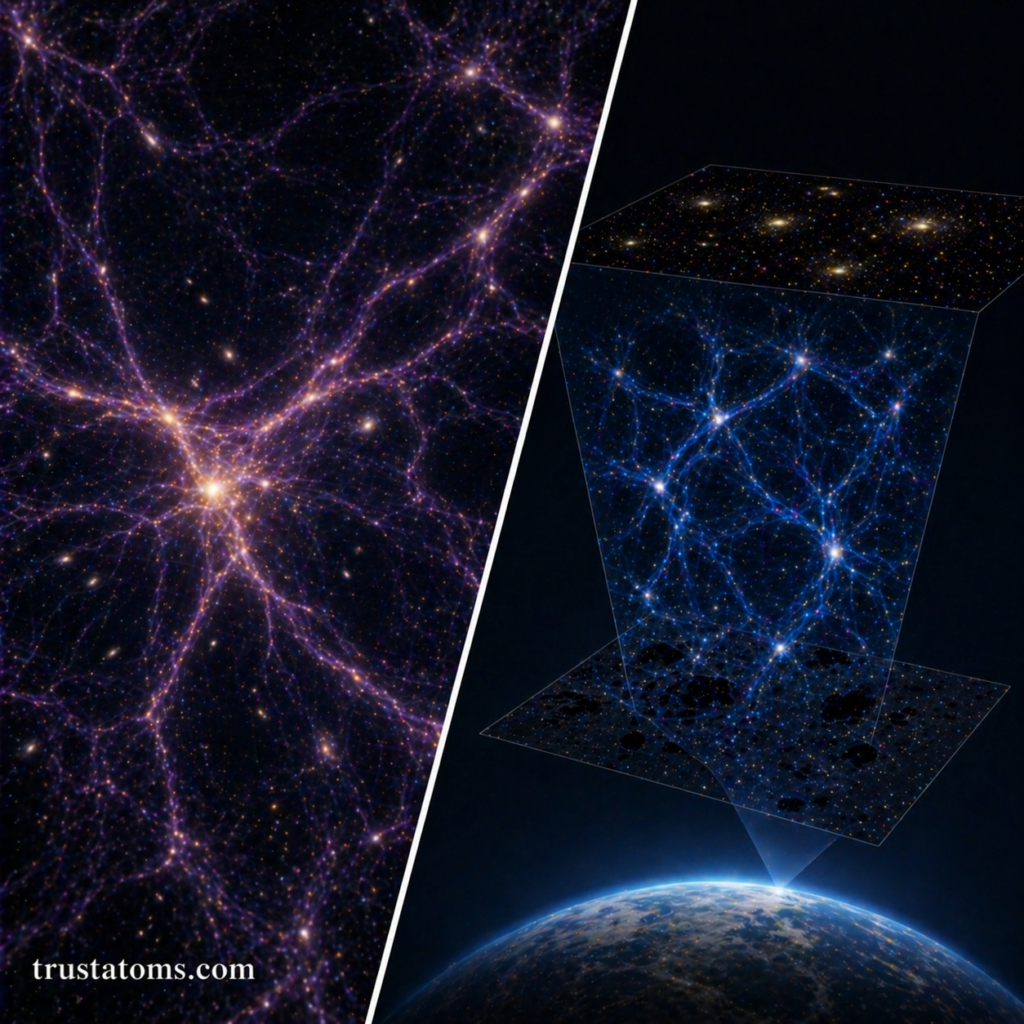
The cosmic web is too vast to see directly in its entirety, but astronomers use several methods to map it.
Observation Techniques
- Large galaxy surveys mapping positions in 3D space
- Gravitational lensing to detect dark matter
- Observing intergalactic gas through absorption lines
- Computer simulations to model structure formation
These methods together create a detailed picture of the universe’s large-scale structure.
Why the Cosmic Web Matters
The cosmic web is essential for understanding the universe.
Key Impacts
- Explains how galaxies form and cluster
- Reveals the influence of dark matter
- Helps measure the expansion of the universe
- Provides insight into cosmic evolution
It acts as the backbone of the universe’s structure.
The Cosmic Web and Galaxy Evolution
Galaxies are not isolated—they evolve within the cosmic web.
Influences on Galaxies
- Gas flows along filaments fuel star formation
- Interactions in dense clusters can alter galaxy shapes
- Environment affects galaxy size, type, and activity
Where a galaxy sits in the cosmic web can determine its entire life cycle.
Simulating the Cosmic Web
Computer simulations are critical for studying the cosmic web.
What Simulations Show
- How matter evolves over time
- The formation of filaments and clusters
- The interaction between dark matter and normal matter
These models closely match real observations, confirming current cosmological theories.
Key Takeaways
- The cosmic web is the universe’s large-scale structure
- It consists of filaments, nodes, and voids
- Dark matter provides the framework for its formation
- Galaxies form and evolve within this network
- Observations and simulations help map and understand it
Final Thoughts
The cosmic web reveals that the universe has a complex and organized structure far beyond what we can see with the naked eye. It connects galaxies across immense distances and shapes the evolution of cosmic systems over billions of years.
As technology improves, astronomers continue to uncover more details about this vast network—bringing us closer to understanding the true architecture of the universe.