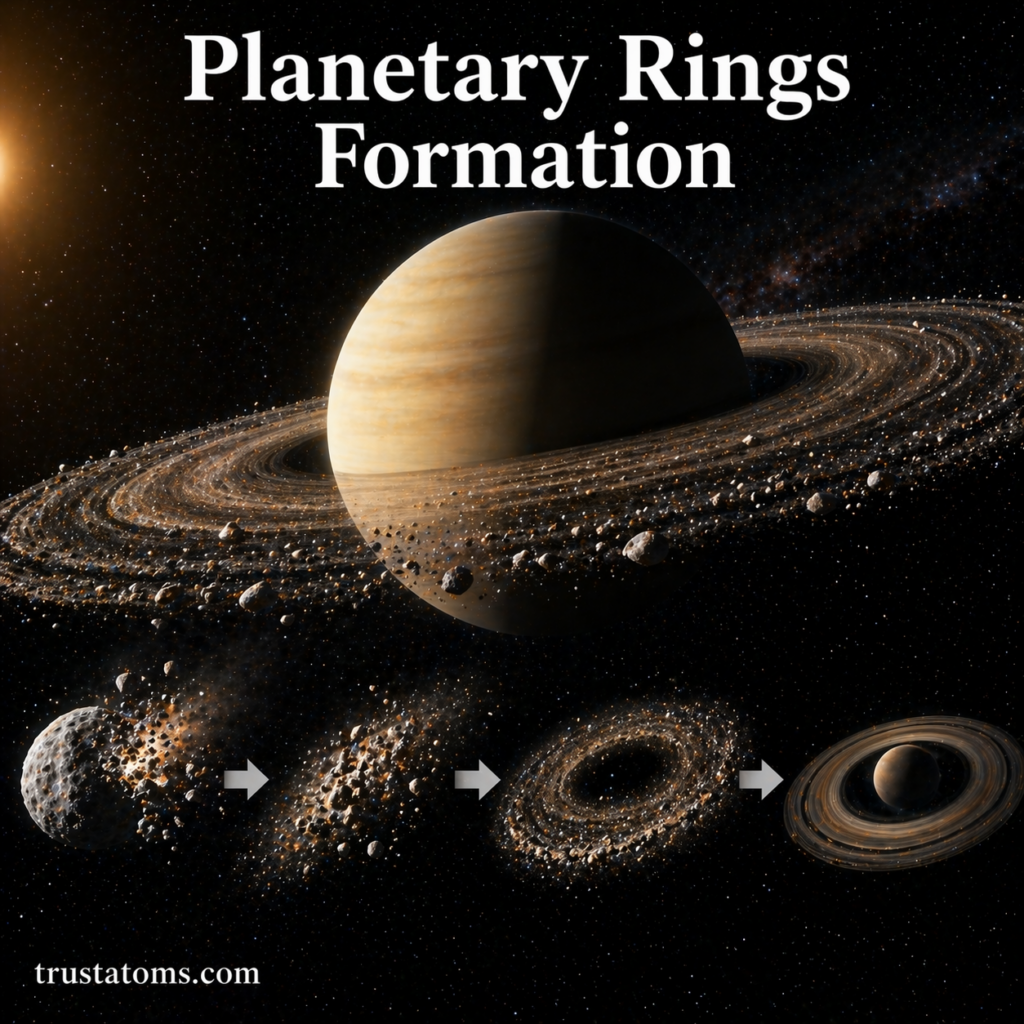
Planetary rings form when particles of ice, rock, and dust remain in orbit around a planet instead of combining into a larger moon or falling onto the planet. This material can originate from shattered moons, collisions, debris released from small satellites, or material left over from earlier stages of a planetary system’s development.
Planetary rings are among the most visually striking features in our solar system. From the bright, complex rings of Saturn to the faint and dusty rings of Jupiter, these structures reveal important clues about how planets and their surrounding systems evolve. Studying them is part of astronomy and planetary science.
Although rings appear solid from a distance, they consist of countless separate particles following individual orbits. Gravity, collisions, and interactions with nearby moons continually change their arrangement.
What Are Planetary Rings?
Planetary rings are broad, relatively thin collections of orbiting material surrounding a planet. Individual particles can range from microscopic dust grains to chunks of ice and rock several meters across or larger.
Most ring particles follow nearly circular orbits close to the planet’s equatorial plane. They travel at different speeds depending on their distance from the planet.
Ring composition varies between planets. Saturn’s main rings contain predominantly water ice, while Jupiter’s faint rings consist largely of dust. Uranus and Neptune have darker ring systems containing material that reflects relatively little sunlight.
Nearby satellites can influence ring edges, gaps, and particle movement. Rings, Moons, and Orbital Stability explains how gravitational interactions affect these systems over time.
Which Planets Have Ring Systems?
All four giant planets in our solar system have rings. Jupiter and Saturn are gas giants, while Uranus and Neptune are classified as ice giants.
| Planet | Ring Characteristics | Main Material |
|---|---|---|
| Jupiter | Faint, thin rings that are difficult to observe from Earth | Fine dust |
| Saturn | Bright, extensive rings with numerous gaps and divisions | Mostly water ice |
| Uranus | Dark, relatively narrow rings | Dark particles and larger debris |
| Neptune | Faint rings containing unevenly distributed material | Dust and darker debris |
While Saturn’s rings are the most visible, all four giant planets demonstrate that ring formation and planetary development involve processes that can occur in different environments.
How Planetary Rings Form
Scientists investigate several mechanisms that can produce planetary rings. Different ring systems may have different origins, and more than one process can contribute material to the same system.
Tidal Disruption of Moons and Other Objects
A planet’s gravity pulls more strongly on the near side of an orbiting object than on its far side. This difference produces tidal forces that can stretch or disrupt an object passing sufficiently close to the planet.
The distance associated with tidal disruption is described by the Roche limit. Its value depends on the densities and physical properties of the planet and orbiting object.
If tidal forces overcome an object’s ability to remain intact, fragments can spread into orbit and contribute to a ring system. This is one possible explanation for the origin of some planetary rings.
Collisions Between Moons or Other Orbiting Bodies
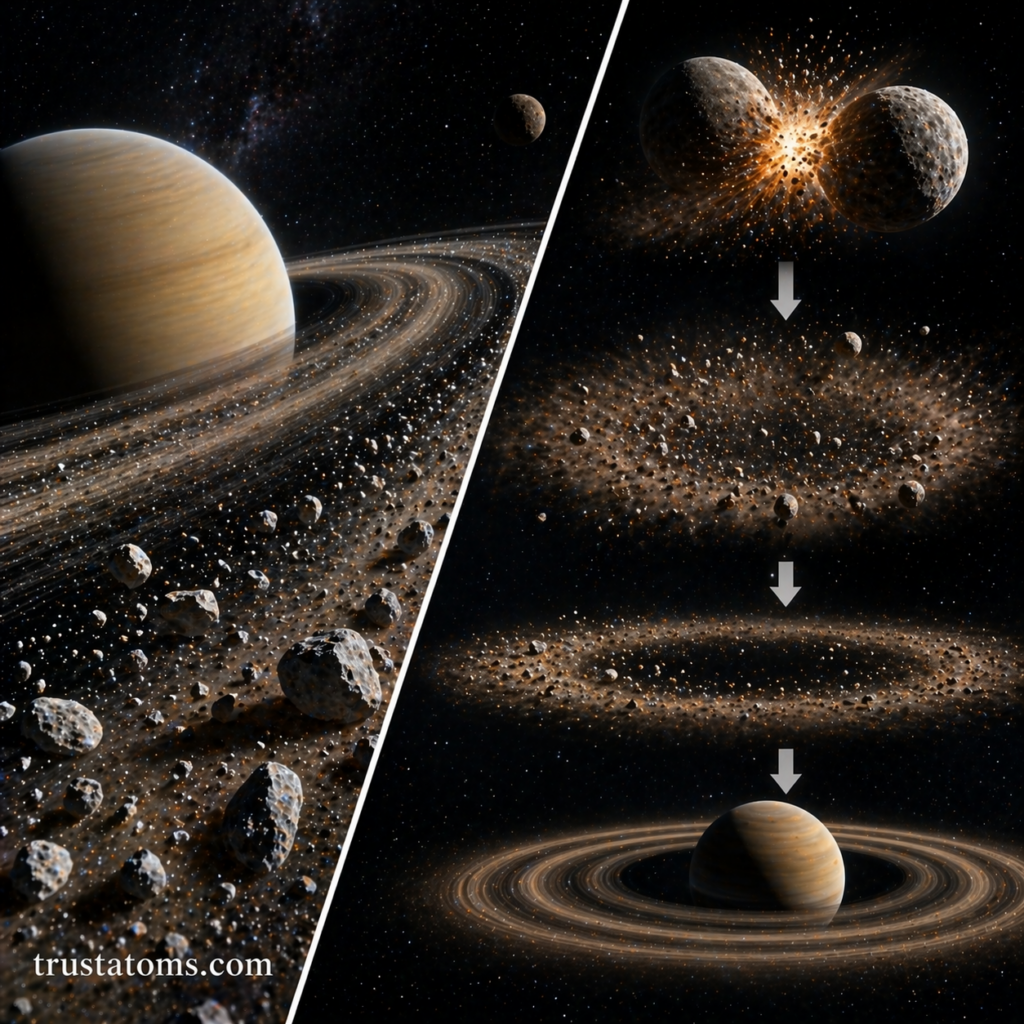
High-speed impacts can break apart small moons or eject material from their surfaces. Some fragments escape, some fall toward the planet, and others remain in orbit.
Orbiting debris can gradually spread around the planet, producing a ring. Repeated collisions among fragments change their sizes and redistribute material.
Jupiter’s dusty rings are thought to be replenished largely by impacts on small inner moons. Micrometeoroids strike these satellites and release particles that enter nearby orbits.
Material That Never Became a Moon
Some rings may be remnants of material that never formed into natural moons. In regions where tidal forces inhibit the accumulation of loose debris, particles may remain distributed in orbit rather than gathering into a larger satellite.
However, scientists do not assume that all present-day rings are ancient leftovers. Ring material can be lost, replaced, or replenished, making its age difficult to establish.
The Roche Limit and Ring Formation
The Roche limit helps explain why some orbiting material remains dispersed instead of forming a moon. Inside this approximate boundary, a loose object held together mainly by its own gravity may be unable to resist a planet’s tidal forces.
For a fluid-like satellite with the same density as its planet, the classical Roche limit is approximately 2.44 planetary radii from the planet’s center. This is a theoretical example, not a universal distance for every satellite.
Using Earth as an illustration, multiplying its approximate radius of 6,371 kilometers by 2.44 gives about 15,500 kilometers from Earth’s center. The actual disruption distance for a particular object would depend on its density, internal strength, and structure.
Solid objects can sometimes survive inside their classical Roche limits because material strength helps hold them together. The Roche limit therefore describes an important gravitational constraint rather than a boundary that automatically destroys everything crossing it.
The Role of Gravity and Orbital Motion
Ring particles remain in orbit because their sideways motion balances the inward acceleration caused by planetary gravity. Particles closer to the planet generally complete their orbits faster than those farther away.
Collisions between particles reduce differences in orbital inclination and help maintain a thin disk. These collisions also transfer energy and angular momentum, gradually changing the distribution of ring material.
Nearby moons exert additional gravitational forces. Some interactions repeat at regular intervals, creating orbital resonances that can concentrate particles, generate waves, or help maintain gaps.
Orbital Resonance in Space explains how repeated gravitational interactions influence the motion of orbiting bodies and particles.
Why Planetary Rings Have Gaps and Sharp Edges
Planetary rings are not uniform disks. Their structures include narrow ringlets, broad divisions, waves, and regions with different particle densities.
Small moons can create disturbances as their gravity influences nearby particles. Some moons, called shepherd moons, help confine ring edges or maintain narrow structures through gravitational interactions.
Saturn’s Cassini Division provides a prominent example of a ring gap associated with orbital dynamics. Gravitational resonance with the moon Mimas contributes to the division’s structure.
Ring gaps are not necessarily empty. Many contain sparse particles, narrow ringlets, or dust that is difficult to detect.
How Long Do Planetary Rings Last?
Planetary rings evolve as particles collide, spread outward, migrate inward, and interact with moons or planetary magnetic fields.
Material can gradually fall into a planet, escape the ring region, or become incorporated into larger orbiting objects. Dust may also be replenished by impacts on nearby moons.
The age of Saturn’s rings remains an active research question. Some measurements suggest that portions of the rings may be relatively young, while other interpretations allow for older material that has evolved through ongoing processes.
Scientists investigate ring lifetimes by measuring particle composition, dust contamination, mass, and rates of material loss. No single lifespan applies to every planetary ring system.
Rings Beyond the Giant Planets
Ring systems are not limited to the four giant planets. Astronomers have detected rings around smaller solar system bodies, including the centaur Chariklo and the dwarf planet Haumea.
These discoveries show that ring formation can occur around objects much smaller than Jupiter or Saturn. The physical processes maintaining such rings may involve collisions, gravitational interactions, and the properties of the orbiting material.
Astronomers have also investigated possible rings around objects outside the solar system. However, individual exoplanet ring candidates require careful confirmation because other structures can produce similar observational signals.
What Planetary Rings Reveal About Planetary Systems
Ring systems provide natural laboratories for studying gravity, orbital motion, collisions, and the behavior of disks containing many particles.
Scientists can observe how moons influence nearby material, how particles spread over time, and how gravitational resonances create organized structures.
These processes also help researchers understand broader questions about the evolution of planetary systems, although planetary rings differ substantially from the much larger disks of gas and dust surrounding young stars.
Frequently Asked Questions
Why does Saturn have such visible rings?
Saturn’s main rings contain abundant water ice, which reflects sunlight efficiently. Their large extent and substantial concentration of particles make them much brighter and easier to observe than the faint rings surrounding the other giant planets.
Can planetary rings turn into moons?
Yes, under suitable conditions. Ring particles can accumulate into larger objects, particularly where tidal forces are weak enough for material to remain gravitationally bound. Strong tidal forces closer to a planet can inhibit this process.
Are planetary rings permanent?
No. Rings change as particles collide, migrate, and interact with nearby moons. Some ring systems may lose material over time, while others are replenished by impacts or additional debris.
Planetary rings develop through the interaction of gravity, collisions, tidal forces, and orbiting debris. Saturn’s bright icy rings, Jupiter’s dusty structures, and the narrow rings of smaller bodies demonstrate that different processes can produce similar orbital features. Studying these systems helps scientists understand how material moves, accumulates, and changes around planets and other celestial objects.
Sources: NASA Solar System Exploration, Saturn and Planetary Rings; NASA Jet Propulsion Laboratory, Cassini Mission Science; Encyclopaedia Britannica, Planetary Ring.